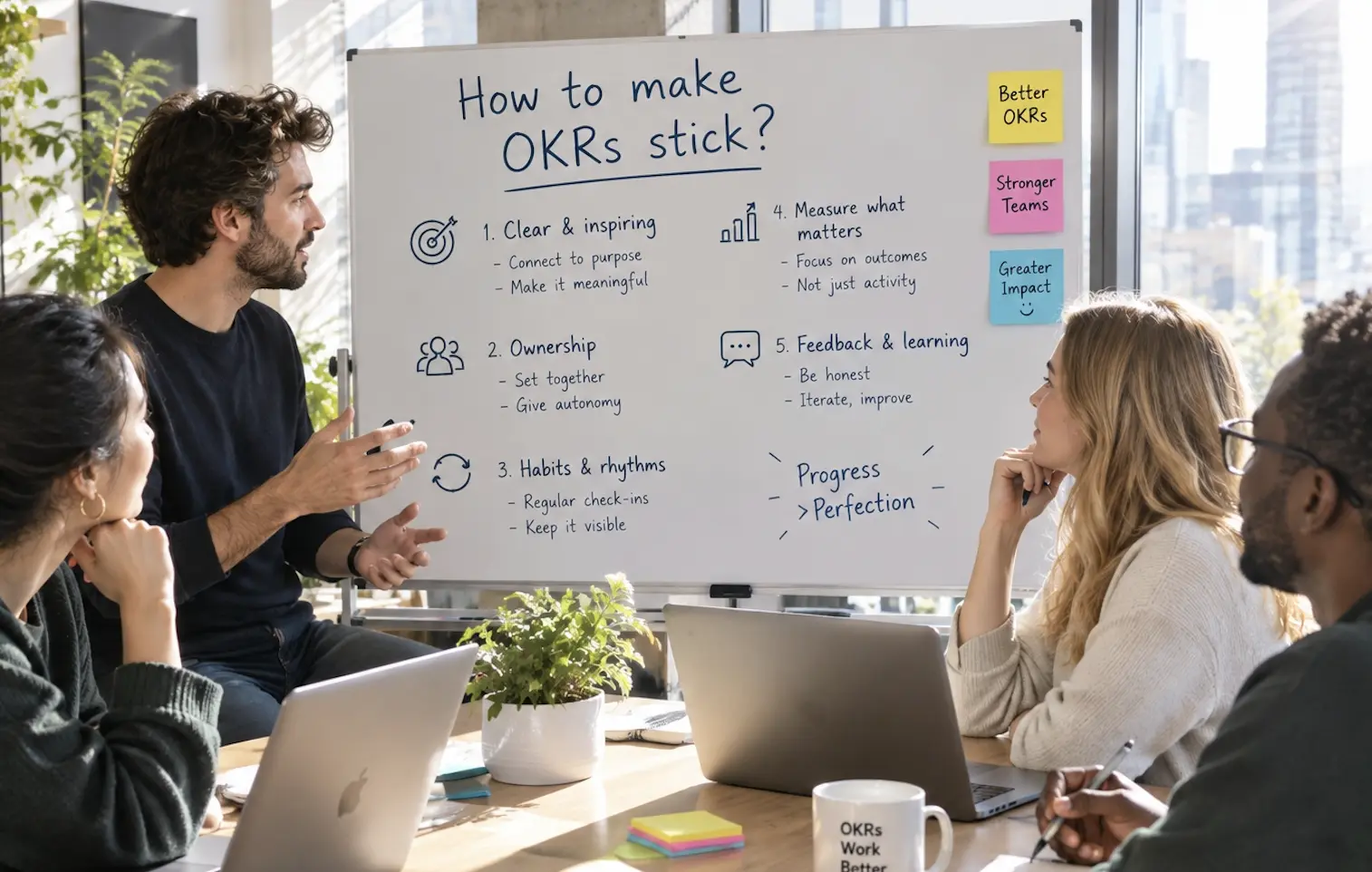
In a startup, OKRs are the founder's project — they hold the context, the authority, and the energy to keep the habit alive. By 50 to 200 people that stops being true: new research across 200+ startups and 420 larger companies shows the Head of Ops or Growth has taken over, while the founder has stepped back. The shift is normal and healthy. The danger is when it happens by accident rather than by decision.
Every growing company makes this handoff whether it plans to or not. The founder who personally chased every goal update at fifteen people cannot do that at a hundred and fifty, and shouldn't try. OKRs pass to an operator regardless — the data shows they do. What's left to decide is whether someone names who owns the process before the founder's attention gets pulled elsewhere, or whether the goals simply lose their champion one busy week and never get one back.
This piece covers who ends up running OKRs as a company grows, why the handoff is the moment programmes most often fall apart, and how to make the transition a decision instead of an accident. It draws on the Growing Pains of OKRs study of companies at the 50–200 band.
OKRs Pass From Founder to Operator
At startup size, OKRs are a founder's job. They set the objectives, they run the planning session, and they personally notice when a goal goes quiet. That works when the whole company fits in one room.

By the 50–200 band, the picture has shifted. The founder still leads the rollout at a quarter of companies, down from a third at startup size — but the Head of Ops or Growth has become the most common owner, running the process at 36% of larger companies.
The baton has passed from founder energy to operator muscle, right around the headcount where a company adds its first real layers of management. That handoff is the natural order of things: the founder's job becomes setting the top-level objectives, and an operator's job becomes making the weekly cadence actually run.
Why the Handoff Is Where OKRs Die
The transition itself is healthy. The risk is in how it happens — and the common way it happens is the dangerous one.
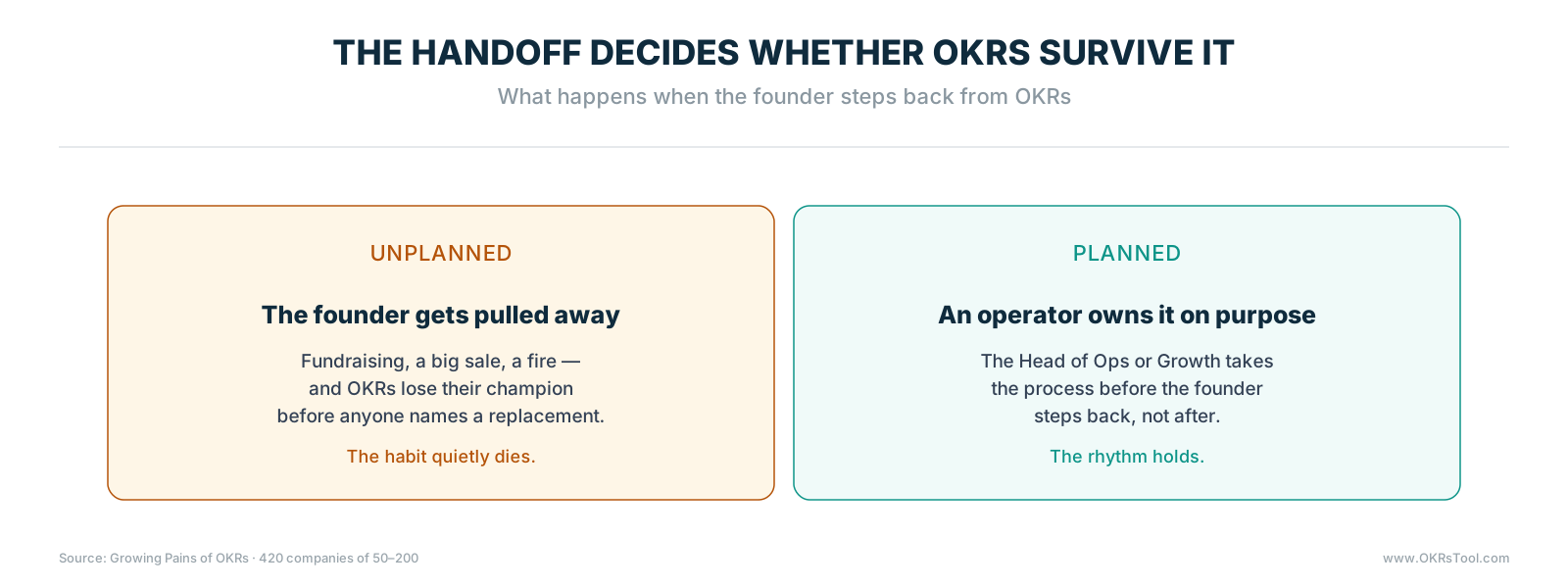
In the unplanned version, nobody decides anything. The founder is running OKRs, then a funding round or a key hire or a major customer crisis consumes their attention, and whatever was holding the weekly habit together simply lets go.
No one was named to catch it. The check-in slips for a week, then a month, and by the time anyone notices, the programme has gone cold — one of the clearest ways OKRs die at a growing company. The goals didn't fail on their merits — a textbook case of why OKRs fail — they lost their owner and nobody replaced them.
The planned version looks completely different. Before the founder steps back, an operator is named to own the process, handed the context, and given the authority to run it. The founder still sets direction and still shows up to planning, but the day-to-day rhythm has a dedicated owner who isn't going to get pulled into a fundraise. The companies that scale OKRs cleanly treat the handoff as a decision made on purpose, not a gap discovered after the fact.
Who Should Actually Own It
If the operator is going to run OKRs, the practical question is who, specifically, and what the role entails. The data points to the Head of Ops or Growth for a reason: the owner of the process needs to sit close enough to strategy execution to see what's drifting, and have enough cross-functional authority to do something about it.
The role is owning the system, not writing everyone's goals. That means enforcing ownership so every key result has a named person before the cycle starts, that the weekly check-in actually happens, that the cascade from company objective to team goal stays connected, and that each cycle closes with an honest review rather than fading into the next.
It's a coordination job, which is exactly why it moves to an operator as the company grows: at scale, OKRs become the mechanism for keeping many teams pointed the same way, and keeping alignment across teams is operational work, not founder work.
Whoever takes it needs three things explicitly handed over: the context (why these goals, what they're meant to unlock), the authority (the standing to chase a VP for an update without it being awkward), and the time (OKR ownership is a real part of the job, not a thing squeezed around everything else). A handoff that transfers the title but not the authority fails as surely as no handoff at all.
Make the Handoff a Decision
The move for any company approaching or inside the 50–200 band is to name the operator who owns OKRs before the founder needs to step back, not after. It costs almost nothing to do early and a cycle or two of lost momentum to do late.
In practice that means three things. Name the owner explicitly — a person, not "the leadership team" — and say out loud that they run the process now. Hand over the context and the authority together, so the new owner can actually enforce the habit rather than just nominally hold it.
And put the rhythm on a system that doesn't depend on any one person's memory, so that even when the owner is busy or changes again, the check-in still fires and the goals stay visible on one platform. The founder-to-operator handoff is one of the five things the research says to prepare as part of OKR adoption before you scale, precisely because it's so much cheaper to plan than to recover from.
There's a version of this handoff that fails even when someone is named: the operator inherits the title and the manual grind along with it — chasing every update by hand, rebuilding the status picture before each leadership meeting, never quite trusting the numbers.
That's a job few people keep doing for long. When the rhythm runs on a system that chases the updates and keeps the picture current on its own, the handoff transfers a working habit instead of a second full-time job. That is often what decides whether the new owner keeps OKRs alive or lets them lapse because the overhead was never worth it.
OKRs that depend on a single champion are fragile by design — when that person's attention moves, the whole habit moves with it. The teams that keep OKRs alive through the handoff are the ones that built the rhythm into a system rather than a person, so ownership can pass from founder to operator, and operator to operator, without the goals going dark in between.
That's the real lesson of the data: the handoff is coming whether you plan for it or not, and the ones who plan for it are the ones whose OKRs survive the transition.
Data: the Growing Pains of OKRs study — 200+ early-stage startups and 420 technology companies of 50–200 employees. No OKRs Tool customers were included.