We asked more than 400 operations and strategy leaders one open question: what's been hardest about getting OKRs to stick? One answer buried every other. Not goal-writing, not tooling, not strategy — consistency and buy-in. A third of all leaders said the same thing, in almost the same words, and no other pain came close.
The question was deliberately open-ended — no checkboxes, no prompts, just a blank field and a chance to say what actually hurts. When the answers came back, the pattern was impossible to miss: keeping people engaged with OKRs past the kickoff was named roughly four times more often than any other single problem. Leaders weren't stuck on how to write a good objective. They were stuck on getting their teams to keep caring about the ones they'd already written.
That gap — between setting OKRs and sustaining them — is the real work, and it's where most programmes fade. This piece walks through what leaders actually said, why OKRs lose momentum after the launch, and the reframe that separates the teams who keep them alive from the ones who watch them drift. It draws on the open responses in the Growing Pains of OKRs study of 420 companies at 50–200 people.
The One Answer That Came Up Again and Again
Across the open responses, one theme dominated: consistency, engagement, and buy-in. Roughly a third of leaders named it as the hardest part of making OKRs work, and nothing else reached even a quarter of that.
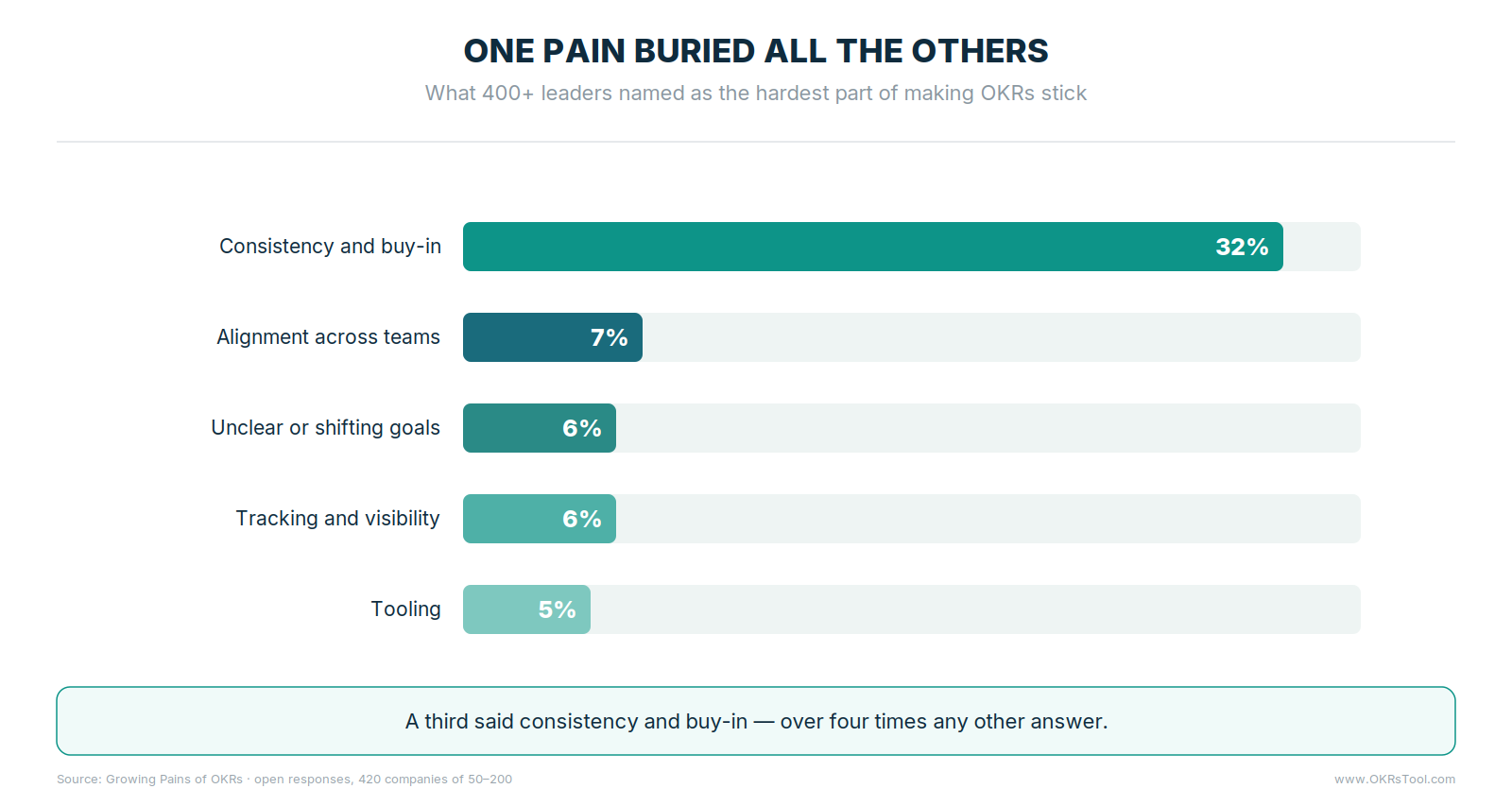
What's striking is what didn't top the list. Goal-writing, which the entire OKR content industry obsesses over, barely registered. Tooling came in low. Strategy itself was rarely the complaint. The hard part, by a wide margin, was human: getting a team to keep showing up for a system after the planning session energy wore off. That's a different problem from writing better goals, and it needs a different answer.
"Getting Everyone on the Same Page"
The verbatims tell the story better than any summary. Asked what's hardest, leaders wrote things like "getting everyone on board to use them," "getting everyone to understand and comply," and "getting complete team buy-in." The same note, struck hundreds of times: the objectives existed, but the collective commitment to them didn't.
Others named the slow erosion rather than the initial sell. "Keeping everyone focused on them while daily tasks distract" and "keeping goals aligned and consistently tracking progress" describe the same decay from a different angle — not a failure to agree, but a failure of OKR adoption to sustain. Buy-in doesn't hold from a single kickoff; it leaks away every week the goals sit untouched while the real work happens somewhere else.
Why OKRs Fade After the Kickoff
The mechanism is honest and familiar. A planning session generates genuine alignment — everyone leaves bought in. Then the quarter starts, a client escalation lands, the sprint fills up, and the OKRs become whatever is calmly not on fire. One leader described the whole arc in four words: "priorities shift; OKRs quietly fade."
That's the pattern in miniature. The goals don't get formally abandoned; they get out-competed. Each week the weekly check-in is the first thing to slip when something urgent appears, and a check-in skipped twice stops being a habit. By mid-cycle the OKRs are a document nobody opens, and the engagement a leader worked to build at launch has drained away one busy week at a time. It's one of the most common reasons OKRs fail, and it has nothing to do with the quality of the goals.
Consistency Is a System Problem Before a Willpower One
The reframe that matters runs against instinct. When engagement fades, is to ask people to try harder — more reminders, a sterner email, a push for accountability. The data points somewhere else.
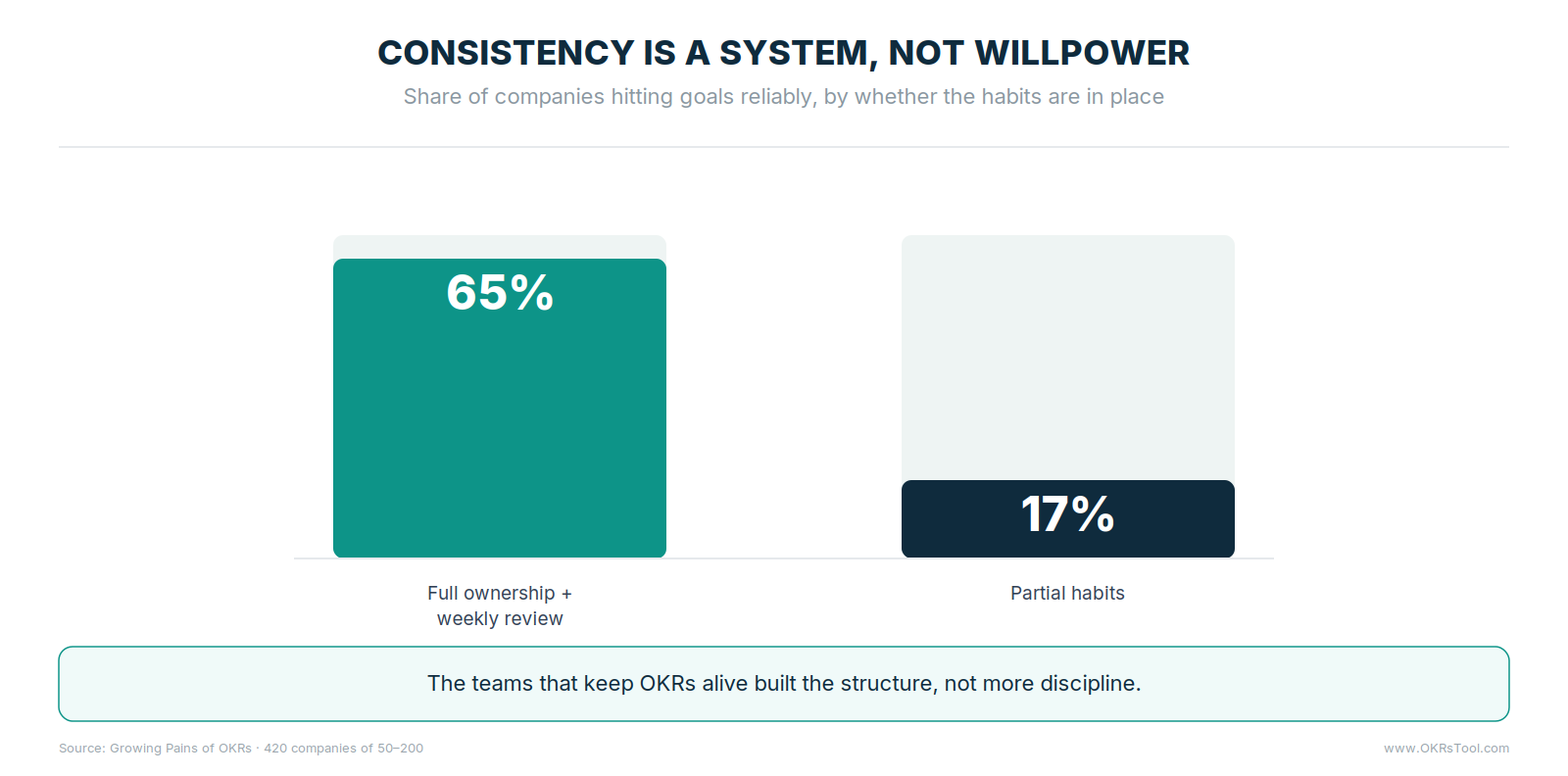
Teams don't keep OKRs alive by being more disciplined than everyone else. They keep them alive by removing the friction that makes consistency hard in the first place. Companies with a named owner on every goal and a weekly review built into the rhythm hit their goals reliably far more often than teams relying on good intentions.
The structure does the work: when the check-in fires on its own and a live alignment map shows where every goal stands, staying consistent stops depending on anyone remembering to care. Consistency becomes the default rather than the thing you have to defend against every busy week — the heart of real goal management at scale.
Four Ways to Make OKRs Stick
The leaders who've solved this didn't find more willpower; they built the system that makes the habit easy. Four moves, each drawn straight from what the data says teams lack.
Make the weekly check-in non-negotiable. It was the single most-requested improvement in the whole study. Keep it short — what moved, what's blocked, what's next — and protect the slot so it survives the weeks it's most tempting to skip. A check-in that happens only when calm is a check-in that never happens when it matters.
Write fewer, clearer goals. Clarity was the second-most-named fix. A vague goal — a task in disguise — can't be tracked, defended, or rallied around — and anything a team can't rally around is the first to be dropped. Fewer, sharper objectives are easier to stay committed to, which is half the goal setting battle.
Give tracking to a system, not a person. Engagement fades fastest when staying current depends on someone chasing updates by hand. Automate the nudge so the habit stops being one person's second job. Manual tracking is exactly where consistency goes to die.
Re-anchor when priorities shift. The recurring killer — goals fading as the quarter moves — happens mid-cycle, not at launch. Build in a mid-quarter moment to reconnect the goals to current priorities rather than letting them drift into irrelevance.
The Teams That Keep OKRs Alive
What separates the leaders who struggle with OKRs from the ones who make them stick comes down to structure, not discipline or talent: whether the habit depends on someone holding it up, or runs on a system that holds it up for them.
A third of leaders named consistency as their hardest problem because, run by hand, consistency is genuinely hard — it asks a busy team to choose the important over the urgent, every week, forever.
Take that choice off the table and the problem mostly dissolves. When the check-in is automatic, every goal is owned, and progress stays visible on one platform without anyone reconstructing it, the engagement that used to drain away by cycle two simply holds. The goal was never to find more willpower. It was to need less of it.
Data: the Growing Pains of OKRs study — open-ended responses from leaders at 420 technology companies of 50–200 employees. No OKRs Tool customers were included.