"How much time do OKRs take?" is one of the most-asked questions about the framework and one of the least-answered with data. New research across 200+ startups and 420 companies of 50–200 gives a real number: most teams spend at least half an hour a week on OKRs, that figure barely changes with company size, and — surprisingly — the amount of time that produces the best results reverses as a company grows.
First, a definition, because the number is easy to misread. "Time spent on OKRs" means the overhead of running them — the weekly check-in, updating progress, reviewing where things stand, the short status conversation. It does not mean the hours spent doing the actual work that moves a key result; that's just the job. So when the data says a team spends thirty minutes a week on OKRs, it means thirty minutes of tracking and review, not thirty minutes of execution.
With that clear, the findings are useful precisely because they're concrete. This piece covers how much time OKRs really take, why that cost stays flat as you scale, and the counterintuitive point where spending more time starts to pay off — drawn from the Growing Pains of OKRs study.
The Short Answer: About 30 Minutes a Week
Across both studies, the most common answer was 30 or more minutes a week spent on OKR overhead — the check-in, the updates, the review.
For a well-run programme, that half-hour is the floor rather than the ceiling: it buys a weekly check-in on a steady cadence that keeps goals current and catches drift while there's still time to act.
What's notable is how little that number moves. The share of teams spending 30+ minutes a week was identical in both studies — of everything the research measured, it was the single most stable figure.
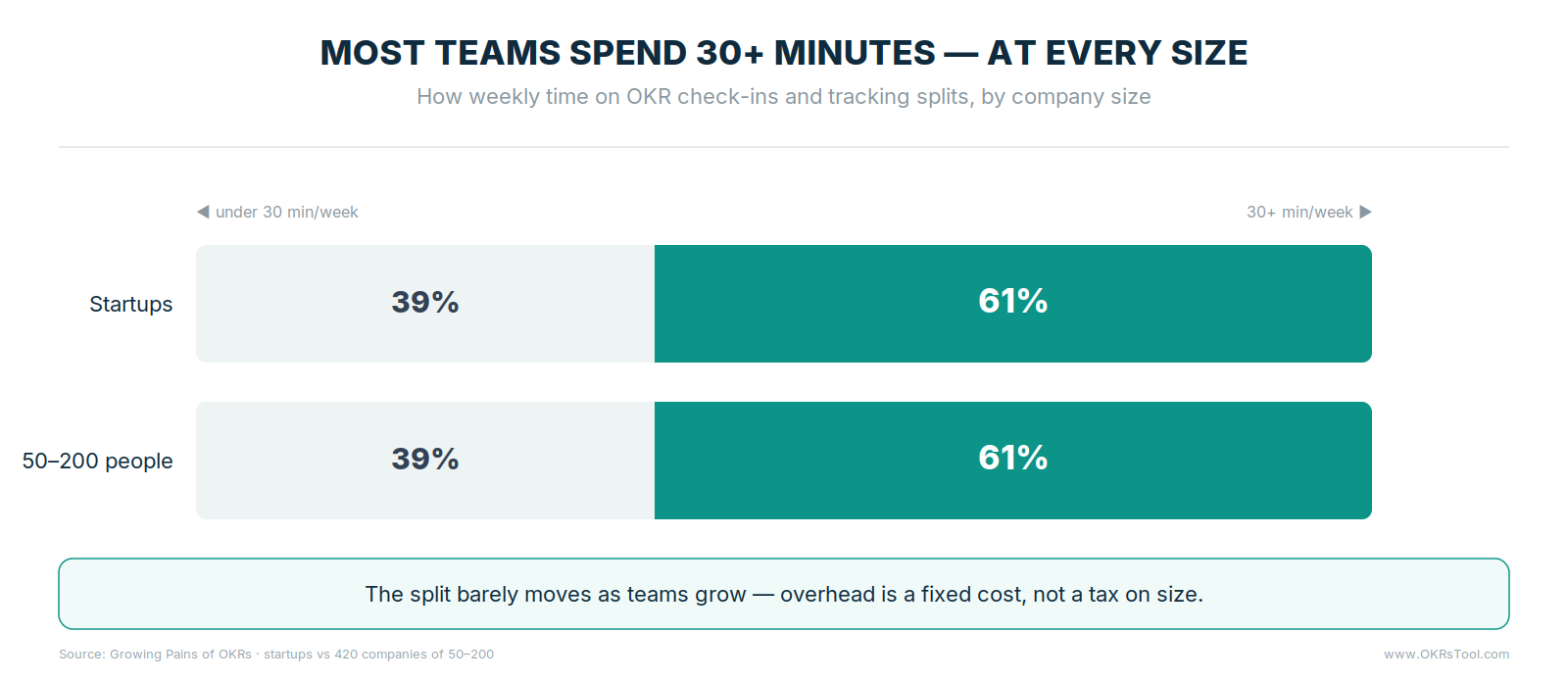
The read is simple: OKR overhead is a fixed cost of doing the framework properly, not a tax that grows with headcount. A team running OKRs in well under half an hour and expecting that to hold as it scales is underpaying — the time comes due eventually, and the strong teams pay it from the start rather than discovering the shortfall mid-quarter.
Why the Overhead Doesn't Shrink
It's tempting to assume that better tooling or more experience should drive the weekly time down over time. The data says it holds steady instead, and the reason is what the half-hour actually buys.
That time isn't administrative waste; it's the mechanism that keeps goals alive between planning sessions. The weekly update is how a team notices a key result has gone quiet, surfaces a blocker at the mid-quarter mark while it's still fixable, and keeps the numbers honest.
Cut it to save time and the goals drift — which is the most-cited reason OKRs fail, and a far more expensive problem than the half-hour it would have taken to prevent. The overhead is the price of the framework working at all, which is why the teams getting value from goal management keep paying it regardless of size.
The Reversal: When Spending More Starts to Win
This is where the data turns genuinely counterintuitive. The floor is stable at about 30 minutes, but the amount of time that produces the best results flips direction as a company grows.
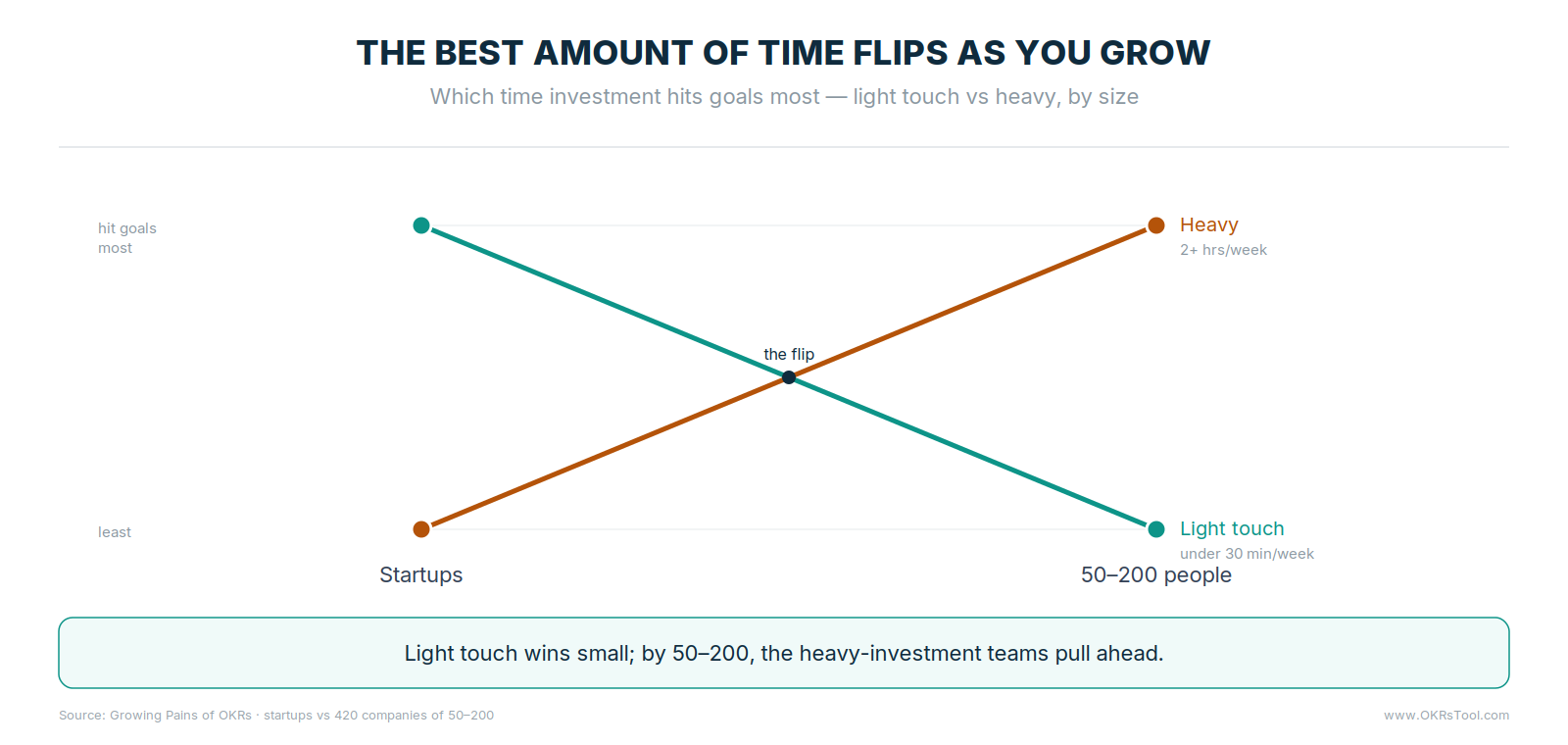
The startup study found the light-touch teams ahead — under thirty minutes a week beat pouring in hours, a hallmark of a lean first cycle, since at fifteen people the thing to fear is ceremony for its own sake. Among companies of 50–200 the order flips entirely: the heaviest-investing teams are the ones landing their goals, and 68% of those putting in two or more hours a week hit them reliably.
The explanation is in what OKRs become at scale. In a small team they're a personal focus tool; in a bigger one they're how work gets coordinated across many teams, and coordination genuinely takes time. The startup instinct to stay light is the right instinct right up until there are teams between you and the work — then it tips into under-investment.
So How Much Time Should Your Team Spend?
The honest answer depends on size, and the research gives a usable rule of thumb for each end.
Under 50 people, keep it light: a focused 15–30 minutes a week is enough, and more process at that stage tends to slow you down rather than help. Protect the speed — it's a real advantage.
As you move into the 50–200 band, plan to spend more, not less: budget an hour or two a week once OKRs are carrying alignment across teams, because under-investing is now what makes them fail. And at every size, the floor holds — a team spending near-zero time on OKRs has stopped running the OKR cycle at all.
The leverage, wherever you sit, is in what that time is spent on. Half an hour of real tracking — current numbers, a surfaced blocker, an honest score — is worth more than two hours of status theatre. The point of the time isn't to log that work happened; it's to catch what's drifting while there's still a quarter left to fix it.
Make the Time Count, Not Just the Clock
The data settles the "how long" question: about thirty minutes a week as a floor, rising to an hour or two once you're running team OKRs across the company, with the sweet spot moving up as you grow rather than down. But the number on the clock matters far less than whether the time does its job — surfacing drift, keeping goals current, forcing the small mid-cycle decisions that stop a quarter from sliding off track.
That's the case for taking the manual work out of it. When the check-in runs on a schedule, progress stays current without anyone chasing it, and what's at risk is visible on one platform without a reporting exercise, the weekly overhead collapses to the part that actually matters: the thinking, not the admin. Spend the half-hour deciding what to do about a goal that's slipping — a platform can handle the rest.
Data: the Growing Pains of OKRs study — 200+ early-stage startups and 420 technology companies of 50–200 employees. No OKRs Tool customers were included.