
OKR management fails at the handoff between planning and execution — not in the planning session itself. The objectives exist. The ownership is vague. The weekly cadence never forms. And by week six, the strategy is theoretical while the work is whatever felt urgent on Monday morning.
The 2026 OKR Benchmark Report found 65% of teams admit their goals aren't clearly linked to company strategy. That figure doesn't describe a planning failure — most of those teams had a planning session, wrote objectives, and left with genuine alignment. It describes what happens in the eight weeks after: the objectives go into a document, the work goes into a sprint board, and the two never meet again until the quarterly review reveals the gap.
The problem isn't ambition or effort. At 50–80 people, there's no founder in every room to pull the thread back when work drifts from strategy. Misalignment compounds quietly — one deprioritised check-in, one unreviewed Key Result, one sprint that nobody connected to an objective — until you're sitting in a mid-quarter review wondering how a capable team is 30% of the way to a goal everyone agreed on.
Effective OKR management is not more sophisticated planning. It's the structural system that keeps goals visible, owned, and honestly tracked between planning sessions. Most organizations have the planning. Almost none have the system.
Where OKR Management Actually Breaks Down
After the planning session, the objectives go somewhere. A Notion page. A slide in the all-hands deck. A section of the company wiki last edited in November. And then the quarter starts.
The sprint backlog fills up. A client escalation lands. The hiring process drags on. Everyone is working — genuinely working — on things that feel urgent and real. The OKRs are not urgent. They're in the document. No one made a decision to ignore them. The work moved faster than the strategy did.
The data from OKRs Tool platform analysis of 7,857 Key Results shows what this looks like in practice: 50% of all Key Results have no single named owner. Not shared ownership — no owner at all. A goal without a named accountable person is not managed. It's stored. And 52% of Key Results are tasks or KPIs in disguise — measuring activity rather than the outcomes that matter. By week six, those goals aren't drifting. They were never tracking anything real to begin with.
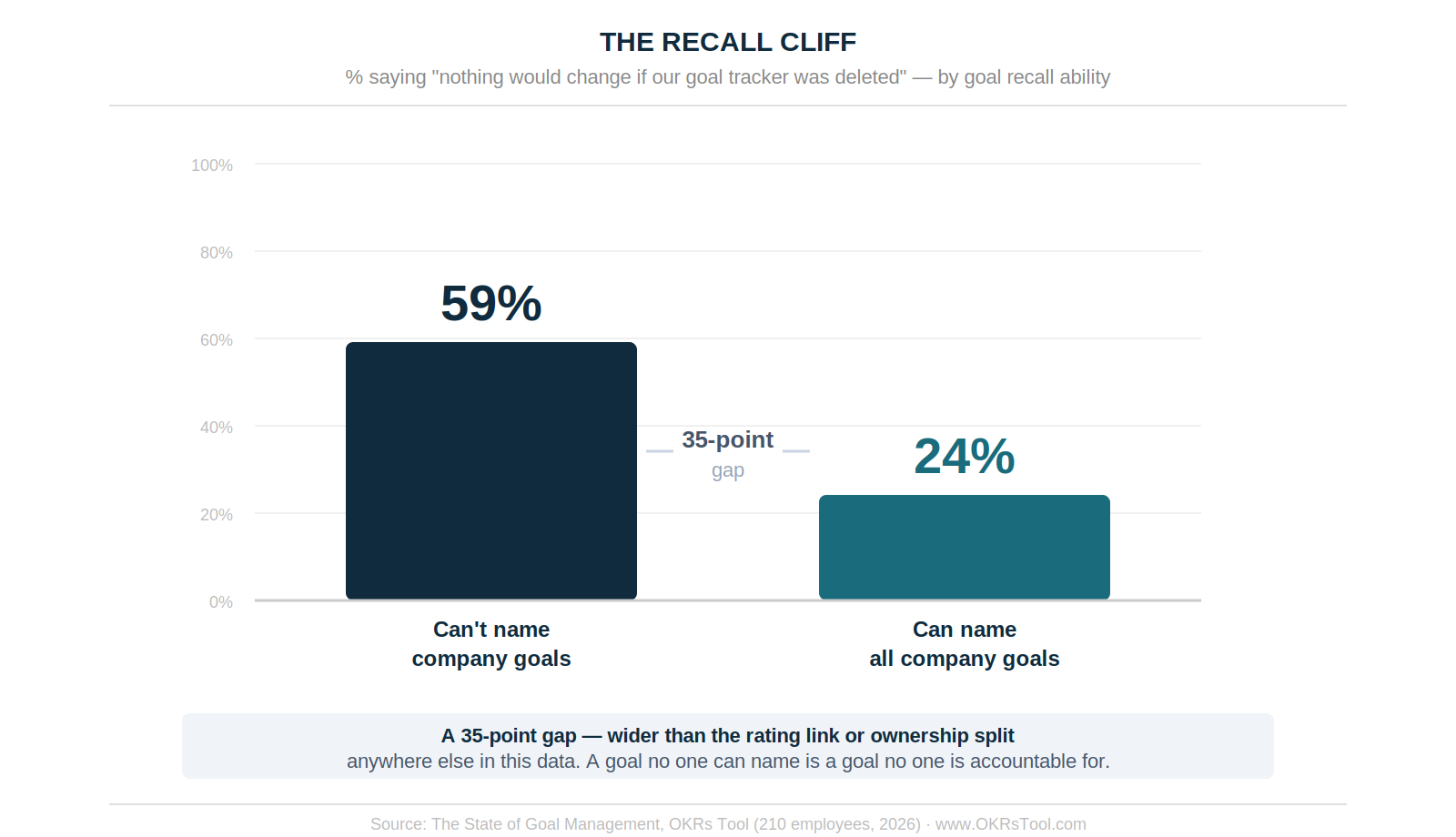
The visibility problem is structural. The State of Goal Management found only 30% of employees can name all their company's current top goals without looking them up. Among those who can't name the goals, 59% say nothing would change if their goal tracker were deleted tomorrow. Among those who can name them, only 24% say the same. The recall gap is a 35-point difference in whether the goal system is load-bearing — and it's driven entirely by whether goals are visible in the daily workflow or stored in a document nobody opens.
What Poor OKR Management Costs
The obvious cost is missed Key Results. A target set with conviction that lands at 40% — or doesn't get reviewed at all. The OKR Intelligence Report 2026 found 7% of off-track Key Results are simply abandoned mid-cycle — informally stopped with no revision, no escalation, and no consequence. These are the Invisible OKRs: technically active on the dashboard, watched by nobody.
The less visible cost is what happens to decision-making without a shared thread. At 20 people, misalignment corrects itself in conversation. At 70, Product prioritises features that don't move the needle. Sales chases logos that don't fit the strategy. Marketing ships campaigns that weren't connected to the growth objective anyone signed off on. Each team is busy. None of it adds up. The disconnect happens gradually — one week, one sprint, one deprioritised OKR planning session at a time — and it's invisible until the quarter is already over.
The State of Goal Management found 34% of employees say nothing about how they work would change if their goal tracker were deleted tomorrow. That figure isn't a reflection of bad intentions. It's the precise measurement of a goal system that has become decorative — maintained as a reporting exercise, influencing nothing.
The Check-In That Never Forms
The weekly check-in is the mechanism that separates managed OKRs from stored ones. Teams that check in weekly complete 43% more OKRs than those reviewing monthly. Teams that skip check-ins entirely are 3x more likely to abandon their OKR cycle altogether before it ends.
The check-in rarely fails because teams don't value it. It fails because it competes with everything else — and everything else is on fire. A 20-minute Key Result review loses to a customer call every time. So it gets pushed, then pushed again, then becomes a mid-cycle review, then an end-of-quarter post-mortem. By the time anyone looks at the objectives honestly, the quarter has been built by the work that happened — not the work that was supposed to happen.
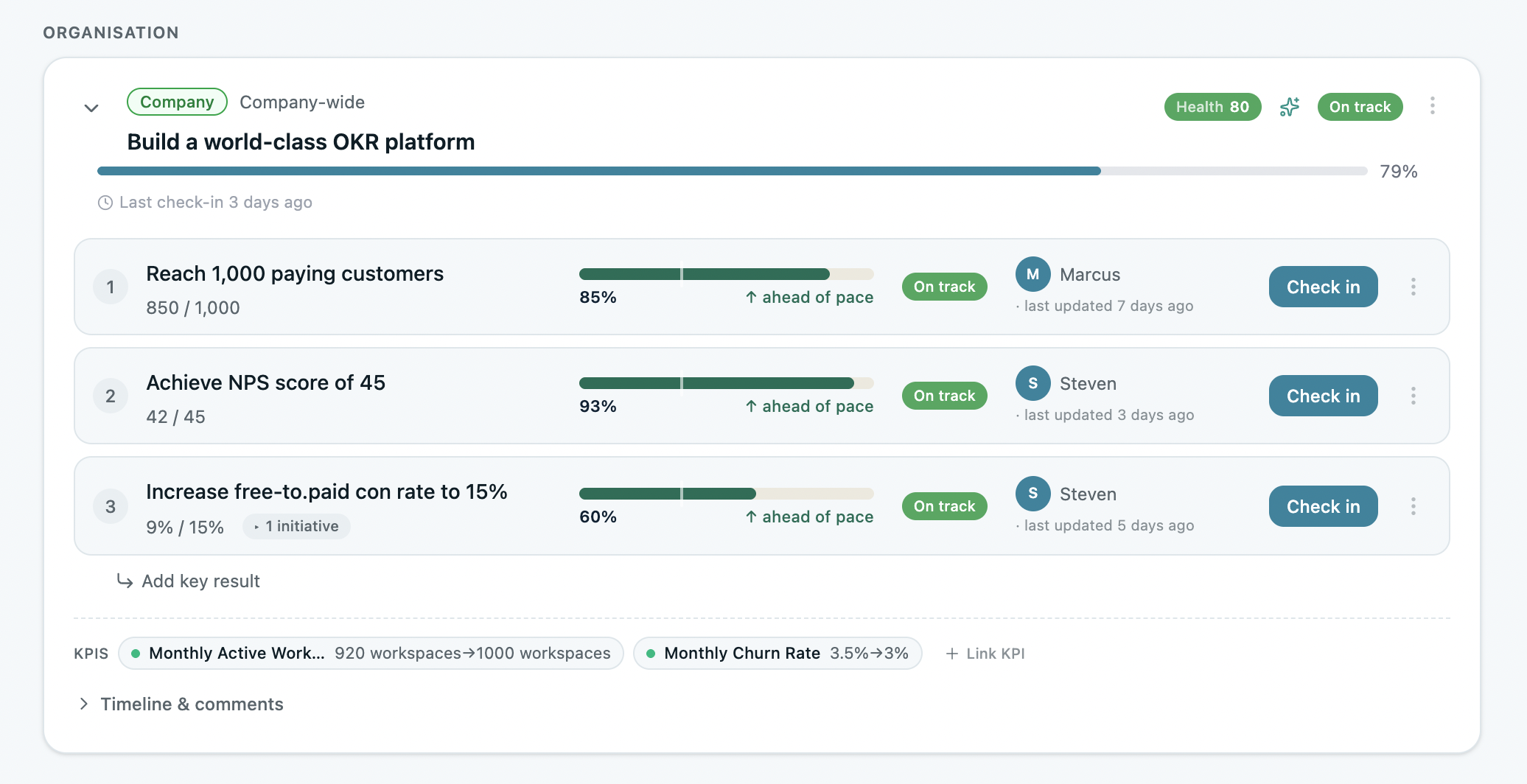
The structural fix: a weekly check-in that fires automatically without anyone scheduling it. Not a meeting — a Slack or MS Teams nudge, five minutes per person, same time every week. When the cadence is structural rather than dependent on discipline, it happens during the quarters when it's most needed, not only the ones when it's convenient.
The Structural Fix: OKRs Where Work Happens
The fix to poor OKR management isn't a better planning session or a stricter retrospective cadence. It's making OKRs structurally impossible to ignore by putting them where work actually gets done.
When someone opens their task board on Monday morning, they should see — without switching tools — which objective their work connects to. When a team makes a prioritisation call mid-sprint, the Key Results should be visible in the room. Progress should update as work moves, not when someone remembers to log it manually. Named ownership should be enforced at goal creation — not assumed. The cascade from company Objective to team Key Result should be visible to everyone, always, without a navigation step.
Teams that build this infrastructure see the maturity curve in action: 51% average completion in cycles 1–2, rising to 79% by cycle five. The improvement doesn't come from writing better goals each quarter. It comes from the accumulated discipline of a weekly rhythm and the learning loop built in the end-of-cycle OKR review.

Organizations using purpose-built OKR software generate a 1:88 return on investment versus 1:25 on spreadsheets. The gap isn't the software cost — it's the tracking infrastructure, the automated cadence, and the alignment visibility that makes goal management load-bearing rather than decorative. See how OKRs Tool implements the full management cycle — cascade planning, automated weekly check-ins, named ownership enforced at goal creation, and at-risk detection before misses compound.
Strategy Doesn't Drift When It's Embedded
The teams that make OKR management work aren't the ones with the most sophisticated frameworks. They're the ones that made the objectives impossible to ignore — by putting them in the same rhythm, the same tools, and the same conversations as the work itself.
Strategy doesn't drift when it's embedded. It only drifts when it's stored.
Data: The 2026 OKR Benchmark Report (330 organizations), OKRs Tool platform data (7,857 Key Results analyzed), The OKR Intelligence Report 2026 (222 organizations), The State of Goal Management, OKRs Tool (210 full-time employees at growing companies, 2026).