A spreadsheet is free to buy and expensive to run. Purpose-built OKR software returns 1:88 per dollar against a spreadsheet's 1:25 — not because the software is magic, but because a sheet can hold your goals without ever making anyone update them. These nine alternatives close that gap.
Every OKR programme starts somewhere, and for most teams at the 50-to-80-person stage that somewhere is a spreadsheet — which is why OKR spreadsheet alternatives become a live question by the second or third cycle. It makes sense at first: spreadsheets are free, familiar, and flexible enough to get something down before the quarter starts.
If you're still at that stage, a structured OKR Excel template beats a blank sheet — though the sections below are the case for why even a good template eventually runs out of road. You build a tab for company objectives, a tab per team, colour-code the key results, share it in the all-hands, and the job feels done.
Then the quarter actually starts. Nobody updates their rows. The person who built the template is out for two weeks. Someone spins up a duplicate with slightly different numbers, and by week six you have three tabs that disagree, none reflecting what's really happening, and a quiet sense that the OKRs aren't being tracked at all. That failure is structural rather than personal, and it shows up in the returns.
The ROI of OKRs 2026 Benchmark Report found purpose-built OKR software returns 1:88 per dollar against 1:25 on spreadsheets. This guide covers what to look for in an alternative, and nine OKR spreadsheet alternatives worth the switch.
What Tracking OKRs in a Spreadsheet Actually Costs
The spreadsheet's price is zero, but its cost is not. None of what follows shows up on an invoice, but all of it recurs every quarter you stay on the sheet — and compounds across the maturity curve.
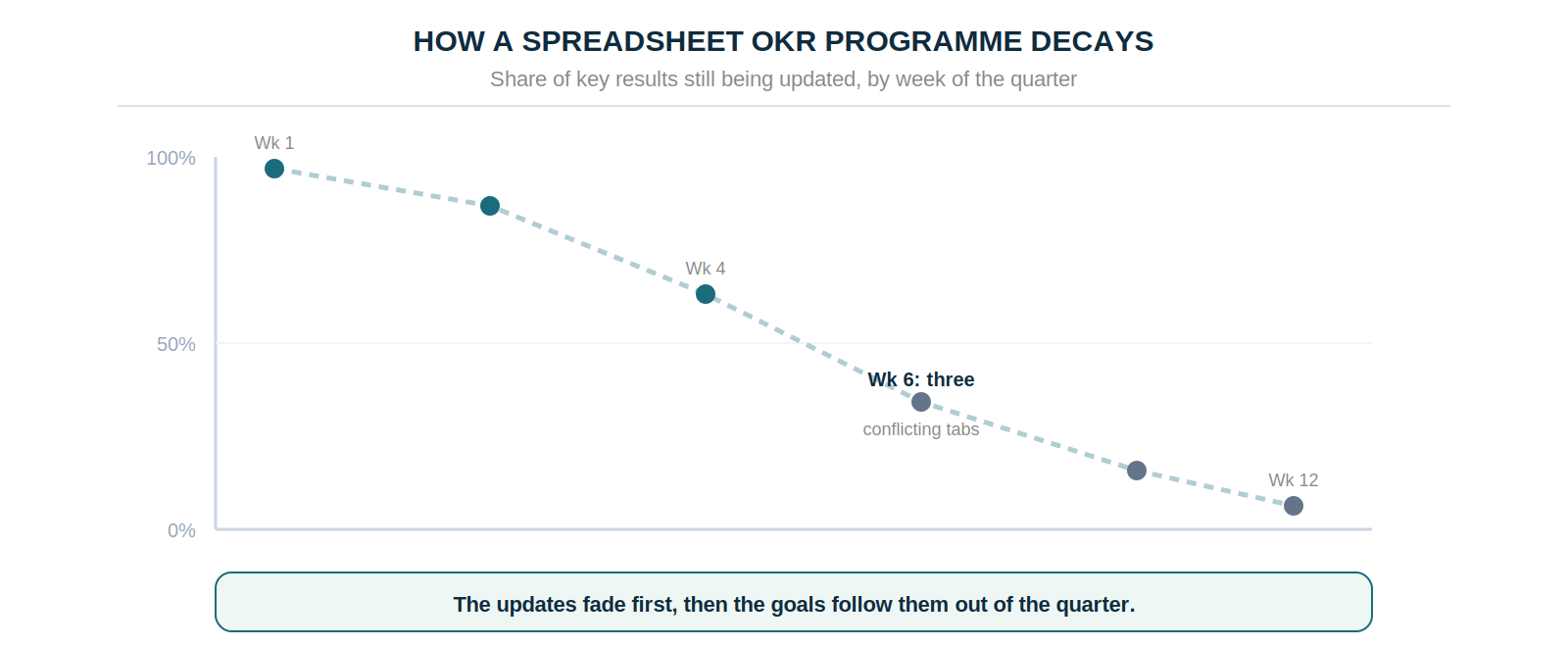
Manual updates are the first tax: someone has to own the sheet, chase inputs, and reformat it every week, and that time compounds. Version confusion is the second — which tab is current, who changed row 14 — and a shared file generates more of those questions than it answers. Progress accuracy is the thir
d: the numbers reflect the last time someone updated them, not what's happening this week. And adoption is the quiet killer, because nobody opens a shared spreadsheet voluntarily, so the goals drift out of sight and out of mind, which is how most OKR programmes fail.
What to Look For in a Spreadsheet Alternative
The best OKR spreadsheet alternatives fix the structural problems a sheet creates rather than just digitising it. Three capabilities separate a real alternative from a prettier sheet.
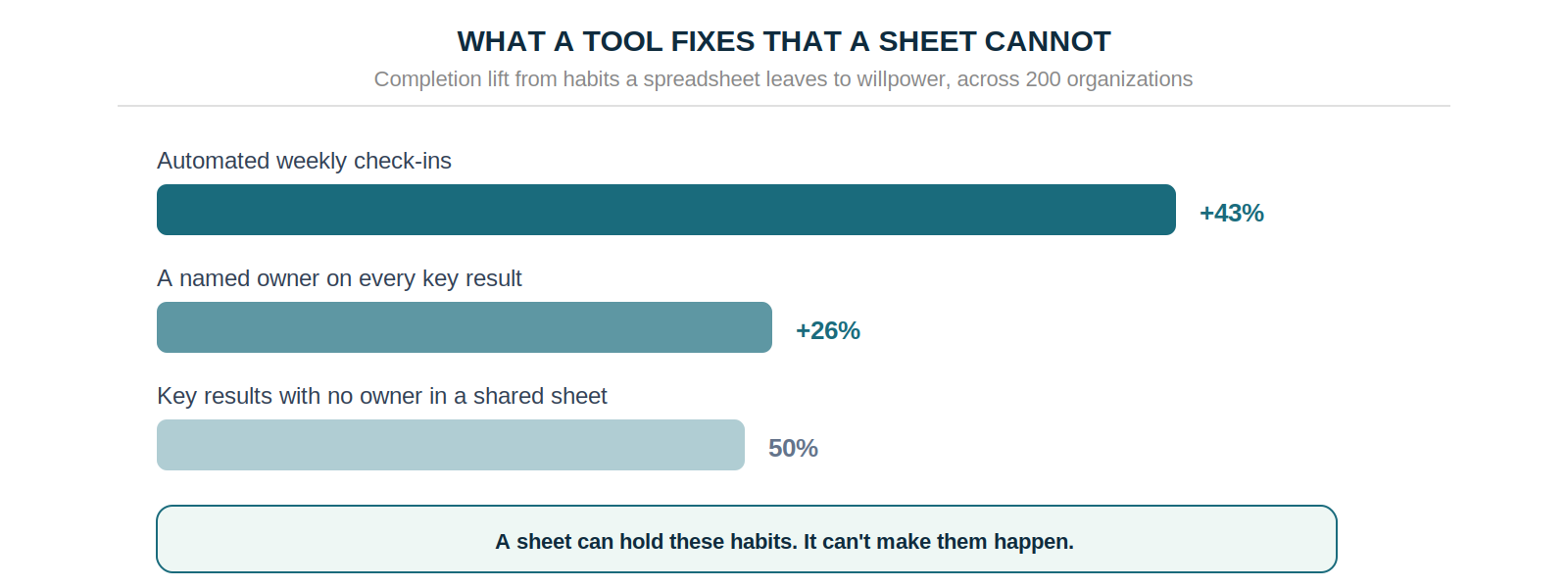
Progress tracking should happen in the rhythm of the work rather than as a separate administrative task — teams with an automated weekly check-in complete 43% more of their goals, and a spreadsheet can record check-ins but can't prompt them.
Ownership should be explicit, not a shared tab everyone assumes someone else maintains: half of all key results in the platform data have no named owner, and teams that enforce single ownership complete 26% more. And the tool should be simple enough that adoption doesn't need a training session, because the sheet's real failure was never features — it was that nobody opened it.
The 9 Best OKR Spreadsheet Alternatives
1. Falen — best for teams just outgrowing the spreadsheet
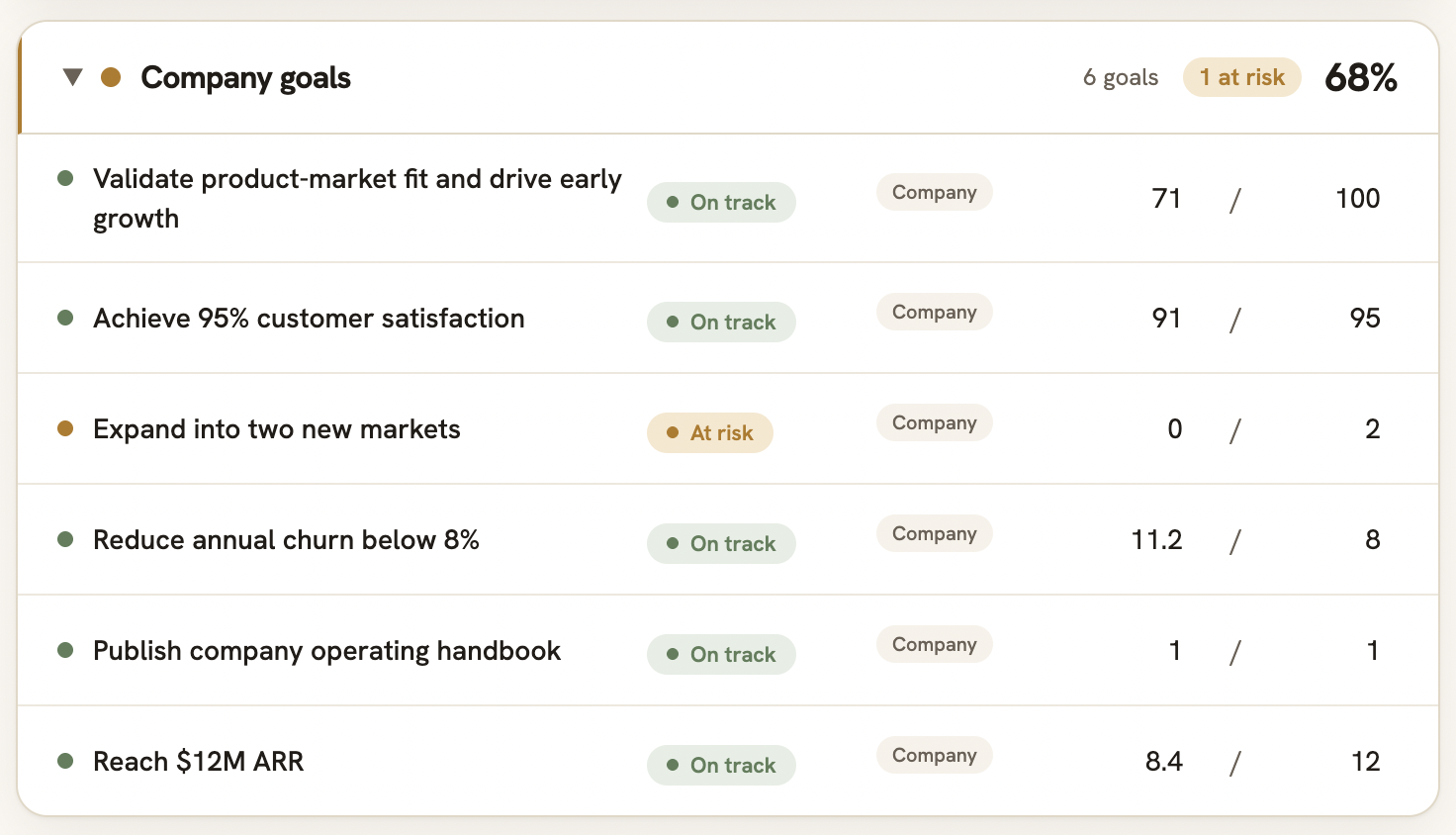
Falen is built for exactly this article's premise: the 20-to-45-person team whose spreadsheet has started to rot. Paste your goals straight from the sheet, and it sorts them into teams and owners in one live view — every goal laddering to the company priority it drives, at-risk ones pulled to the top the moment they slip.
Each owner gets a one-tap email to update their own goals, so no one has to chase. It's goal-tracking, not a full OKR-plus-performance suite, which is the point for a team whose only job this quarter is getting off the sheet.
What it does well: spreadsheet import, one-view goal alignment, at-risk surfacing, one-tap owner check-ins, flat whole-company pricing.
Where it falls short: goal-tracking only — no scoring, 360s, or reviews; built for 20–45-person teams, not enterprise.
Pricing: flat $89/month for the whole company, unlimited users.
2. OKRs Tool — best for growing teams (50–200)
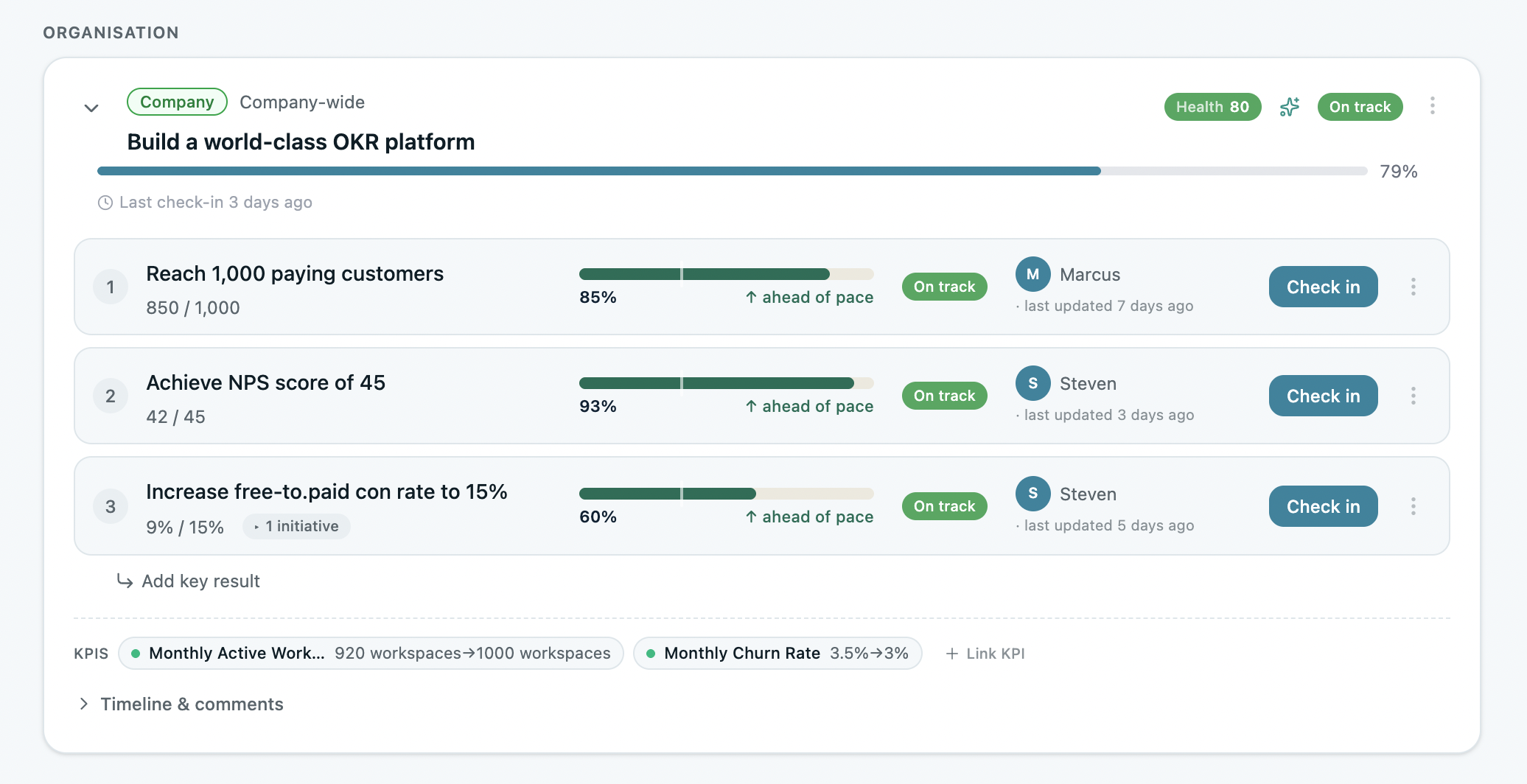
OKRs Tool is built for teams that want OKRs working without the overhead of an enterprise platform. Setup takes minutes, the interface stays clean, and the weekly check-in nudges handle the cadence problem that kills most spreadsheet-based programmes.
The alignment map makes the link between individual work and company objectives visible to everyone, not just leadership, and at a flat $49 per month beyond the free tier, the pricing doesn't punish growth.
What it does well: AI-generated OKRs, weekly check-in nudges, alignment map, Microsoft Teams and Slack integrations, flat-rate pricing.
Where it falls short: fewer integrations than larger platforms; built for growing companies rather than enterprise.
Pricing: 14-day full trial (no credit card). Flat-rate from $129/month per organization.
Switching from spreadsheets to OKRs Tool gave everyone easy access to the status of every OKR, with each update tracked through comments and charts. Assigning owners to key results gives real accountability and alignment. It's the difference between a generalist tool and a specialised one — and it saves a lot of time.

Everton Marcelino Jr
CTO & Co-Founder, Stift
3. Weekdone — best for weekly check-in rhythm
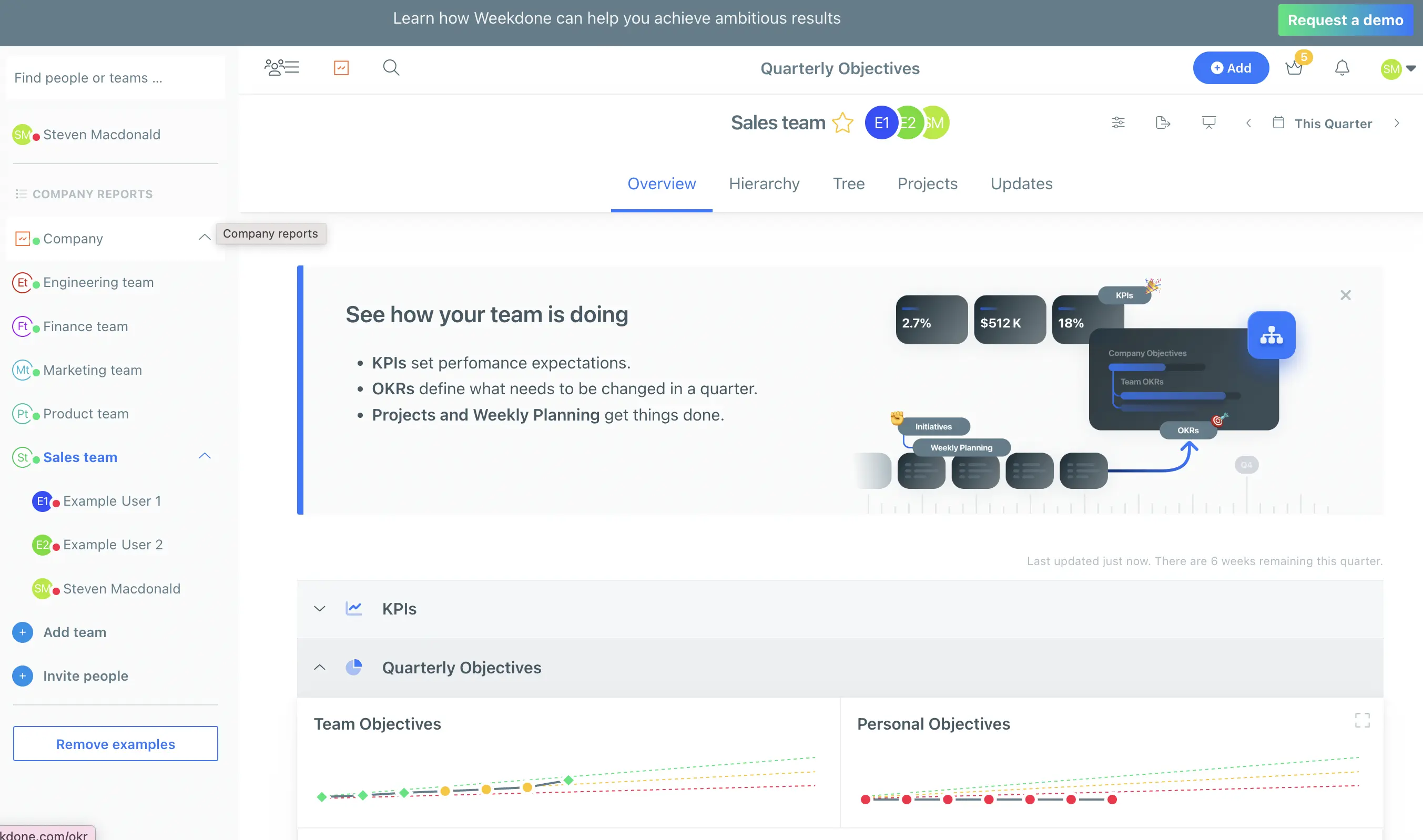
Weekdone is built around the weekly check-in and does that one thing better than most tools here. If your team struggles with the cadence of OKRs more than the goal-setting itself, it's worth a look — and cadence is the single highest-leverage habit, worth 43% more completed goals.
What it does well: weekly progress reporting, visual tracking, team alignment without extra meetings.
Where it falls short: free plan limited to 3 users; interface can feel cluttered after setup.
Pricing: Free for up to 3 users. Paid plans from $90/month.
4. Perdoo — best for OKRs and KPIs together
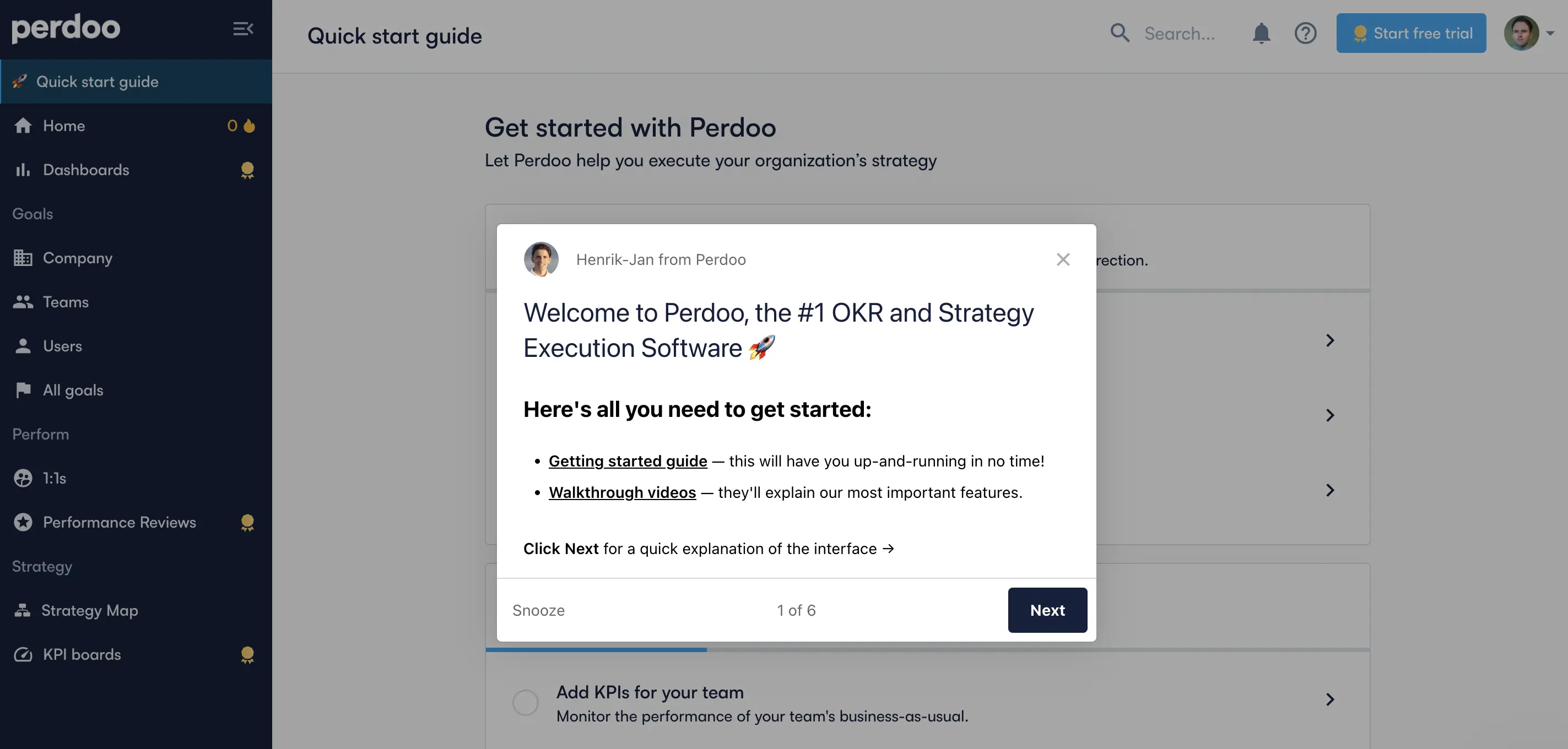
Perdoo is one of the few tools that tracks OKRs and KPIs in the same view. For teams that need to connect strategic objectives to ongoing performance metrics, that combination is genuinely useful and hard to find elsewhere.
What it does well: strategy map, OKR and KPI tracking in one view, strong alignment features.
Where it falls short: the KPI view can overshadow OKR tracking; steeper learning curve than simpler tools.
Pricing: Free for up to 5 users. Paid plans available.
5. Tability — best for outcome-focused teams

Tability is built on the idea that OKRs should connect to outcomes, not activity. It makes it easy to see whether the work is actually moving the goals — the question most OKR tools quietly sidestep.
What it does well: outcome tracking, weekly check-ins, progress visualisation that separates effort from impact.
Where it falls short: less established than some alternatives; limited free plan.
Pricing: Free plan available. Paid plans from $5/user/month.
6. Lattice — best for connecting OKRs to performance

Lattice goes beyond OKR tracking to connect objectives with performance reviews, 1:1s, and development. For teams that want goal management and people management in one platform, it's among the most complete options.
What it does well: OKRs integrated with reviews, engagement surveys, and manager tools; strong reporting.
Where it falls short: significant cost; more complexity than most growing teams need; real implementation time.
Pricing: Paid only. Plans from $11/user/month.
7. Betterworks — best for enterprise-grade management

Betterworks is built for larger organisations that need OKRs to work across departments, geographies, and complex structures. It's more platform than tool, with calibration workflows, HRIS integrations, and analytics built in.
What it does well: scale, compliance, HRIS integrations, manager enablement.
Where it falls short: priced and scoped for enterprise — significant overkill under 100 people.
Pricing: Paid only. Enterprise pricing on request.
See the Betterworks alternatives comparison for lighter options.
8. SugarOKR — best for zero complexity

SugarOKR is the most stripped-back tool here, and that's deliberate. If your team finds most OKR tools overwhelming, its simplicity is the feature: colour-coded progress, a clean interface, no unnecessary friction.
What it does well: extremely easy setup, visual progress tracking, low learning curve.
Where it falls short: limited reporting; no check-in features on the free plan; not built to scale.
Pricing: Free plan available with limited features.
9. Teamflect — best for Microsoft 365 teams
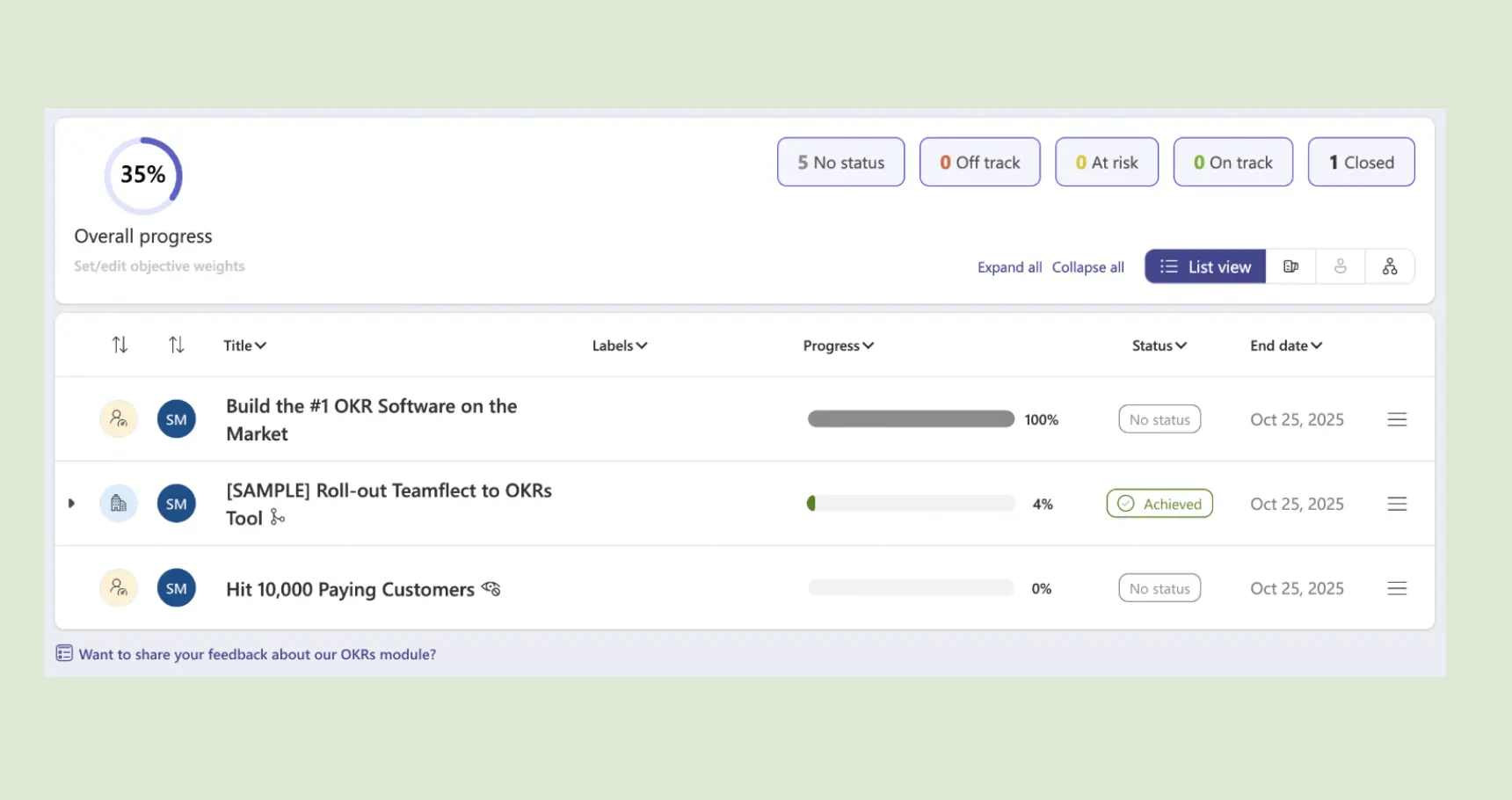
Teamflect runs OKRs and performance management directly inside Microsoft Teams, so there's no separate tool to adopt — which matters, because the adoption gap is what sinks most spreadsheet replacements. For teams already living in Microsoft 365, it removes the switching friction entirely.
What it does well: Teams-native OKRs, 360 feedback and reviews, per-goal visibility settings.
Where it falls short: no value outside the Microsoft 365 ecosystem; setup feels clunky at first.
Pricing: Free for up to 10 users, then $3–7/user/month.
How to Choose Your Alternative
Nine OKR spreadsheet alternatives is still a decision, and the right one depends less on features than on what your team is actually struggling with — cadence, visibility, adoption, or scale.
Not sure? Start with OKRs Tool — free for up to 5 users, and set up in under five minutes.
The Spreadsheet Isn't the Problem — Staying on It Is
By the time a team goes looking for alternatives, the spreadsheet has usually already stopped working. The update cadence drops off, the tab goes stale, and the OKRs quietly stop being part of how the quarter runs. The switch gets delayed because it feels like effort — and it is, once.
But the cost of staying compounds every quarter. The manual updates, the version confusion, the low adoption — none of it fixes itself; it just becomes the background noise of an OKR programme that never quite delivers. The gap between 1:25 and 1:88 is what that noise costs. Any of these nine tools will close it faster than another quarter on a sheet, and the best one is whichever your team will actually open — starting this week.
Data: the ROI of OKRs 2026 Benchmark Report (330 respondents), the 2026 OKR Benchmark Report (200 organizations), and OKRs Tool platform data (876 organizations, 20,952 key results).