
SMART is the most common on-ramp to writing OKRs — but 52% of all key results end up as tasks in disguise, and a goal can pass every SMART test and still be one. Three of SMART's five letters quietly work against what OKRs are built to do. Here's where the framework helps, where it breaks, and how to fix it.
If you've written a goal in the last decade, you've met SMART: Specific, Measurable, Achievable, Relevant, Time-bound. It's the default checklist for turning a vague intention into a real goal, and for good reason — it forces clarity where most goals are mush, and it draws on decades of research on goal-setting.
So it's natural to reach for SMART when writing OKRs. And as a starting point, it works: a key result that's specific and measurable is already better than most. But SMART was built for individual goals, not for the stretch-and-outcome logic that makes OKRs different — and if you apply it uncritically, it quietly steers you toward exactly the goals OKRs are meant to avoid.
What SMART Gets Right
Start with the good, because most of SMART earns its place. Two of its five letters map cleanly onto what a strong key result needs.
Specific forces you to name exactly what changes. "Improve customer satisfaction" fails this; "raise CSAT from 72 to 85" passes. That precision is the difference between a goal you can manage and a wish you can't.
Measurable forces a number. If you can't put a metric on it, you can't tell whether you hit it — and an unmeasurable key result is just an objective wearing the wrong hat. Note that measurable doesn't mean it should be a KPI: a steady-state metric you monitor isn't the same as a change you're driving. On these two, SMART and OKRs agree completely.
The trouble starts with the other three.
Where SMART Breaks: "Achievable" Fights the Stretch
Here's the first real conflict. SMART tells you to make goals Achievable — realistic, within reach, something you're confident you can hit. OKRs, done well, tell you the opposite.
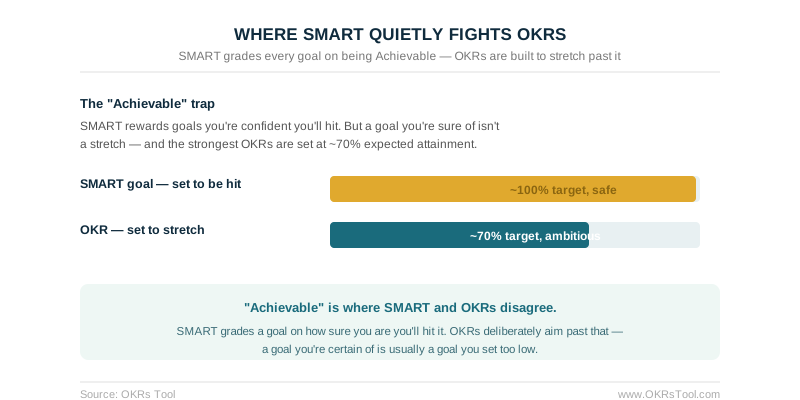
The strongest OKRs are set as stretch goals — aimed at roughly 70% expected attainment, not 100%. This is the split between aspirational and committed OKRs that SMART has no concept of: some goals you commit to fully, but the ones that move a company are deliberately set beyond safe reach. The logic is that a goal you're certain you'll hit is usually a goal you set too low, and the ambition itself is what pulls better work out of a team. "Achievable" grades a goal on how safe it is, which is precisely the instinct OKRs are trying to break.
This doesn't mean goals should be impossible. It means "can I definitely hit this?" is the wrong question. The right one is "is this worth reaching for even if we fall short?" — the same judgment a confidence score captures far better than a yes/no achievability test, and one SMART's Achievable criterion never asks.
Where SMART Breaks: "Time-bound" Is Already Handled
The second conflict is smaller but worth naming. SMART tells you to make goals Time-bound — attach a deadline. For OKRs, this is redundant at best and misleading at worst.
OKRs already run on a fixed cycle, almost always a quarter. The timeframe isn't a property of each individual goal you have to remember to add — it's a property of the system. Bolting a separate deadline onto each key result either just restates the cycle or, worse, creates mismatched mini-deadlines that fragment the team's rhythm. The cycle is the clock; you don't need a second one on every goal, and scoring happens at the cycle's end regardless.
Where SMART Breaks Most: It Says Nothing About Outcomes
This is the big one — the gap that causes the most damage. SMART checks the format of a goal. It says nothing about whether the goal measures an outcome or just an activity.
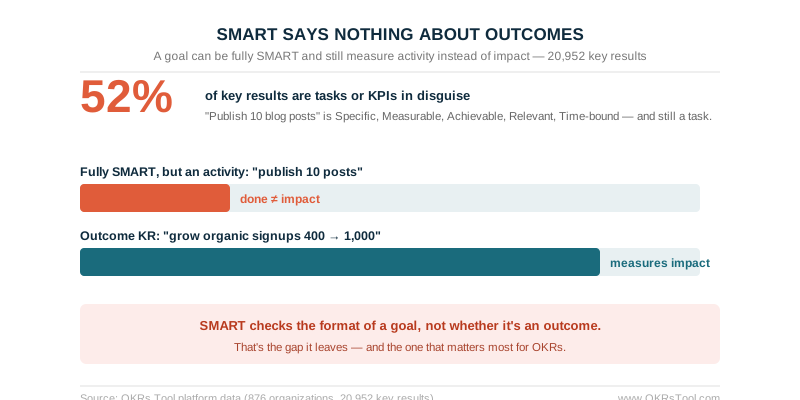
"Publish 10 blog posts this quarter" is Specific, Measurable, Achievable, Relevant, and Time-bound. It passes every SMART test — and it's still a task, not an outcome. Across the OKRs Tool platform of 876 organizations and 20,952 key results, 52% of all key results are tasks or KPIs in disguise, and SMART is part of why: a fully SMART goal feels rigorous, so nobody notices it measures effort instead of impact.
This is the difference between outcomes and outputs, and it's the single most important thing SMART leaves out. "Publish 10 posts" measures activity you control. "Grow organic signups from 400 to 1,000" measures the change the posts are supposed to create. The first is a to-do list; the second is an OKR. SMART can't tell them apart — you have to, and the teams that don't are living out one of the most common reasons OKRs fail: goals that look rigorous but track outcomes no one actually set.
The SMART Criteria, Scored for OKRs
Put together, here's how each SMART letter holds up when you're writing OKRs specifically.
The pattern is clear: SMART's format criteria (Specific, Measurable) are genuinely useful, its alignment criterion (Relevant) is handled better by OKR structure — through real alignment and cascading goals rather than a per-goal relevance check — and its judgment criteria (Achievable, Time-bound) actively pull against how OKRs work.
The Fix: A Better Checklist for OKRs
So if SMART only gets you part of the way, what's the rest? Keep the two letters that work, drop the two that fight you, and add the one test SMART is missing. A key result is ready when it's:
- Specific — it names exactly what changes.
- Measurable — it has a baseline and a target number.
- An outcome — it measures a result, not an activity you control. This is the test SMART leaves out, and the one that matters most.
- A stretch — it's ambitious enough that hitting 70% would still be a real win.
- Aligned — it ladders up to a company objective, which is what "relevant" should actually mean.
That last checklist is what writing OKRs well comes down to, and it's the standard to bring into OKR planning each cycle. It keeps the discipline SMART brought to goal-setting while fixing the two places SMART sends OKRs off course — and it puts the outcome test where it belongs, at the center.
Worked Examples: SMART vs OKR
Three quick before-and-afters show the shift. Each "before" is a perfectly SMART goal; each "after" is the OKR version.
In every case, the SMART goal describes work you'll do, and the OKR describes the change that work is meant to create. That's the gap SMART can't close on its own — and closing it is the whole point of writing OKRs instead of a task list. Strong company OKR examples all sit on the "after" side of that line, and the same test applies whether you're writing team OKRs or browsing OKR examples for a specific function.
Use SMART as the On-Ramp, Not the Destination
SMART isn't wrong. It's incomplete for OKRs, in specific and predictable ways. Used as a first filter — is this specific, is it measurable? — it does real work. Used as the whole standard, it quietly rewards safe, activity-based goals that pass every check and change nothing.
The fix is to keep SMART's clarity and add what it misses: aim past "achievable," lean on the cycle instead of per-goal deadlines, and above all, test whether each key result measures an outcome or just an activity. Get that last part right and you've solved the problem SMART can't even see — which is the same problem behind more than half the key results teams write. The OKRs Tool platform is built around that outcome-first standard, with a weekly check-in to keep the stretch honest — free for up to five users.
Data: OKRs Tool platform data (876 organizations, 20,952 key results).