
Specific, difficult goals produce higher performance than vague encouragement to do your best — and the effect has held across five decades of research, hundreds of studies, and tens of thousands of participants. The OKR framework is one applied expression of that science, and behavioral data from 876 real OKR programs confirms the same forces at work.
Edwin Locke and Gary Latham's research programme began in the late 1960s and accumulated into one of the most replicated findings in organizational psychology: people given specific and difficult goals consistently outperform people told simply to do their best. That conclusion sits directly beneath the OKR structure, whether or not the teams running OKRs have ever read the underlying research.
Beginning with Locke's 1968 paper and extending through Latham's field studies with logging crews, engineers, and clerical workers, the research moved goal-setting from laboratory observation to a tested theory of performance.
Their 2002 review covered 35 years of evidence and remained stable: harder goals produced more effort than easy ones, specific goals outperformed vague ones, and the relationship between goal difficulty and performance was close to linear until the limits of ability were reached.
What Locke and Latham Actually Found
Locke's core finding in 1968 was that conscious goals regulate effort, and harder goals pull more effort than easy ones — as long as the person has the ability and stays committed. Latham brought the same questions out of the laboratory and into real workplaces, testing them on logging crews, engineers, and clerical workers.
The pattern held in every setting. The two consolidated their results into goal-setting theory in a series of papers culminating in their 2002 review, now one of the most cited papers in management psychology.
The theory rests on four conditions that repeated across study after study. Specific goals outperform vague ones because "do your best" has no external reference point — almost any level of effort can be judged as meeting it.
Difficult goals outperform easy goals because higher targets raise both effort and persistence. And two conditions must be present for a hard goal to work: the person has to genuinely accept it, and they need ongoing feedback on how they are doing against the target. A goal without commitment or feedback underperforms even a moderate goal with both.
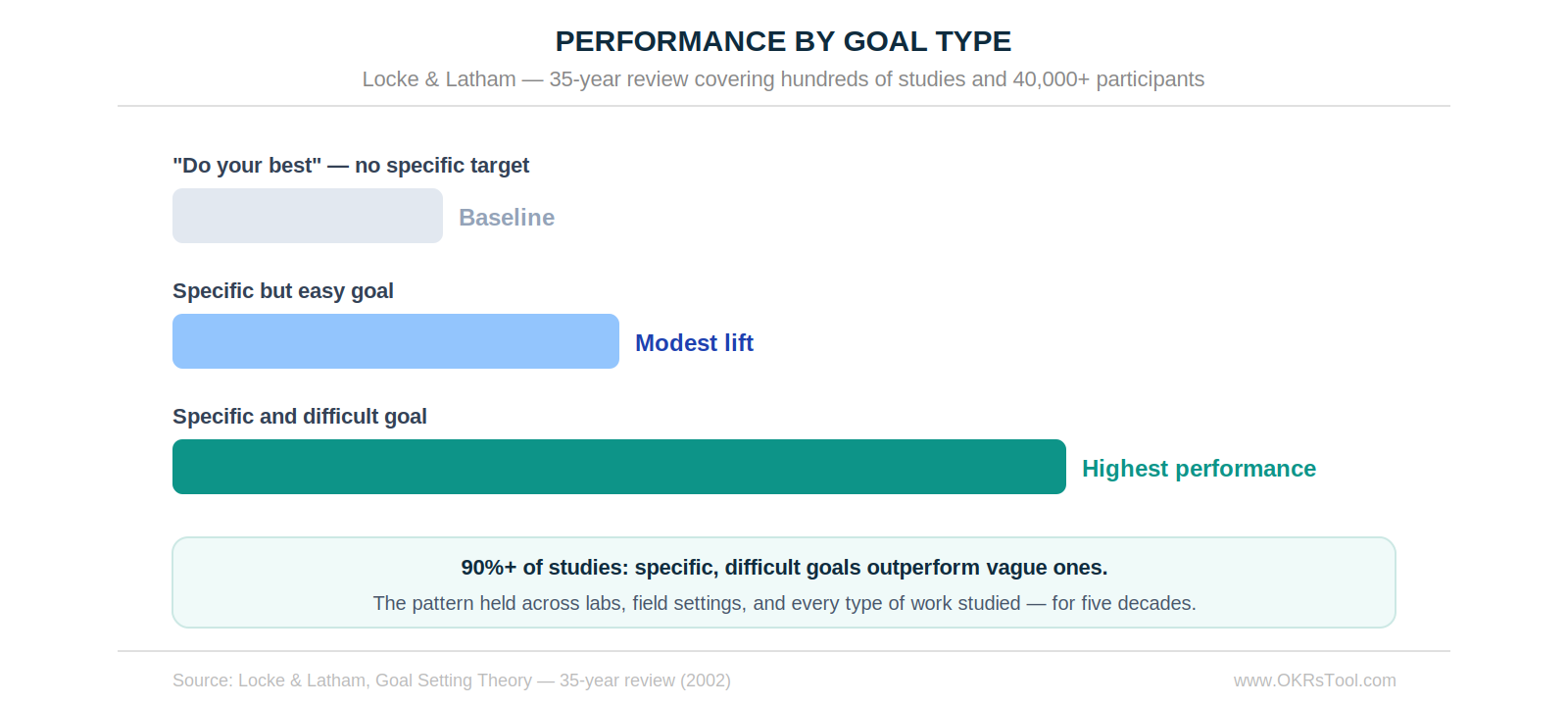
These four conditions — specificity, difficulty, commitment, and feedback — are the replicated, peer-reviewed findings of a research programme that covered 35 years and multiple independent investigators. Every OKR programme either satisfies them or quietly violates them, regardless of whether anyone designed it that way.
Why the Framework Mirrors the Research
The structure of an OKR maps almost directly onto goal-setting theory. The Objective supplies direction and the commitment condition — a good Objective is one a team can believe in, not one handed down from above. The Key Results supply specificity and difficulty — a Key Result is by definition a measurable outcome moved from a baseline toward a harder target.
The most common failure in writing OKRs is also the most predictable from the theory. When a Key Result is written as a task rather than an outcome, it loses the specificity of a measurable target and the difficulty of a real stretch — and reverts to the "do your best" condition the research showed to be weakest.
OKRs Tool's analysis of 7,419 objectives and 20,952 Key Results across 876 organizations found 52% were tasks or existing metrics in disguise rather than genuine outcome targets. More than half of all goals studied had already forfeited the mechanism that makes goals work.
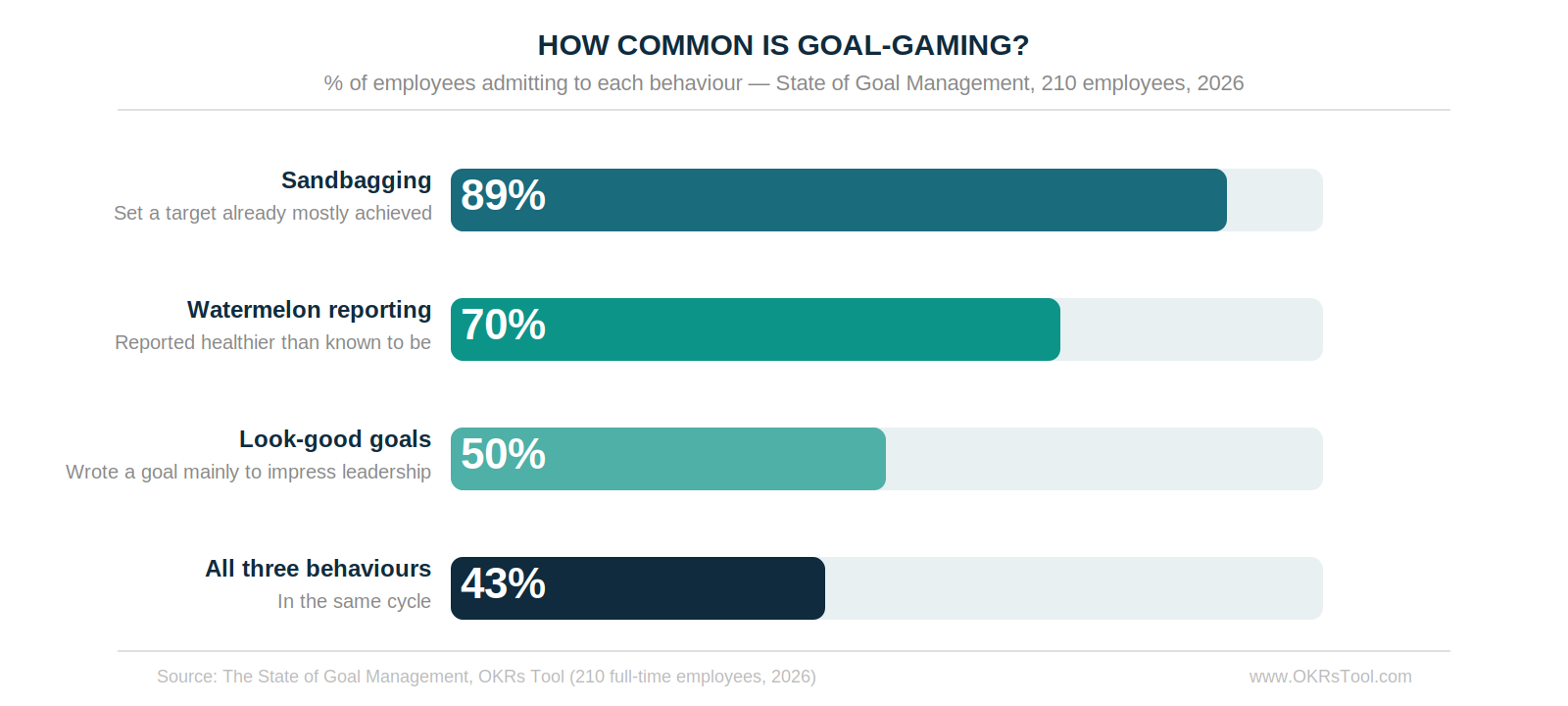
The same logic explains why stretch goals are scored differently from committed ones. Goal-setting theory predicts that difficulty raises performance only while commitment holds. Tie a genuinely hard stretch goal to a pass-fail judgment — or to compensation — and commitment collapses into sandbagging, exactly the behavior the research warns about.
The State of Goal Management confirms it: 89% of employees sandbag when goal scores affect their performance rating. Separating ambition from punishment is not soft management. It is the condition the theory requires.
The Feedback Loop the Theory Requires
The single most important refinement to the original theory was feedback. Locke and Latham found that a difficult goal without progress information produced almost no advantage over no goal at all. People cannot regulate effort toward a target they cannot see themselves approaching or missing. Goals and feedback work together, and neither does much alone.
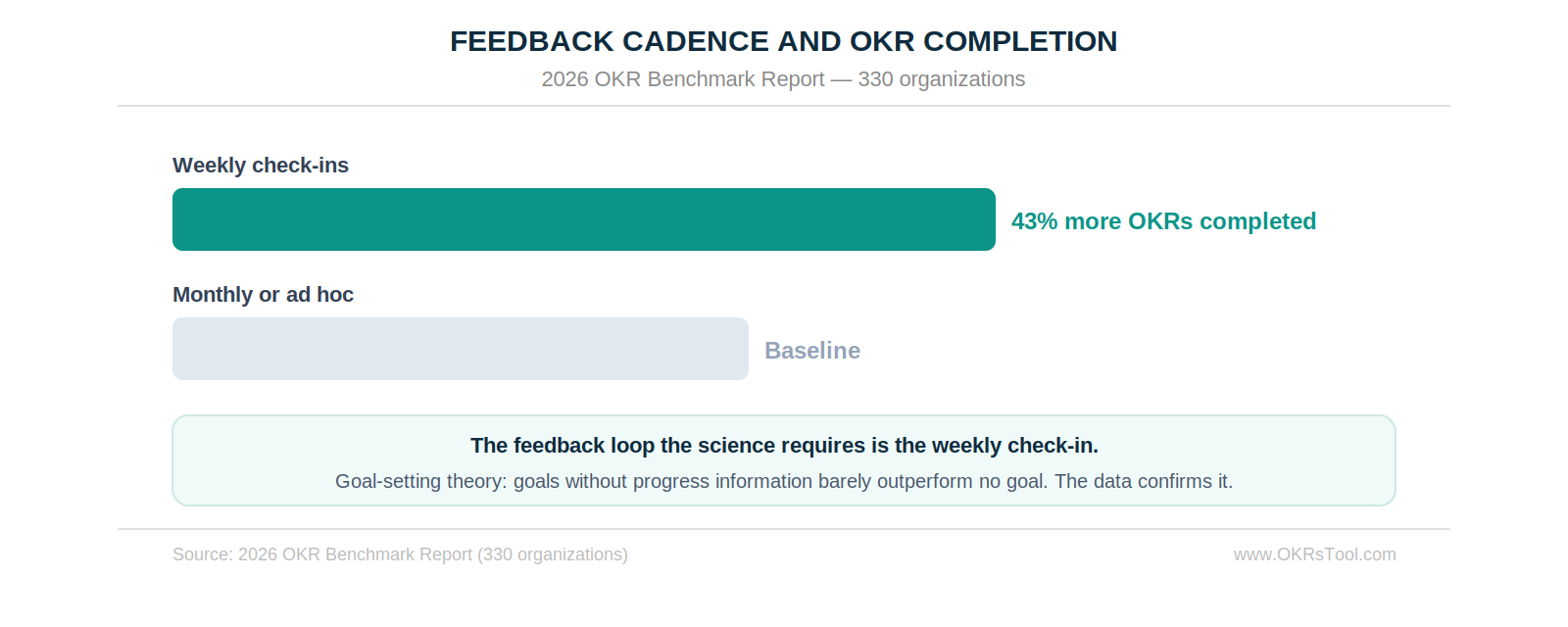
A goal set in January and reviewed in March is a goal without feedback for eleven weeks in between — which the research predicts will underperform a goal with weekly visibility. The mechanism that makes OKRs work is not the quarterly target. It is the weekly check-in that supplies the feedback loop the theory requires.
Teams running weekly check-ins complete 43% more OKRs than teams checking in monthly or less often. The wording of the goal matters, but the feedback cadence matters more — which is exactly the order of importance the 2026 OKR Benchmark Report assigns to specificity and feedback acting together.
Commitment, and Why Ownership Is Not a Formality
The second condition the research identified was commitment. A hard goal raises performance only for someone who has genuinely accepted it. Goals assigned without buy-in, or owned by everyone and therefore no one, lose the difficulty advantage because the person never internalized the target.
This is the science behind a finding that looks like a process detail. Across the platform data, Key Results with a single named owner are completed at materially higher rates than those with shared or absent ownership — and roughly 50% of all Key Results studied had no named owner at all.
The research explains why: ownership is the operational form of commitment, and commitment is a precondition for the goal working. A Key Result owned by nobody is a goal nobody has accepted.
Where the Science Argues Against Common Practice
Read carefully, goal-setting theory contradicts several habits that OKR programmes commonly develop. It argues against tying stretch goals to compensation, because the resulting drop in commitment outweighs the incentive effect. It argues against annual goals reviewed quarterly, because the feedback gap removes the mechanism that makes the goal work. It argues against accumulating objectives, because attention is finite — a person genuinely committed to ten hard goals is committed to none of them.
The benchmark data agrees on the last point. Teams running one or two objectives per quarter complete them at far higher rates than teams running more — the predictable result of commitment and attention being spread too thin.
The science and the behavioral evidence both point toward fewer, harder, owned goals with frequent feedback, which is a fair description of an OKR programme that survives past its first cycle.
The Research Is Settled. The Execution Is the Work.
The science of goal setting is one of the few areas of management where the evidence is genuinely strong and genuinely old. Specific beats vague. Hard beats easy. Owned beats assigned. Frequent feedback beats none. The behavioral data from 876 organizations does not overturn any of it — it confirms the theory inside real OKR cycles and puts numbers on each effect.
The work was never deciding whether goals matter. It is building the cadence, ownership, and specificity that make them work, week after week, for more than one quarter. See how OKRs Tool implements all four conditions by default — free for up to 5 users.
Data: OKRs Tool platform data (876 organizations, 7,419 objectives, 20,952 key results), The 2026 OKR Benchmark Report (200 organizations), The State of Goal Management (210 full-time employees at growing companies, 2026). Research: Locke, E. A. (1968). Toward a theory of task motivation and incentives. Locke, E. A. & Latham, G. P. (2002). Building a practically useful theory of goal setting and task motivation: A 35-year odyssey.