65% of teams admit their goals aren't linked to company strategy. The work breaks down between the company OKR and the team Key Result — not in the planning session, but in the gap where strategy is supposed to become weekly execution.
Strategy execution is the discipline of turning a small set of company priorities into team-level commitments that shape what people actually do each week. The planning is rarely the failure point. Leadership aligns on direction, the targets are sound, and the deck is convincing. The breakdown happens in the weeks after, when the work inside teams stops mapping cleanly to the outcomes leadership committed to.
The 2026 OKR Benchmark Report puts a number on it: 65% of teams admit their goals aren't connected to company strategy at all. That isn't a strategy-quality problem. It's a translation problem — the company Objective was never decomposed into team-level Key Results that describe what each function must change. This guide covers where the translation layer breaks and the six-step mechanic that high-performing teams use to close the gap.
Where the Translation Layer Breaks
Company OKRs describe where the business has to go. Team OKRs describe what each group changes to make that real. The distance between the two widens with every layer of headcount, and at 100+ employees it stops being intuitive and starts needing structure.
Three structural forces open the gap. Broad company Objectives like "improve retention" leave each function guessing at its own contribution, so clarity drops while output rises. Cross-functional dependencies multiply until every team is optimising locally and the company moves nowhere. And the Objective itself is often written in a way that reads well but doesn't decompose — strategically sound, operationally abstract.
The result is the misalignment gap the benchmark data captures. Teams work hard, dashboards look busy, and the outcomes leadership committed to don't move. The disconnect between strategy and daily work isn't a motivation failure — it's the absence of a translation layer.
The Cascade Gap Starts Before the Quarter Does
The first place execution leaks is the cascade itself — the speed at which company OKRs become team OKRs. The OKR Intelligence Report 2026 found only 16% of organizations complete the full cascade within the same week. For teams taking a month, the quarter is already a third over before everyone is aligned.
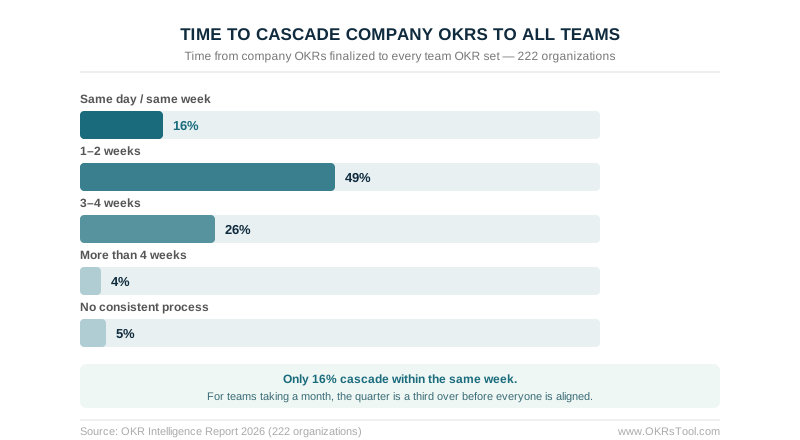
A slow cascade isn't a scheduling inconvenience. Teams that launch in under a week see up to 50% higher completion than those taking two to four weeks. The mechanics of cascading OKRs determine how much of the quarter is spent aligned versus how much is spent guessing — and the top-down to bottom-up balance decides whether teams own their contribution or wait to be told it.
Step 1: Turn Each Company Objective Into Strategic Questions
The fastest way to make an abstract Objective decomposable is to interrogate it before writing any goals. For each company Objective, the team answers what must be true for it to succeed, where the biggest levers sit, and what constraints shape execution.
These questions convert a broad intention into a set of solvable problems. "Improve retention" becomes "which early churn drivers do we control, and which function owns each one?" That reframing is what makes the next step — assigning outcomes to teams — possible at all.
Step 2: Assign One Outcome Per Team
Each team identifies the single outcome it directly influences, anchored to the company Key Result above it. One company Key Result usually becomes three or four team commitments, each owned by the function closest to the lever.
This is translation done correctly — one strategic Key Result becoming four functional commitments, each one a real outcome rather than a restatement of the company goal. Working from company-wide OKRs down to cross-department ownership is the difference between a goal every team shares and a goal no team owns.
Step 3: Resolve Cross-Functional Dependencies Before Committing
This is where execution is won or lost. Before any OKR is finalised, teams review each other's dependencies, confirm sequencing and shared ownership, and remove any goal that quietly relies on invisible work from another function.
Teams that skip this discover the conflicts mid-quarter, when they're expensive to fix. Teams that run it eliminate the conflicts before execution begins. The whole point of OKR alignment is that the dependency map is explicit, not assumed — and that every Key Result has a single accountable owner before it goes live, since clear ownership is what turns a shared dependency from a risk into a commitment.
Step 4: Write Outcomes, Not Activities
Team commitments only steer work when they describe change rather than effort. "Launch the new onboarding flow" is an activity that can score complete while the underlying problem remains. "Reduce onboarding drop-off from 44% to 28%" is a measurable movement that can't be faked.
Across the OKRs Tool platform — 876 organizations and 20,952 key results — 52% of Key Results use output language ("launch," "complete," "deliver") while only 34% use outcome language ("increase," "reduce," "achieve"). That gap is the translation layer failing at the sentence level. Getting Key Results right means writing outcomes over outputs, and the baseline-to-target format in the how-to-write-OKRs guide is what makes a commitment scoreable. A library of outcome-based OKR examples shows the pattern across every function.
Step 5: Attach Initiatives in the First Seven Days
A translated goal isn't finished until the work that moves it is visible. Within the first week of the cycle, each team attaches the initiatives — the specific projects and actions — beneath each Key Result, then refines them weekly as reality changes.
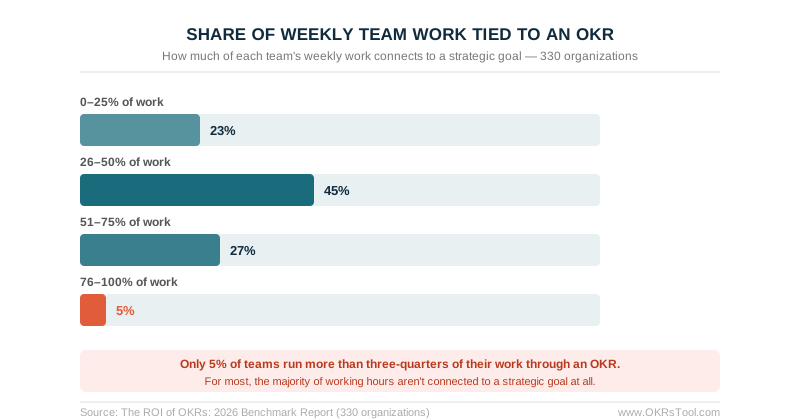
The benchmark data is consistent here: only 5% of teams have more than three-quarters of their weekly work tied to an OKR. The translation is incomplete precisely because the work was never connected to the goal.
Step 6: Build the Weekly Execution Rhythm
The final conversion point is cadence — where a translated goal becomes a weekly behaviour. Teams update Key Results, add context, flag dependencies, and adjust initiatives as movement dictates, every week, on the same rhythm.
Teams that check in weekly complete 43% more OKRs than those reviewing monthly or ad hoc. The mechanism isn't the information the check-in produces — it's that a Key Result drifting in week four is recoverable while the same drift found in week eleven isn't. A structured weekly check-in surfaces problems while there's still time to act, and the check-in itself is what keeps strategy present in the work rather than stored in a document nobody opens.
What Changes When Translation Works
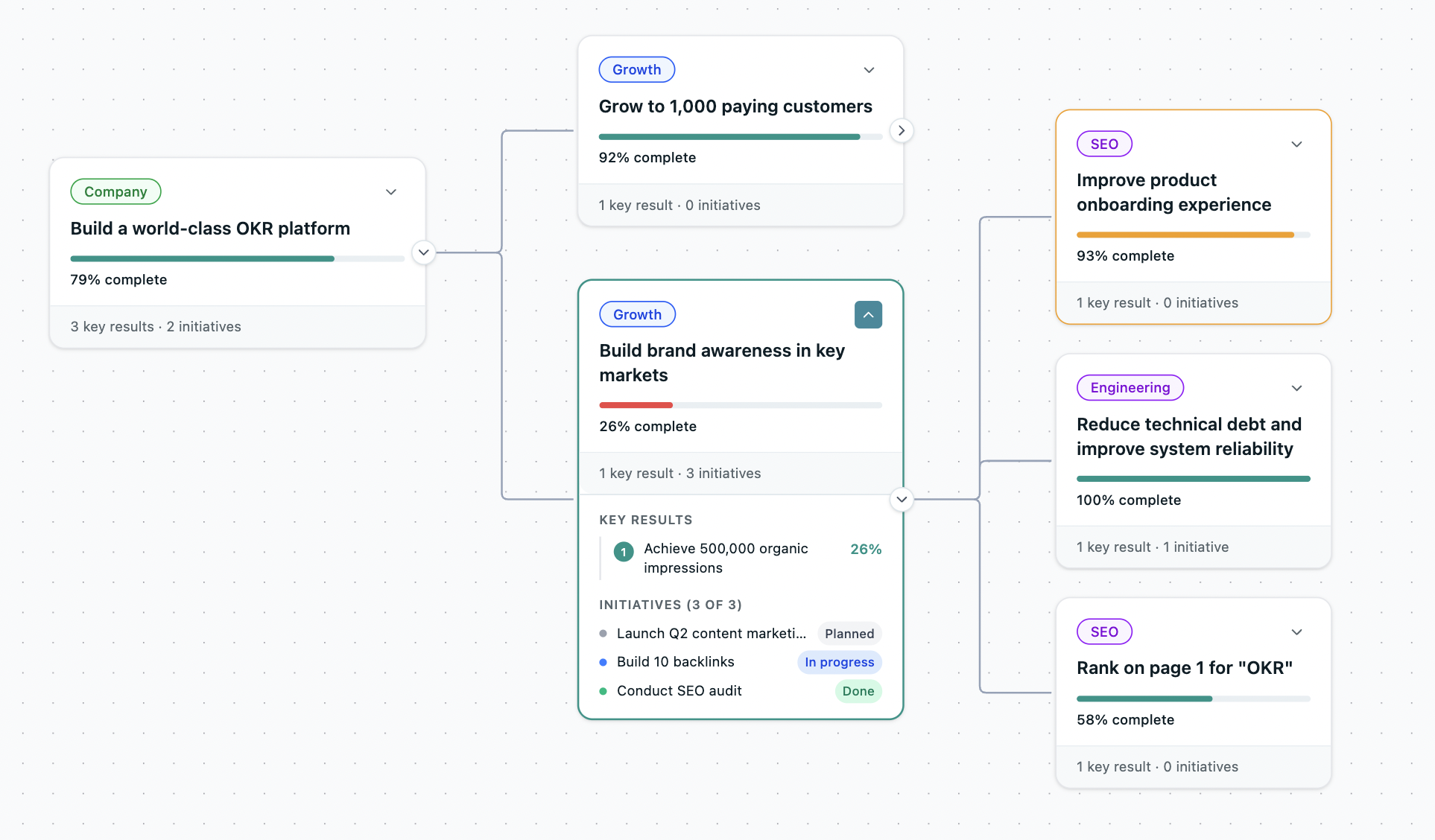
When the translation layer holds, the question inside teams shifts from "what are our priorities?" to "what has to change this week?" Ownership gets clearer, derailments get rarer, and execution becomes predictable enough to plan the next quarter against.
The four stages stay connected — company OKRs, cross-functional interpretation, team OKRs, weekly commitments — so strategy stops living in slides and starts shaping daily decisions.
The Tooling Decision Behind Strategy Execution
A spreadsheet stores a translated goal as easily as an untranslated one — it has no opinion on whether a team's Key Result actually connects to the company Objective. The cascade, the ownership, and the weekly rhythm all depend on discipline rather than structure, and discipline-dependent systems collapse under quarterly pressure.
Purpose-built strategy execution software enforces the structure the translation layer needs: a visible cascade, required ownership before a goal goes live, and an automated weekly check-in that doesn't depend on anyone scheduling it. Organizations running purpose-built tools generate a 1:88 return versus 1:25 on spreadsheets — and the strategy execution culture that produces that return is built on structure, not motivation. See how the OKRs Tool platform connects company Objectives to team Key Results in one live alignment view, free for up to 5 users.
Strategy Only Counts When It Reaches the Team
Leadership can define direction, finance can set targets, and the deck can be flawless. None of it moves the business until every team knows its piece of the outcome, how to measure progress, and what work moves the metric week after week.
That translation layer — from company OKR to weekly commitment — is where strategy execution is won or lost. When it holds, OKRs stop being an operating burden and become the clearest driver of alignment and growth a growing company has. When it breaks, the 65% alignment gap is what's left.
Data: The 2026 OKR Benchmark Report (330 organizations), OKR Intelligence Report 2026 (222 organizations), The ROI of OKRs: 2026 Benchmark Report (330 organizations), OKRs Tool platform data (876 organizations, 20,952 key results).