Most HR and payroll platforms have a goal field. None of them have a goal system. The difference is a weekly cadence, named ownership, cascade visibility, and honest progress data — the four things that turn a static record into an operating rhythm.
An OKR layer sets, cascades, and tracks outcomes. A payroll or HRIS platform processes compensation, time, attendance, leave, and compliance. Both are systems of record — but for completely different things. When a team tries to run OKRs inside an administrative suite, the goals become a static field nobody updates, and progress reporting drifts toward optimism. The platform isn't failing at its job. It's being asked to do a job it wasn't designed for.
The confusion is understandable. Buyers evaluating a new HR or payroll platform increasingly expect it to handle goal management as well. Many platforms now include a goal module — a tab, a form, a field labelled "objectives" — precisely because the demand is there. What those modules almost never include is the operating rhythm that makes goals work: a weekly check-in cadence, named ownership per goal, cascade visibility from company to team, and honest progress scoring rather than self-reported status. A field is not a system. The absence of the rhythm is what kills the goals.
The State of Goal Management found 34% of employees say nothing about how they work would change if their goal tracker were deleted tomorrow. That figure describes exactly what happens when goals live in an administrative platform with no audience and no cadence — they get maintained as a compliance exercise rather than as a steering mechanism.
The data also found 70% of employees have reported a goal as healthier than they knew it to be. Without a weekly rhythm surfacing the real state, there is no structural pressure to keep the numbers honest.
The model that works isn't replacing the payroll platform — it's adding a dedicated OKR layer on top of the system you already run. The two handle different jobs and connect rather than compete. Understanding where the line sits — and what the outcome layer needs to do — saves a quarter of disappointment.
What Payroll and HRIS Platforms Are Built to Do
Payroll software, HRIS platforms, and broader business-management suites are administrative systems of record. They store contracts, calculate compensation, track time and attendance, manage leave, and keep the organisation compliant. Some extend into performance reviews and basic KPI tracking, but these are high-stakes, high-accuracy administrative functions — and the better tools in this category are excellent at them.
Goal management is a different discipline. Setting an objective, cascading it so a team's work connects to a company priority, capturing weekly progress, and flagging the goals that are drifting before the cycle closes — none of that is back-office processing. It is an ongoing operating rhythm. A field labelled "goals" inside a payroll record does not create that rhythm. It stores a sentence.
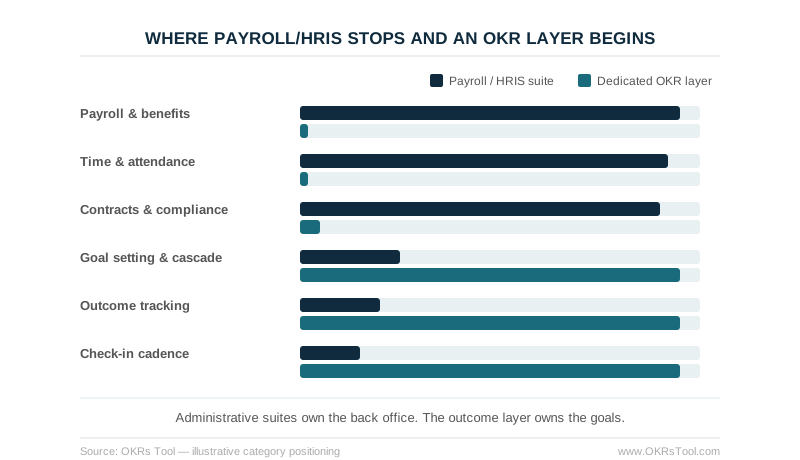
The chart above maps the divide. Payroll and HRIS suites cover the administrative columns almost completely and the outcome columns barely at all. A dedicated OKR layer inverts that — the same gap that opens up when teams try to run goals in spreadsheets or stretch a project management tool to cover them. Neither tool is failing at its job. They are built for different jobs.
Why Bolting OKRs onto a Payroll Suite Fails
When goal tracking is a secondary feature inside an administrative platform, three things happen consistently. The interface for goals is an afterthought, so updating progress is friction nobody opts into — the same reason teams stop updating OKRs by week three. There is no cadence — no weekly nudge, no check-in prompt — so goals are set once and left untouched. And because the platform's centre of gravity is compliance and pay, the goal data is read by almost no one, which removes any reason to keep it honest.
That last point is the expensive one. The State of Goal Management found 70% of employees admitted to reporting a goal as healthier than they knew it to be — watermelon reporting that looks green on the dashboard while the reality is red underneath. When the system holding those goals has no review rhythm and no audience, optimistic manual reporting becomes the default. The goal data exists, but it tells you nothing.
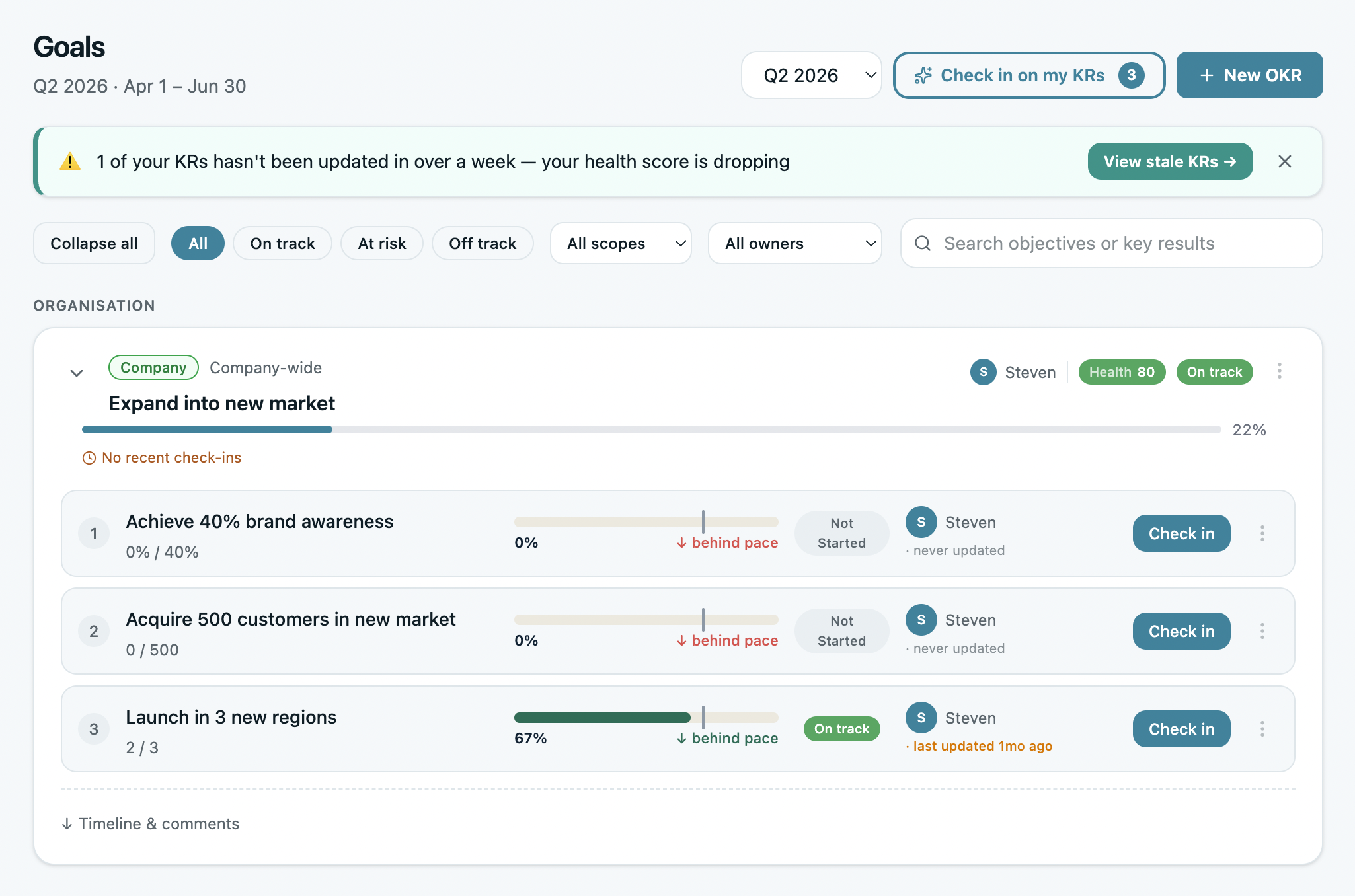
A dedicated outcome layer reverses the incentives. Progress is captured through a lightweight weekly check-in rather than a buried form, the cadence is built in, and the data is visible to the people whose work it describes. Teams checking in weekly complete 43% more OKRs than those reviewing monthly or ad hoc.
The Better Model: An Outcome Layer on Top
The administrative system keeps running compensation and compliance. The OKR layer owns goal setting, cascade, check-ins, and outcome tracking. The two run alongside each other rather than competing for the same function.
Your HRIS remains the system of record for who works where. The OKR layer is the system of record for what the company is trying to achieve and whether it is on track. Most teams keep the payroll or HR platform they already have and add the outcome layer alongside it — faster and lower-risk than switching systems or waiting for an administrative suite to grow a credible goal-management module it was never designed to build.
What to Look for When Adding the Outcome Layer
A few criteria separate an outcome layer that sticks from one that becomes another abandoned field.
A real check-in cadence — a weekly prompt rather than an open-ended form — because cadence is what keeps goal data honest between planning sessions. Cascade visibility, so a team objective visibly connects to a company priority rather than sitting in isolation. Fast setup without a consultant — the entire point is to avoid the heavyweight rollout that enterprise platforms require, and to clear the adoption bar that kills most goal programmes. And flat pricing that doesn't punish you for adding the whole company — per-user goal-tracking fees discourage exactly the broad participation that makes OKRs work.
OKRs Tool was built as that outcome layer. It runs alongside whatever payroll or HRIS system you already have, adds the weekly check-in cadence that keeps goals honest, and uses flat pricing so adding every team costs the same as adding one. Free for up to 5 users, setup takes an afternoon, and a 60-day adoption guarantee covers the risk of the rollout not landing.
Data: The State of Goal Management, OKRs Tool (210 full-time employees at growing companies, 2026). The 2026 OKR Benchmark Report (330+ organizations).