
The teams generating the highest returns from OKRs aren't the ones with the most sophisticated frameworks. They're the ones that kept the methodology simple, ran the weekly rhythm without exception, and resisted the urge to add process every time something broke.
John Doerr introduced OKRs to Google in 1999 on a single slide.
One objective. A handful of key results. A shared understanding of what the quarter was for. The whole thing fit in a room and took an afternoon. Google was 40 people at the time — not far from where a lot of teams reading this sit today.
What most of those teams have built instead would be unrecognisable to that room.
It's a shame, really.
How Simple Becomes Complicated
It usually starts with good intentions. The first OKR cycle runs, something doesn't work, and the instinct is to add structure. A scoring system. A confidence rating. A weekly template with five mandatory fields. A cascade framework that requires every team OKR to map to a company OKR, which maps to a pillar, which maps to a strategic theme.
Each addition feels reasonable in isolation. Together, they turn a lightweight goal-setting framework into a quarterly compliance exercise — one that takes more time to administer than it saves in clarity. By the third or fourth cycle, the people closest to the work have mentally checked out. They're filling in the fields, not using the framework.
This is how OKR methodology dies at your stage. Not with a decision to abandon it, but with a slow accumulation of process that makes it not worth the effort.
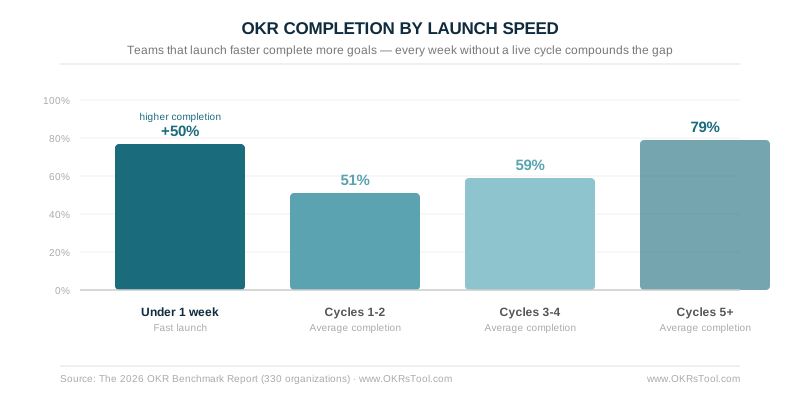
The 2026 OKR Benchmark Report captures what that accumulation costs: teams in cycles 1–2 average 51% completion. By cycle 5+, the same organizations average 79%. The teams that make that jump don't get there by adding process — they get there by running a clean, simple structure consistently until the habits compound.
What The Methodology Actually Requires
Strip it back and OKR methodology has three jobs.
The first is focus. An objective is a forcing function — it makes you choose what matters this quarter and, by implication, what doesn't. If the objective doesn't require you to deprioritize something, it isn't doing its job.
The second is measurement. Key results exist to make progress legible. Not to create accountability theatre, not to give managers something to report upward — to answer a simple question at the end of the quarter: did we move the thing we said we were going to move?
Show ImageOKRs Tool — Key Results scored 0.0–1.0 with named owners, progress tracking, and weekly check-in status visible in one view.
The third is rhythm. OKRs only work if they're revisited often enough to be useful. A quarterly goal that gets checked quarterly isn't a management tool — it's a prediction made in January and evaluated in March, with no opportunity to learn or adjust in between.
The benchmark data is precise on this: teams with an automated weekly check-in habit complete 43% more OKRs than those reviewing monthly or ad hoc. Teams that skip the weekly rhythm are 3x more likely to abandon OKRs altogether in the first cycle.
Focus, measurement, rhythm. Everything else is optional.
The Three Mistakes That Add Complexity Without Value
Scoring for its own sake. The 0.0–1.0 scoring system has its place — but for most teams at your stage, it adds a layer of interpretation that creates more debate than insight. A key result is either moving or it isn't. If it isn't, the conversation should be about why, not about whether the score is a 0.6 or a 0.7.
Cascading everything. Full top-down cascade sounds like alignment but often produces the opposite — team leads writing objectives that satisfy the cascade requirement rather than reflecting what their team actually needs to accomplish. Alignment comes from shared context and conversation, not from a hierarchy of nested objectives. The cascade should connect teams to company priorities, not become an administrative layer that everyone resents completing.
Quarterly kick-offs that take weeks. When the planning process consumes so much time and energy that teams are relieved when it's over, the methodology has already failed. An OKR planning session should produce clarity, not exhaustion. If it regularly runs past a day, something has been added that shouldn't be there. The benchmark data confirms the cost: teams that complete the full cascade in under a week see up to 50% higher completion rates than those that take three to four weeks. The planning overhead itself predicts worse outcomes.
Simplicity As A Competitive Advantage
At 50 to 80 people, the teams that get the most out of OKR methodology are the ones that resist the urge to make it more sophisticated every cycle. They run a lean process, fix what breaks, and leave everything else alone.
Three objectives per team. Two to four key results each. A weekly check-in that takes fifteen minutes. A mid-quarter conversation about what needs to change. An end-of-quarter reflection that informs the next cycle, not a retrospective that generates a new layer of process.
That's it. That's the methodology. The discipline isn't in the framework — it's in resisting the temptation to keep adding to it.
The ROI data is clear on what that discipline produces: organizations using purpose-built OKR software — with the simple structure maintained through automated check-ins and required ownership — generate a 1:88 return on investment versus 1:25 on spreadsheets. The difference isn't sophistication. It's consistency.
Where OKRs Tool Fits in The Methodology
The irony of most OKR software is that it encourages exactly the kind of complexity that breaks adoption — elaborate dashboards, multi-level cascades, weighted scoring, and fields nobody fills in honestly.
OKRs Tool is built around the opposite philosophy. Set an objective, define the key results, assign an owner, track progress weekly. The interface reflects the methodology — simple, fast, and designed for teams that want to spend their time hitting goals rather than administering them. At a flat $49 per month, it's built for the stage you're at, not the enterprise you might become.
OKR methodology works when it's easy to use and hard to ignore. That's the version worth building — for us, and for you.
Data: The ROI of OKRs: 2026 Benchmark Report (330 respondents), The 2026 OKR Benchmark Report (200+ organizations).