
A team hitting 79% of its goals and a team stuck at 51% often write goals that read exactly the same on paper. What separates them is ownership, cadence, visibility, and honest scoring — three of these habits lift completion by 26 to 50% on their own, and not one of them touches how a goal is worded.
Nearly every list of goal setting strategies is about wording: how to phrase an objective, how to make a target measurable, how to write a key result that isn't vague. The data points somewhere else. Teams write perfectly reasonable goals and miss them anyway, because nothing structural carries the goal from the planning document into the week.
The evidence is blunt. The State of Goal Management surveyed 210 employees and found that 34% of employees would carry on exactly as before if their goal tracker were switched off overnight. The goals are there and the updates get logged, but nothing downstream moves. The system around the goal failed, even where the sentence the goal was written in was perfectly fine.
The eight strategies below cover both halves: what to write, and the structure that makes the writing matter. They sit inside the wider practice of goal setting, where the same pattern holds.
Structure Matters More Than Wording
Before the eight strategies, the finding that reorders all of them: the biggest gains in goal completion come from structure rather than language. That claim isn't a hunch. When the Goal-Setting Benchmark surveyed 280 operations and strategy leaders, the framework a team ran came out as one of the weakest signals of whether it hit its goals; the structural habits came out as the strongest. Teams that keep those habits land their goals nearly three times as consistently — 2.9x — as teams that let them slide.
Three of them — launching fast, checking in weekly, naming one owner — lift completion by 26 to 50% on their own, and not one touches how a goal is phrased. To see why structure outweighs wording, look at how teams find out a goal is drifting in the first place.
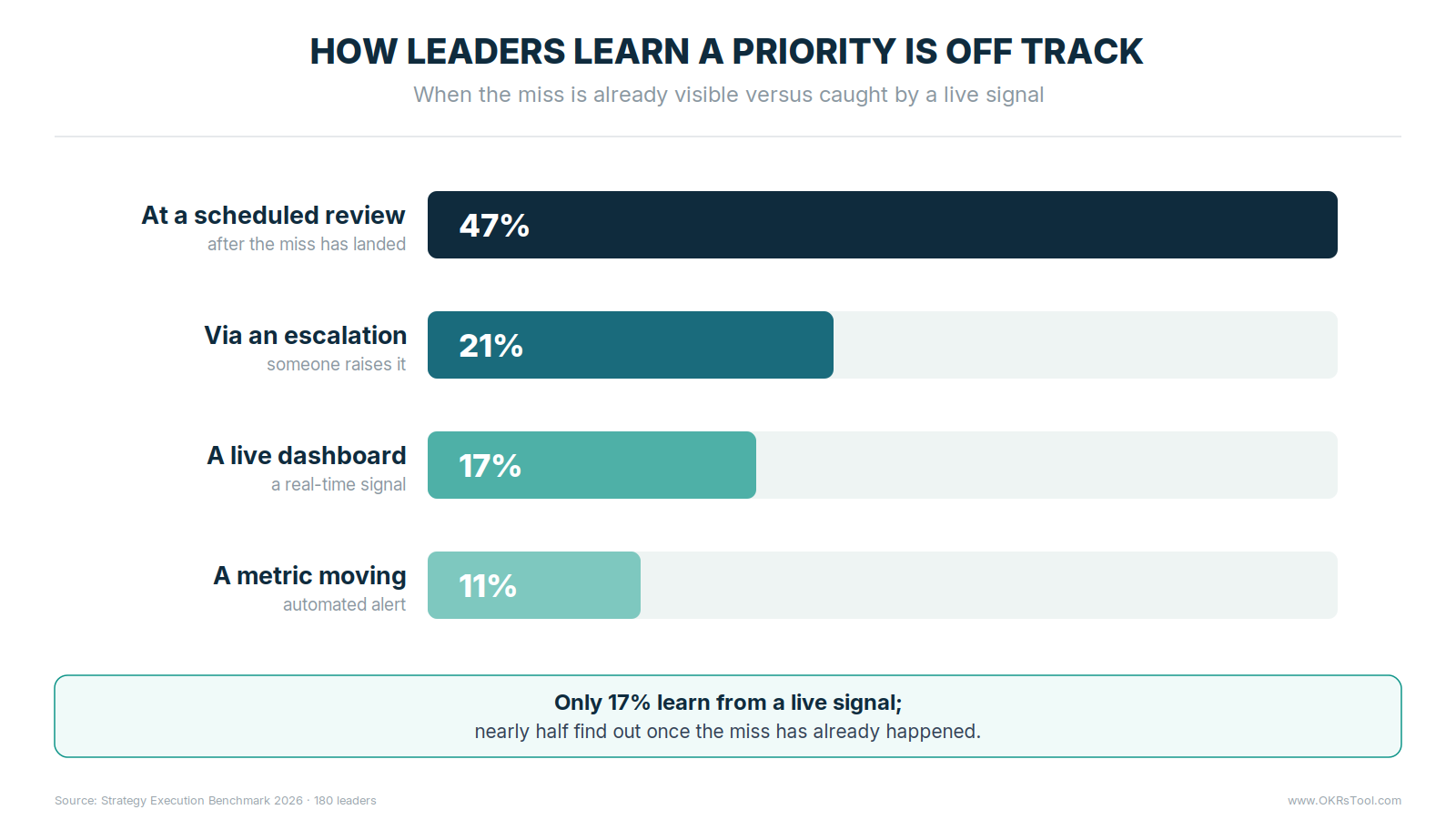
Only 17% of leaders learn from a live signal; 47% find out at a scheduled review, once the miss has already landed. That's the lens for everything below. Get the structure right and mediocre goals still get hit; get it wrong and beautifully written ones still drift.
Strategy 1: Write Outcomes, Not Activities
The first strategy is the most fundamental, and the one teams most often miss. Across 20,952 key results analysed in the platform data, output verbs — launch, complete, deliver, implement — appeared in 52% of them. Outcome verbs — increase, reduce, achieve, grow — appeared in only 34%.
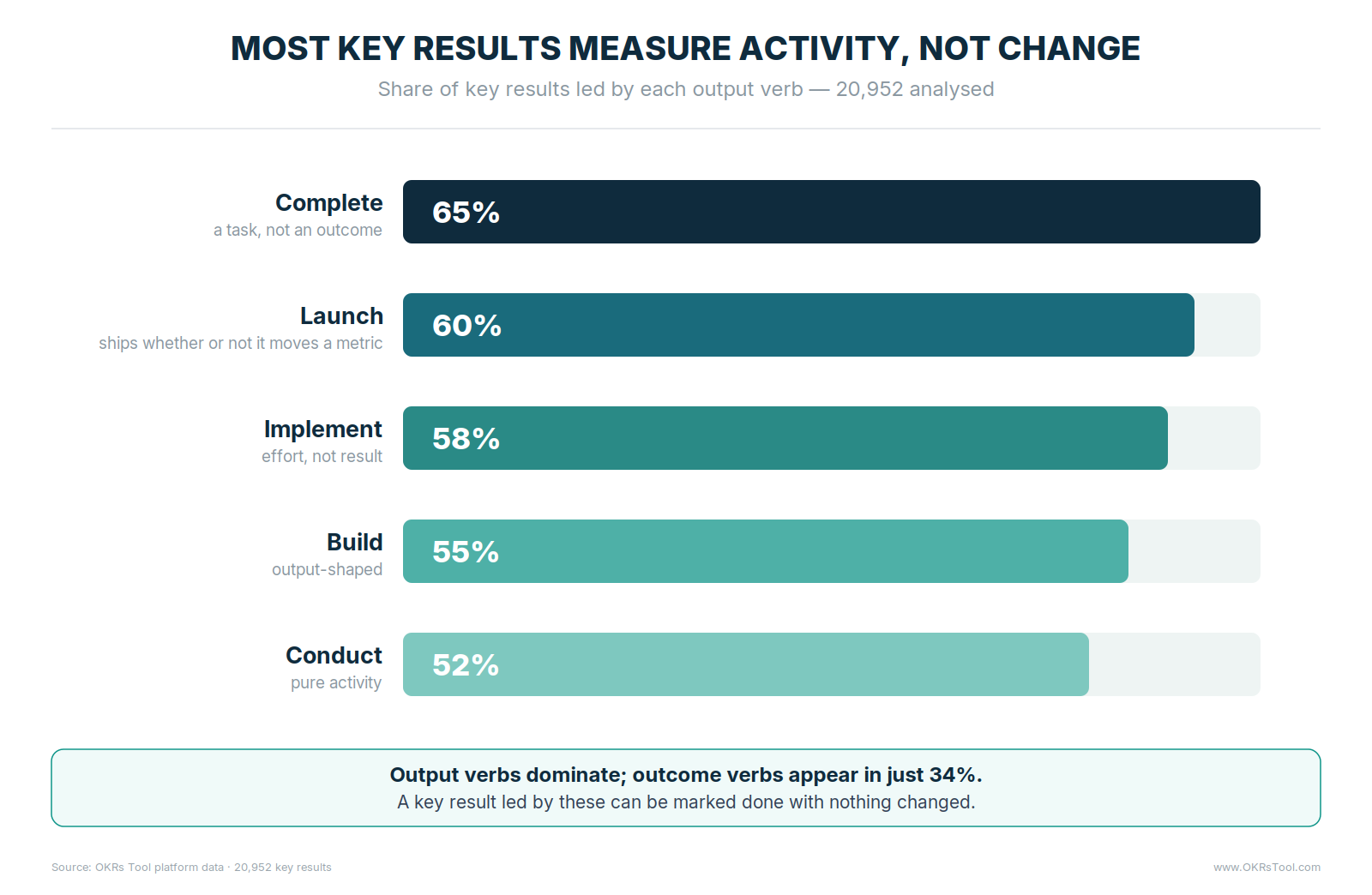
A task describes work done; an outcome describes something that changed. "Launch the new onboarding flow" gets marked complete whether or not the metric it was meant to move budges. "Increase trial-to-active conversion from 25% to 40%" can't be gamed that way — the number moved or it didn't. The test for any key result: can you mark it complete without a business metric moving? If yes, it's a task, and it needs rewriting as the outcome the task was meant to produce. Give it a baseline and a target, or there's no honest way to score it at cycle end.
Strategy 2: Name One Owner Before the Cycle Starts
Half of all key results across growing organizations have no named owner, and teams that require a single owner per key result complete 26% more of them than teams with shared or vague accountability.
Shared ownership is the most common and most fixable failure in goal setting. Split a goal between two people and accountability evaporates — each assumes the other has it. The fix is mechanical: nothing goes live without one named person, not a team and not "leadership," whose name sits beside the progress score every week. Pair that with restraint on volume — past four or five key results per objective, focus dilutes and ownership diffuses together.
The right question at the planning session isn't "what does everything we want to achieve look like?" It's "which two or three outcomes, if we moved them this quarter, would make everything else less important?" Answering that honestly is the goal-setting discipline that matters most, and it's the same logic behind keeping the goal count low.
Strategy 3: Check In Every Week Without Exception
Teams that check in weekly complete 43% more of their goals than teams reviewing monthly or ad hoc. It's the highest-leverage habit in this list, and it doesn't require a meeting — five minutes per person on four questions: what moved, what's blocked, what's the priority this week, where is help needed.
The cadence is the part that can't flex. The weekly check-in has to happen regardless of how loud the quarter gets, because the weeks it feels most skippable are usually the weeks a goal has started to slip unnoticed. Weekly beats monthly because it surfaces problems while they're still recoverable — drift caught in week four gets corrected; the same drift found in week eleven is a post-mortem. Monthly tracking turns goal management into autopsies; a weekly cadence turns it into steering.
Purpose-built OKR software automates the rhythm — a nudge via Slack or Teams that fires every week without anyone scheduling it. Organizations on purpose-built platforms report a 1:88 return against 1:25 on spreadsheets, largely because the weekly habit becomes structural rather than a test of willpower.
Strategy 4: Make Goals Visible and Nameable
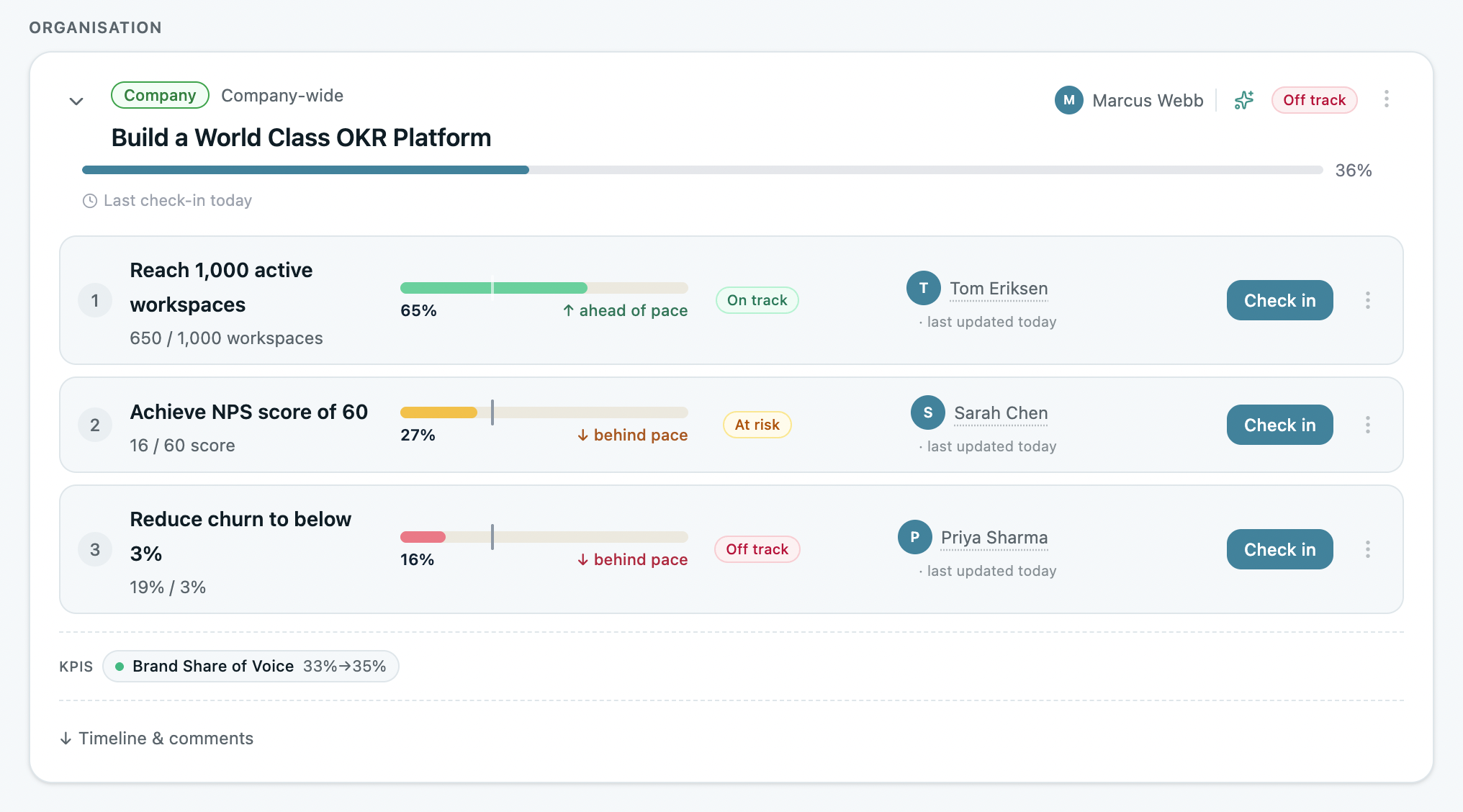
A goal nobody can name can't be pursued, and visibility is the earliest warning that a goal system has gone decorative. Among the 210 employees surveyed, the ones who couldn't name their company's goals were far more likely to say deleting the tracker would change nothing — the recall problem and the relevance problem turn out to be one problem.
Visibility doesn't come from a strategy document or an all-hands slide. It comes from goals showing up in the tools people already use — the Slack channel, the weekly dashboard, the check-in flow. Roughly two-thirds of teams — 65% — say their goals sit disconnected from company strategy, almost always because the cascade tying a team key result back to a company objective was never built into the process.
Make every team key result cascade from a company objective before the cycle starts, visible in the tool people open daily on one platform, and the recall problem resolves on its own. A live alignment map is what keeps it that way.
Strategy 5: Decouple Goals From Performance Ratings
The State of Goal Management found that 92% of employees cop to at least one flavour of goal-gaming: setting a bar they have already cleared, dressing up a struggling goal as healthy, or writing one purely to look good. Just 8% claim a clean record.
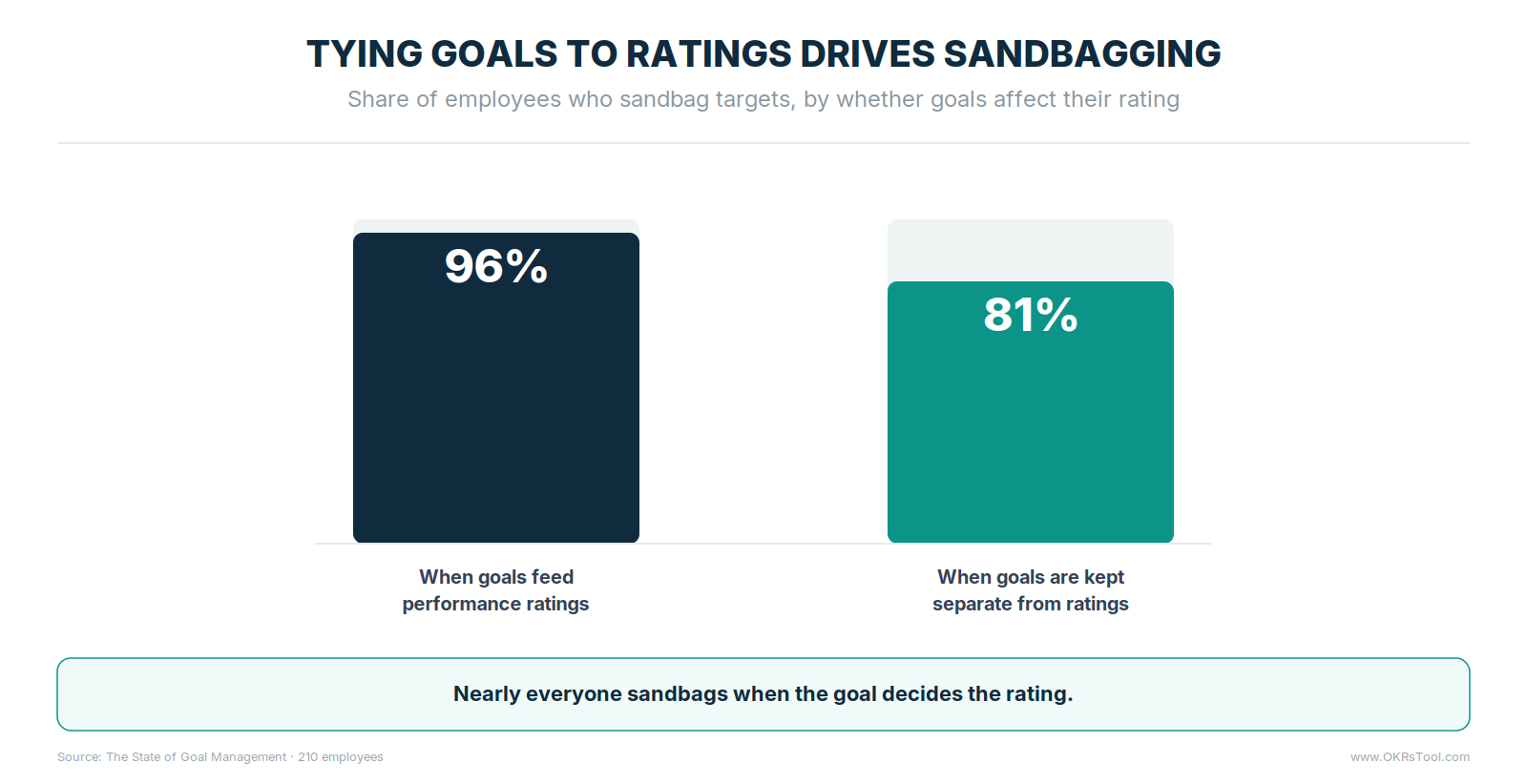
The behaviour intensifies when goals feed performance ratings. The mechanism organizations use to make goals "count" is often the same one that teaches people to manage appearances instead of outcomes: tie a missed goal to a performance mark and the rational move is to set a target at 90% of what the team already does, then call a 1.0 at cycle end.
When a missed goal feeds a rating, 96% of employees sandbag their targets, against 81% when goals are kept separate — the incentive to set a safe number is almost universal once the number decides the review.
Scoring on a 0.0–1.0 scale with a 0.7 target exists to make ambition safe — a 0.7 is a strong result. Use goal data as one signal among several in a performance review, never as the determining input.
Strategy 6: Launch Before the Quarter Gets Loud
Teams that launch within one week of quarter start see up to 50% higher completion than teams taking two to four weeks. Fast planning doesn't produce better goals — it produces a clean start. Teams launching late spend the opening weeks in an ambiguous state where some key results are live and some aren't, some owners are named and some aren't, and that ambiguity kills the weekly check-in habit before it forms.
A clean launch produces the opposite state: cascade complete, every owner named, the first check-in already on the calendar. The planning session doesn't need to be elaborate — one half-day, company objectives set, team key results drafted in parallel, every one with an owner before the room empties. The cascade should finish before the cycle starts, not three weeks into it.
Strategy 7: Score Honestly — 0.7 Is the Target
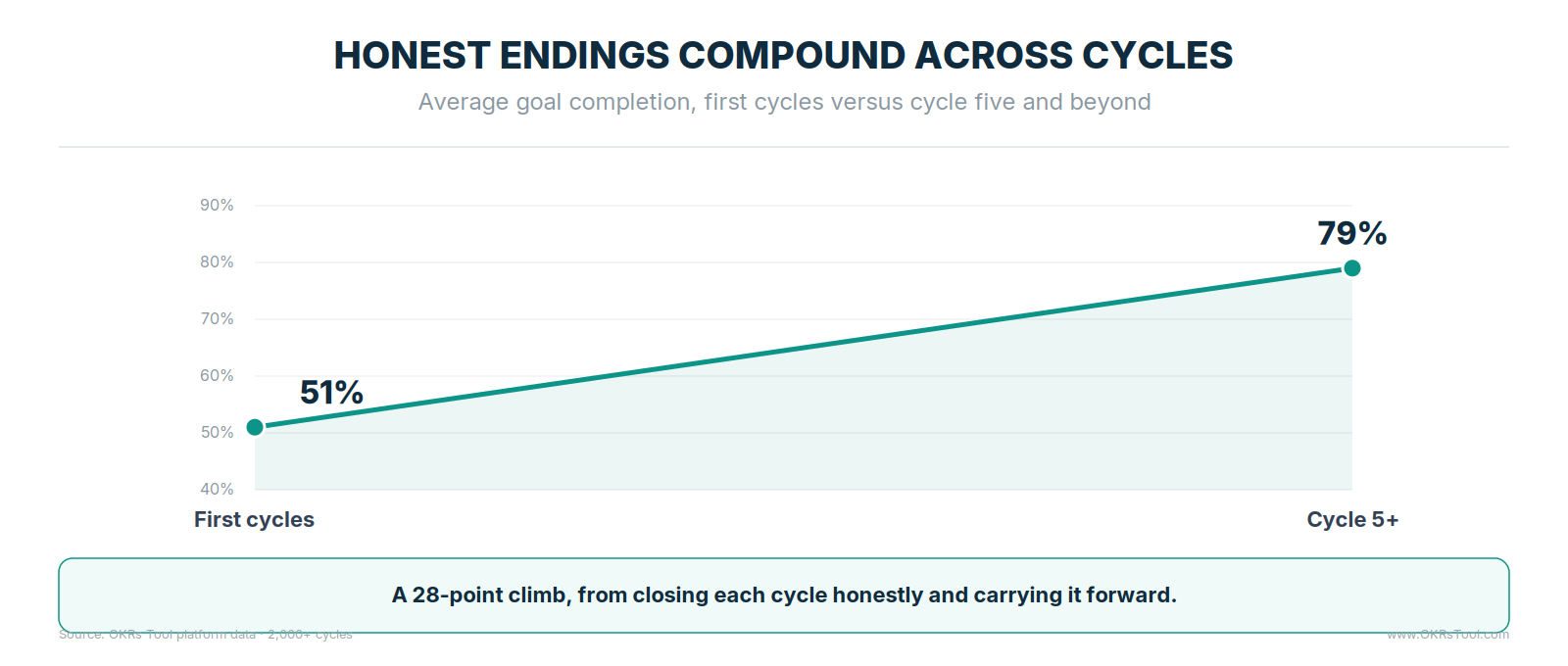
Teams in their first cycles average 51% completion; by cycle five that climbs to 79% along the maturity curve — a lift that compounds from the discipline of honest scoring rather than from easier targets.
Purpose-built goal software returns 1:88 against 1:25 on spreadsheets and 1:16 on a generic enterprise suite, largely because it makes honest, consistent scoring the path of least resistance. The tell is what a team does with a 1.0: scoring the top of the scale on everything means the targets were set too low to learn anything from. A 0.65 in cycle one, scored accurately and diagnosed in the retro, produces a sharper cycle two; an inflated 0.9 that hides a miss carries the same problems into the next cycle untouched.
The discipline that matters at mid-cycle: every off-track key result leaves the mid-quarter review with one of three outcomes — revised target, escalated blocker, or formally closed. Naming the outcome is what separates a managed miss from a goal that simply disappears.
Strategy 8: Give Every Goal a Real Ending
Teams that run structured end-of-cycle retrospectives complete 30 to 45% more goals the following quarter. What divides a load-bearing goal system from a decorative one is whether goals get a real ending.
A real ending has three parts: honest scoring on the 0.0–1.0 scale for every key result, not a narrative of "we basically got there"; a structured retrospective naming what drove progress, what blocked it, and what structural change would produce a different result next cycle; and explicit commitments — three specific things that will change at the next planning session — written down before the retro ends.
The retrospective is the piece teams drop when the quarter gets busy, and that decision compounds. Teams that skip cycle one's retro enter cycle two without the data to improve, and they stay near 51% while the disciplined teams reach 79%.
The 8 Goal Setting Strategies at a Glance
The Strategies Compound — Start With Structure
The eight strategies work as a connected system, not eight independent techniques. Outcome-based key results only produce honest signals if someone owns them. Ownership only produces accountability if progress is visible weekly. Weekly visibility only produces intervention if a mid-cycle review acts on what it surfaces. And all of it only compounds if every cycle ends with an honest retrospective feeding the next planning session.
Teams that adopt one or two of these in isolation see marginal improvement. Teams that adopt all eight climb the 51-to-79% curve, because the habits reinforce each other: the weekly check-in makes ownership visible, honest ownership makes watermelon reporting harder, decoupling from ratings makes honest scoring rational, honest scoring makes the retrospective valuable, and a valuable retrospective sharpens the next cycle's goals.
So start with the structure — named ownership, weekly cadence, cascade alignment — before touching the goal language. Across 200 organizations, the gap between a 1:25 and a 1:88 return traces to structural discipline applied cycle after cycle.
The lesson underneath all eight is that a goal is only ever as good as the system carrying it into the week: write the best objective in the company, and without an owner, a cadence, and an honest ending, it decays into the 34% that would change nothing if you deleted it tomorrow. The strategies are scaffolding — they decide whether a goal survives contact with a busy quarter, a separate question from how well it was written.
Data: the 2026 OKR Benchmark Report (200 organizations), the Goal-Setting Benchmark (280 operations and strategy leaders), OKRs Tool platform data (876 organizations, 20,952 key results), and the State of Goal Management (210 employees).