
Enterprise OKR platforms are engineered for governance — approval chains, audit logs, executive roll-up dashboards. At 50–200 people, your problem isn't governance. It's signal. This guide covers why the mismatch is structural, not a training issue, and what the benchmark data shows about the return difference.
_______________________________________________________________________________________________________
I've spoken with hundreds of operators at growth-stage companies.
The conversation almost always goes the same way: they tried Profit.co, 15Five, or Betterworks, spent weeks configuring it, and by the end of Q2 the tool was a ghost town.
This isn't a coincidence. It's structural. Enterprise OKR platforms are engineered for a different organizational reality — and deploying them at 50–200 people doesn't simplify OKR execution. It buries it.
Here's exactly why, and what to do instead.
Enterprise OKR Tools Are Not Built for Execution
The core design assumption of enterprise platforms is that the primary consumer of OKR data is leadership — not the individual contributor running a sprint.
Every feature flows from that assumption: cascading approval chains, executive roll-up dashboards, audit logs, compliance exports. At a 5,000-person company, that's appropriate. Governance matters when misaligned priorities cost millions across hundreds of teams.
At 65 people, your problem isn't governance. You need to know what's actually moving and what's stalled, in real time, without a weekly status call to find out. When you deploy a governance tool into a signal problem, you get the worst of both worlds: overhead without clarity.
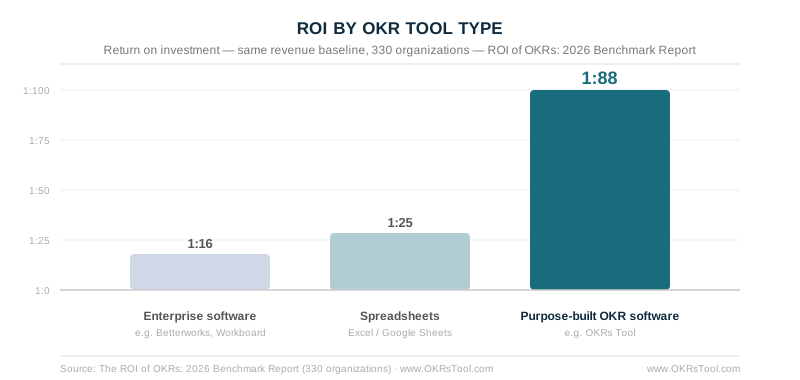
The ROI data confirms this structurally. Organizations using enterprise OKR software generate a 1:16 return on investment — compared to 1:88 for organizations using purpose-built tools designed for the 50–200 person stage. The gap isn't features. It's fit.
The Onboarding Cost Is a Structural Mismatch
Enterprise platforms typically require 4–8 weeks of configuration before they're usable: admin setup, permission hierarchies, SSO provisioning, integration mapping, and in many cases a dedicated customer success manager walking you through templates.
A Head of Ops at a 70-person logistics SaaS told me her team spent three weeks in onboarding calls before a single OKR was entered. By the time the tool was "ready," the quarter was halfway done and her team members had already reverted back to Notion.
The benchmark data is precise on this: teams that launch OKRs in under a week see up to 50% higher completion rates than those with extended rollout timelines. At your stage, a tool that isn't running in 48 hours is already a liability. You don't have a program manager whose job is to maintain the OKR system. You have operators who need it to work immediately or they'll find a workaround.
Feature Bloat Kills Adoption
Here's the adoption curve I've seen play out at growth-stage companies that went enterprise too early.
Weeks one and two: enthusiastic rollout. Goals entered. Leadership optimistic. Weeks three and four: updates slow. Contributors find the interface confusing or low-priority. Weeks six to eight: only managers are updating — reactively, before review meetings, not reflectively. End of quarter: the tool shows 80% green. The business missed three key outcomes. Nobody trusts the data.
This is what happens when a tool is designed for administrators and executives, then handed to individual contributors with no time to learn it. When updating the system takes more effort than telling your manager in Slack, people choose Slack every time.
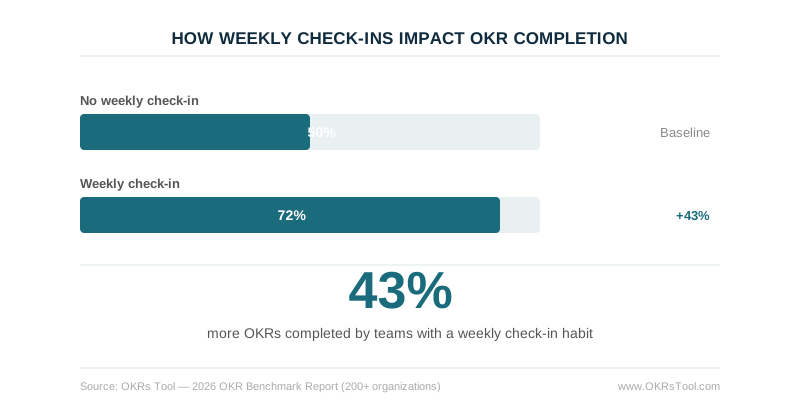
The weekly check-in habit is the single highest-return OKR behavior — teams with it complete 43% more OKRs than those reviewing monthly or ad hoc. Enterprise platforms support weekly check-ins. They don't make them structurally unavoidable. That distinction determines whether adoption holds or collapses by week six.
You're Paying for Complexity You Don't Need
Enterprise platforms come with capabilities that are genuinely powerful at scale — multi-tier OKR cascades, custom weighting algorithms, advanced API integrations, cross-department dependency mapping. These features exist because large organizations have problems that require them.
At 60 people, you don't have those problems. You have simpler, sharper problems: unclear ownership, delayed progress visibility, and status meetings that exist only because no one knows what's actually happening. An enterprise platform won't solve those — it'll obscure them behind a layer of interface complexity.
One fintech COO described it perfectly: "We were so busy configuring the tool that we forgot we still hadn't fixed the underlying accountability problem." The tool became the project, instead of execution becoming the habit.
The OKR Intelligence Report 2026 puts the accountability problem in context: 50% of all Key Results across growing organizations have no named owner. Teams with required single ownership see 26% higher completion rates. That's a structural fix — not a feature that requires four weeks of configuration to enable.
What Execution Breaks Down at This Stage
Having built OKRs Tool specifically for this company size, the failure modes are consistent. They're not about goal quality or strategic clarity. They're operational.
Key Results get assigned to teams rather than people. When something is everyone's responsibility, it's no one's. Progress gets reported once a week in a meeting, not continuously — by the time a risk is visible, it's already a problem. Teams report optimistic progress to avoid uncomfortable conversations. Leaders see green dashboards and miss the quarter.
None of these are solved by adding more software features. They're solved by removing friction from the update loop and making ownership impossible to misread.
What the Right Tool Looks Like at Your Stage
You don't need a platform that can handle 10,000 users. You need one that makes the 65 you have impossible to lose sight of. The design criteria are fundamentally different.
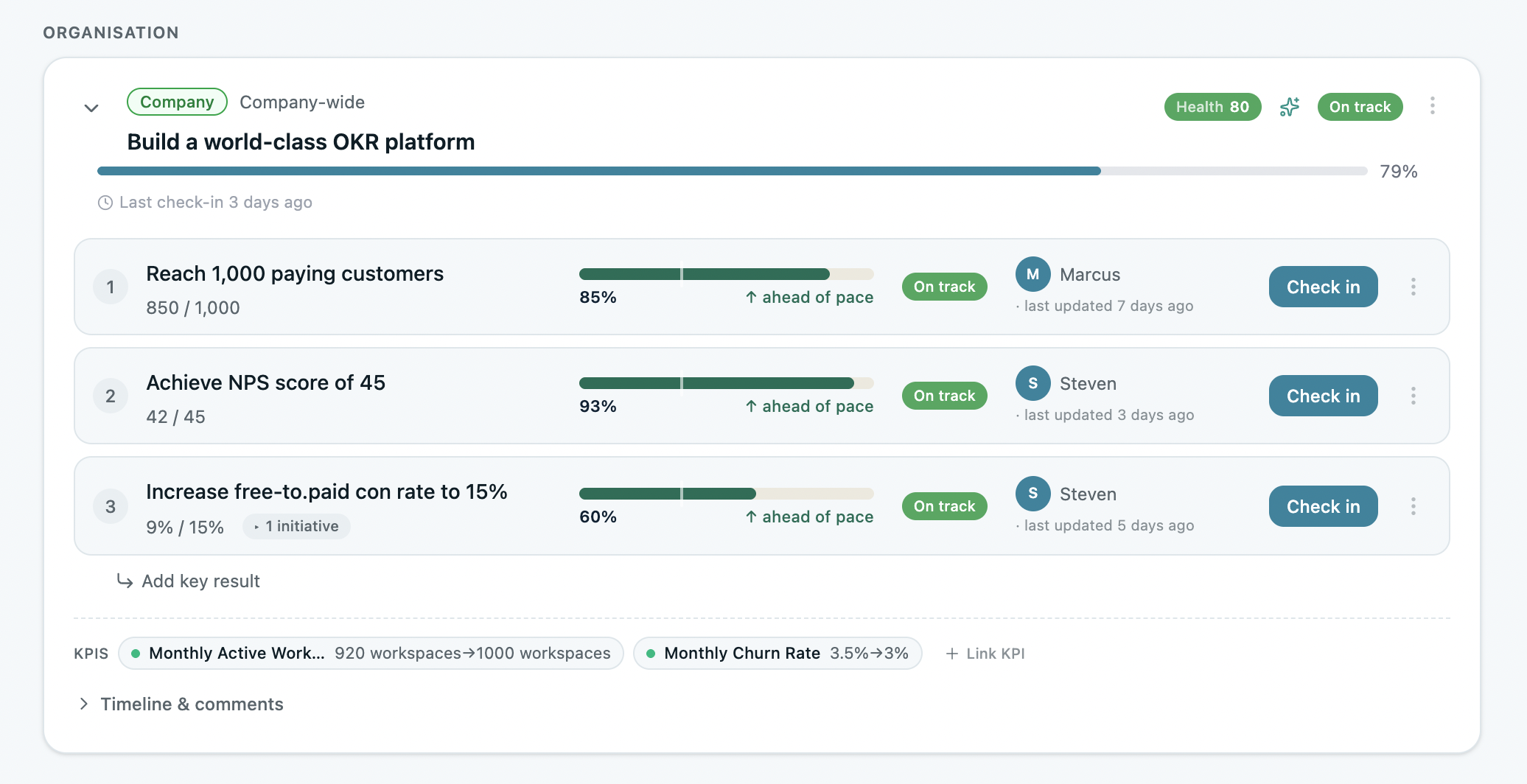
The right tool for a 50–200 person company is lightweight enough that a team lead can update their Key Results in under two minutes, transparent enough that a Head of Ops can see cross-team progress without pulling reports, and structured enough that ownership is explicit at every level — from company objective to individual task.
That's not a simpler version of an enterprise tool. That's a different category of tool entirely — one built around execution cadence, not governance reporting.
The Practical Test Before You Buy
Before you pay for another OKR platform, sign up for any of the free OKR tools and run this test: ask your team lead to update three Key Results on day one, without a training session. If they can't do it intuitively in under five minutes, the tool is already too heavy for your stage.
Then ask yourself: does this tool make it easier to update progress than to avoid it? If the answer is no, adoption will collapse by week six — regardless of how good your OKRs are.
The companies that execute consistently at this stage aren't the ones with the most sophisticated OKR software. They're the ones that have a system their teams actually use — every week, without being chased.
Data: The ROI of OKRs: 2026 Benchmark Report (330 respondents), The 2026 OKR Benchmark Report (200+ organizations), OKR Intelligence Report 2026 (222 organizations).