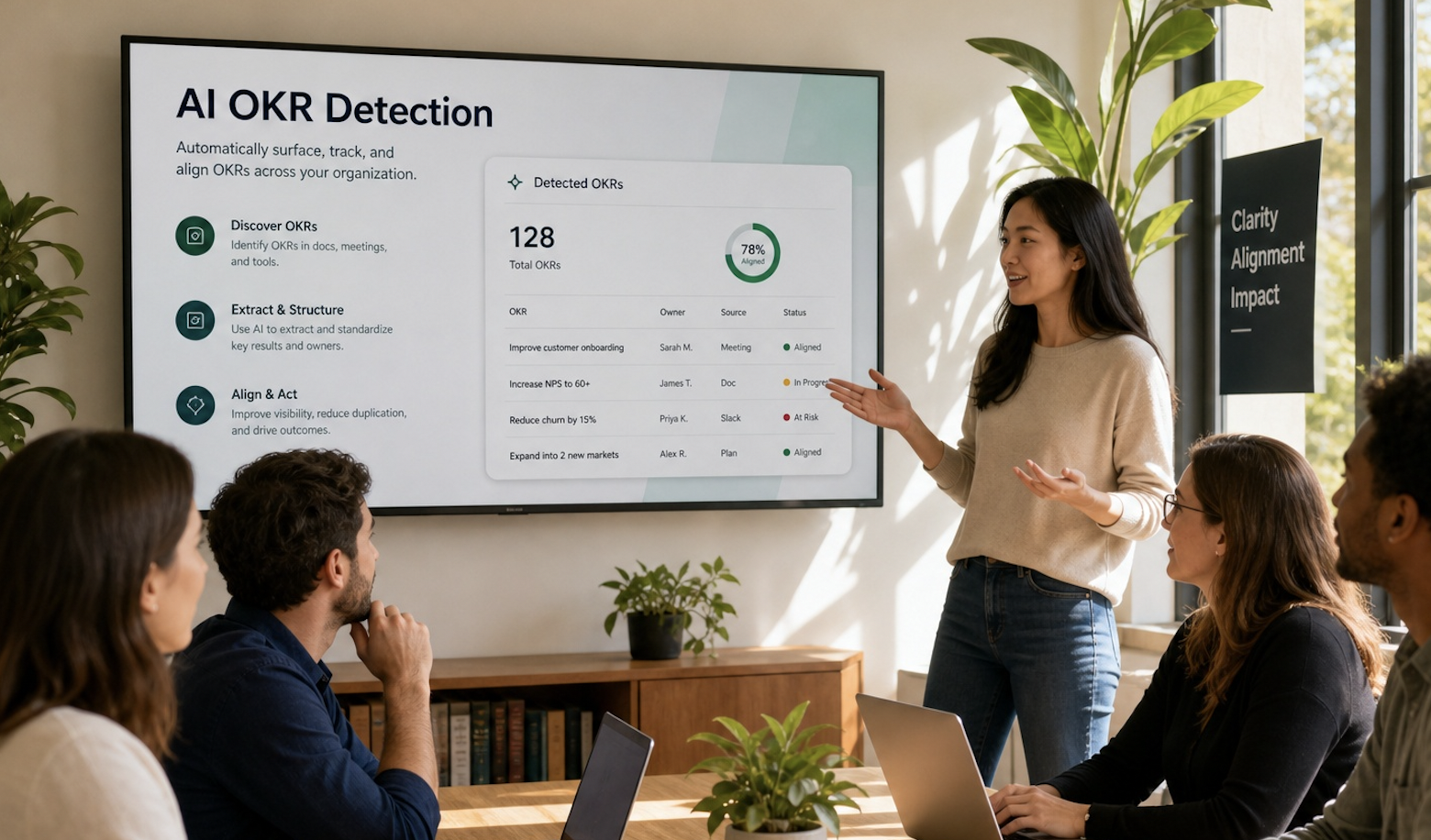
Manual RAG status updates surface problems in week ten. Trajectory-based AI detection surfaces the same problems in week four — when there are six weeks left to act on them. The benchmark data is direct: teams that check in weekly complete 43% more OKRs than those without a consistent cadence. The detection is only as good as the data it reads.
Most OKR programmes rely on the same status mechanism: a traffic light. Red means off track, amber means at risk, green means on track. The team lead looks at the dashboard. Everything is green. In week eleven, the quarterly review reveals that three Key Results were amber from week five and nobody said so. The State of Goal Management found 70% of employees have reported a goal as healthier than they knew it to be. Manual RAG status doesn't surface problems — it surfaces what the owner is willing to disclose, which is a different thing entirely.
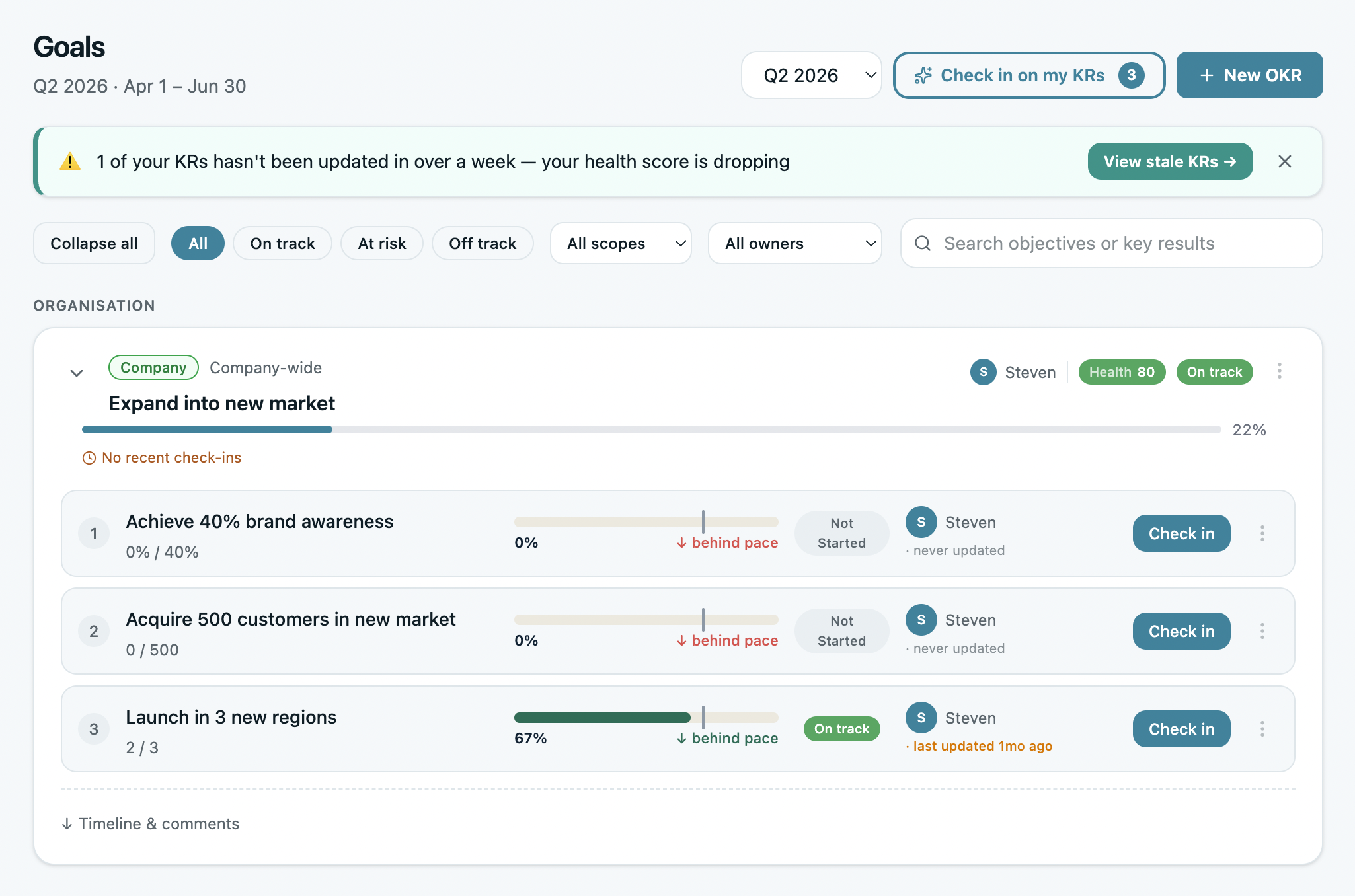
Trajectory-based AI detection removes that dependency. Instead of asking whether the owner has manually flagged a problem, it reads the rate of progress updates relative to the time and distance remaining to target. A Key Result at 18% progress in week five of a twelve-week cycle, with a target of 100%, is on a pace to finish at roughly 40%. That calculation doesn't require the owner to volunteer it — the system flags it automatically, routes it to the right person, and surfaces it before the window for intervention closes.
The second thing AI changes is the Excel grind. For most teams, weekly status updates mean someone manually collating inputs from across the team, chasing responses, compiling a summary, and distributing it before the check-in. That overhead is the reason weekly check-in habits collapse by week four — not because teams don't want the visibility, but because producing it manually costs more than most teams will consistently pay. Automated weekly check-ins replace the grind: a nudge via Slack or MS Teams, five minutes per person, result surfaced in the dashboard without any aggregation step.
What an At-Risk OKR Actually Is
An at-risk OKR is one whose current pace predicts it will miss its target before the cycle closes. The definition has two components: current pace (the trajectory derived from check-in updates) and a predicted outcome (the extrapolated result if pace doesn't change). Both require data that exists only if teams are updating progress consistently — which is why automated check-ins are a prerequisite for detection, not a separate feature.
At-risk is distinct from off-track. An off-track Key Result is one the owner has manually flagged as behind. An at-risk Key Result is one where the trajectory data indicates a miss regardless of what the owner has reported. In most OKR programmes, 7% of off-track Key Results are simply abandoned mid-cycle — informally stopped with no revision, no escalation, and no consequence. These are not flagged as off-track. They are flagged as green until they disappear. Trajectory detection catches this pattern at the point where the pace drops, not at the point where the owner finally discloses it.
Why Manual RAG Status Always Surfaces Problems Too Late
The traffic light system has one structural problem: it relies on the owner. The owner has a rational incentive not to self-report a problem — watermelon reporting, where a goal shows green externally while the reality is red, is the predictable result of a system where the consequence of honest reporting is scrutiny and the consequence of optimistic reporting is no immediate friction.
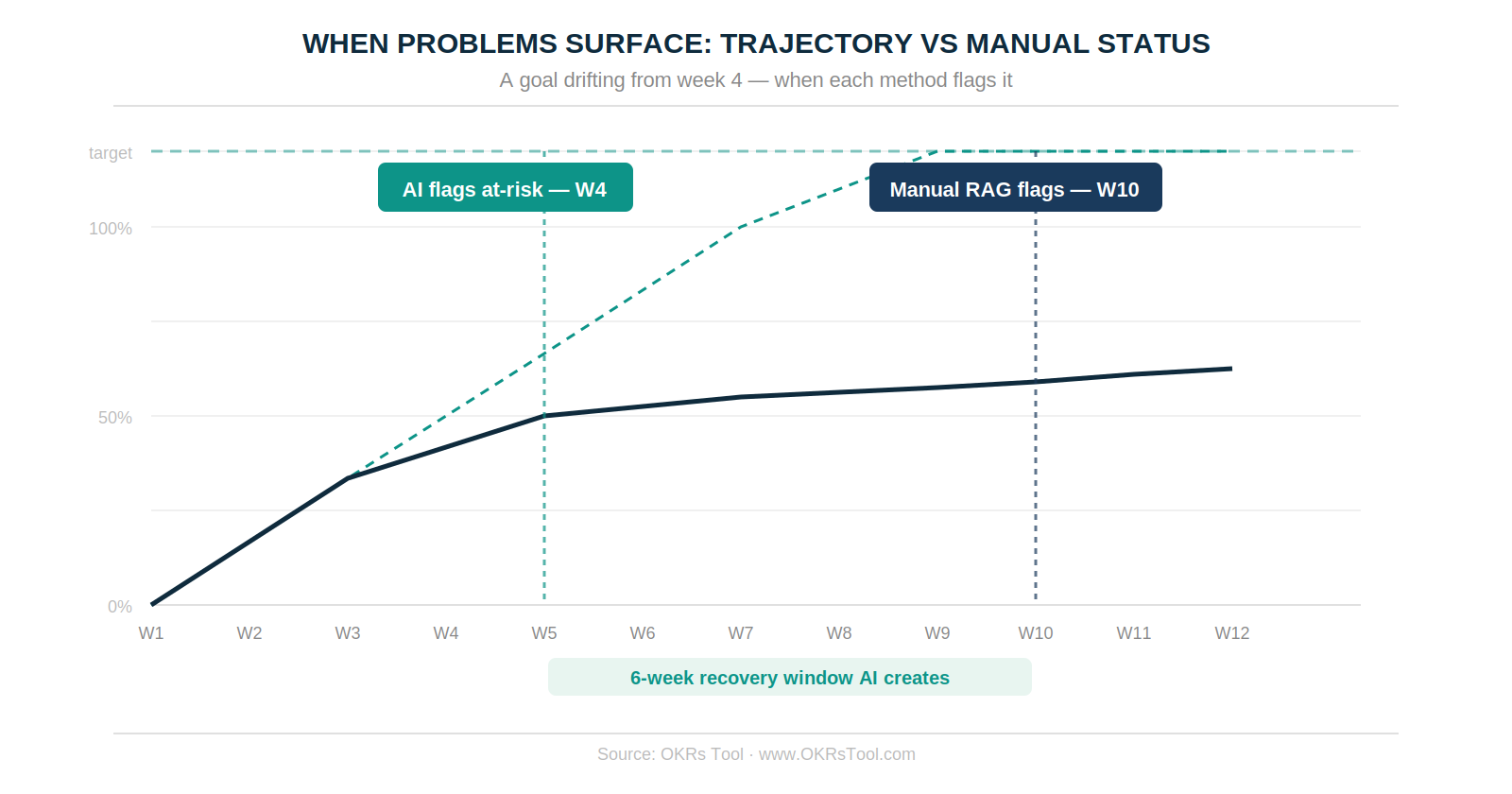
The chart illustrates the timing problem. A goal drifting from week four looks green on a RAG dashboard until week ten, when the gap between expected and actual progress becomes undeniable. By then, there are two weeks left in the quarter. The mid-cycle review — typically scheduled for week six — is the last point where an at-risk goal can be meaningfully revised, escalated, or formally closed. Trajectory detection at week four puts the problem on the table two weeks before that intervention point. Manual RAG status puts it on the table four weeks after.
How Automated Check-ins Kill the Excel Grind
The volume angle on this topic is real: most teams searching for AI OKR tools are looking for something more specific than AI-generated goal writing. They are looking for the elimination of the manual weekly status rollup — the spreadsheet, the Slack chase, the copy-paste from five team members into one summary document before the check-in call.
Automated check-ins replace that cycle. A Slack or MS Teams nudge fires at the same time each week. Each Key Result owner updates their progress directly in the tool — current value, status, one-line note on blockers. The results aggregate in the OKR dashboard automatically, visible to the whole team before the check-in starts. No manual aggregation, no chasing, no version control problem.
The 2026 OKR Benchmark Report puts a number on why this matters: teams that check in weekly complete 43% more OKRs than those reviewing monthly or ad hoc. The mechanism isn't the information produced by the check-in — it's the cadence that surfaces problems while there's still time to act. Automated check-ins make that cadence structural rather than dependent on discipline.
How AI Detection Works in Practice
The OKR Intelligence Report 2026 found 83% of organizations are now actively using AI in their OKR process. The more important finding is what they're using it for: teams using AI for both goal writing and mid-cycle analysis accept a low score on missed goals only 14% of the time — compared to 35% for teams using AI for writing only. The gap reflects what mid-cycle detection actually changes: it converts missed goals from retrospective surprises into mid-cycle decisions.
In OKRs Tool, AI detection works across three signals. Trajectory: current progress relative to time elapsed and target distance. Update frequency: Key Results that stop receiving updates signal disengagement before the progress score reflects it. Historical patterns: teams and functions that consistently stall at certain completion percentages get flagged earlier because the pattern is predictable.
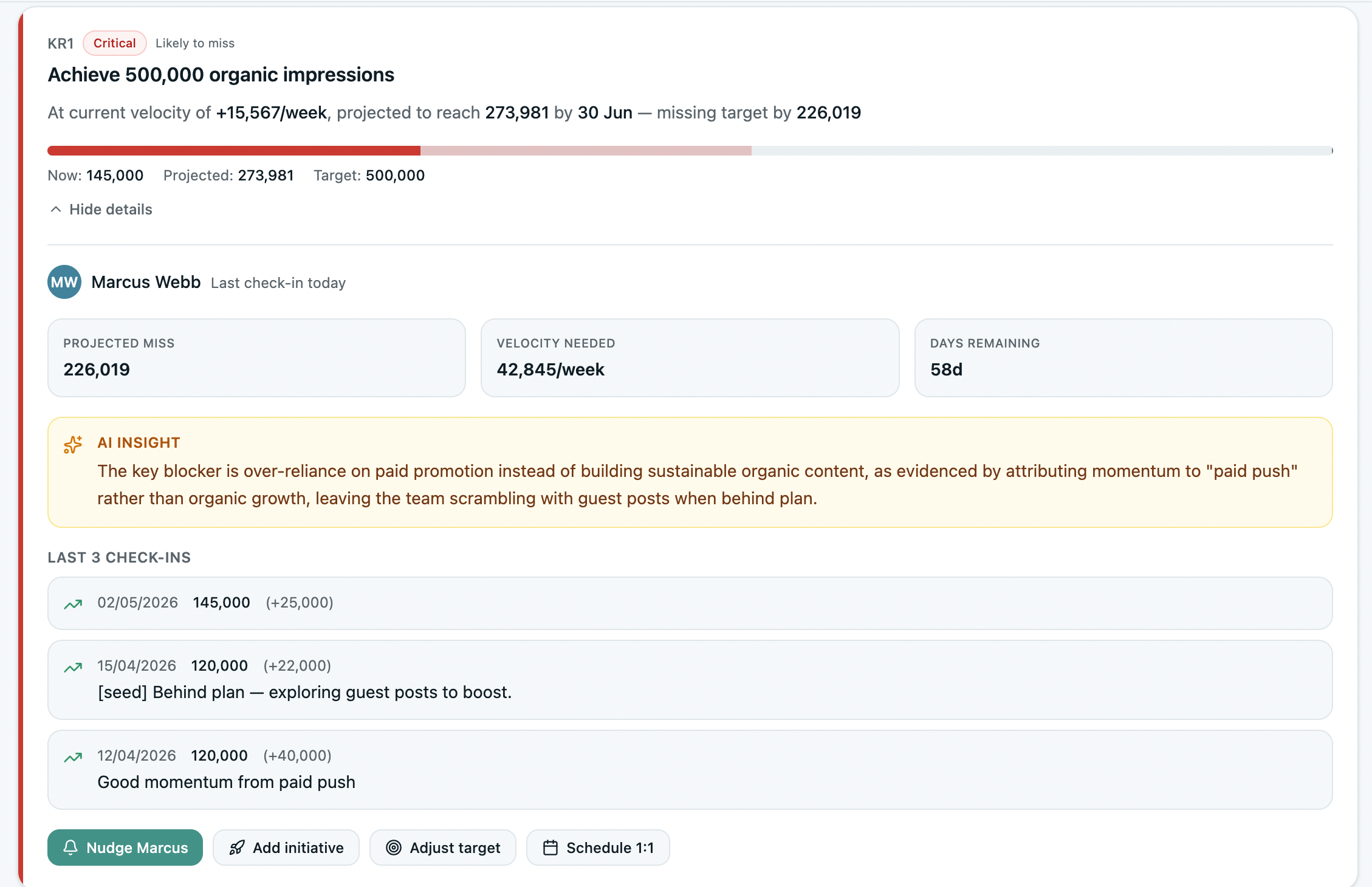
When the system flags a Key Result as at-risk, the owner receives a notification and the goal appears in the at-risk view for the team lead. The intervention options are the same as in a manual mid-cycle review: revise the target, escalate the blocker, or formally close the goal. The difference is that the conversation happens in week four rather than week ten — and with eight weeks remaining rather than two.
The Moat This Builds
There are two ways to run an OKR programme. The first is as a planning and reporting exercise: goals get set, progress gets reported, misses get explained. The second is as a prediction and intervention system: goals get set, trajectory data gets read, problems get surfaced while they're still recoverable.
The first model is what most OKR software supports. The second is what AI detection makes possible — and it's the model that produces the 43% completion lift, the compounding from 51% to 79% completion by cycle five, and the 1:88 return on investment that purpose-built platforms generate against the same revenue baseline. The prediction engine is not a feature. It's what makes goal management a steering system rather than a record-keeping system.
See how OKRs Tool implements AI at-risk detection alongside automated weekly check-ins, named ownership, and cascade alignment — the complete outcome layer for growing teams between 50 and 200 people.
Data: The 2026 OKR Benchmark Report (330 organizations), The OKR Intelligence Report 2026 (222 organizations), The State of Goal Management, OKRs Tool (210 full-time employees at growing companies, 2026).