
Every organization that has successfully adopted OKRs has done so at exactly that same inflection point: when growth creates coordination complexity that informal alignment can no longer handle. The 2026 OKR Benchmark Report across 330 organizations finds that gap costs companies an estimated 65% misalignment rate — teams executing work that isn't clearly connected to company strategy. The history of OKRs is a history of successive attempts to close that gap.
Understanding why the OKR framework works requires understanding what problem it was originally designed to solve — and why each of the three people most responsible for its development made the specific choices they made.
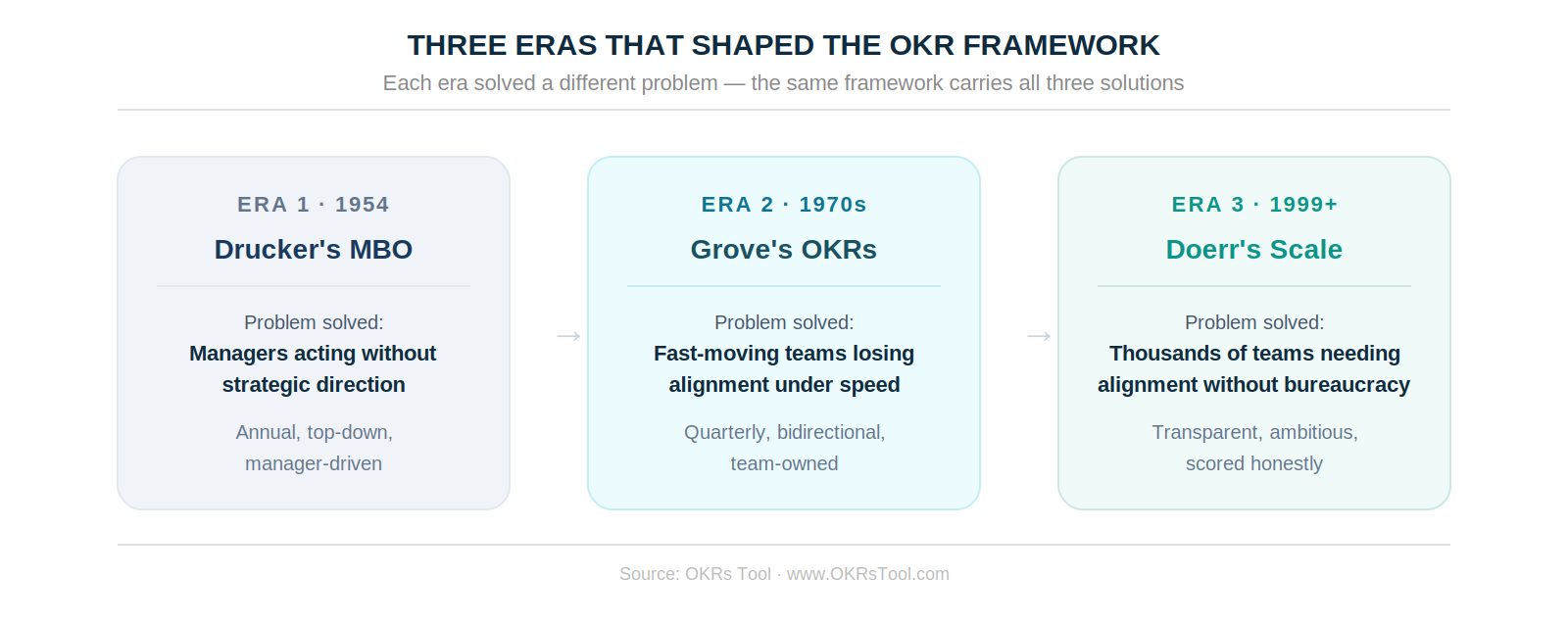
The framework is not a single invention. It is the product of three successive iterations, each one correcting a structural failure in the version that preceded it. Drucker identified the problem. Grove built the solution. Doerr scaled it, and in scaling it added the transparency layer that made alignment visible across thousands of teams rather than assumed within a single organization.
Most accounts of the history of OKRs treat the framework as a Silicon Valley invention — a Google-era productivity system that spread outward from Mountain View.
That account misses the fifty years of management theory and operational failure that preceded it. The specific choices Grove made at Intel in the 1970s — quarterly cadence instead of annual, scores decoupled from compensation, bidirectional goal-setting instead of top-down mandates — were not arbitrary design preferences.
They were deliberate corrections for failure modes he had observed firsthand in Peter Drucker's Management by Objectives system. Understanding those corrections is what explains why the framework produces the results the data now confirms.
The 2026 OKR Benchmark Report across 330 organizations documents what running OKRs the right way produces: a 1:88 return on investment, 43% more goals completed with a weekly check-in habit, and a maturity curve that compounds from 51% completion in cycles 1–2 to 79% by cycle five. Those numbers don't come from the framework itself — they come from the specific design decisions Grove embedded in it, and from the organizations that run it the way he designed it to be run.
Peter Drucker and the Origin: Management by Objectives (1954)
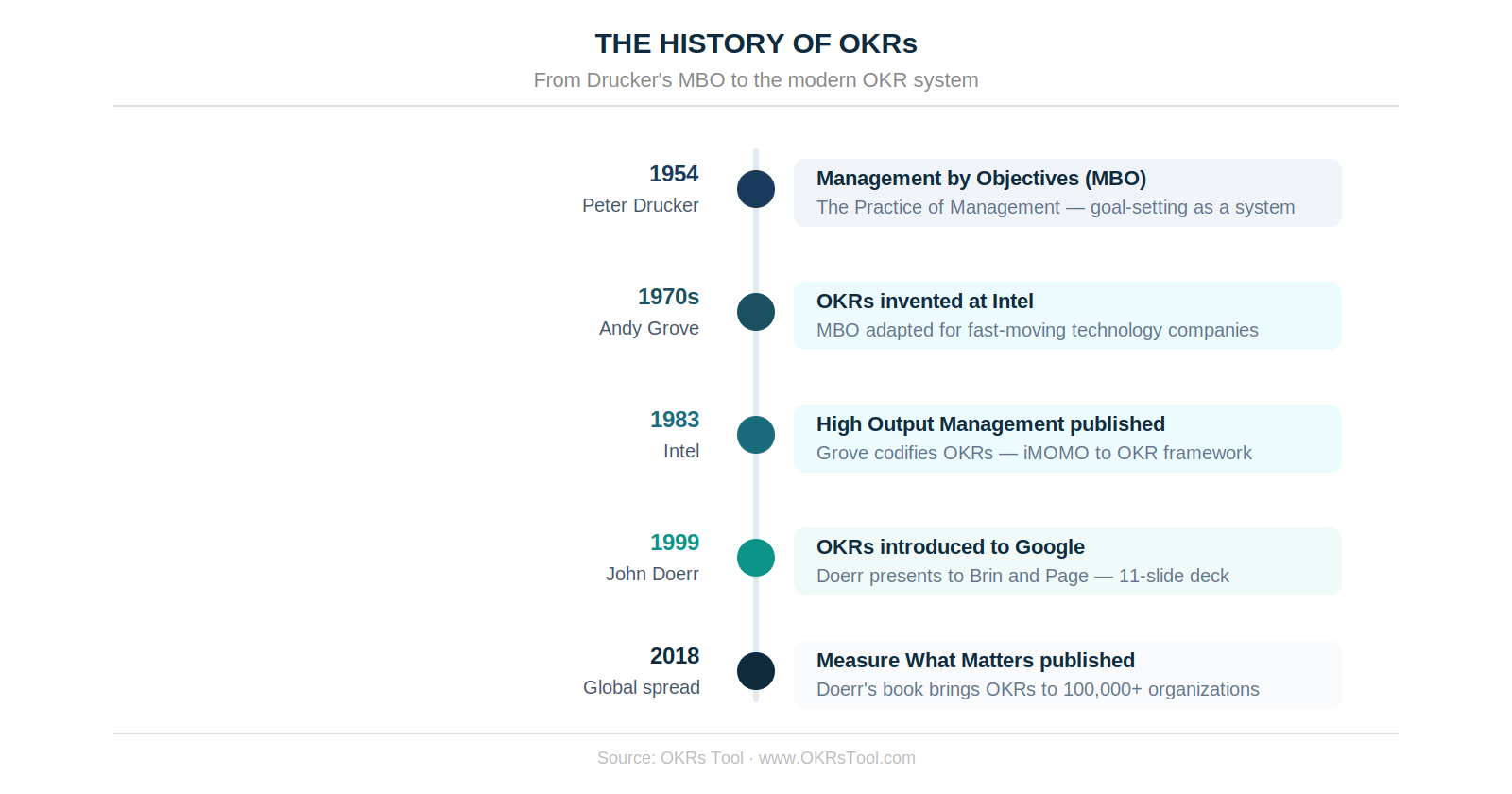
The intellectual foundation of OKRs is Peter Drucker's Management by Objectives (MBO), introduced in The Practice of Management in 1954. Drucker's diagnosis was specific: most managers in large organizations operated without a clear understanding of how their work connected to the goals of the business.
They optimized for what they could measure locally — activity, output, departmental efficiency — without reference to the outcomes the organization actually needed. MBO was designed to fix this by establishing shared objectives between managers and their superiors, creating a contract of mutual accountability that ran from the top of the organization down to every team.
Drucker's framework was influential but imperfect. MBO operated on an annual cycle, which was too slow for fast-moving organizations. Objectives were set top-down by senior management, which created compliance rather than ownership.
And because compensation and performance reviews were tied to MBO scores, managers systematically set conservative targets they could reliably achieve — the earliest documented version of what The State of Goal Management would find seventy years later: 89% of employees admitting they sandbagged goals when ratings were linked to outcomes. Drucker identified the right problem. His solution had three failure modes that Grove would spend the 1970s correcting.
Andy Grove and the Invention of OKRs at Intel (1970s)
Andy Grove joined Intel as one of its founding employees and became its president in 1979, but his goal-setting system OKRs began much earlier, in Intel's operational management culture of the early 1970s.
Grove had encountered Drucker's MBO while at Fairchild Semiconductor and found it directionally correct but structurally broken for the pace Intel needed to operate at. He kept Drucker's core insight — that shared, explicit goal commitments are the mechanism that converts individual effort into organizational outcomes — and rebuilt the system around three fundamental changes.
Grove shortened the cycle from annual to quarterly, arguing that a goal-setting system operating on a twelve-month cadence was useless for an industry where the competitive landscape could shift in a quarter.
He separated the goal-setting process from compensation, explicitly forbidding the use of OKR scores in performance reviews — on the grounds that linking scores to pay guaranteed sandbagging and destroyed the honest, ambitious goal-setting that made the system valuable. And he made the process bidirectional: rather than senior management cascading objectives down to teams, Grove's system allowed teams to propose their own Key Results in response to company-level Objectives, creating a negotiated contract rather than a mandate.
Grove formalized the approach in Intel's internal management training under the name "iMOMO" — Intel's Management by Objectives and Milestones — and codified it in High Output Management, published in 1983.
The book describes the system in terms that remain the clearest articulation of OKR logic ever written: the Objective answers "where do I want to go?" and the Key Results answer "how will I pace myself to see if I'm getting there?" Grove's insistence on stretch targets — setting Objectives ambitious enough that achieving 70% represented genuine progress — became the defining characteristic that separated OKRs from every predecessor goal-setting system.
John Doerr Carries OKRs to Google (1999)
John Doerr joined Kleiner Perkins as a venture capitalist in 1980, having worked directly under Grove at Intel and absorbed the OKR system firsthand. For nearly two decades he applied OKRs informally across his portfolio companies, but the moment that defined their global spread came in 1999, when he presented the framework to the founders of a company with fewer than forty employees: Larry Page and Sergey Brin of Google.
The presentation was eleven slides. Doerr's argument was that Google had found product-market fit and would now face the challenge that had defined Intel a generation earlier: how to scale a fast-moving organization without losing the alignment that made it effective.
Page and Brin adopted the framework immediately — not because it was fashionable, but because the problem Doerr described was the exact problem they were already anticipating. Google has run OKRs on a quarterly cadence from that point forward, through its growth from 40 to 150,000 employees.
What Google added to Grove's framework was transparency. Intel had run OKRs within teams and departments; Google made company-level OKRs visible to every employee, and made individual OKRs visible across teams. This visibility layer — the ability for any engineer to see how their Key Results connected to company priorities — solved the cascading problem that Drucker's top-down MBO had never adequately addressed. Alignment became structural rather than assumed.
The Spread Beyond Silicon Valley (2018–Present)
For nearly two decades after Google adopted OKRs, the framework remained largely confined to Silicon Valley technology companies that had direct connections to either Intel alumni or the Google model. LinkedIn, Twitter, Uber, Airbnb, Spotify, and dozens of other high-growth technology companies adopted OKRs during this period, each adapting Grove's original structure to their own scale and operating context.
The publication of John Doerr's Measure What Matters in 2018 changed the distribution curve entirely. The book brought the full history of OKRs — Grove's Intel framework, Doerr's Google presentation, and the case studies from a generation of Silicon Valley companies — to a mainstream business audience for the first time.
Adoption accelerated rapidly outside the technology sector, reaching professional services firms, healthcare organizations, manufacturing companies, and non-profits across more than 100 countries. The OKR Benchmark Report data from 330 organizations reflects this post-2018 expansion: most organizations in the dataset are in their first three OKR cycles, and the 51% average completion rate in cycles 1–2 rising to 79% by cycle five measures exactly the learning curve that every new adopter navigates.
What the History Explains About How OKRs Work
The most common failure mode in OKR adoption — teams setting goals that look rigorous but measure nothing that's actually being changed — is a direct consequence of ignoring the design decisions Grove made at Intel. Separating OKR scores from compensation was not an administrative choice; it was Grove's specific correction for the sandbagging dynamic he had observed in Drucker's MBO.
When organizations today tie OKR outcomes to performance ratings, they recreate exactly the failure mode Grove built the system to prevent. The State of Goal Management confirms it remains widespread: 96% of employees admit to sandbagging when goals affect their performance rating, compared to 81% when goals are tracked separately.
The quarterly cadence Grove chose over Drucker's annual cycle was equally deliberate. A goal-setting system that creates one learning loop per year produces one data point per year. Grove's quarterly system produces four — four retrospectives, four planning sessions, four opportunities to apply what was learned in the previous cycle to the next one.
The compounding effect is what the benchmark data measures in the maturity curve: each cycle makes the next one sharper, and by cycle five the system is producing nearly 30 percentage points more goal completion than it did at the start.
The Framework Grove Built Is the Framework That Works
Seventy years after Drucker identified the manager alignment problem, fifty years after Grove corrected it at Intel, and twenty-five years after Doerr introduced it to Google, the OKR framework has not fundamentally changed.
The Objective still answers "where do I want to go?" The Key Results still answer "how will I know I'm getting there?" The weekly check-in still closes the gap between setting a goal and actually moving toward it — teams that check in weekly complete 43% more OKRs than those reviewing monthly or ad hoc.
What has changed is the evidence base. Grove operated on intuition and operational observation.
The 2026 OKR Benchmark Report across 200 organizations now confirms what he built into the design: named ownership per Key Result drives 26% higher completion, goals decoupled from compensation produce more ambitious and more honest targets, and fast launch within one week of quarter start produces up to 50% higher completion than extended rollouts. Grove got the design right. The data now explains why. See how OKRs Tool implements the full Grove-to-Google framework — free for up to 5 users.
Data: The 2026 OKR Benchmark Report (200 organizations), The State of Goal Management, OKRs Tool (210 full-time employees at growing companies, 2026).