92% of employees admit to goal-gaming. That is a rational response to systems that reward the appearance of progress over honest progress — not a character flaw. Fix the system and the behavior changes. These five structural habits are what that fix looks like.
The phrase "culture of execution" gets used to describe organizations where strategy lands — where the work on Monday morning reflects the priorities agreed in the planning session, where problems surface in week four rather than week eleven, and where every cycle ends with an honest score rather than a polished narrative. Building that culture is a system design problem, not a values problem.
The State of Goal Management found 92% of employees admit to at least one form of goal-gaming — sandbagging targets they've already mostly achieved, reporting a goal as healthier than it is, or writing goals to impress leadership rather than to change anything. Only 8% say they've never done any of it. That number doesn't describe a culture of low integrity. It describes a rational response to systems that reward the appearance of progress over honest progress. Fix the system and the behavior changes. Try to fix the behavior without changing the system and nothing changes.
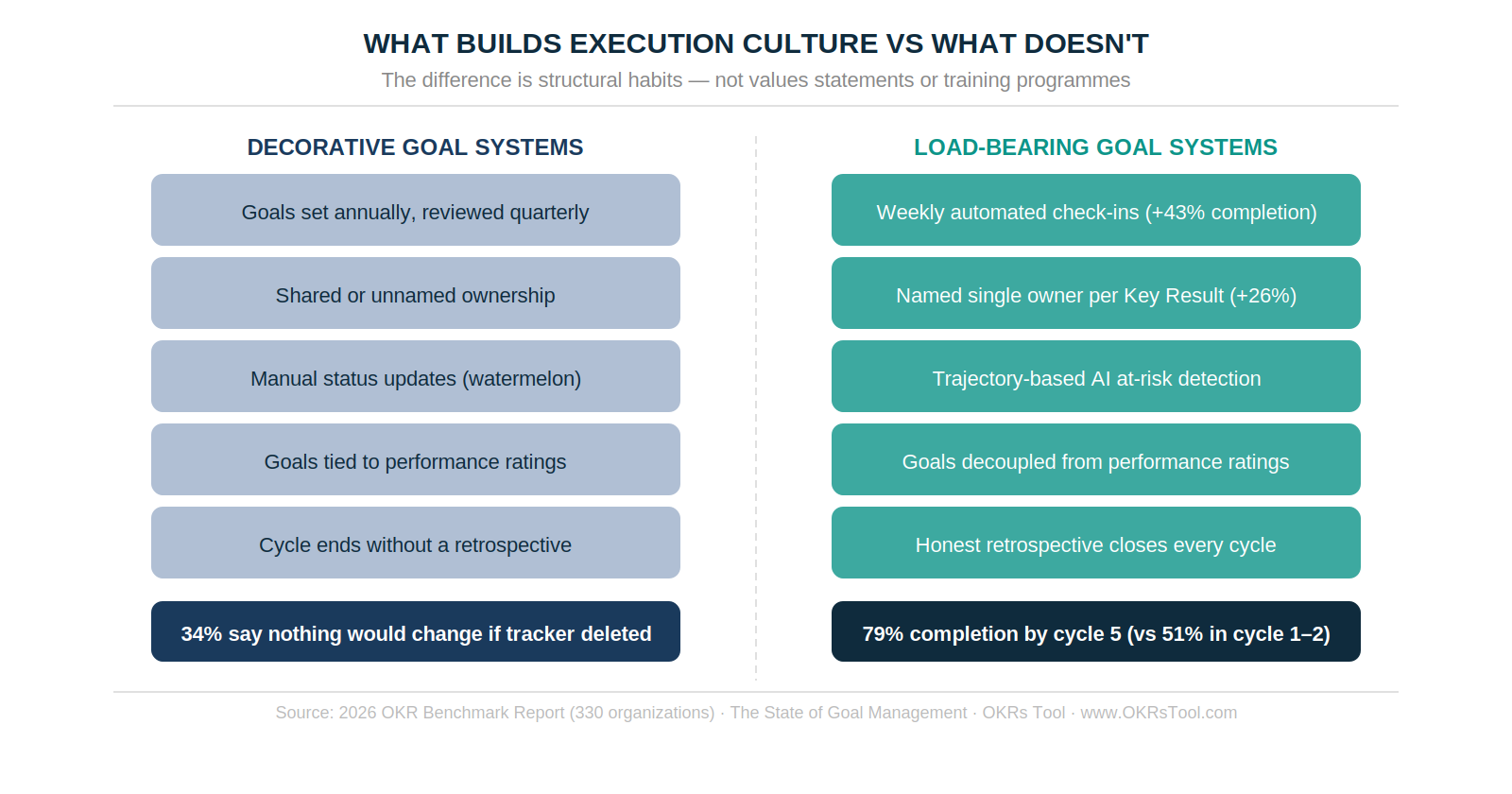
The 2026 OKR Benchmark Report shows what the system looks like when it works: 43% more OKRs completed by teams with weekly check-ins, 26% higher completion with required single ownership per Key Result, 51% completion in cycle one rising to 79% by cycle five. Each of those numbers describes a structural habit — not a motivational state.
What a Strategy Execution Culture Actually Is
A strategy execution culture is one where goals influence decisions. Not goals that get set and reviewed — goals that determine what gets prioritized on Monday morning, what gets deprioritized when something urgent arrives, and what gets an honest score at cycle end regardless of how uncomfortable that score is.
The test is simple. The State of Goal Management called it the load-bearing test: 34% of employees say nothing about how they work would change if their goal tracker were deleted tomorrow.
In those organizations, goals are maintained as a reporting exercise. They exist. They get updated. They influence nothing. A strategy execution culture is one where that figure is not 34% — where removing the goal system would visibly change what the team works on, because the goals are the steering mechanism rather than the record of what happened.
The gap between decorative and load-bearing goal systems is not a values gap. It's a visibility gap, an accountability gap, and a cadence gap. All three are structural and all three are fixable.
Habit 1: Make Weekly Progress Visible by Default
Goals that are only visible at planning sessions and quarterly reviews can't steer daily decisions. The weekly check-in is the mechanism that changes this — a brief, structured update that keeps Key Result progress in the room where work gets prioritized.
Teams that check in weekly complete 43% more OKRs than those reviewing monthly. The mechanism isn't the information produced by the check-in — it's the cadence that surfaces problems while there's still time to act. A Key Result drifting in week four is recoverable. The same drift discovered in week eleven isn't. Organizations that build a strategy execution culture make the weekly cadence structural — an automated nudge via Slack or MS Teams that fires at the same time every week without anyone scheduling it, because discipline-dependent cadences collapse under quarterly pressure.
Habit 2: Name One Owner Before the Cycle Starts
50% of all Key Results across growing organizations have no single named owner. Not shared ownership — no owner at all. A goal without a named accountable person is a strategic intention, not a commitment. Nobody flags it when it drifts. Nobody escalates the blocker. Nobody owns the score at cycle end.
Teams with required single ownership per Key Result see 26% higher completion rates. The structural fix is a gate at goal creation — no Key Result goes live without a named owner. This one constraint changes accountability more than any cultural initiative does, because it removes the ambiguity that makes diffuse accountability rational.
Habit 3: Decouple Goals from Performance Ratings
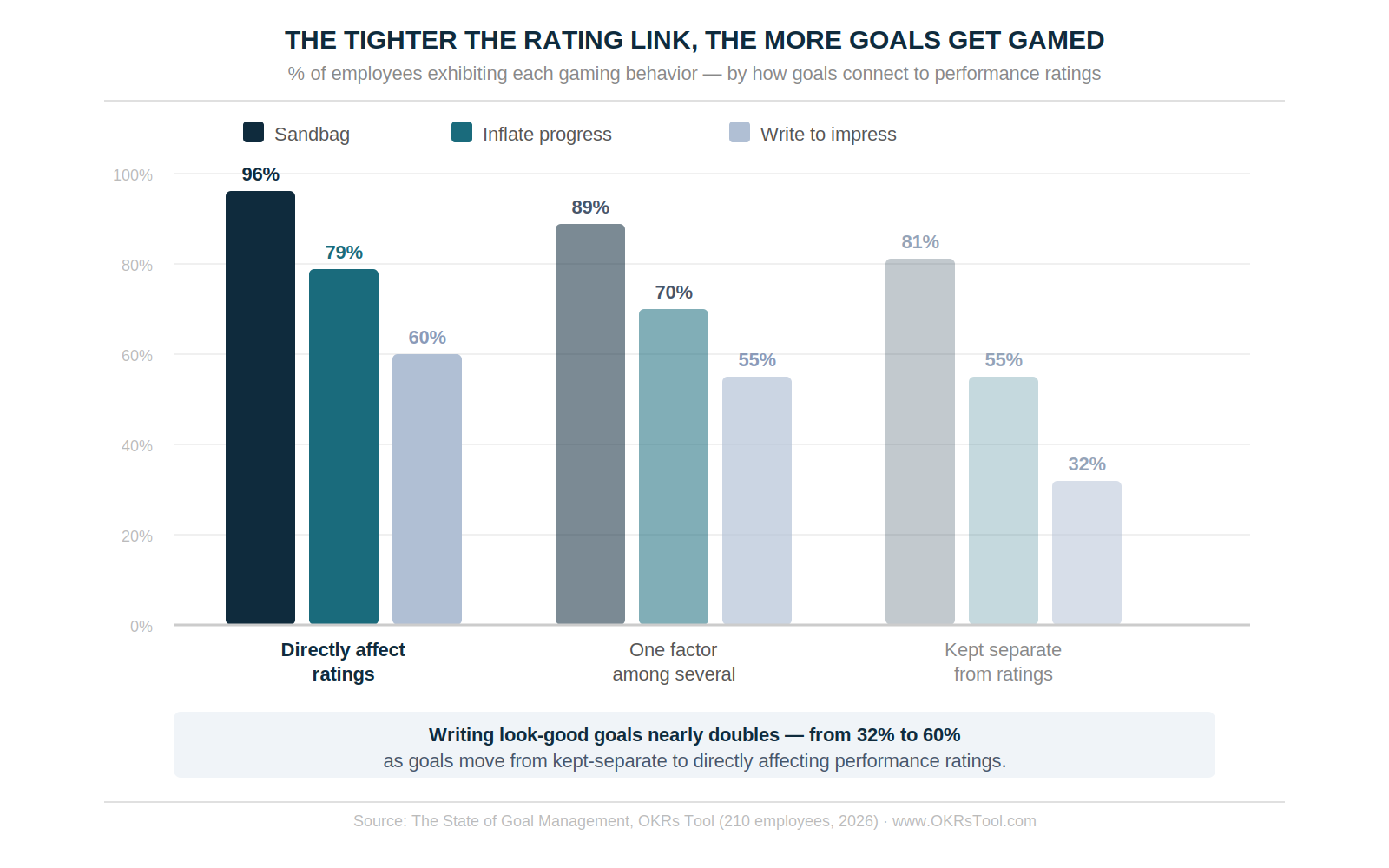
The State of Goal Management found the most powerful predictor of goal-gaming: when goals directly affect performance ratings, 96% of employees sandbag — versus 81% when goals are kept separate. The mechanism that most organizations use to make goals count is the same mechanism that teaches people to game them.
A strategy execution culture requires psychological safety around goal honesty. That safety is structural, not cultural. OKR scoring on a 0.0–1.0 scale with a 0.7 target — where a 0.7 is a strong result, not a failure — changes what behavior is rational. Using OKR delivery data as context in performance conversations rather than as the determining input removes the incentive to set goals at a level already mostly achieved.
Habit 4: Score Honestly and Give Every Cycle a Real Ending
A strategy execution culture requires cycles that end. Not quarterly reviews where everyone nods at the slide deck — actual retrospectives where each Key Result gets an honest 0.0–1.0 score, each miss gets a root cause, and each pattern produces a specific change in how the next cycle is planned.
Teams that run structured end-of-cycle retrospectives complete 30–45% more goals the following quarter. The compounding effect across cycles produces the maturity curve: 51% completion in cycles 1–2 rising to 79% by cycle five. That improvement comes entirely from four real endings per year rather than one — four opportunities to learn what drives progress and what structurally blocks it.
The most common way this habit fails: the retrospective gets compressed into the planning session for next quarter. The OKR cycle ends not with a real score and a real lesson but with the team already looking at the next set of goals. That's not a retrospective — it's a transition. Build the retrospective as a standalone 60-minute session in the final week of the cycle, before the next quarter's planning session begins.
Habit 5: Make Goals Visible in the Tools the Team Already Uses
The State of Goal Management found only 30% of employees can name all their company's current top goals without looking them up. Among employees who can't name the goals, 59% say nothing would change if their goal tracker were deleted tomorrow. Among those who can name all of them, only 24% say the same — a 35-point gap driven entirely by whether goals are present in daily work or stored in a document nobody opens.
A strategy execution culture requires goal visibility in the tools people already use — the Slack channel, the weekly dashboard, the meeting agenda. The cascade alignment that connects every team Key Result to a company Objective is the structural mechanism that makes goals nameable — because they're visible in the daily workflow rather than stored in a planning document.
Culture Follows Structure
The organizations with the strongest strategy execution cultures didn't build them through values work or change management programmes. They built them by making honest progress structurally easier than managed appearances — weekly visibility that surfaces problems early, named ownership that makes accountability concrete, honest scoring that makes gaming immediately apparent, and real cycle endings that make every quarter's lessons available for the next one.
The five habits above are not a transformation initiative. They're a system design. Build the system and the culture follows. Try to build the culture without the system and 92% of employees will continue making the rational choice.
Read our complete guide to strategic management and our guide to the best strategy execution tools in 2026. Ready to get started? See how OKRs Tool implements all five habits — automated weekly check-ins, named ownership enforced at goal creation, honest scoring, and AI at-risk detection — free for up to 5 users.
Data: The 2026 OKR Benchmark Report (200 organizations), The State of Goal Management, OKRs Tool (210 full-time employees at growing companies, 2026).