
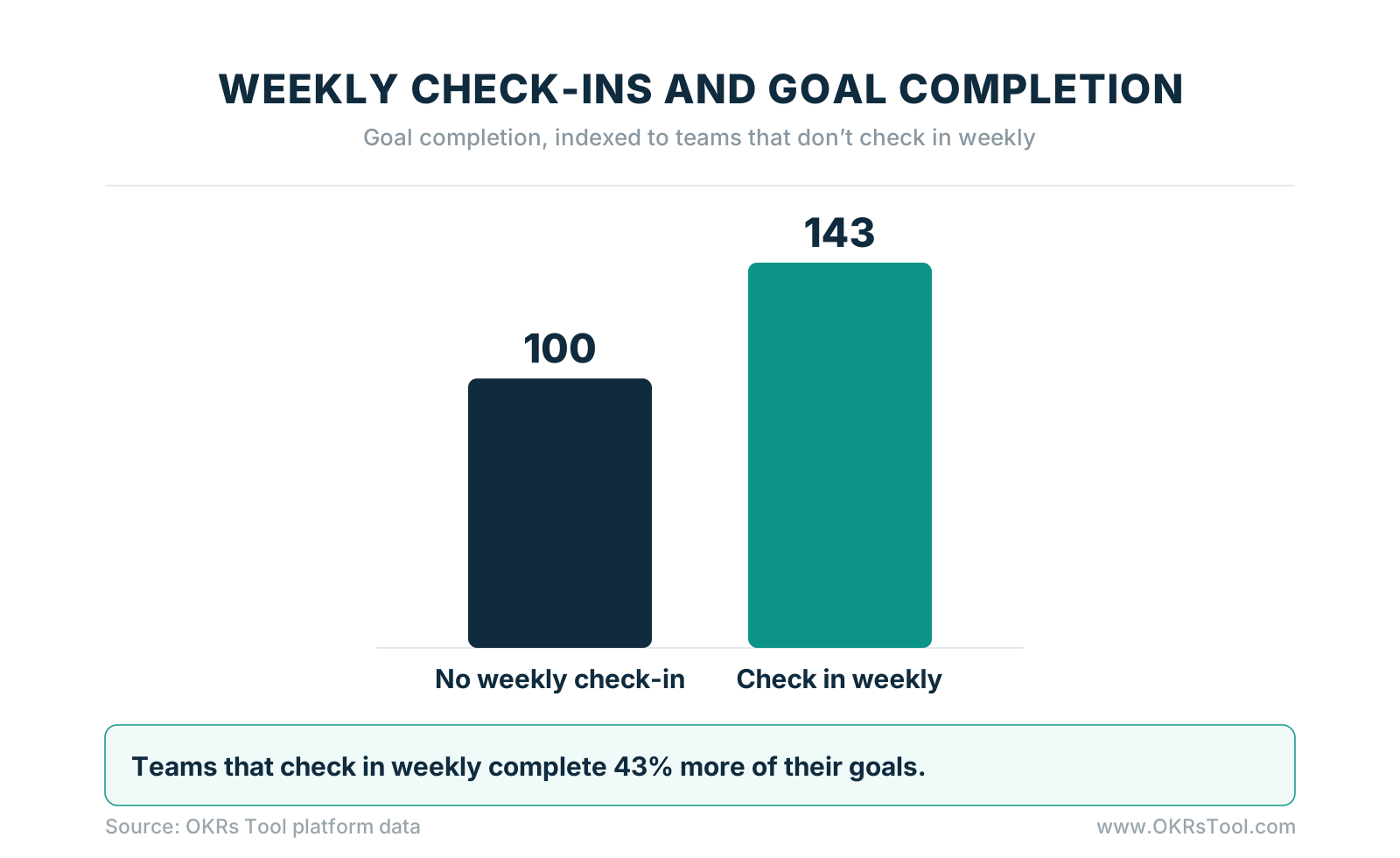
Teams that check in weekly complete 43% more of their goals. The chasing that keeps that cadence going is also what burns a champion out by the second cycle, which is when programs stall.
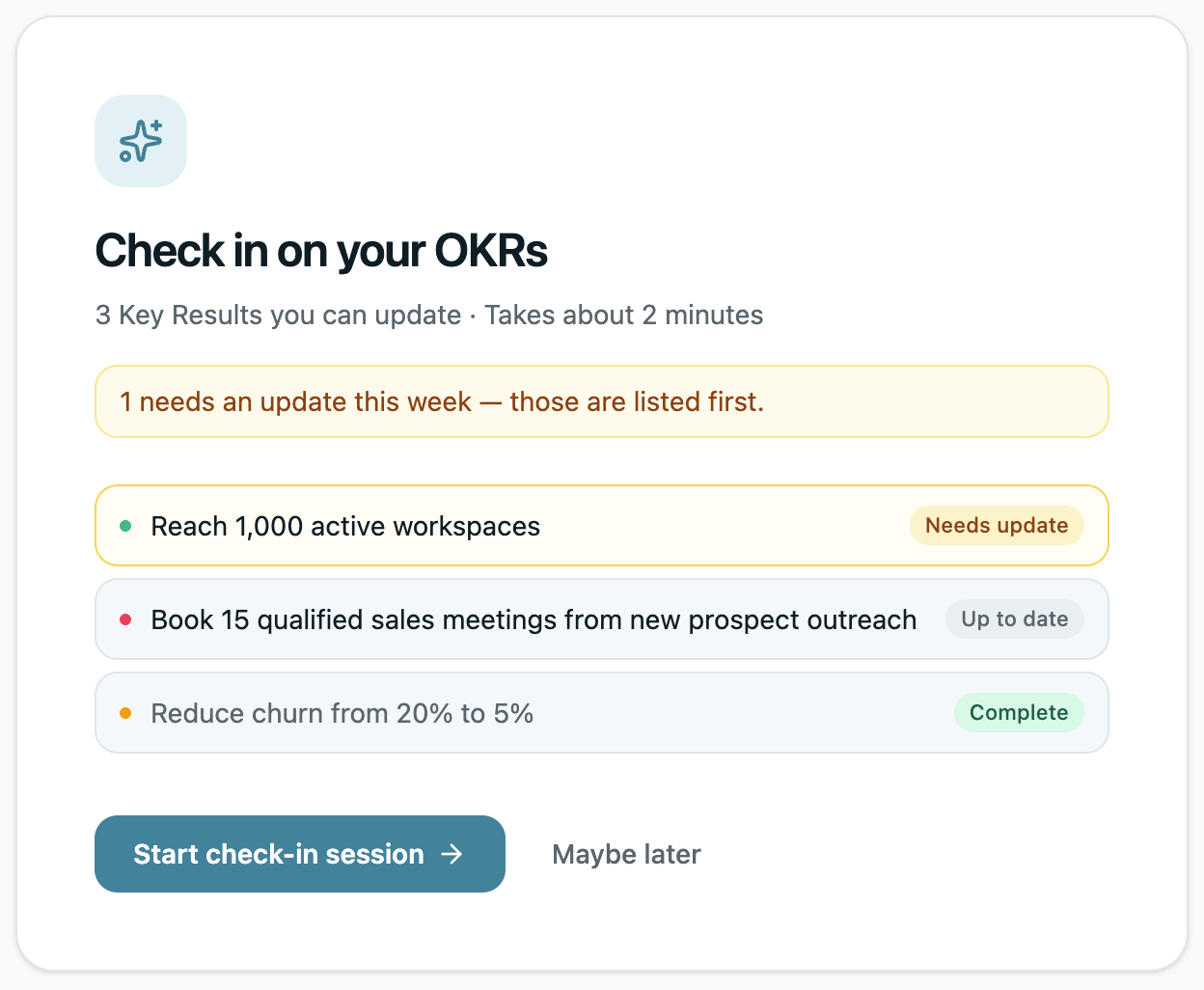
OKRs Tool automates the OKR check-in cadence so no one has to chase updates. Each key-result owner gets an automatic weekly reminder, logs an update in under a minute from desktop or a mobile check-in page, and sets a status on the goal — on track, at risk, behind, or blocked.
Every key result keeps a timestamped check-in history, two-way Jira sync keeps progress in step with the work, and each objective's progress updates from its own key results, so dashboards reflect reality without anyone collecting updates by hand. Teams that check in weekly complete 43% more of their goals, and the automation is what makes that cadence hold once the novelty of launch wears off.
What Automated Check-Ins Do
The software sends each owner a reminder when an update is due, they log it in under a minute, and the goal's status moves on its own from there. An owner opens the check-in from the email or the mobile page, updates the current value on each of their key results, sets a status, and adds a note if something changed. No one has to assemble a status report or ask around for numbers.
Each key result carries its own timestamped history, so a goal's progress is a record rather than a guess, and an objective's progress updates from the key results beneath it. The reminder cadence is set once and runs every week, which is the part that matters: a weekly check-in rhythm only works when it survives the quarter, and automation is what carries it past the point where a person would otherwise let it slide.
The reminders go to the owners who still have updates outstanding, so the chasing points at the people who are behind rather than the whole team, and logging an update is a single click straight from the reminder email. For the work that lives in Jira, two-way sync keeps key results and their linked issues in step, so progress reflects what is happening there without anyone re-keying it.
Why Chasing Updates Kills OKR Programs
Manual chasing is the overhead that ends programs, and it compounds every week. Someone has to notice who has not updated, send the reminder, collect the numbers, and reconcile them before a meeting — and when that person gets busy, the whole cadence goes with them.
In the Death of OKRs study, roughly half of programs were abandoned on at least one team, and the drop-off peaked at the second and third cycle rather than at launch, which is exactly when the chasing has worn the champion down.
The cost of a stale cadence shows up as blind spots at the top. The Strategy Execution Benchmark found that 21% of priorities run off-track for a month or more before the leader hears about it, because the status lives in someone's head until a review forces it out. When updates stop, the tracker stops earning its place — in the State of Goal Management, 34% of people said nothing would change if their goal tracker were deleted tomorrow.
What Automated Check-Ins Change
Completion is the number that moves. Across OKRs Tool platform data spanning 3,527 organizations, teams that check in weekly complete 43% more of their goals than teams that let the cadence lapse. The habit is doing the work, and the automation is what keeps the habit from depending on one diligent person.
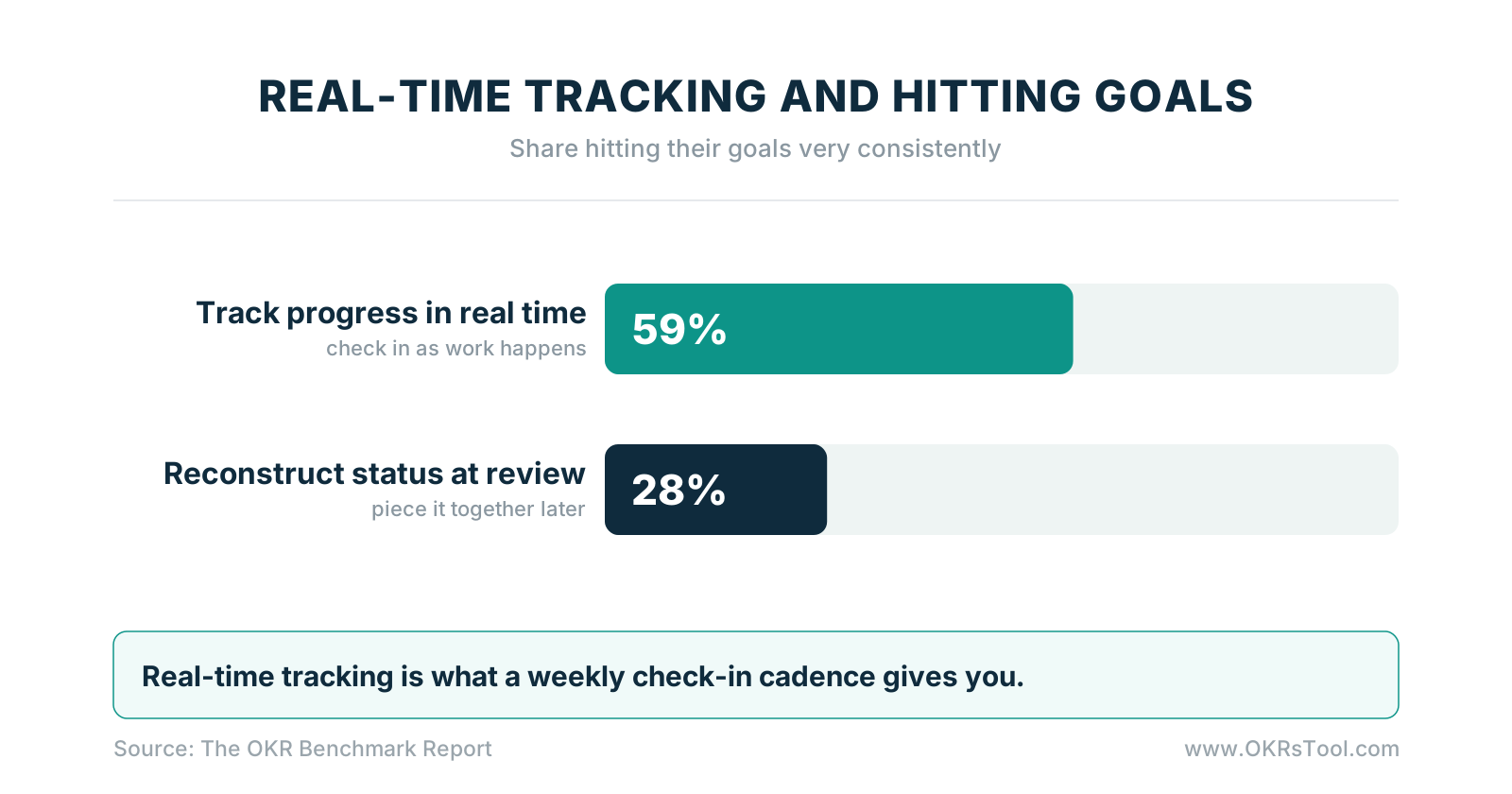
Real-time status is the other shift. Teams that track progress as work happens report hitting their goals consistently far more often than teams that reconstruct status at review time, 59% against 28% in the OKR Benchmark Report. A check-in cadence is what produces that real-time status, and a status call on each key result surfaces a goal that is slipping while there is still a quarter left to fix it.
What to Look For in Check-In Software
The features that matter are the ones that remove manual effort and keep everyone in the cadence. A tool that only stores goals still leaves someone doing the chasing by hand, so the test is whether the reminders, the logging, and the history run without a coordinator.
The common thread is that the cadence should not rest on one person remembering to run it. Flat pricing belongs on that list because the moment a tool charges per head, teams start trimming who gets an account, and the people left out are the ones whose updates go missing first.
Common Questions About OKR Check-Ins
Does OKRs Tool send automatic check-in reminders? Yes. Each key-result owner gets an automatic weekly reminder and logs an update in under a minute from desktop or the mobile check-in page, so no one has to chase the team for status.
How long does a check-in take? Under a minute per key result. The owner updates the current value, sets a status of on track, at risk, behind, or blocked, and adds an optional note on what changed.
Can people check in from their phone? Yes. There is a dedicated mobile check-in page for logging updates away from a desk, with the same per-key-result history as the desktop view.
Is check-in history saved? Every key result keeps a timestamped check-in history, and each objective's progress updates from its own key results, so dashboards reflect the latest reality.
What does it cost to give everyone check-in access? OKRs Tool is a flat price per organization with no per-seat fees, so every owner can be in the cadence without the cost rising for each person you add.
Does the tool chase people, or pull updates from Jira automatically?
Both. Automatic reminders chase the owners who still owe an update, and two-way Jira sync keeps key results in step with their linked Jira work, so progress from Jira reflects without re-keying. Anything that lives outside a connected tool still comes from a one-click check-in.
Does it flag people who haven’t checked in?
Yes. The weekly reminders go to the owners who still have updates outstanding, so follow-up points at the people who are behind rather than the whole team.
A Cadence That Holds Without the Chasing
Having goals in a tool and running them as a weekly habit are two different things, and the gap between them is almost always manual upkeep. Check-in software closes that gap by sending the reminders, logging updates in a minute, keeping a history on every key result, and surfacing a slipping goal through its status — the work a person used to do by hand every week.
Teams that sustain the cadence complete far more of what they set, and automation is what lets the cadence outlast the quarter it was launched in.
Data: The Death of OKRs, The Strategy Execution Benchmark, The State of Goal Management, The OKR Benchmark Report, and OKRs Tool platform data.