OKR certifications range from a $49 online exam to a $1,999 coach-level cohort, and they're not aimed at the same person. This guide covers the real programs — who issues them, what they cost, and who each one suits — then makes the practical case: a certification teaches you the concepts, but hitting goals comes down to habits you can only build by running cycles. For most operators, the credential is optional; for coaches and consultants, it's often worth it.
If you're searching for OKR certification, you're usually one of two people: an operator who wants their team's OKRs to work and wonders whether a course is the way in, or a coach or consultant who needs a credential that carries weight with clients.
The answer is different for each, so this guide gives the full landscape first — every serious program, what it costs, and who it's built for — and then the honest read on whether you need one at all.
The question connects to the broader goal setting discipline, and one theme carries through it: knowing the framework and running it week to week are separate skills.
The Main OKR Certifications, Compared
The market splits into three groups: academically-backed programs, coach and consultant credentials, and low-cost online exams. The landscape as it stands is below, with representative pricing (check each provider for current fees and cohort dates).
A few things stand out. Price tracks depth and endorsement, not just brand: the ~$49 exam-only certificates are a résumé line rather than training, while the coach-level programs at the top include live facilitation, a capstone, and professional-body recognition.
Academic affiliation (OKRI's Copenhagen Business School link, BSI's George Washington CEUs) is what separates the credible programs from the certificate mills. And vendor certifications like Oboard's are tied to a specific tool, which is useful if you've committed to that platform and less so if you haven't.
Who Actually Benefits From a Certification
For a coach or consultant, a recognised credential is often worth the fee. It signals credibility to clients — several run OKR software alongside their advisory, the ICF and HRCI endorsements on programs like OKR International's carry real weight in the coaching and HR world, and the structured body of knowledge gives you a repeatable methodology to sell. If OKR advisory is your business, certification is a reasonable investment in that business.
For an operator — a team lead or ops person who just wants their own OKRs to work — the calculation is different. You don't need a credential to run OKRs for your team; no one is checking your certificate at the planning session. What you need is to understand the concepts well enough to write good goals via OKR examples, and then the discipline to run them week after week. A course can give you the first. Only practice gives you the second.
What the Data Says Actually Predicts Success
This is where the honest operator case rests, and it's worth being precise about what the data does and doesn't show. It doesn't compare certified teams to uncertified ones — no one measures that. What it does show is which behaviours correlate with hitting goals, and the answer is consistent: the execution habits, not the framework knowledge.
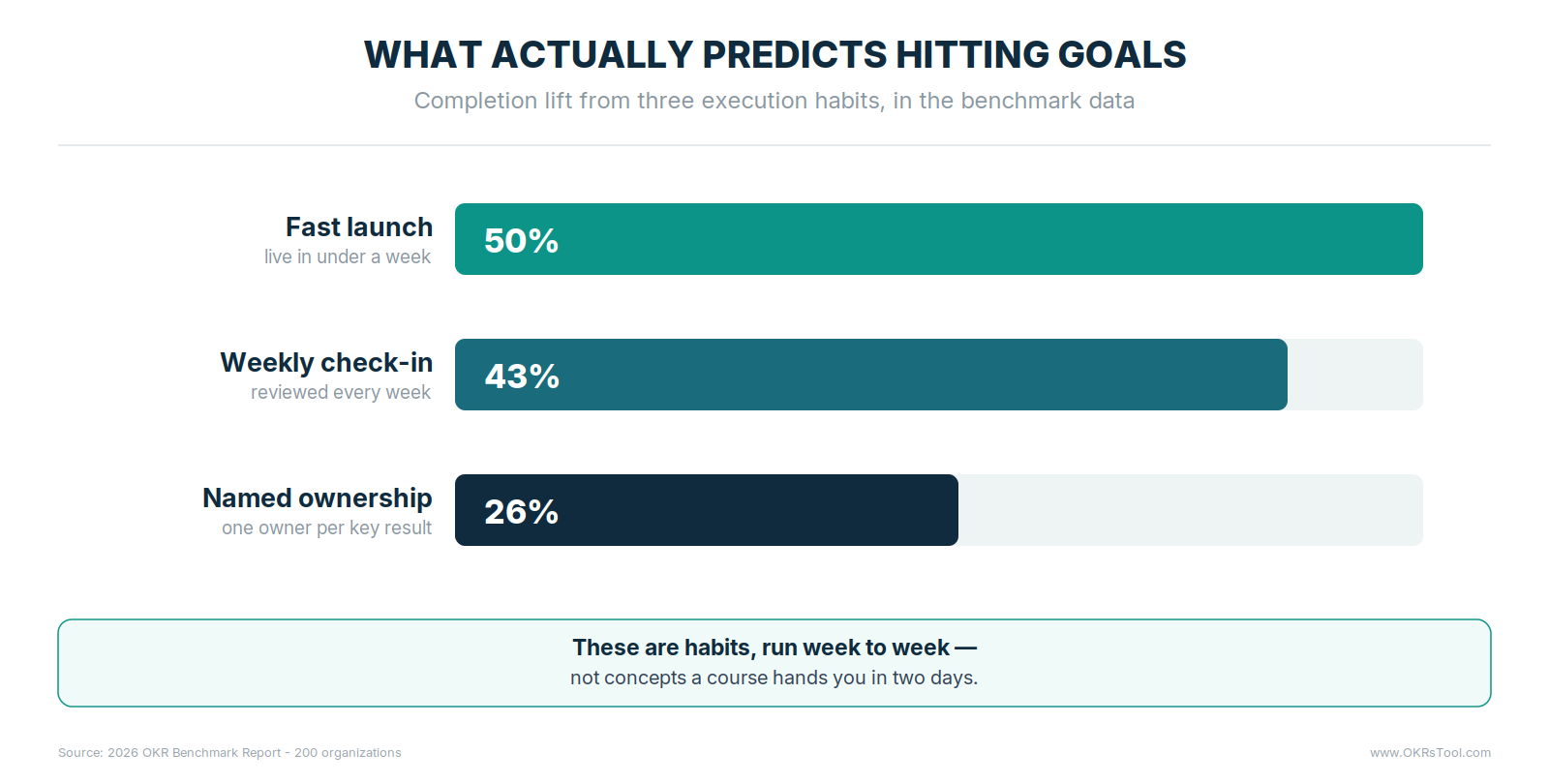
Teams that launch in under a week see up to 50% higher completion; teams with an automated weekly check-in complete 43% more of their goals than those reviewing monthly; teams with a single named owner on each key result complete 26% more. None of those is a concept you learn once — each is a habit run every week for the length of the cycle. The wider Goal-Setting Benchmark points the same way: teams running three or four of these habits hit their goals 2.9x more consistently than teams running none.
That's the gap a certification doesn't close. A course teaches you what a good key result looks like and how a cascade should work — genuinely useful concepts. It can't install the weekly rhythm, the named ownership, or the honest scoring that the data ties to actually hitting goals. The distance between knowing OKRs and running them is exactly where most teams fail, and that distance is closed by doing, not studying.
The Cheaper Path for Most Operators
If you're an operator weighing a certification against your own time and budget, there's a lower-cost route that teaches the same concepts and then closes the practice gap the course can't:
Learn the concepts free. A free OKR course — short lessons on writing outcome-based key results, building a cascade, and running check-ins — covers the same fundamentals a paid certification's first module does. These are teaching lessons rather than a graded credential — you finish knowing how OKRs work, with nothing to frame on the wall.
Then run a real cycle. This is the part no course provides. Set two or three objectives, write outcome-based key results, put one owner on each, and hold a weekly check-in for twelve weeks. One cycle run honestly teaches more about what actually moves goals than a two-day course, because it forces the habits into your team's routine instead of leaving them as notes.
Software makes those habits the default rather than a test of memory. Purpose-built goal management enforces ownership before a goal goes live, runs the check-in on a schedule, and keeps the whole thing visible on one platform — which is the mechanism behind the benchmark finding that disciplined teams reach 74% very-consistent goal success on real tracking software versus 33% on spreadsheets.
So — Do You Need an OKR Certification?
If you coach or consult on OKRs for a living, yes — a recognised credential like OKRI or OKR International is a fair investment in your credibility, and the endorsements are real.
If you're an operator who wants your own team's goals to work, probably not. The concepts are learnable free, and the part that actually decides whether goals get hit — the weekly habits — can't be certified into existence anyway.
Learn the fundamentals, run a cycle with a tool that enforces the discipline, and you'll know more about running OKRs than a certificate would tell anyone about you. Certification proves you studied OKRs; running a good cycle proves you can do them, and only one of those shows up in your results.
Data: the 2026 OKR Benchmark Report (200 organizations), the Goal-Setting Benchmark (280 operations and strategy leaders), and OKRs Tool platform data (876 organizations, 20,952 key results). Certification details from provider sites; check each for current pricing and dates.