Only 30% of employees can name their organisation's top goals unprompted, and among those who can't, 59% say nothing would change if the goals vanished — figures from The State of Goal Management 2026. Meanwhile 92% admit to at least one form of goal-gaming, and the way progress is communicated is what drives that number up or down. Communicating OKR progress isn't a reporting nicety; it's what keeps goals visible, honest, and worth pursuing through the quarter.
Progress that isn't communicated may as well not exist. An OKR can be moving in the right direction all quarter, but if the team can't see the key result climbing, leadership can't act on it, and the company never hears the story, the work generates no alignment and no momentum.
The data says two things drive whether progress communication works: whether people can see the goals at all, and whether the way progress is shared makes honesty safe. Poor communication on either front is a leading reason OKRs fail. The practices below cover both.
First, People Have to See the Goals
The State of Goal Management 2026, a survey of 210 employees, found a visibility problem beneath most OKR programs: only 30% can name their organisation's top goals without looking them up. The rest are working in a company whose priorities they can't recall.
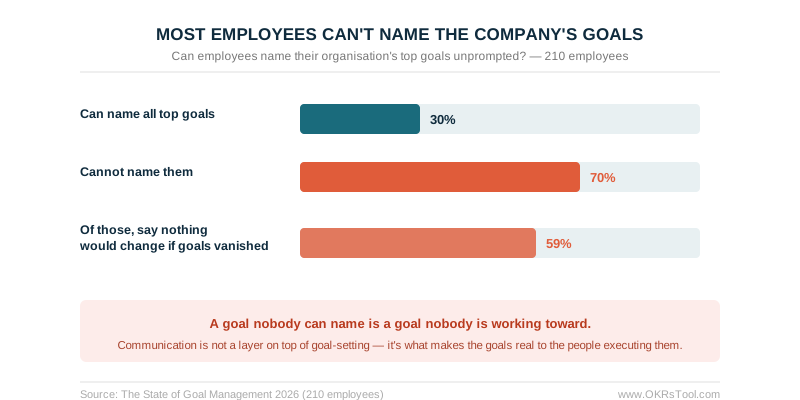
What that costs is measurable. Among employees who can't name the goals, 59% say nothing would change if the goals disappeared entirely. Among those who can name them, only 24% say the same — a 35-point gap the report calls the recall cliff. A goal people can't recall is a goal they've already stopped working toward, and no amount of careful goal-writing fixes it.
Communication does: keeping goals present through the quarter is what converts a goal from a line in a file into something the team is actually pulling toward. It's a core part of rolling OKRs out so they survive past the first cycle, and a large part of getting a team to actually use them.
Match the Message to the Audience
A single progress update has three different jobs depending on who's reading it, and the most common mistake is sending everyone the same version.
The team needs detail: every goal, its movement since last week, and what's blocked. Leadership needs the exceptions: what's on track, at risk, or off track, and which decisions are required — the detail is noise at their altitude. The company needs the story: the trend and what it means for the company-wide goals, not a metrics dump. Get the altitude wrong and the team drowns leadership in detail, or the company gets a spreadsheet it can't parse. The same underlying progress, told three ways — and a board update is a fourth altitude again.
Set a Communication Rhythm People Can Rely On
How often progress is communicated sets the ceiling on how much it can do. The 2026 OKR Benchmark Report of 330 organizations is precise on this.
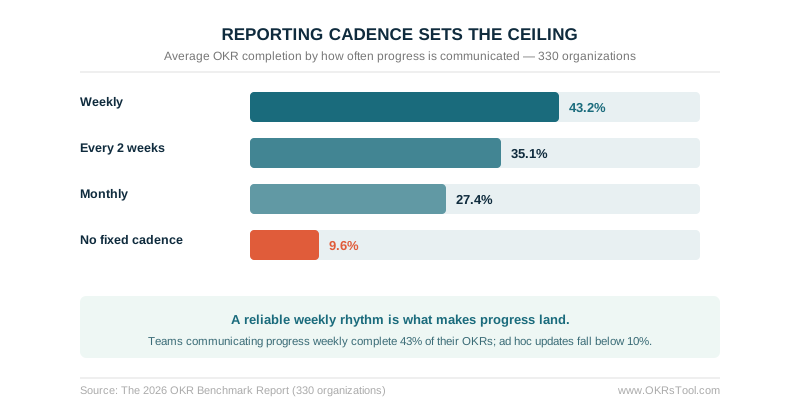
Teams that communicate progress weekly complete 43% of their OKRs, against 35% every two weeks, 27% monthly, and under 10% with no fixed rhythm. The reason is timing: a weekly update surfaces a slipping goal while there's still runway to recover it, and a monthly one surfaces it after the window has closed.
Fix the cadence per audience and hold it — the team hears progress at the same weekly check-in, leadership gets its summary on the same day each cycle, the company hears the story at a standing all-hands. Reliability is what builds the habit of attention; a rhythm that never slips trains people to expect the update and act on it, while irregular updates train them to ignore you.
Communicate Trajectory, Not a Snapshot
A single number is a snapshot, and a snapshot can't say whether a goal is recovering or collapsing. A goal at 45% is on track if it climbed from 30% and failing if it fell from 60%.
Communicate where each goal has moved since the last update. A running check-in history shows the slope, and the slope is what tells leadership whether to intervene now or wait. This matters most for goals drifting off pace: a status of "at risk" invites a shrug, while "at risk, and dropped 15 points in two weeks" invites a decision. Progress communicated as a trend provokes action; progress communicated as a dot on a page provokes a nod.
Make Honesty Safe, or the Numbers Lie
Here is the finding that should worry every leader: 92% of employees admit to at least one form of goal-gaming, and 70% have reported a goal as healthier than they knew it to be — a watermelon report, green on the surface and red underneath.
Gaming isn't random; it tracks the incentive. When goals are tied directly to performance ratings, 96% of employees sandbag their targets; when goals are kept separate from ratings, that falls to 81%. How progress is communicated is what decides which regime you're in. If reporting a goal at risk gets a person punished, they stop reporting it at risk — and the whole communication system fills with numbers that look fine and mean nothing.
Communicating progress in a way that makes an honest "this is off track" safe is the difference between a report you can act on and theatre. This is why psychological safety is a communication problem, not a soft one.
Lead With What's Off Track
Attention is scarce in every audience. An update that opens with wins buries the one thing that needs a response, and by the time the reader reaches the at-risk goal the meeting is half over.
Put the goals that are behind at the top of every communication, regardless of audience. On-track goals can be scanned; the goals in trouble are where decisions get made. Leading with risk also does something the honesty problem needs: it makes surfacing a miss the normal, expected shape of an update, so a team that flags problems early reads as in control rather than as failing. When the mid-quarter review opens on what's at risk, the meeting becomes a decision session instead of a status recital.
Connect Progress to the Bigger Picture
Progress on a single goal means little if nobody can see what it connects to. A team hitting its numbers while disconnected from strategy is communicating activity, not contribution — and communicating outcomes rather than activity is what makes an update worth reading.
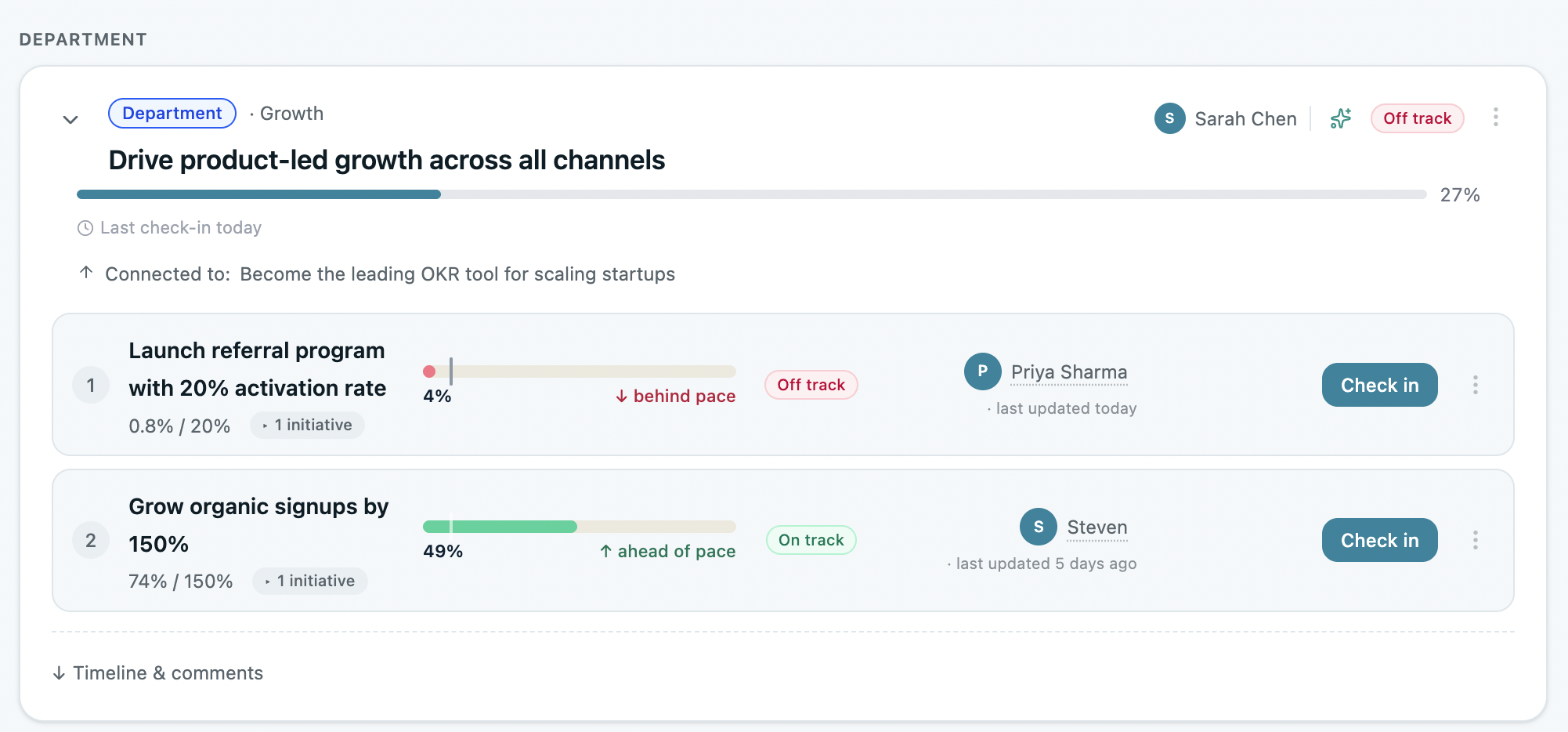
Every progress update should make the alignment visible: how this team's progress ladders up to a department goal and a company priority. When a team can see its slipping key result is the one blocking a company objective, the update carries weight it wouldn't otherwise. This is where cross-department visibility matters most — a goal that depends on another team needs both teams seeing the same picture, or the dependency surfaces only once it's already a problem. Progress communicated against a visible cascade becomes a coherent picture of where the company is heading, not a pile of disconnected status lines.
Close the Loop
Communication that flows only one direction — teams up to leadership — misses half the point. An update should provoke a response: a decision, a reprioritisation, a blocker cleared.
When a team reports a goal at risk, the loop closes only when leadership responds with a decision or the resources to recover it. An update that vanishes into a report nobody acts on teaches teams that honesty is pointless, and the next update quietly turns green — straight back to the watermelon problem. Two-way communication keeps ownership real. This is where leadership accountability shows: leaders who act on progress updates get honest ones, and leaders who ignore them get reports engineered to look good.
What Good Progress Communication Looks Like
The practices reduce to a short standard, one that holds across every audience and channel.
None of it requires more communication. It requires the right message reaching the right audience on a rhythm they can act on, in a culture where the truth is safe to send.
Communication Is a Byproduct of Good Tracking
The hardest part of communicating progress is sustaining it. An update assembled by hand for three audiences every week becomes a chore, gets shortcut, and reverts to the quarterly deck that lands too late to matter.
The pattern worth ending on is that good communication falls out of tracking progress well, rather than being a separate task bolted onto the work. When check-ins are captured weekly and alignment is visible, the team update, the leadership exceptions, and the company story become three views of one dataset, not three documents written from scratch — and honest tracking is what keeps the numbers true.
The OKRs Tool platform generates all three from the weekly check-ins the team already does. It's free for up to five users.
Data sources: The State of Goal Management 2026 (210 employees); The 2026 OKR Benchmark Report (330 organizations).