
Teams rewrite their key results endlessly, chasing better wording. Across 24,000 analyzed OKRs, the winning ones aren't better written — they're better owned and tended. Assigning a single accountable owner to every key result alone lifts completion by 26%. The formula that works is the familiar sentence plus two commitments no template includes.
There's a ritual every planning season, and it's the heart of every key result formula you'll find online. A team spends an afternoon wordsmithing its key results — tightening the verb, arguing the target, making each one read like it belongs on a wall. The sentences come out clean. Everyone feels good. Then the quarter runs, and half of them never move.
We went looking for what separates the ones that land from the ones that die in the dashboard. Twenty-four thousand OKRs, and the answer wasn't the thing everyone spends the afternoon on. It wasn't the wording. Beautifully formatted key results missed constantly; blunt, plain ones hit.
The sentence was never where the outcome lived. It lived in three things the template doesn't ask about — who owns the goal, whether anyone tends it through the quarter, and whether a stalled one gets rescued or left to rot.
The classic formula writes the sentence and stops at the exact moment the real work starts.
The Key Result Formula We Know Today
You've seen this template. Every guide to writing OKRs lands on some version of it, and for good reason — it drags a vague ambition into something with edges. It makes you name a segment, commit to a number, and put a clock on it.
That's real value. It's also the whole of what the template does. It's a sentence you write once and file, and it only covers the part of a key result that's easy to get right sitting in a planning room. Who owns it once everyone leaves? When does anyone look at it again? What happens the week it doesn't move? The template is silent — and that silence is exactly where the goals go to die.
The Key Result Formula, Backed by the Data
The goals that hit across 24,000 OKRs weren't better written. They were better wired. A single name on the hook, a check-in every week from that person, and a stall caught in week one instead of week ten. So the data-backed formula keeps the good bones of the classic template — segment, target, timebox — and bolts on the two commitments it forgets.
One change lives inside the sentence: owned by one named person, because that's the single biggest swing in the numbers. The rest lives after it, in the two lines no template writes down — checked in weekly by the owner, and rescued the first week it sits at zero.
Put plainly: a good key result isn't a well-written sentence. It's a concrete result, owned by one person, checked in on every week, and pulled back the first week it stops moving.
The rest of this guide walks each element, with the number behind it — and it's straight about which parts are solid and which are a lean.
Deliver a Concrete Result, Ideally From Zero
Compare two key results. "Improve retention from 42% to 50%." "Ship 5 partner integrations, 0 to 5." The first sounds more sophisticated. The second is the one that gets done.
Here's why. A rate you're nudging has no honest finish line — 44% arrives, someone calls it progress, and the goal spends the quarter in a fog of partial credit, which is how an output dressed as an outcome always ends. Five integrations from zero has a floor you can't argue with: you've shipped two, or you haven't. The work is countable, so it stays honest, and honest goals get scored cleanly instead of debated.
In the data, key results built to deliver something concrete from zero beat ones built to nudge an existing metric by about 52%. Real gap — but the softest finding here, and it earns a caveat. It's an organization-level correlation, and some of the lift is probably just that buildable work is more controllable than a moving rate.
So the formula says ideally zero, not always zero. Where a rate genuinely is the outcome, a clean baseline-to-target key result is still right — just pin the target hard enough that no one can litigate partial credit at the end. Vague metrics are where accountability goes to hide.
Owned by One Named Person
This is the element most teams get wrong, and it applies at every level — a company key result needs a single named owner just as much as an individual one does. Ownership isn't about hierarchy; it's about clarity. One person on the hook, not a team, not "shared between sales and marketing." Even when several people contribute, one name owns the outcome.
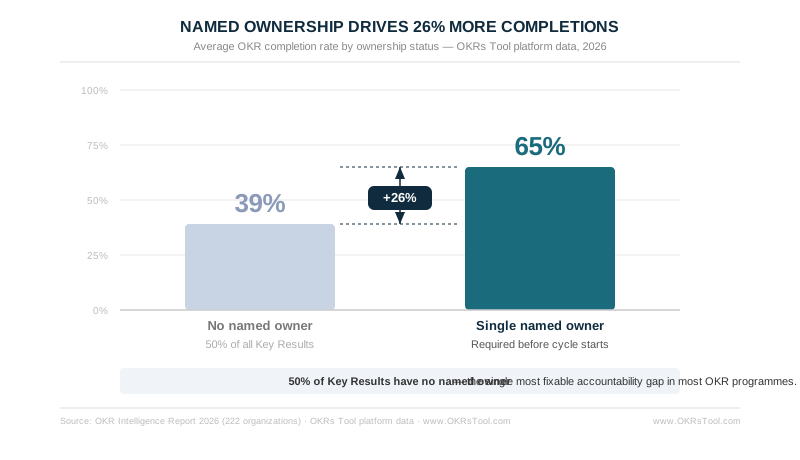
The 2026 OKR Benchmark Report puts a number on it: teams that assign a single accountable owner to every key result complete 26% more of their goals than those that don't. The failure mode it fixes is the co-owned key result — two or three names on one line, which reads as collaborative and functions as diffusion, because no single person feels the weekly pull to move it, escalate when it stalls, and own the score at the end.
Level is a related but separate effect worth naming honestly. In the platform data, individual key results complete far more often than company-level ones — the higher a goal sits, the more diffuse its day-to-day work tends to be.
Company goals are worth setting; they just demand more deliberate ownership than any other level. A company key result with one clear owner is how you close that gap, instead of letting altitude turn into "owned by everyone, tended by no one."
This Quarter, Not This Year
Keep one part of the old template untouched: the quarterly timebox. The data is blunt about it. Quarterly cycles hit their target 52% of the time. Annual goals: 8%. Monthly: 23%.
The reason is human, not statistical. A year is too far off to feel — the deadline is someone else's problem until suddenly it's October. A month is too tight for anything real to land, so the team just restarts the treadmill every four weeks. A quarter is the one window long enough to do the work and short enough that the work stays in view. The template got this right the first time. Leave it alone.
Checked In Every Week, By the Owner
This is the line no template includes, and the one the data leans on hardest. Writing the key result takes an afternoon. Checking in on it is what actually moves it — and the gap between doing that and not is enormous.
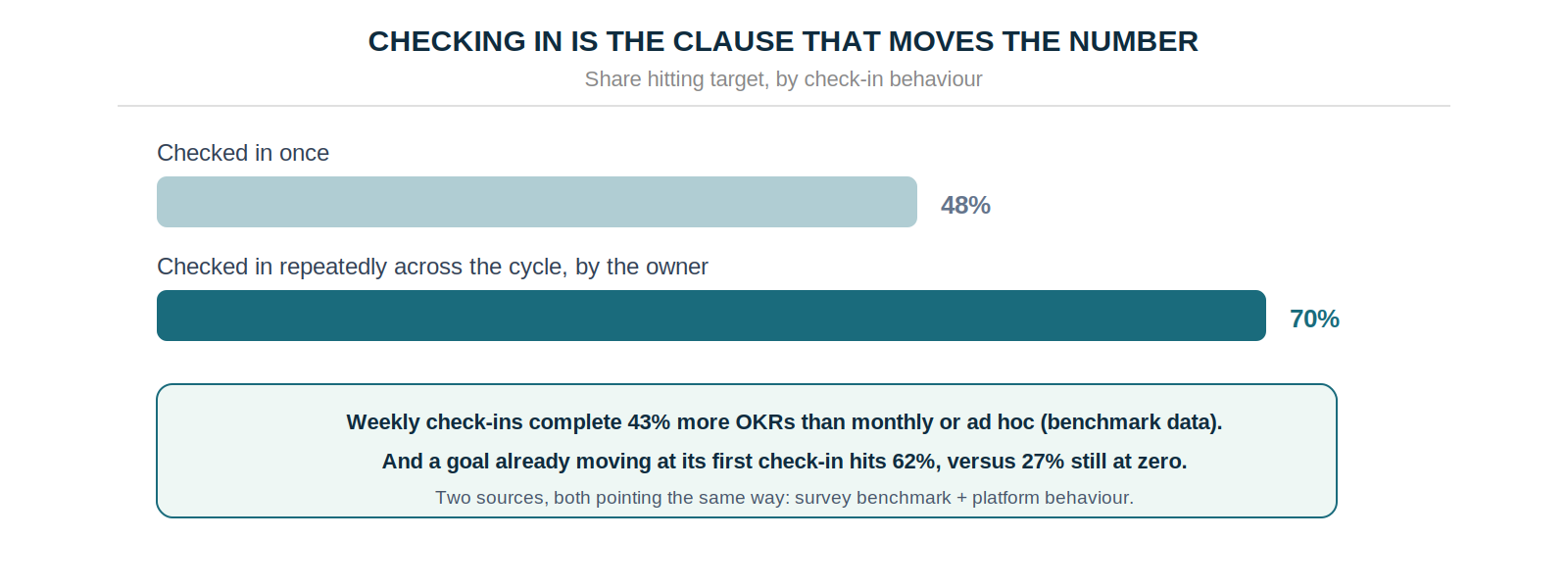
Touched once, a key result hits 48% of the time. Touched steadily across the quarter — real tracking, not one panicked catch-up the week before the deadline — it climbs toward 70%. And it matters whose hands are on it: goals tended by more than one active person hit 59%, against 45% when a lone person ever touches them, so the owner has to be genuinely in it, not forwarding a reminder.
The weekly cadence itself shows up in separate benchmark research — teams running a real weekly rhythm complete 43% more OKRs than the monthly-or-whenever crowd. Two roads, same destination: platform behaviour and survey data agree.
Rescued the First Week It Doesn't Move
The last commitment turns a check-in from a status update into a save. The first check-in is your earliest honest signal, and there's only one thing to read: did the number move, or is it still sitting at zero.
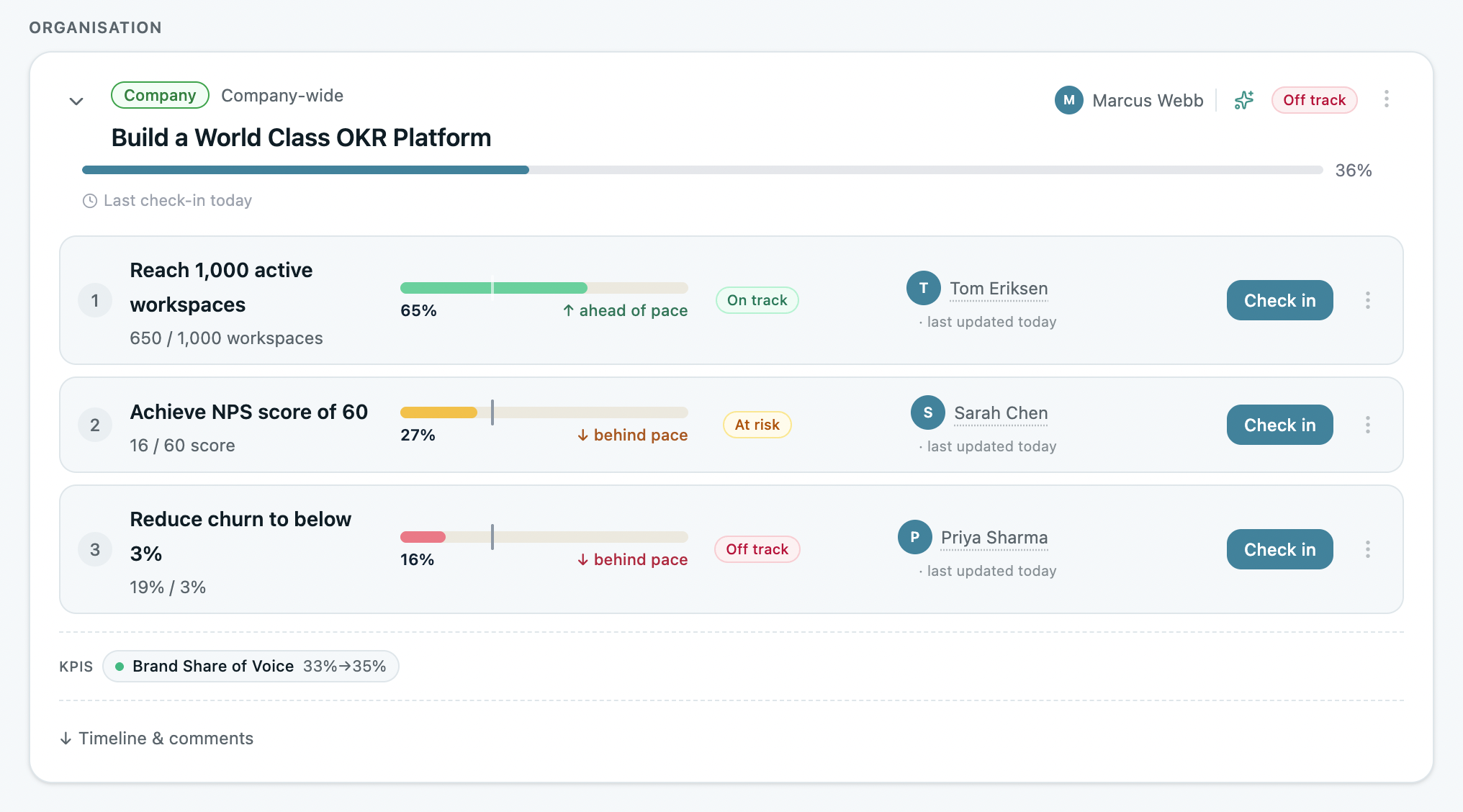
Moving at that first check-in, a key result hits 62%. Still frozen at zero, it hits 27%. A flat zero in week one isn't a slow start — it's the loudest early warning you'll get that the goal is going to miss, and the moment to step in while a whole quarter is still on the table. The instinct is to shrug it off as a warm-up and wait.
The data says the waiting is the loss — a goal caught at week-one zero can still be re-scoped, reassigned, or rescued; the same goal noticed at week ten is just a post-mortem. Build the rescue into the formula, and a stall becomes a signal instead of a surprise.
The Sentence Was Never the Hard Part
The shape holds across 24,000 OKRs, and it's almost boring in its consistency. The key results that hit weren't the sharply worded ones. They were concrete, owned by one person, boxed to a quarter, touched every week by that owner, and pulled back the first week they stalled.
That's the whole reframe, and it should change where you spend your planning time. Perfecting the sentence was never the bottleneck — teams have had a workable template for decades.
What the data moves is the effort: less wordsmithing, more wiring. Put one name on each key result. Check it every week. Step in the first week it doesn't move. The old key result formula handed you the sentence; this one adds the parts that decide whether the sentence ever comes true.
Data: OKRs Tool platform data (24,000 OKRs analyzed), The 2026 OKR Benchmark Report (200 organizations).