
Feedback saved for the annual review arrives late, vague, and skewed toward whatever happened in the last month. It's the same recency problem that makes ratings hard to defend: 68% of HR leaders have watched a strong performer marked down because their best work happened early and faded from memory by review time. Continuous feedback fixes it by capturing input as the work happens — tied to the goal record, not a once-a-year event.
Continuous feedback is the practice of giving, requesting, and recording input throughout the cycle rather than banking it for a single annual review. A manager notes what went well after a launch, a peer flags a blocker in the moment via 360 feedback, someone requests input before a big decision — and all of it lands against the work it refers to, while the detail is still fresh. Done this way, the review stops being the first time feedback gets said out loud and becomes a summary of a running record.
The case for it is the same case the data makes against annual everything. Drawing on the Performance Rating Benchmark Report — an independent survey of 230 People and HR leaders — this guide covers why annual feedback breaks, what continuous feedback replaces it with, and how to run the loop so it connects to the goal record rather than floating free of it. It sits inside the wider shift to continuous performance management, where feedback is one moving part of a system built to run all year.
Why Annual Feedback Breaks
The problem with saving feedback for one yearly conversation is that memory doesn't hold a year evenly. By the time the review arrives, most of what happened has faded — a known OKR mistake at review time — and what's left is whatever occurred most recently or most visibly.
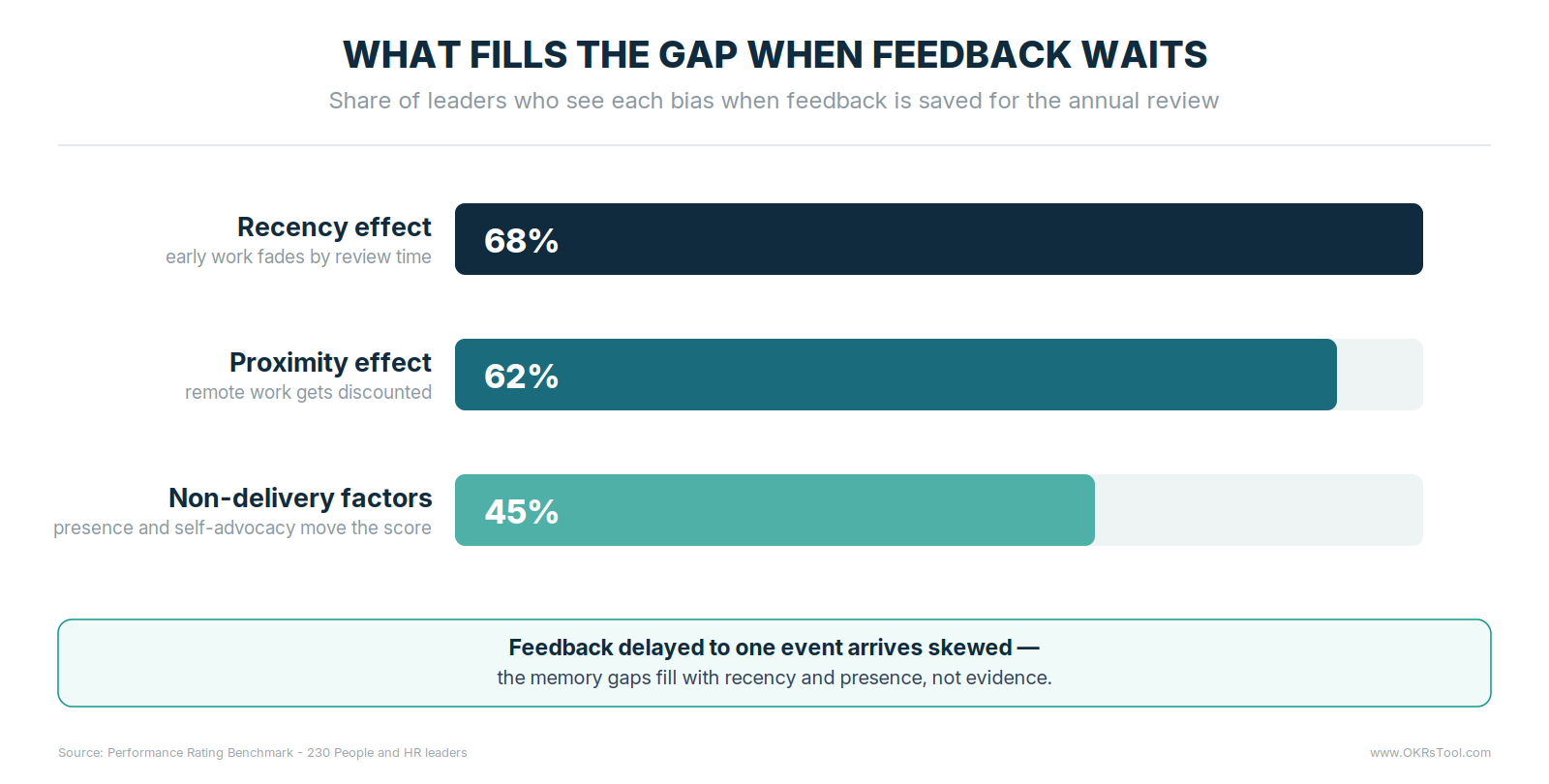
The benchmark puts numbers on what rushes in to fill that gap. More than two-thirds of leaders — 68% — have seen a strong contributor marked down because their standout work came early and slipped out of memory by review season; that's recency at work.
Another 62% say remote and hybrid people lose out, their off-screen contribution discounted without anyone deciding to. And nearly half, 45%, concede that something other than actual delivery — who was visible, who advocated for themselves, what happened to be fresh — ends up swinging the score.
Feedback held back until the review inherits every one of those distortions, because it's being reconstructed rather than recorded. 35% of leaders say they have to rebuild an employee's record from memory at review time, the gap that makes ownership of the record matter; feedback saved for that moment is built on the same shaky foundation.
What Continuous Feedback Replaces It With
Continuous feedback swaps the single verdict for a running stream of small, specific inputs captured close to the work. The point is to give feedback while it's still accurate and still useful, when the person can act on it rather than file it — not simply to give more of it.
Three kinds of input make up the loop. Praise recognises good work in the moment, publicly where it reinforces the behaviour and supports a healthy OKR culture. Constructive notes flag something to adjust while there's still time to adjust it, privately where that keeps the conversation safe. Requested feedback lets someone pull input before a decision or after a milestone rather than waiting to have it pushed at them once a year. Together they turn feedback from an annual event into a habit that runs on the same cadence as the weekly check-in.
The reason this works is structural more than cultural. Feedback tied to a live goal record has evidence attached — it points at a specific key result, a specific week, a specific piece of work. That's what a defensible performance review — and honest scoring — needs and what memory can't supply. Where goals and reviews run as one connected system, the share of leaders who say every rating is defensible jumps from 17% to 42% — and a steady feedback trail is a big part of what builds that record.
Annual vs. Continuous Feedback
The difference isn't only frequency; it changes what the feedback can do.
The right-hand column is what turns a review from a verdict into a summary. When feedback has been landing against the goal record all cycle, the end-of-period conversation reads from something real instead of scrambling to remember it.
How to Run a Continuous Feedback Loop
Making feedback continuous is less about a new process and more about lowering the friction so it happens close to the work.
Put it where the work lives. Feedback that requires opening a separate HR tool won't happen in the moment; feedback attached to the goal or the check-in someone is already updating will. Proximity to the work is what makes the habit stick.
Make requesting normal, not just giving. A loop that depends on managers remembering to give feedback stays thin. Let anyone request input — from a peer, a report, a manager — before a decision or after a milestone, and the volume of useful feedback rises without anyone being nagged into it.
Keep praise public and correction private by default. Public praise reinforces the behaviour for the whole team; private constructive notes keep the conversation safe and honest, which is what stops feedback from curdling into the kind of impression-management that skews reviews.
Tie it to the goal, not the calendar. Feedback that references a specific goal or a specific week carries evidence into the review. Feedback floating free of the work is just opinion, and opinion is what bias fills when the record is thin.
Run it on software that captures it. A loop that lives in someone's memory or a scattered Slack thread isn't a record. This is exactly what the Feedback feature in OKRs Tool is built for: anyone can give, request, or record feedback against a live goal at any point in the cycle — praise posted publicly to the recognition feed, or a constructive note kept private — so development conversations stay ongoing and tied to the work actually happening, not saved for the annual review.
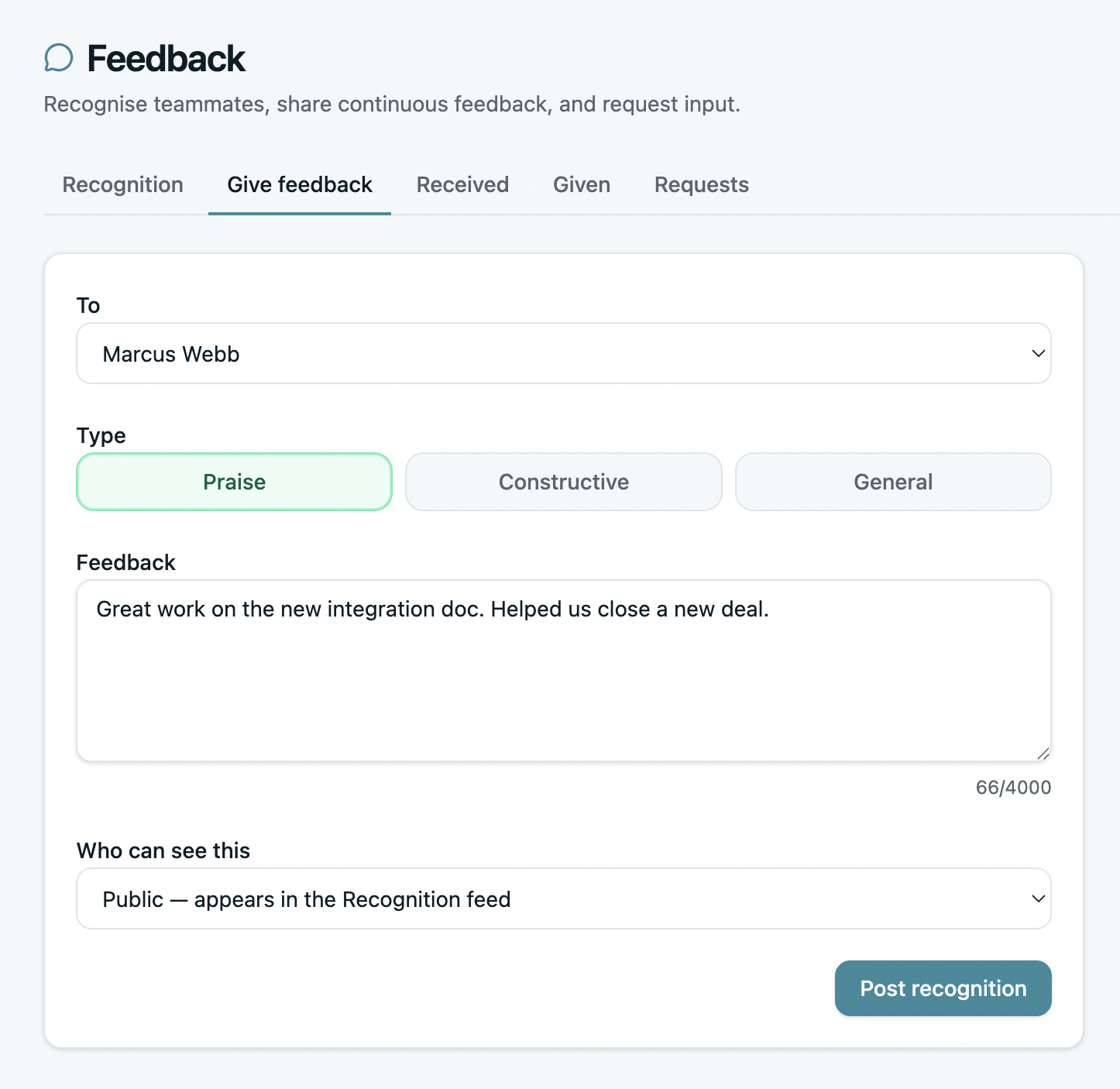
Purpose-built performance management software keeps every piece of feedback attached, on one platform, to the goal it refers to, so the review has a trail to read from rather than a memory to reconstruct.
Feedback Is Only as Good as the Record It Leaves
The move from annual to continuous feedback is the same move the data keeps pointing to across continuous performance management: stop reconstructing the period from memory and start reading it from a record built while the work happened. Feedback given in the moment, tied to a live goal, and captured where everyone can see it is what turns the review from the first honest conversation of the year into the last one in a series.
For a growing team, the practical version is small: make it easy to drop praise or a note against a goal, let people request input instead of only receiving it, and keep the whole stream connected to the work. Do that and the annual review stops being a verdict written from partial memory and becomes what it should be — a summary of feedback that was already said, already recorded, and already acted on.
Data: the Performance Rating Benchmark Report, an independent survey of 230 People and HR leaders at technology companies of 50–200 employees.