
Strategy execution is the work of turning a plan into results — and it fails far more often than the planning does. Across 180 companies, 93% of leaders say most daily work doesn't clearly ladder up to their strategy, and 86% say their own workforce can't even name the priorities. The plan is rarely the problem. The connection between the plan and the work is.
A failed strategy usually gets post-mortemed for a flaw in the strategy itself — the wrong market, the wrong bet, the wrong timing. Sometimes that's true. But far more often the strategy was sound and simply never happened: it was written at an offsite, presented at an all-hands, and then disconnected from what anyone actually did the following Monday. Execution, not analysis, is where most strategies die.
This is a structural failure, not a motivational one, and it shows up the same way across companies of every kind. The four causes below account for most of it — each a specific, measurable break in the chain between deciding a strategy and doing it.
The Work Doesn't Ladder Up to the Strategy
The single biggest cause is the simplest to state: the daily work and the strategy are disconnected. Teams are busy, output is high, and almost none of it traces back to a stated priority.
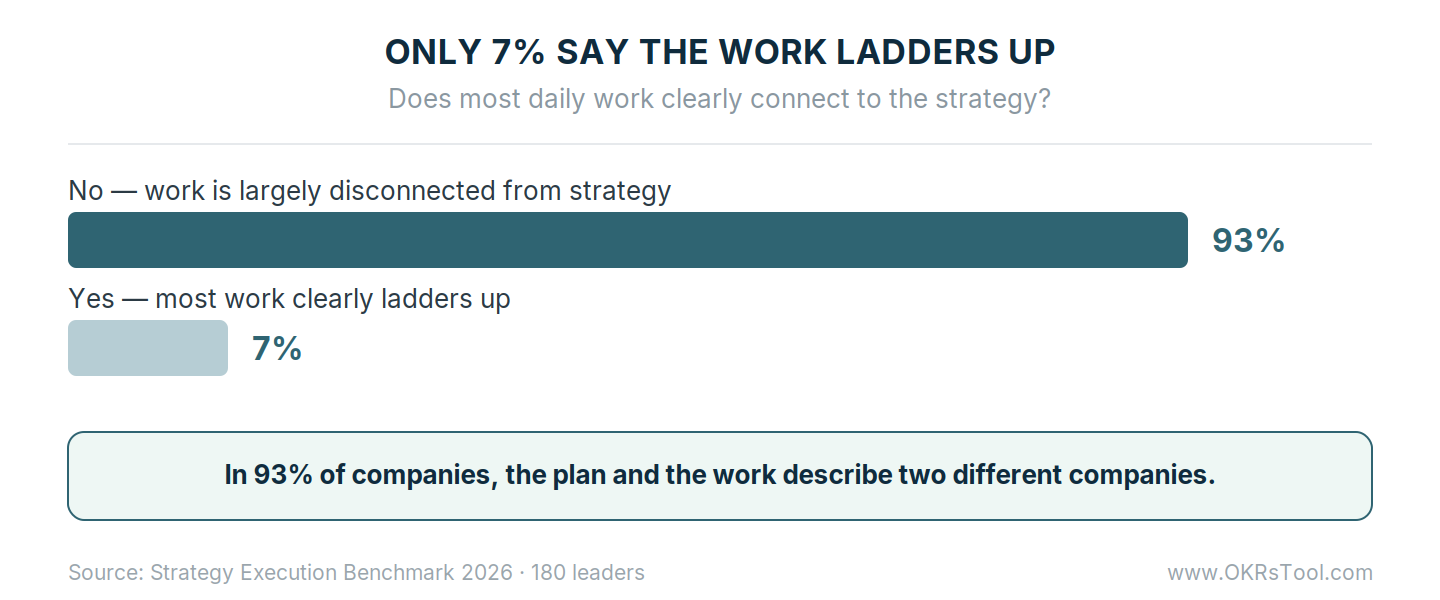
In only 7% of companies do leaders say most daily work clearly connects to a strategic priority. In the other 93%, the plan and the work describe two different companies — the strategy deck says one thing, the team trackers say another, and nothing reconciles them.
The result is motion without direction: real effort, none of it compounding toward the outcomes the strategy named. This is the strategy execution gap in its purest form, measured across the 2026 Strategy Execution Benchmark, and every other failure below is a variation on it.
The mechanism is a missing link, not missing effort. When there's no explicit connection between a priority and the goals a team owns, work defaults to whatever was already on the list — and the strategy, however good, organizes nothing.
Nobody Can Name the Strategy
A strategy that lives only in a leadership deck can't guide the thousands of small decisions made below the leadership team. And in most companies, that's exactly where it lives.
Across the benchmark, 86% of leaders said their workforce couldn't name the company's top priorities without prompting. A strategy the team can't recall can't shape a single decision they make — which means for most of the quarter, the strategy isn't operating at all. It surfaces at the quarterly review, gets nodded at, and recedes again.
The people doing the work are steering by their own local sense of what matters, because the actual priorities never made it into their working memory.
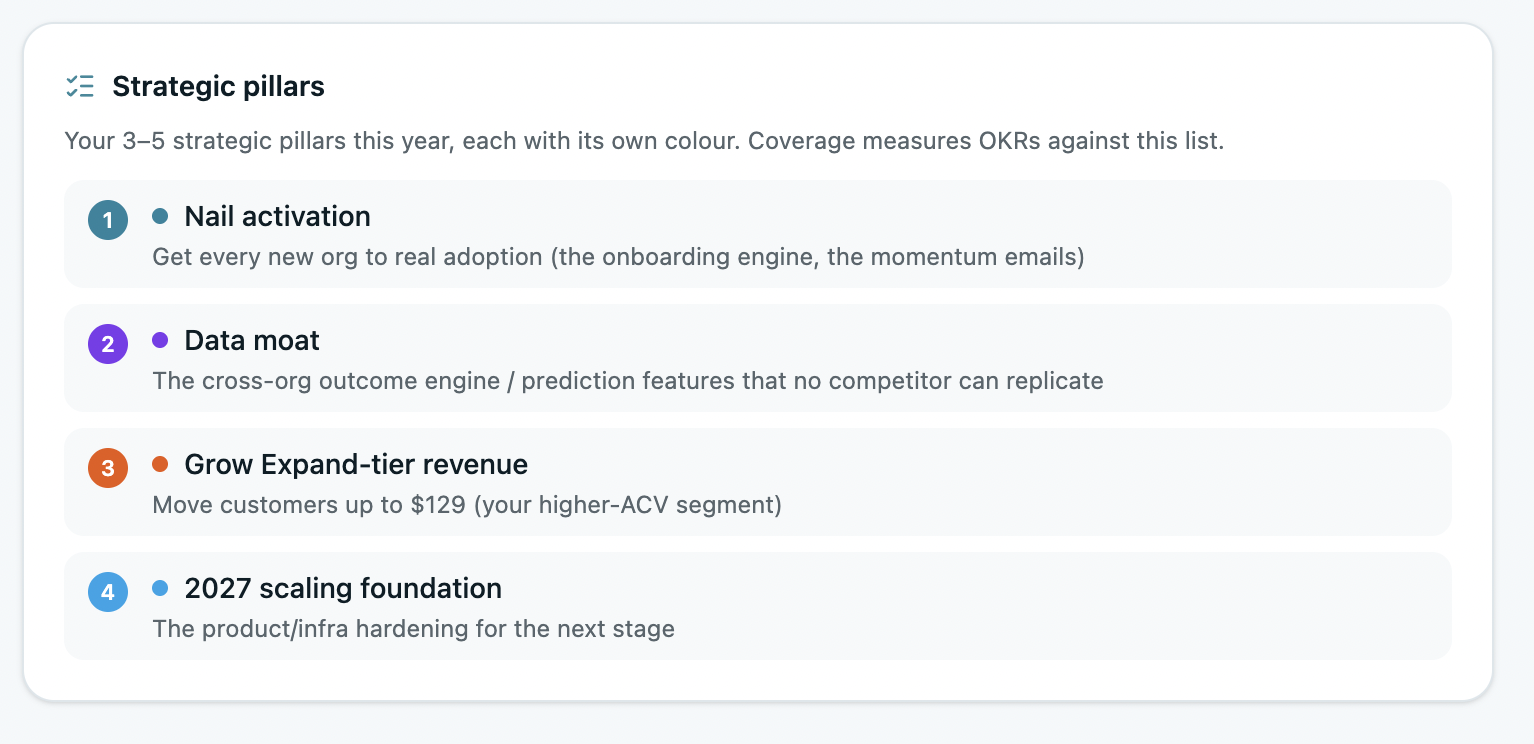
This is why strategic alignment is a communication problem before it's a structural one. A priority has to be stated, repeated, and connected to work often enough that a team can act on it without looking it up — and a deck opened once a quarter clears none of those bars. The companies that clear them tend to organize around a handful of strategic pillars simple enough to recall, then map an alignment view that shows which work sits under each.
No Signal When a Priority Drifts
Even when work is connected and the strategy is known, most companies have no way to tell when a priority is slipping until it's too late to act.
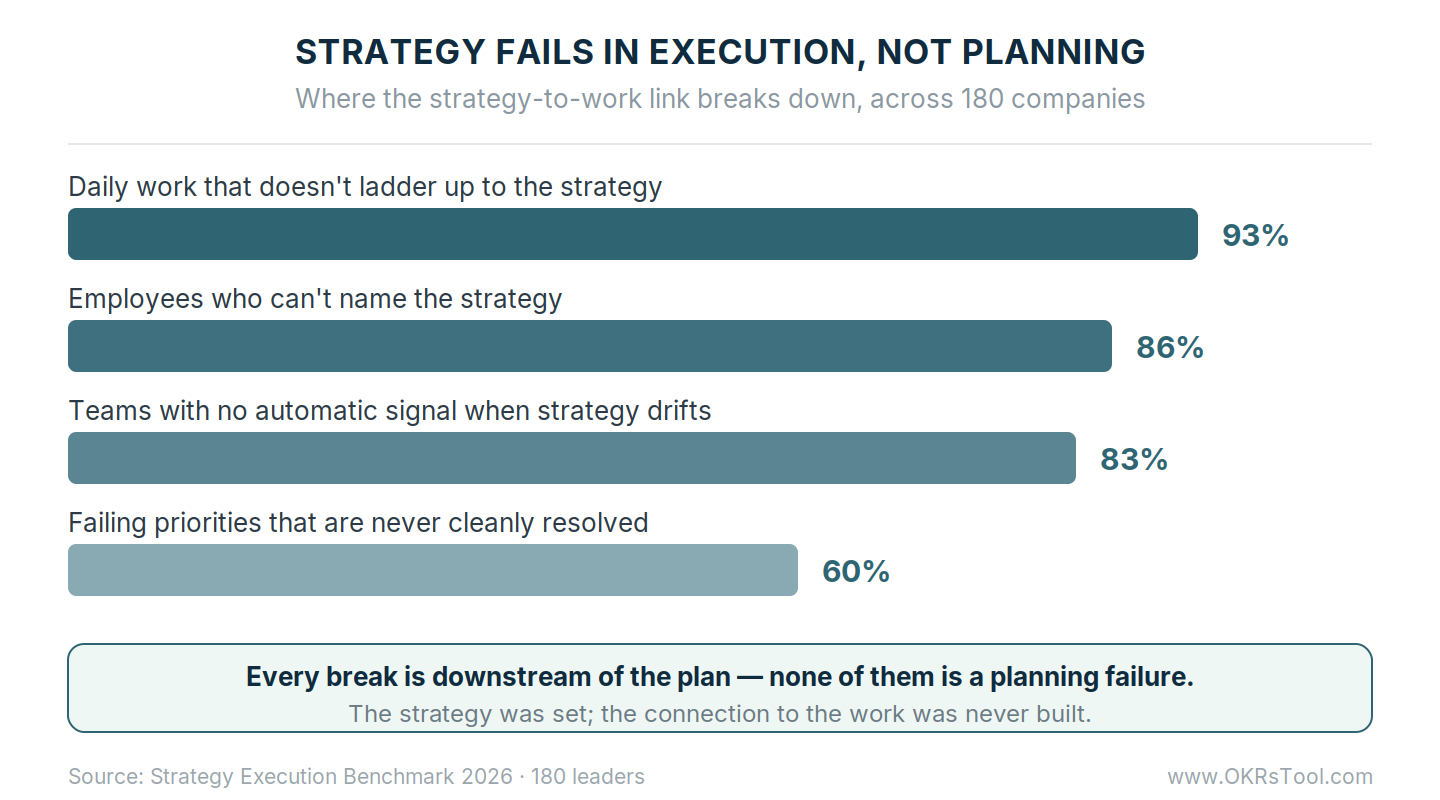
83% of teams get no automatic signal when a strategic priority drifts off track, and 60% of failing priorities are never cleanly resolved — they just fade, absorbed into the noise, never formally killed or fixed. A strategy without a drift signal is being flown blind: leadership finds out a priority stalled at the end-of-quarter review, the one moment when nothing can be done about it. By the time the miss is visible, the quarter that could have corrected it is gone.
The absence of a signal is itself a design choice, even when it's an unconscious one. A company that reviews strategy quarterly has decided, in effect, to learn about problems a quarter late — and strategy that isn't tracked between reviews will always surface its failures too late to matter. A weekly check-in cadence and a mid-quarter review are the cheapest signals there are, and most companies run neither.
Failing Priorities Never Get Resolved
The last failure compounds all the others: when a priority is clearly not working, most companies neither fix it nor formally cut it. It lingers.
That 60% of failing priorities that never get cleanly resolved is what erodes execution slowly, because an unresolved priority keeps consuming resources while producing nothing. Teams keep nominally working toward a goal everyone privately knows is dead, because no one has the signal or the authority to call it.
It's one of the clearest reasons strategies fail that has nothing to do with the quality of the planning framework behind them. The strategy becomes a graveyard of half-abandoned priorities that no one will officially bury, and each one drains attention from the priorities still worth pursuing.
Resolving a failing priority — reworking or cutting it mid-cycle rather than at the post-mortem — requires exactly the two things the earlier failures removed: a signal that it's failing, and a cadence where someone is expected to act on that signal. Without them, the honest call never gets made.
The Common Root: A Missing Connective Layer
Read together, the four failures are one failure wearing four faces. Work doesn't ladder up, nobody can name the strategy, no signal fires when it drifts, and failing priorities never get resolved — every one of them is a break in the connective layer between the plan and the work. The strategy exists. The work exists. What's missing is the wiring that would make them the same thing.
That's why execution failures are so resistant to more strategy. A company that responds to a failed quarter by writing a better plan is fixing the half that mostly wasn't broken. The plan will be just as disconnected from the work as the last one, because the disconnection was never about the plan's quality — it was about the absence of a system that ties a priority to a team's goals, makes the connection visible, and surfaces drift while there's still time to act.
Building that layer in one platform rather than across scattered docs is the subject of the companion piece on turning strategy into execution; the diagnosis here is the prerequisite for it.
Strategy execution fails, in the end, not because the strategy was wrong or the people didn't care, but because nothing connected the two. Fix the connection and most of these failures resolve at once. Leave it broken and no amount of replanning will help — the next brilliant strategy will die in the same gap as the last one.
Data: The 2026 Strategy Execution Benchmark, an independent survey of 180 strategy and operations leaders at 50–200 person companies.