
Writing the goal is one step out of five, and it's the step that predicts success the least. The four that come after — make it visible, track it, review it weekly, close it honestly — are where goals are won or lost. Teams that run all five hit their goals 2.9x more consistently than teams that stop after the planning session, which is where most stop.
A goal-setting process is the repeatable sequence a team runs to turn a priority into a result: set the goal, make it visible, track it, review it, and close it out. Skip the middle and you get what most teams have — a list written in January that nobody looks at until the cycle ends. Run the full sequence and goal setting becomes an operating rhythm rather than a planning-week ritual.
The steps below come from the Goal-Setting Benchmark, an independent survey of 280 operations and strategy leaders. It measured which parts of the process actually correlate with hitting goals, and the answer reshapes where teams should spend their effort: less on the wording of the goal, more on the four steps that keep it alive.
The Goal-Setting Process at a Glance
The five steps run in order, and each one makes the next one possible. Setting comes first, but it's the four that follow that separate teams who hit their goals from teams who miss.
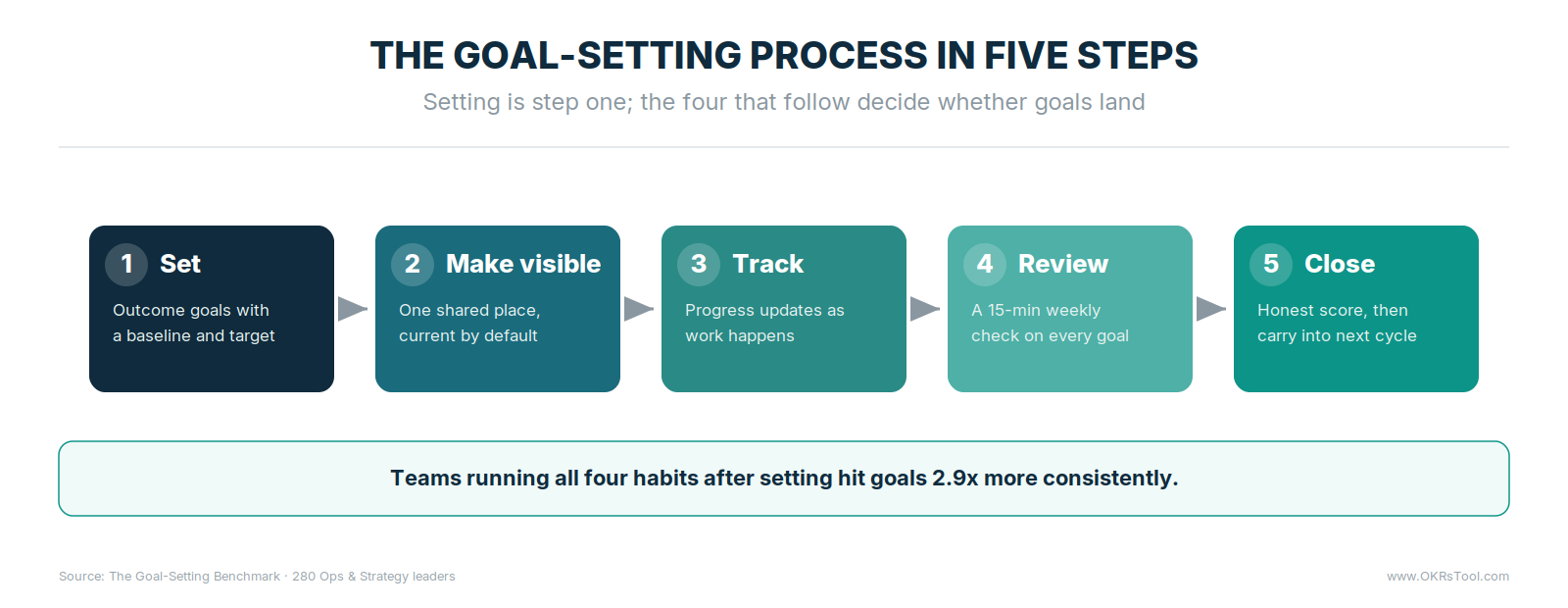
Step 1: Set the Goal as an Outcome
A goal worth running through the process names an outcome, not an activity. "Launch the new onboarding flow" is a task with a deadline; "raise Day-7 activation from 34% to 52%" is a goal you can score.
That gap is decisive: we analyzed 20,952 real key results, more than half — 52% — turned out to be tasks or KPIs dressed up as goals, tracking effort instead of change. Goals framed as outcomes rather than outputs get hit 30% more often.
Give each goal a baseline, a target, and a single named owner before the cycle starts. Keep the count low — one to two objectives per quarter with two to four key results each. Whatever goal-setting framework you use to write them, SMART or OKRs, the shape matters less than the discipline of making each goal measurable.
Step 2: Make the Goal Visible
Once a goal is set, it has to be somewhere the team can actually see it — one shared platform that stays current on its own. This is the cheapest step in the process and the one that makes the next three possible. Bury the goals in a deck reviewed once a quarter and the daily work drifts off them within weeks.
Two numbers show what that costs. Two-thirds of teams — 66% — end up doing work twice because nobody can see what everyone else is chasing, and just 30% of employees could name their company's top goals off the top of their head.
Visibility is also the fix for misalignment: 65% of teams say their goals aren't clearly tied to company strategy, and that only shifts once a live cascade linking company objectives to team goals is on screen and kept up to date, not drawn once on a whiteboard. A visible alignment map is what holds it together.
Step 3: Track Progress Continuously
Tracking carries at least as much weight as setting, and it's the step teams most often skip. Set a goal carefully and then track it loosely and you land roughly where a sloppy goal does — the benchmark's setting-versus-tracking quadrant puts teams strong on both at 51% consistency, but a well-written goal left to drift falls to 29%.
"Continuous" is the operative word. Progress should land as the work happens, not get pieced back together the night before a review. That scramble has a price tag: 59% of teams burn an hour or more every month just working out where their goals currently stand. Updating goals as you go turns the review from an archaeology exercise into a quick read of a live record.
Step 4: Review Every Week
No single step moves the number like a standing weekly check-in. Weekly reviewers complete 43% more of their goals than teams that check in monthly or whenever a deadline looms, and teams that drop reviews altogether abandon their goals mid-cycle three times as often.
The review is short by design — teams spending 45 minutes or more a week on goals perform worse than those under 30. A good weekly check-in answers three questions per goal: did it move, what's blocking it, what's next. Fifteen to twenty minutes, same time each week, so it runs on a cadence rather than a scheduling decision. The point is to catch a drifting goal in week four, while there's still time to act, instead of finding it in the end-of-cycle review.
Step 5: Close the Cycle Honestly
The last step is the most skipped and the most valuable over time. Closing means an honest score on each goal, a short retrospective on what worked, and explicit changes carried into the next cycle. Teams that run structured end-of-cycle retrospectives complete 30–45% more goals the following quarter.
Honest scoring is what makes closing worth anything — a 0.7 is a strong result, consistent 1.0s mean the goals weren't ambitious enough, and scores below 0.5 signal something structural to fix rather than just a harder push next time. Closing is what turns a one-off process into a compounding one: completion climbs from 51% in a team's first cycles to 79% by cycle five as each cycle feeds the next.
Where the Process Breaks Down
Almost half of teams say they run a consistent goal-setting process. When the benchmark asked what those teams actually do between reviews, the middle steps mostly weren't there.
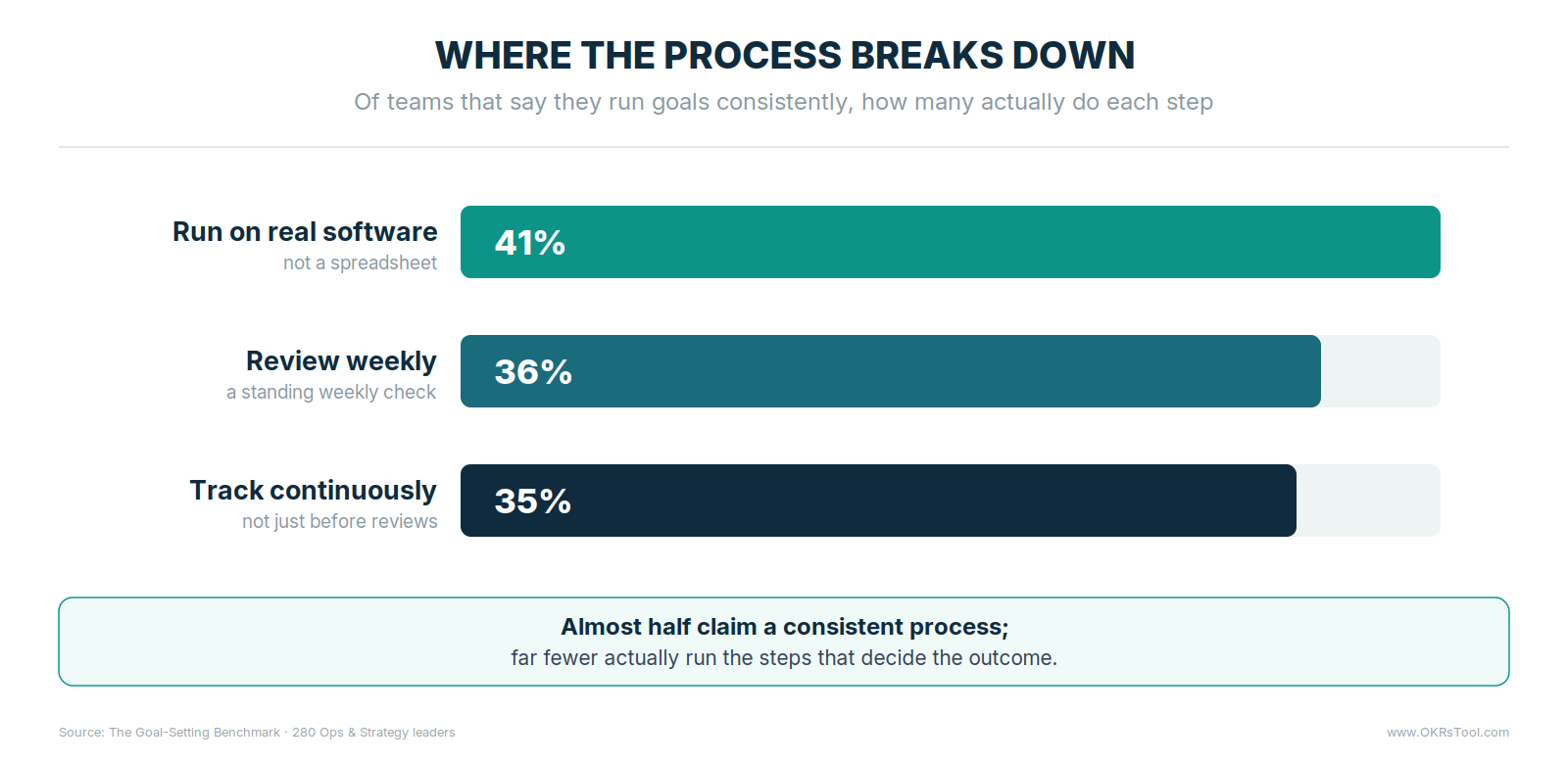
Only 41% run on dedicated goal tracking software, only 36% review weekly, and 35% update their goals only right before a review rather than continuously. The label of a process is common; the steps that decide the outcome are rare. Closing that gap doesn't require a new goal-setting strategy — just the five steps, run for real.
Run the Whole Process, Not Just Step One
Setting the goal is where most teams put their effort and where the process returns the least. The return comes from steps two through five — visible, tracked, reviewed, and closed — which is why the same goal produces wildly different results depending on what happens after it's written.
A goal set brilliantly and then ignored lands about where a sloppy one does; a goal set roughly but watched closely pulls ahead. The steps after setting are the ones the outcome actually turns on.
You don't have to build all five at once, and trying to is how most process overhauls stall. Start with the step you're weakest on — for most teams that's visibility or continuous tracking, the two teams skip most often — run it for one full cycle until it's a habit, then add the next.
Each step makes the one after it easier: visible goals make weekly reviews fast, continuous tracking makes closing honest, and an honest close makes the next cycle's goals sharper.
Run the whole sequence and goal setting stops being a January event and becomes the rhythm that carries a plan to a result.
Data: the Goal-Setting Benchmark (280 operations and strategy leaders) and OKRs Tool platform data (876 organizations, 20,952 key results).