
At 10 people, chasing works — you follow up with two people and the goals move. As you scale, chasing quietly becomes the operating model, and it still misses things. 62% of leaders say progress reaches them only when they ask or at a scheduled review. A goal that moves only when someone chases it isn't a goal the company owns. It's a task the leader is holding in their own memory.
There's a moment every growing company hits where the person running operations realizes their week has quietly reorganized itself around a single activity: asking people where things stand. The Monday sync exists to extract status. The one-on-ones open with "so where are we on…". The Slack messages that start with "quick one — did we ever…". None of it felt like a system being built. It accreted, one reasonable follow-up at a time, until chasing progress became the actual job — and that moment is where scaling goal management quietly breaks.
That's the tell that scaling goal management has broken, and it's worth naming precisely: the goals are only moving because someone is pulling them. Take away the chasing and the movement stops — which means the chasing isn't oversight of the work, it is the mechanism of the work. This piece is about why that happens as you grow, why it reads as a discipline problem when it's really an architecture one, and what it takes for goals to move without anyone extracting them.
Pull-Based Progress: The Thing You Actually Built
Every company runs its goals on one of two models, and most never choose which. In the first, progress pushes — a goal that stalls raises its own hand and the news travels to whoever needs it, the way strategy execution is supposed to work. In the second, progress pulls — the information sits still until someone goes and gets it. Chasing is what pulling looks like from the inside.
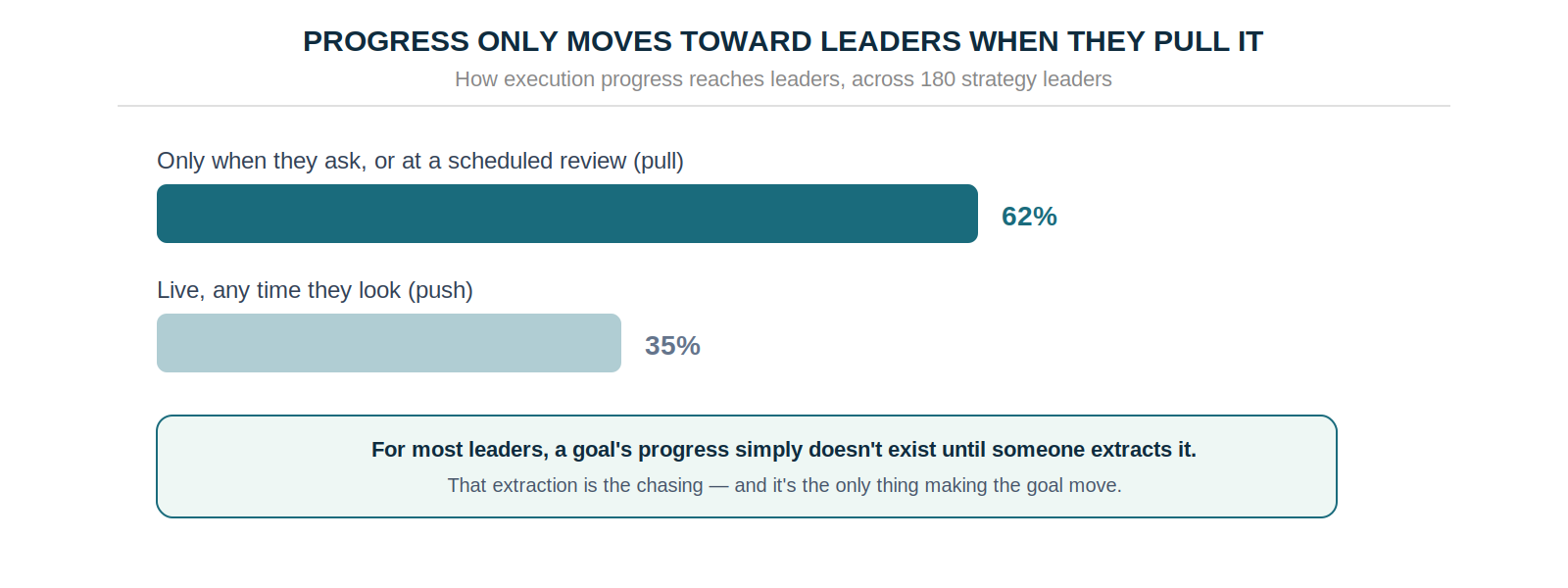
The data says pull has become the default. Across 180 leaders in the Strategy Execution Benchmark 2026, 62% said execution progress reaches them only when they ask or when a scheduled review comes around; just 35% can see it live, any time they look.
For most of a company, a goal's progress simply doesn't exist as information until a person extracts it — and the extraction is the chasing. That reframes the whole problem. You didn't fail to install accountability. You installed a pull system by default, and pull systems run on someone's continuous effort.
Why Chasing Feels Fine Until Suddenly It Doesn't
The reason this goes unnoticed for so long is that pull works at small scale, and works well.
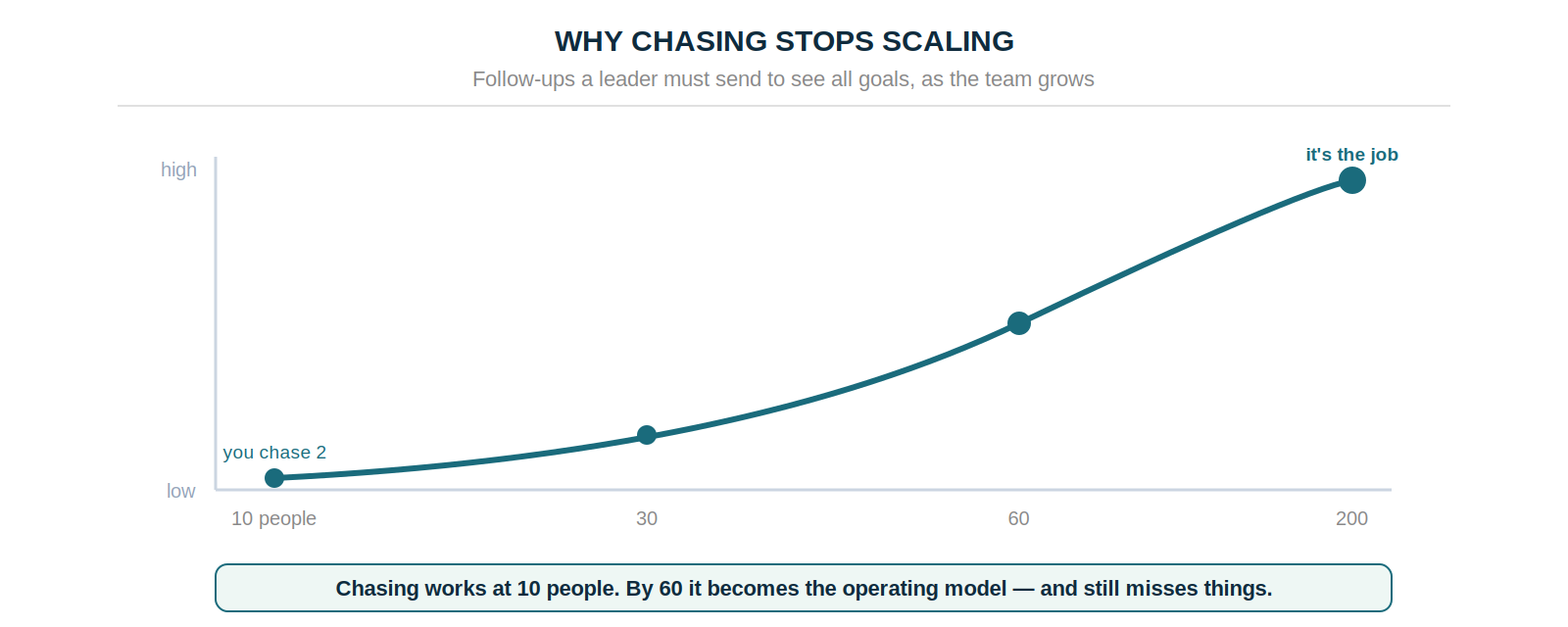
At 10 people, chasing two colleagues for an update is a two-minute conversation, and you have the whole company in your head anyway. The pull is cheap because there's so little to pull. Then you hire. Every new person adds goals, and every goal adds a thing you now have to remember to ask about. The cost of pull doesn't rise with headcount in a straight line — it compounds, because the coordination surface grows faster than the team does.
Somewhere around 50 to 80 people, the arithmetic turns: keeping the picture current would take more follow-ups than any one person can send, so the picture is never current. You feel it as a vague sense that you no longer know where things stand, punctuated by the specific horror of finding out about a stalled priority weeks after it stalled.
The trap is that nothing broke. No single follow-up failed. The system did exactly what a pull system does at scale, which is quietly stop covering everything while feeling like it still might if you just tried a bit harder.
The Discipline Misread
Here's where most leaders take the wrong turn. The chasing feels like a people problem — my team isn't proactive enough, they should update me without being asked, we need to build a culture of accountability. So the fix becomes exhortation: a stern all-hands about ownership, a new rule that everyone posts updates on Fridays, a push to make people more disciplined.
It rarely holds, and the reason is structural. Asking people to reliably push updates into a system that has no defined place for them, no fixed rhythm, and no single owner per goal is asking for discipline to compensate for missing architecture.
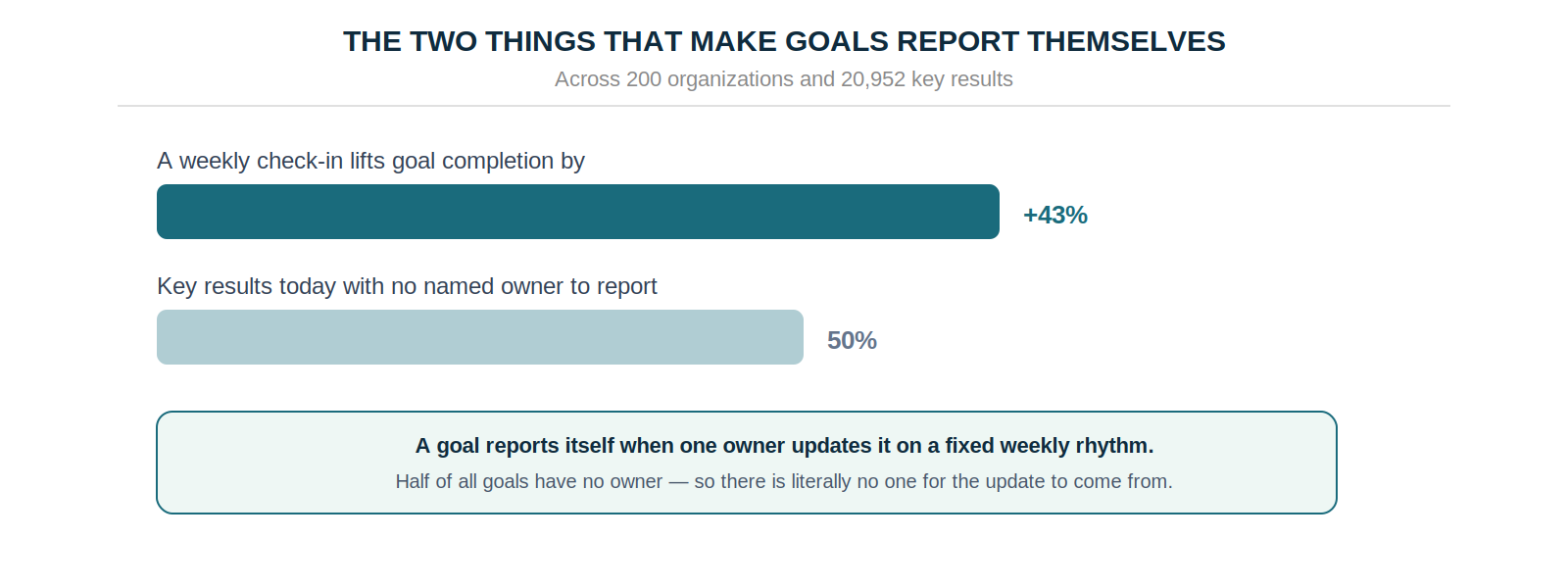
Half of all goals don't even have someone to chase: across 20,952 key results in the platform data, 50% had no named owner at all. You can't build a reporting habit on a goal that belongs to everyone, because "everyone" never feels the specific tap on the shoulder that produces an update.
The chasing isn't happening because your people lack discipline. It's happening because the goals have no structure that would let them report on their own.
What Push Actually Requires
Closing this gap isn't more meetings or a better dashboard — a dashboard is still pull, because someone has to open it and read it. Push means the goal itself surfaces when it stalls, and that takes three specific things working together.
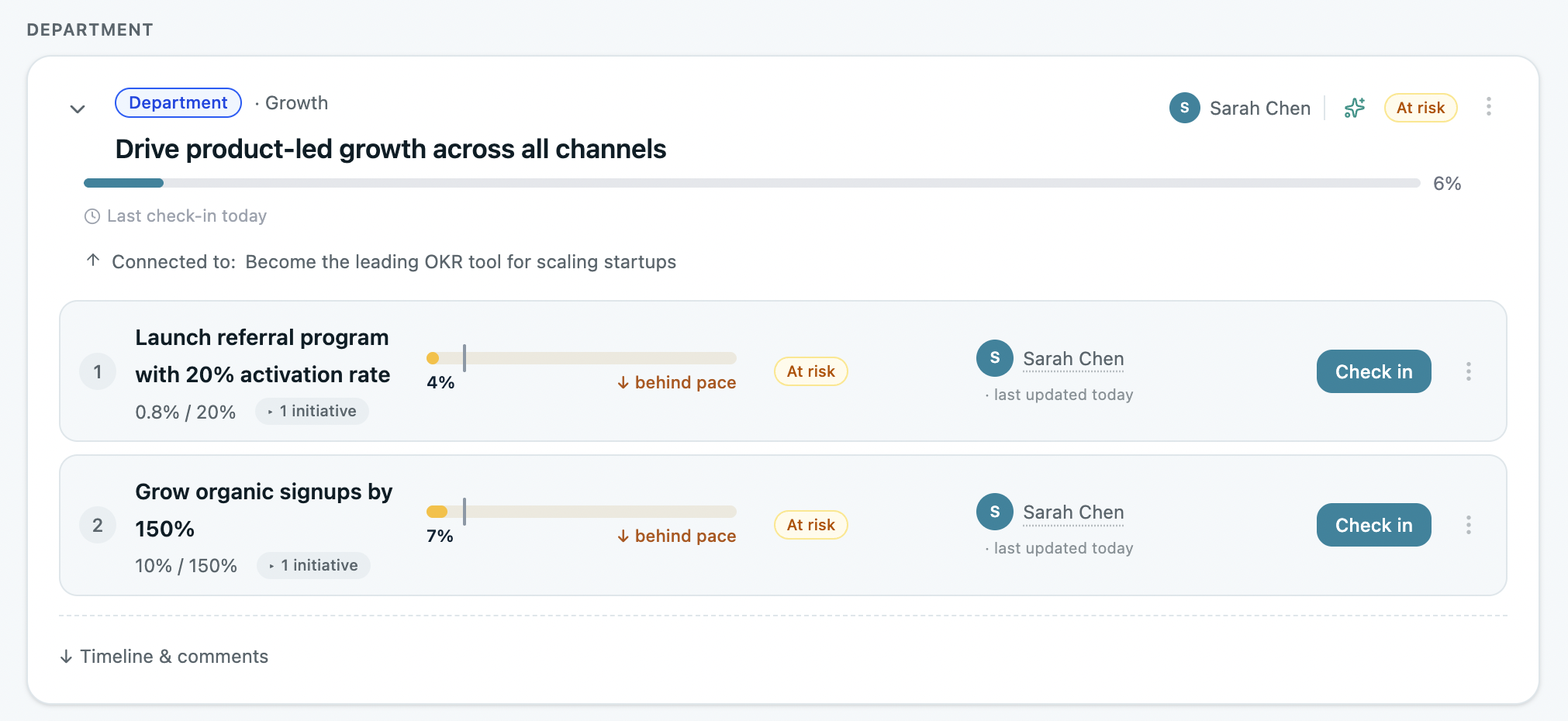
The first is a single owner per goal. A signal needs a recipient — "this key result hasn't moved in three weeks" is only actionable when one named person is accountable for it, not a team. Ownership is what converts a goal from something the leader holds in memory into something someone else is responsible for surfacing.
The second is a fixed weekly rhythm. When every key result gets a weekly check-in, a goal that stops moving becomes visible as an absence — no update this week is itself the signal, produced automatically, with nobody having to assess anything. Teams with the habit complete 43% more of their goals than those reviewing monthly or ad hoc, partly because problems surface while they're still small enough to fix.
The third is a live home for the goals, not a stored one. A goal in a spreadsheet or a slide deck can't notice that it hasn't changed and tell anyone. This is why the chasing and the tooling tend to fail together: a static document has no capacity to push, so every static document quietly forces you back into pull. The point of purpose-built OKR software is precisely that it can notice an absence and raise it, which a file never will.
Put those three together and the mechanism inverts. Instead of you pulling status out of people, the goals push their own state at you — and the only thing that reaches your desk is the exception, the goal that stalled, while it's still week three and not week eleven.
Scaling Goal Management Is a Growth Problem, Not a Goals Problem
It's tempting to file this under "we need to get better at OKRs," but the forcing function is growth itself. A pull system has a carrying capacity — a team size below which one person's follow-ups can keep the whole picture current. Scaling is the act of exceeding that capacity, reliably, every time you hire past it.
That's why the companies that scale cleanly treat progress reporting as infrastructure they install before they need it, the same way they'd add a real CRM before the deal count outgrows a spreadsheet.
Teams get measurably better at this with reps: completion climbs from 51% in a team's first two cycles to 79% by the fifth, as ownership and cadence become habit rather than exhortation. The leaders who make that climb aren't more disciplined than the ones still chasing. They stopped asking discipline to do a job that belongs to structure.
Stop Being the Reason Goals Move
The test is simple and uncomfortable: if you went quiet for two weeks — no syncs, no follow-ups, no "quick one" messages — would your goals keep moving, or would they stall in silence until you came back and started pulling again? If it's the latter, you don't have a goal-management system. You have a goal-management person, and that person is you, and you do not scale.
The way out isn't to chase harder or to guilt the team into pushing more. It's to give every goal a single owner, a weekly rhythm, and a live place to report from, so the movement stops depending on your attention and starts depending on the structure. Do that, and the thing that reaches you changes — from "everything, but only when I ask" to "just the goal that stalled, the week it stalled." That shift is what scaling goal management actually means.
Data: Strategy Execution Benchmark 2026 (180 strategy and operations leaders), The 2026 OKR Benchmark Report (200 organizations), OKRs Tool platform data (876 organizations, 20,952 key results).