Teams that go from decision to first check-in in under a week see up to 50% higher completion than teams still planning in week three. An OKR implementation plan exists to compress that window — five phases, one week to launch, twelve weeks to the first retrospective.
Deciding to implement OKRs is the easy part.
The hard part is the 72 hours after that decision, when someone has to answer: who owns this, where do we start, what does week one actually look like?
Most OKR implementations fail not because the framework is wrong, but because the rollout creates the wrong conditions from day one. Goals get set before the cadence is established. Tools get chosen before the process is clear. Teams spend three weeks in planning and start the first cycle already behind.
The benchmark data makes the cost of a slow start concrete: teams that launch OKRs in under a week see up to 50% higher completion rates than those that drag setup across several weeks. Speed of first move is one of the strongest predictors of cycle one performance.
This guide gives you a complete OKR implementation plan — the phases, the decisions, the timeline, and the template — so you can move fast without missing the things that matter.
What Is an OKR Implementation Plan?
An OKR implementation plan is a structured rollout guide that covers every step between "we're going to use OKRs" and "we have live goals, named owners, and a weekly check-in happening."
It's not a strategy document. It's not a goal-writing workshop. It's the operational blueprint that answers:
- Who owns the rollout?
- What gets done in what order?
- What does a successful first cycle look like?
- How do we avoid the failure patterns that kill most programs in cycle one?
A good implementation plan is short, specific, and fast to execute. The goal is a working OKR system — not a perfect one.
The 5-Phase OKR Implementation Plan
Phase 1: Align on Purpose (Days 1–2)
Before writing a single objective, leadership needs to agree on why OKRs are being introduced — and what specific problem they're solving.
This matters more than most teams realize. OKR programs introduced as "a management initiative" fail at a higher rate than those introduced with a specific, honest problem statement: "we're scaling past 50 people and priorities are drifting" or "we set goals in January and nobody looks at them by March."
What to do:
- Leadership holds a 90-minute session to answer three questions: what problem are we solving, what does success look like in 90 days, and what would make this fail?
- Agree on rollout scope — company-wide or pilot team first
- Name one person as the OKR champion
The pilot vs company-wide decision:Both work. The data shows fast execution matters more than the approach chosen. If the team is under 30 people, company-wide is simpler. If the team is 50–200, a pilot with one team first reduces coordination overhead and creates internal examples for the broader rollout.
Output: A one-paragraph "why we're doing this" statement to share with the team. This becomes the anchor for every decision that follows.
Phase 2: Set the Cycle Structure (Days 2–3)
Before anyone writes an OKR, the operating system needs to be in place.
Cycle decisions to make:
- Cadence: Quarterly is the standard. A 6–8 week first cycle works well for teams new to OKRs — short enough to stay focused, long enough to see meaningful progress.
- Start date: Set a specific date. OKRs start on Monday of week 1 — not "sometime next week."
- Weekly check-in slot: Block the recurring 20-minute slot before the cycle starts. This is the most important calendar decision in the entire implementation. Teams that establish the weekly cadence in week one maintain it at a significantly higher rate throughout the quarter than those that add it later.
- End-of-cycle date: Block the retrospective now. The end-of-cycle retro is easier to protect if it's in the calendar before the cycle begins.
Output: A cycle calendar — start date, weekly check-in time, mid-cycle review date, and end-of-cycle retrospective date — shared with everyone before the first OKR is written.
Phase 3: Write and Align OKRs (Days 3–5)
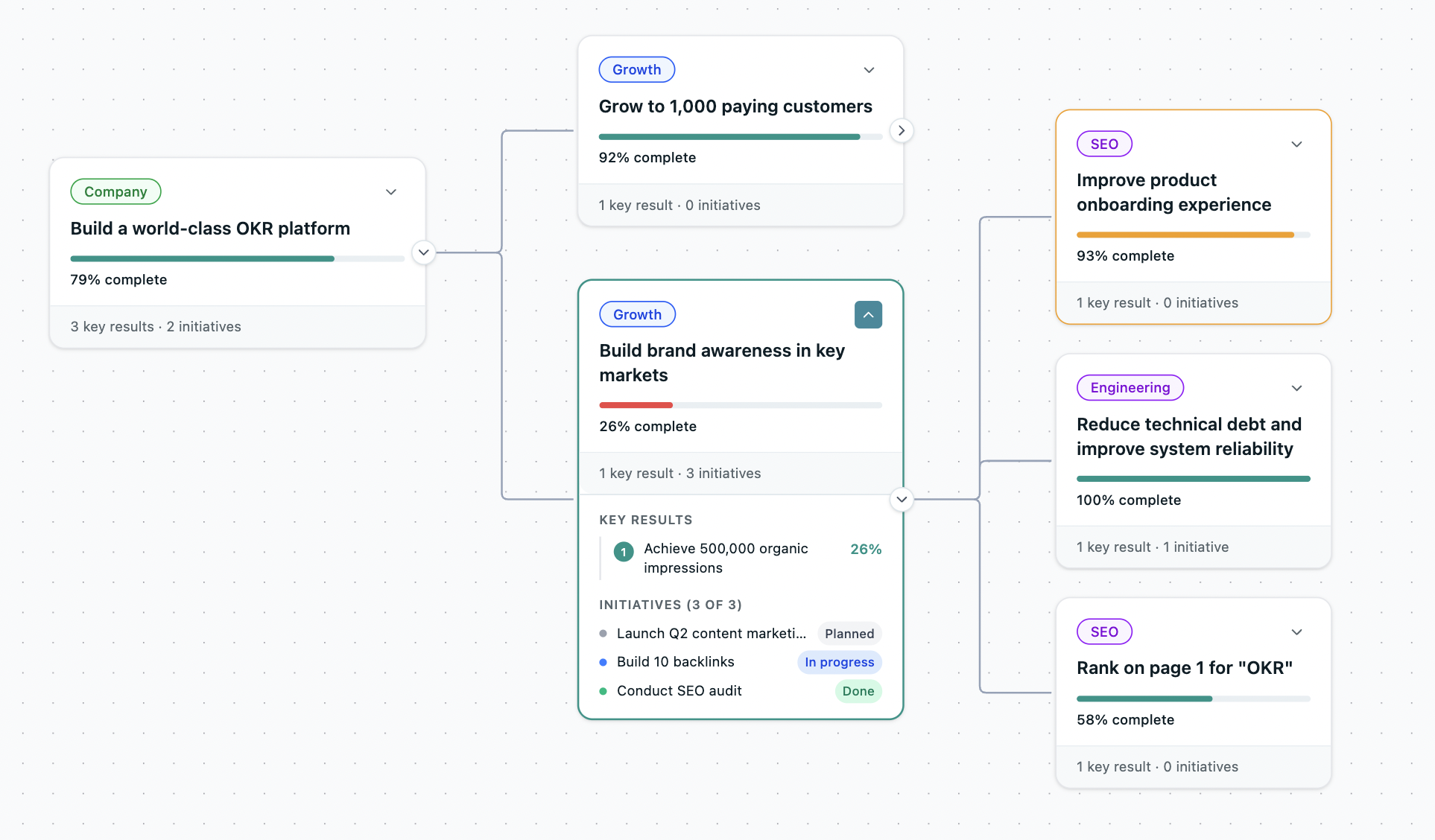
The planning session is where company-level OKRs get set, team OKRs get drafted, and ownership gets assigned — in one afternoon, not three weeks.
The planning sequence:
Step 1 — Company OKRs (60 minutes). Leadership sets 1–2 company-level Objectives with 2–3 Key Results each. These become the direction every team's OKRs connect to. Teams running 1–2 company OKRs are twice as likely to achieve them as those running three or more.
Step 2 — Team OKRs (45 minutes, in parallel). Each team lead drafts their team's OKR — 1 Objective, 2–3 Key Results — that interprets their specific contribution to the company priority. Teams work in parallel, not sequentially. This keeps planning to half a day rather than a week.
Step 3 — Alignment review (30 minutes). All team OKRs reviewed together. Check for: overlaps, misalignments, and KRs that are actually tasks or KPIs in disguise. Our analysis of 20,952 Key Results found 52% were tasks or KPIs disguised as outcomes. The alignment review is the right moment to catch this before the cycle starts.
Step 4 — Ownership assignment (15 minutes). Every Key Result gets one named owner — not a team, not "leadership." One person. Teams with clear single ownership per KR see 26% higher completion rates.
Output: Live OKRs with named owners, visible to the whole team before cycle day one.
Phase 4: Launch and Execute (Weeks 1–11)
The cycle is live. Execution now depends on three habits — and how quickly they become structural.
Weekly check-ins (every week, 20 minutes)
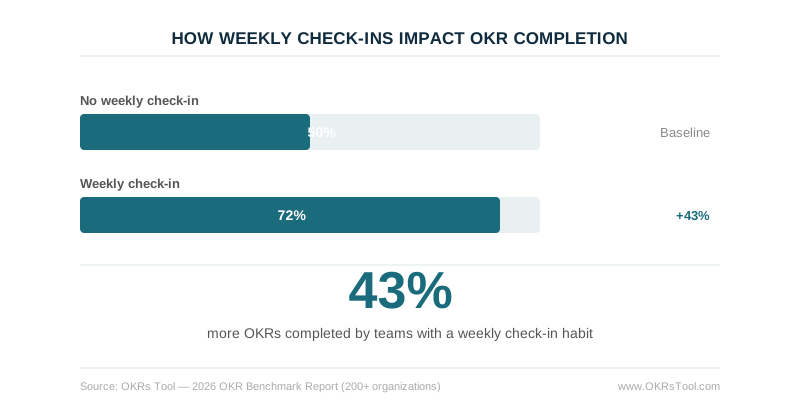
The single most impactful execution habit. Teams with weekly check-in habits complete 43% more OKRs than those reviewing monthly or ad hoc. Teams that skip the weekly rhythm are 3x more likely to abandon OKRs altogether.
Four questions, 20 minutes:
- What moved last week?
- What's at risk?
- What's the priority this week?
- Where do we need help?
Initiatives attached in week one
High-performing teams attach 2–3 initiatives per Key Result within the first week of the cycle. The initiative is the work — the campaign, the sprint, the experiment. The Key Result is what that work is trying to change. Teams that delay this step almost never recover the momentum. Launch before they're perfect.
Mid-cycle review (week 6)
A structured 60-minute check on cycle health: which OKRs are on track, which are at risk, and whether any should be adjusted given changes in the business since planning.
Adjusting OKRs mid-cycle is appropriate and expected — the key is doing it transparently. Silent rewrites erode trust in the system. Explicit adjustments with a named reason preserve it.
Phase 5: Retrospective and Reset (Week 12)
The retrospective is where the implementation becomes a system.
Teams that run structured end-of-cycle retrospectives complete 30–45% more OKRs the following quarter. By cycle five, teams complete 20.3% more goals than those still in their first two cycles. The compounding improvement comes entirely from the learning loop — and it starts here.
The 60-minute retrospective agenda:
The scoring guide: 0.7–0.8 is the target range. 1.0 every quarter means goals are too easy. Below 0.5 usually means a clarity or ownership problem. A 0.65 in cycle one is exactly right.
The Full OKR Implementation Timeline
Total elapsed time from decision to first check-in: under one week. That's the target. The benchmark data is clear — fast-launching teams are significantly more likely to complete their first cycle goals than those still planning in week three.
Common OKR Implementation Mistakes
Starting with the tool, not the process. The software choice matters less than most teams think. A process that works in a spreadsheet will work in any tool. A process that doesn't work in a spreadsheet won't be fixed by software.
Writing OKRs in isolation. Leadership sets company goals. Teams never see them until the all-hands. The cascade session (Step 3, Phase 3) only works if it's actually collaborative — teams interpreting their contribution, not just receiving direction.
No named owner at the start. The most common and most fixable mistake. If every Key Result doesn't have one named owner before the cycle starts, the 26% completion advantage disappears immediately.
Weekly check-in added in week three. By week three, the pattern is already set. If the first two weeks had no check-in, week three feels like an intervention, not a habit. The check-in has to start in week one.
Treating cycle one as a test. Teams that approach cycle one as a pilot never fully commit to the habits. The 51% average completion in cycles 1–2 isn't a ceiling — it's what happens when teams treat the framework as provisional. Commit to the system, not just the goals.
What Comes After the First Cycle
The first cycle establishes the foundation. Everything after that is refinement.
By cycle 3–4, completion rates typically rise to 59%. By cycle 5+, they reach 79%. The compounding improvement comes from the retrospective loop — each cycle, the team writes better goals, assigns clearer ownership, and runs tighter check-ins because they've learned from the previous one.
The OKR maturity curve makes the long-term case: the effort invested in a solid implementation plan pays back across every subsequent cycle. Teams that get the fundamentals right in cycle one — fast launch, named ownership, weekly rhythm, honest retrospective — consistently outperform those that spend three cycles trying to recover from a slow or chaotic start.

One Week to Launch, Twelve to Learn
Speed is the point. Not because rushing produces better goals, but because every week spent perfecting the plan is a week the team isn't building the habit that actually drives completion — and the habit is what compounds. A cycle-one team at 51% completion becomes a cycle-five team at 79% through the retrospective loop, not through a better planning document.
So aim for working, not perfect. One named owner on every key result. A twenty-minute check-in that happens every week without negotiation. An honest score at cycle end, even when it's a 0.65. Those three things, running for twelve weeks, will teach the team more about its own execution than any amount of pre-launch design.
Data: The 2026 OKR Benchmark Report (200 organizations), The ROI of OKRs 2026 Benchmark Report (330 organizations), OKRs Tool platform data (876 organizations, 20,952 key results).