
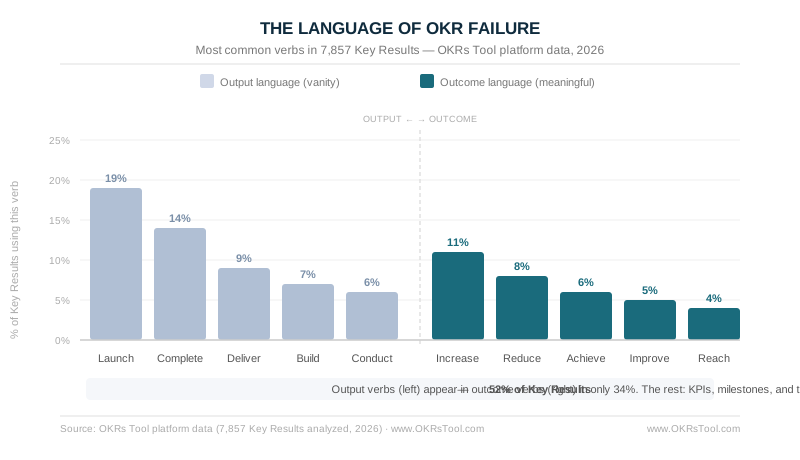
Our analysis of 7,857 Key Results found that 52% were tasks or KPIs in disguise — measuring what was done rather than what changed. Most teams tracking vanity metrics inside their OKRs don't know they're doing it. Here's how to tell the difference.
A vanity metric is any number that can go up without the business getting better.
Page views. App downloads. Social followers. Emails sent. Features shipped. These numbers feel like evidence of momentum — and sometimes they are. The problem is they're equally consistent with a business that's stagnating or declining. You can double your page views and lose customers. You can ship twenty features and watch engagement drop.
In OKRs, vanity metrics are particularly dangerous because they look like Key Results. They have a number. They can be tracked. They move. The team feels like it's making progress. And at cycle end, the scores come in green — while the actual outcome the Objective was designed to move hasn't changed at all.
Why Vanity Metrics End Up in OKRs
The 2026 OKR Benchmark Report found that 52% of Key Results across 7,857 analyzed are tasks or output metrics in disguise. Not because teams don't understand the difference between vanity and substance — but because of how goal-setting sessions actually work.
A team sits down to write Key Results. Someone asks "how do we know we're making progress?" The first answers that come to mind are the metrics the team already tracks — the ones that live in the dashboard, get reported in standups, and feel familiar. Page views. Downloads. Features shipped. Open rates.
These get written into OKRs because they're available, not because they're meaningful.
The result is a cycle where the team hits its scores, leadership sees green dashboards, and the strategic outcome — more customers, better retention, faster growth — hasn't moved. The OKR system looks like it's working. The business isn't improving.
The Diagnostic Test: Vanity Metric or Real Metric?
One question separates vanity metrics from meaningful ones:
Can this number go up while the business gets worse?
If yes — it's a vanity metric.
Page views can go up while conversions drop. Features shipped can increase while user satisfaction falls. Emails sent can grow while revenue declines. Any metric that measures activity rather than outcome will pass the vanity metric test.
The second diagnostic is equally useful:
What would cause this metric to move — and does the team control it?
If the answer is "posting more on social media" or "sending more emails" — that's an activity metric, not an outcome metric. If the answer is "we need to fundamentally change how users experience the product in their first 30 days" — that's a real outcome. Write the metric that captures the change, not the activity that might cause it.
Vanity Metrics vs Actionable Metrics: Side by Side
The pattern is consistent. Every vanity metric on the left can be replaced by an actionable metric on the right — one that measures the change the Objective actually requires.
How to Rewrite a Vanity Metric as a Real Key Result
The how to write OKRs guide covers this in detail, but the core rewrite formula is simple:
Step 1: Ask "so what?"
"We shipped 12 features." So what? "More users will engage with the product." So what? "Day 30 retention will increase." That's the metric. Write that.
Step 2: Add a baseline and a target.
"Improve retention" is not a Key Result. "Increase Day 30 retention from 28% to 45%" is. The baseline tells you where you are. The target tells you what success looks like. The gap between them is the actual OKR challenge.
Step 3: Apply the stress test.
Can this number go up while the business gets worse? Can the team move it without actually improving the outcome? If yes to either — rewrite it. If no — it's a real metric.
Step 4: Check the verb.
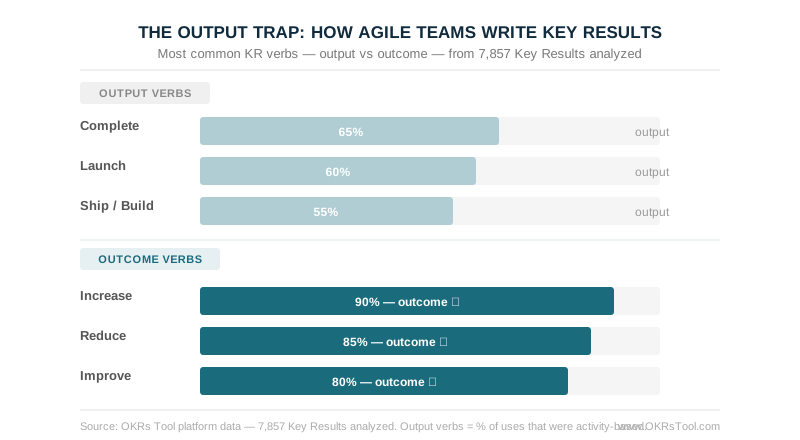
Our analysis of 7,857 Key Results found a reliable signal in the verb. Output-language KRs use: launch, complete, conduct, deliver, publish, build, create. Outcome-language KRs use: increase, reduce, improve, achieve, reach, grow, decrease. If your Key Result starts with an output verb — it's almost certainly measuring activity.
The Vanity Metric Problem in Practice
The most common vanity metric pattern in OKRs is the milestone KR — a deliverable dressed up as a measurable outcome.
"Launch the new onboarding flow by end of Q2" is a milestone. It describes something that gets done, not something that changes. You can launch the onboarding flow on deadline, have nobody use it effectively, and score 1.0 on the Key Result while the actual onboarding problem remains unsolved.
The outcome-based version: "Increase onboarding completion rate from 41% to 68% by end of Q2." This is scoreable, meaningful, and impossible to hit without actually improving the onboarding experience.
The distinction matters more than it might appear. The OKR Intelligence Report 2026 found that teams using AI for both goal-writing and mid-cycle analysis accept a low score on missed goals only 14% of the time versus 35% for teams that only use AI for writing. The analysis layer — the mid-cycle check that asks "is this KR actually measuring the right thing?" — is where the vanity metric problem gets caught and corrected.
Why OKR Software Matters for This Problem
A spreadsheet can store a vanity metric as easily as a real one. The platform has no opinion on whether "Blog posts published: 24" is measuring the right thing.
OKR software that flags output-language during Key Result creation, requires a baseline and target before a KR goes live, and surfaces mid-cycle progress against a meaningful target — rather than just a checkbox — structurally reduces the vanity metric problem.
OKRs Tool flags Key Results that use output language during setup and enforces a baseline-to-target format before the goal goes live. The weekly check-in then surfaces progress against that target every week — making it impossible to quietly avoid the question of whether the number is actually moving.
Teams with a consistent weekly check-in habit complete 43% more OKRs than those reviewing monthly. The structural habit that makes that happen also makes vanity metrics visible — because when a Key Result hasn't moved for three consecutive weeks, it's usually because the metric was measuring activity rather than outcome.
The Real Test Is Whether the Number Moves
Vanity metrics are not a sign of bad intentions. They're a sign of goal-setting sessions that default to what's already being tracked rather than what actually needs to change.
The fix is structural: outcome language over output language, baselines and targets over milestones, and a weekly review cadence that asks whether the metric is moving — not just whether the work is being done.
The how to write OKRs guide covers the full Key Result writing process. The OKR metrics guide covers the five metric types and which situations each suits. Both are worth reading before the next planning session.
Data: OKRs Tool platform data (7,857 Key Results analyzed), The 2026 OKR Benchmark Report (200+ organizations), OKR Intelligence Report 2026 (222 organizations).