Goal management software helps a company set measurable goals, assign owners, track progress, and connect daily work to strategy. This comparison scores 20 tools on the capabilities that actually move completion — weekly check-in infrastructure, required ownership, AI, and pricing — and splits them by the three buyer types the category really contains. The benchmark underneath it is blunt: teams that check in weekly complete 43% more of their goals than teams reviewing monthly or ad hoc.
Choosing goal management software is harder than it should be, because the category isn't one thing. A goal-native OKR tool, an HR platform with a goals module, and a work-management suite with a goals feature all show up in the same search — and they solve different problems for different buyers. Comparison guides tend to blur them together and rank on feature counts that don't predict whether anyone will keep using the tool.
This comparison takes the opposite approach. The 20 tools below are scored on the handful of capabilities the benchmark data ties to real completion, grouped by which of the three buyer types they fit, so you can find the right category first and the right tool second. If you're new to the discipline, the goal management primer and the OKR framework guide cover the fundamentals the tools are built around.
What Actually Matters in Goal Management Software
The features that demo well aren't the ones that drive results. The benchmark data points at a short list of capabilities that separate goal software people keep using from software they abandon by week four.
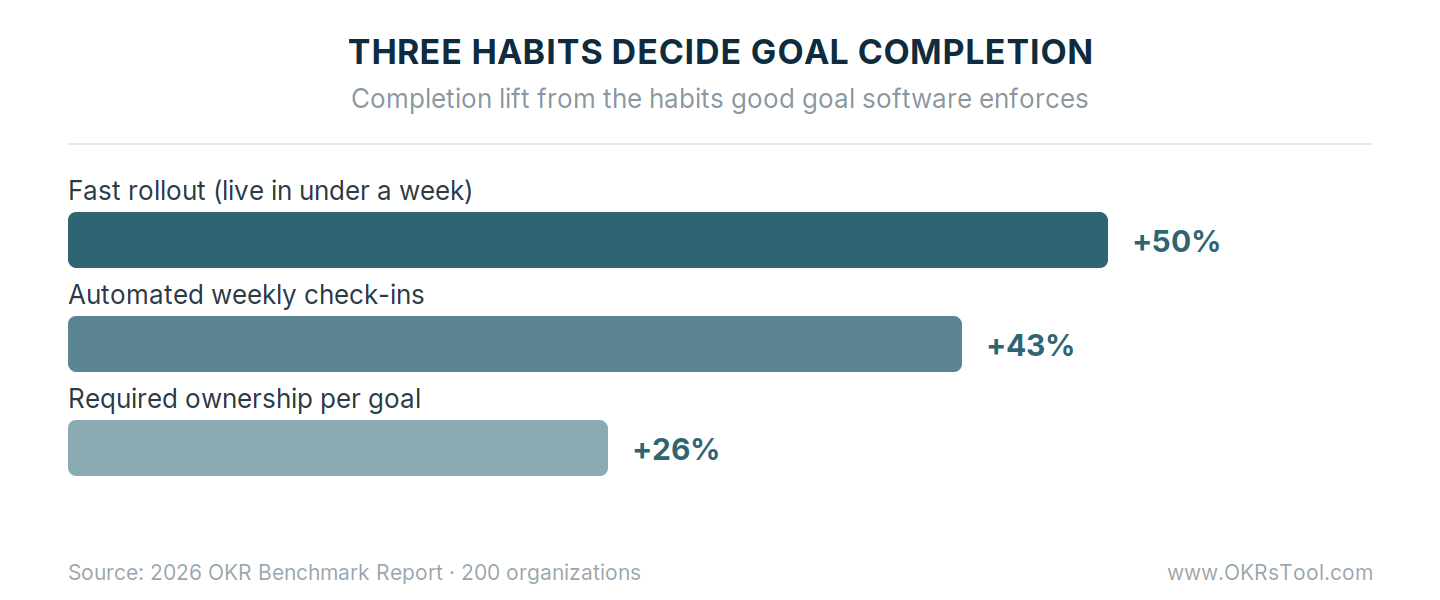
Weekly check-in infrastructure. A weekly check-in habit is worth 43% more completed goals than monthly or ad-hoc review. A tool that automates the rhythm — nudges, a light update flow, no manual scheduling — is structurally different from one that merely allows check-ins as an option, and the check-in cadence matters more than any single feature.
Required ownership per goal. Half of all goals across growing organizations have no named owner, and teams that enforce single ownership on every key result before a goal goes live complete 26% more of them. A tool that makes ownership mandatory closes that gap by design rather than relying on discipline.
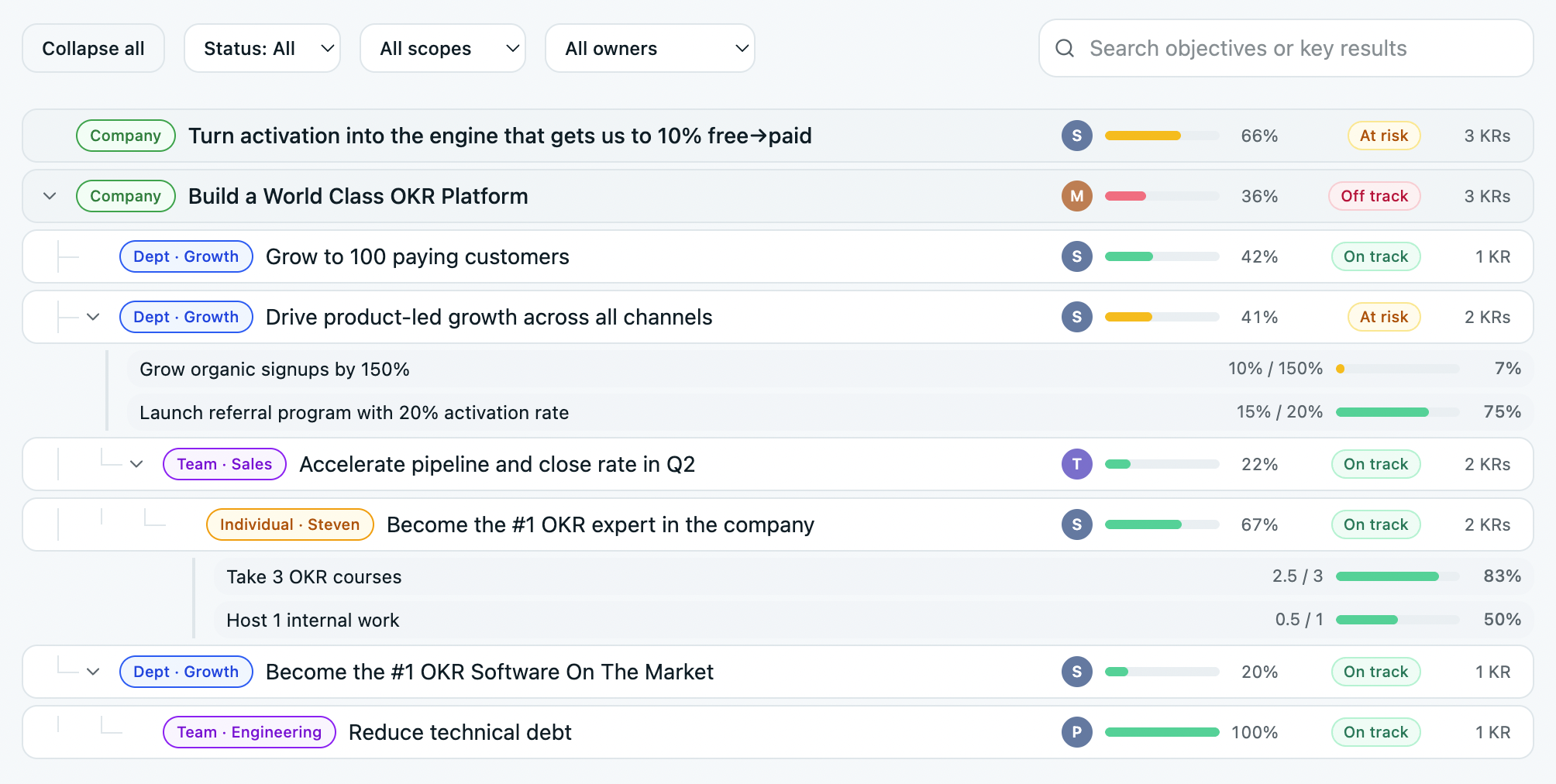
Alignment visibility. Around 65% of teams say their goals aren't tied to company strategy. A live alignment map — showing how every team's work connects to company priorities — closes that gap the way cascading goals are meant to, without a standing meeting.
Fast setup. Teams that launch in under a week see up to 50% higher completion than those with drawn-out rollouts. A tool that needs an implementation project carries that overhead straight into the first cycle's results.
Pricing that doesn't tax growth. Per-seat pricing that climbs with headcount is a structural mismatch with a tool the whole company needs to see. Flat-rate pricing stays predictable as you scale.
The Goal Management Software Comparison Matrix
Each tool below was assessed on the capabilities above, with G2 scores cited where the tool has enough verified reviews. The tools split into three groups by buyer type — goal-native platforms, HR and performance suites, and work-management tools with goals features — because the right choice depends on which category you're actually in.
The Three Buyer Types, Explained
The category split above is the most useful filter in this whole comparison, because picking the wrong category wastes weeks of demos on tools that were never going to fit.
Goal-native platforms are built around the goal itself — OKRs, KPIs, check-ins, and alignment as the core product, not a bolt-on. If a strategy, ops, or product team is running goals as a quarterly execution framework, this is the category, and the check-in and ownership infrastructure tends to be strongest here.
HR and performance suites make sense when goals connect to performance reviews, compensation, or engagement. Lattice, 15Five, Leapsome, and Betterworks bundle goal tracking with review cycles and people data. The goals module is rarely best-in-class against a dedicated tool, but the bundled performance context can be worth the trade for a people-ops-led rollout.
Work-management tools with goals features — monday.com, ClickUp, Asana — fit teams already living in those tools who want lightweight goal visibility without adding a separate system. The honest caveat the vendors themselves make: goals are not the core product, and the feature depth reflects that. It works for visibility; it's thinner on the weekly-habit enforcement that drives completion.
Why the AI Column Deserves a Closer Look
Nearly every tool now advertises AI, so "has AI" as a yes/no tells you almost nothing. What matters is which job the AI does.
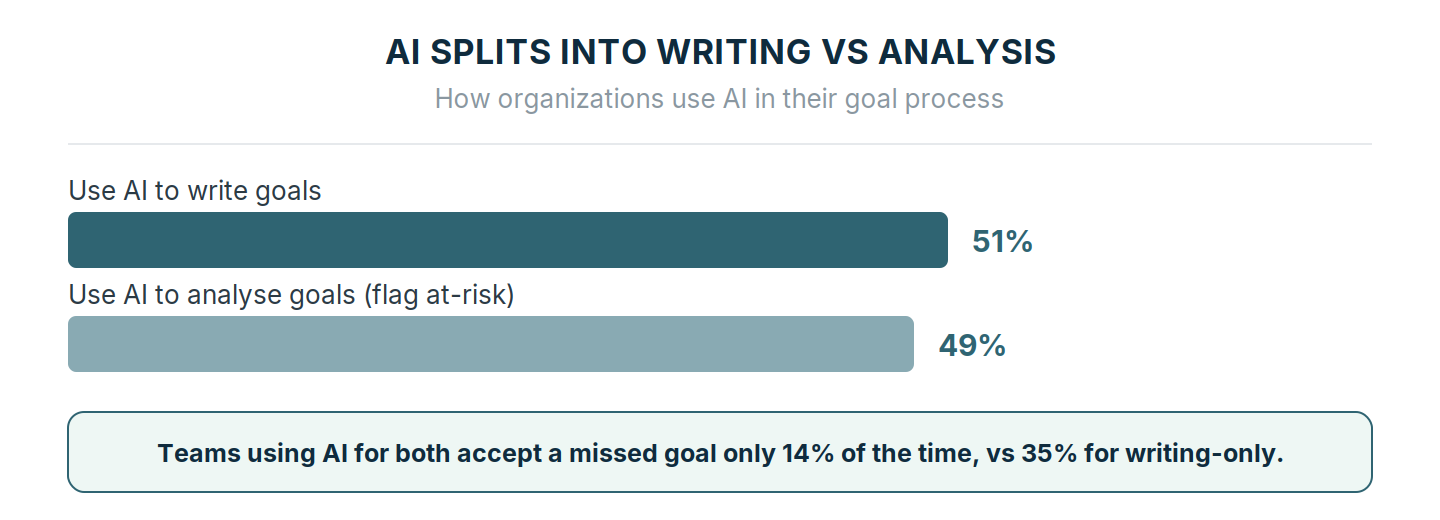
The OKR Intelligence Report 2026 found 83% of organizations now use AI in their goal process, split roughly evenly between writing (51%) and analysis (49%). Those are different capabilities. AI that drafts a cleaner goal helps at the planning stage; AI that flags an at-risk goal mid-cycle helps at the execution stage — and execution is where goals are won or lost.
Teams using AI for both writing and analysis accept a low score on a missed goal only 14% of the time, against 35% for writing-only teams. When a comparison lists "AI," check which half you're getting.
What the Matrix Alone Won't Tell You
A feature grid is a starting point, not a decision. Four things decide whether the tool you pick actually works.
Adoption isn't automatic. The most common failure pattern is a tool chosen for its feature list, adopted in week one, and abandoned by week four — one of the clearest ways goals die mid-cycle. Something light enough to build a weekly habit beats a richer tool nobody opens, and sidesteps the usual reasons goals fail.
Setup time predicts first-cycle results. The under-a-week launch advantage is real, and a tool that demands a dedicated rollout project spends that advantage before the cycle starts. Weigh time-to-live as heavily as any feature.
A tool won't fix a broken process. No feature set compensates for vague objectives or inconsistent check-ins. Pick the tool that reinforces the habits you want — weekly reviews, named ownership, honest scoring — rather than one that adds process for its own sake.
Per-user pricing compounds. A tool at $8 per user per month runs $800 a month at 100 people and $4,000 at 500. Flat-rate pricing stays flat; per-seat pricing becomes a growth tax, and it discourages the whole-company visibility goal management depends on.
Our Pick for Growing Teams
Full disclosure: OKRs Tool is our own product, so we're biased. We built it because we couldn't find a goal-native tool that made the weekly execution habit structurally unavoidable for a 50–200 person team without enterprise complexity or per-seat pricing.
The capabilities the data ties to completion — required ownership before any goal goes live, automated weekly nudges, a live alignment map, AI for both goal drafting and at-risk flagging, and review-linked goals — are on by default rather than gated behind an enterprise tier, all in one platform.
Pricing is flat: free for up to 5 users, then flat monthly tiers as you grow, with no per-user fees. For the wider field, the OKR software comparison scores the goal-native category in more depth, team OKRs covers how to roll goals down to each team, and progress tracking explains the update flow that keeps them live.
If the matrix pointed you elsewhere, those are the right calls for those situations: Tability for the cleanest check-in UX, Lattice or 15Five when goals must connect to performance reviews, Teamflect for Microsoft 365 shops, and monday.com or ClickUp when your team already lives there and wants goals beside the work.
The Shortlist, in One Line
Twenty tools, one filter: which makes the weekly habit unavoidable rather than optional, in the category that fits how your team works. For a growing team running goals as an execution framework, a goal-native tool wins; for a people-ops rollout, an HR suite; for a team already inside a work platform, its goals feature may be enough.
Start a free cycle, run one real week of check-ins, and you'll know inside seven days whether the tool disappears into the work or adds to it. That test settles the comparison faster than any feature grid.
Data: The 2026 OKR Benchmark Report (200 organizations) and the OKR Intelligence Report 2026 (222 organizations). G2 ratings as of 2026; verify current pricing with each vendor.