Betterworks is built for 500-plus employees, HR-led programmes, and enterprise budgets, and below that line the economics invert: enterprise platforms return 1:16 per dollar against 1:88 for purpose-built OKR software. The overhead that buys depth at a thousand people delays the weekly habit at a hundred. Ten alternatives, with honest notes on which ones you can actually test yourself.
Betterworks connects OKRs to continuous feedback, calibration, and compensation data in a single system. For a thousand-person company with an HR team to administer it, that integration justifies both the price and the implementation. Teams searching for Betterworks alternatives are usually signalling that they aren't that company — the best OKR software for a hundred people looks nothing like the best for a thousand.
The complaints repeat with striking consistency: no self-serve evaluation, pricing that assumes a procurement cycle, implementation that needs dedicated support, and depth that turns into overhead somewhere around a hundred people, which is where most OKR programmes fail. The ROI of OKRs 2026 Benchmark Report puts a number on what that costs — enterprise platforms return 1:16 per dollar against 1:88 for purpose-built OKR software, because every week spent in implementation is a week not spent on the weekly check-in that actually drives completion.
A note on method: I signed up for a real account and ran a live cycle wherever self-serve evaluation was possible.
Why Teams Look for Betterworks Alternatives
Four reasons come up again and again, in G2 reviews and in direct conversations.
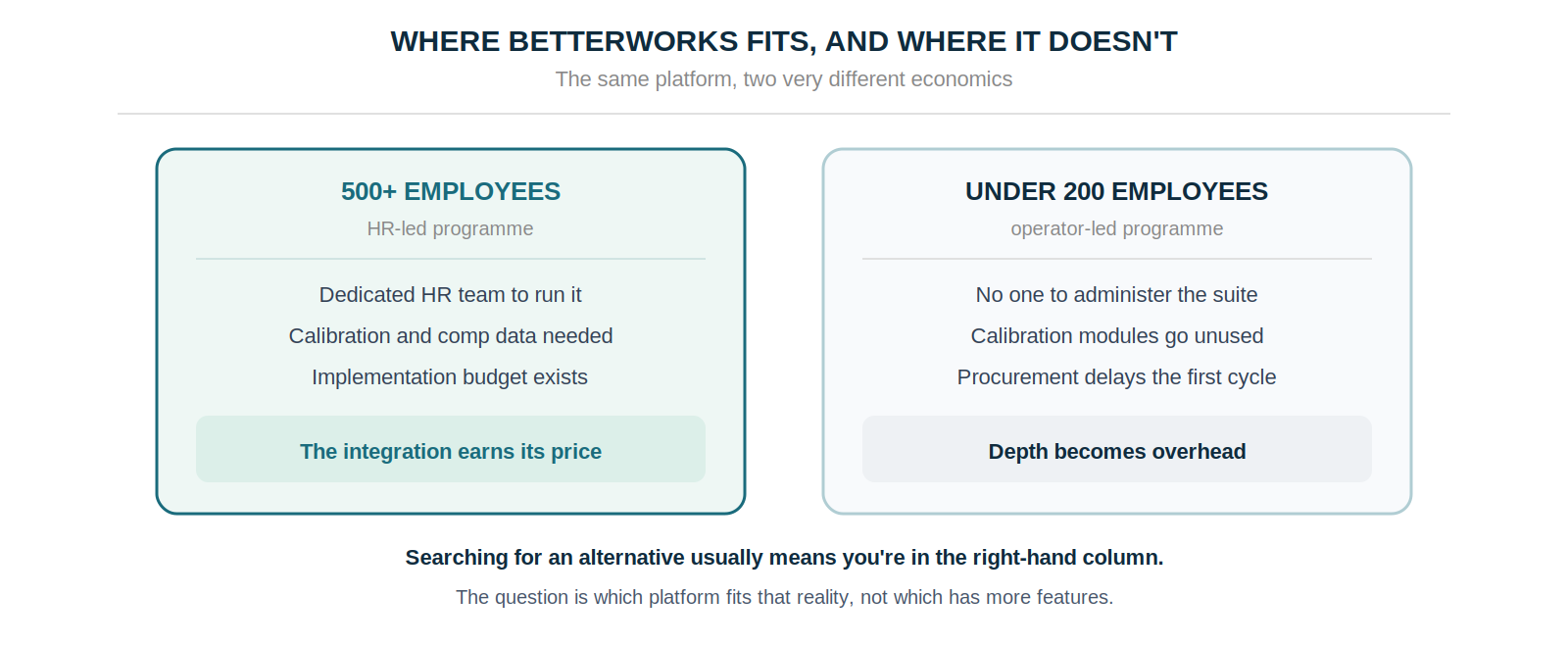
Pricing. Betterworks is enterprise-priced, and teams evaluating alternatives are typically looking for something that doesn't require a procurement cycle or a multi-year contract to get started.
Setup complexity. Proper implementation needs dedicated onboarding support. For a team that wants OKRs running this quarter rather than next year, that timeline is the blocker.
No self-serve evaluation. You can't sign up and test Betterworks; a sales demo is mandatory. Nearly every alternative here offers a free trial or free plan you can evaluate on your own schedule.
Feature depth that becomes overhead. The platform is designed for HR-led programmes at 500-plus employees. Under 200, the calibration modules, HRIS integrations, and manager coaching tools add administrative weight without adding execution value.
What to Judge a Betterworks Alternative On
Feature parity is the wrong test. The benchmark data points at three habits that predict whether a goal programme works, and the right question is which platform makes them automatic.
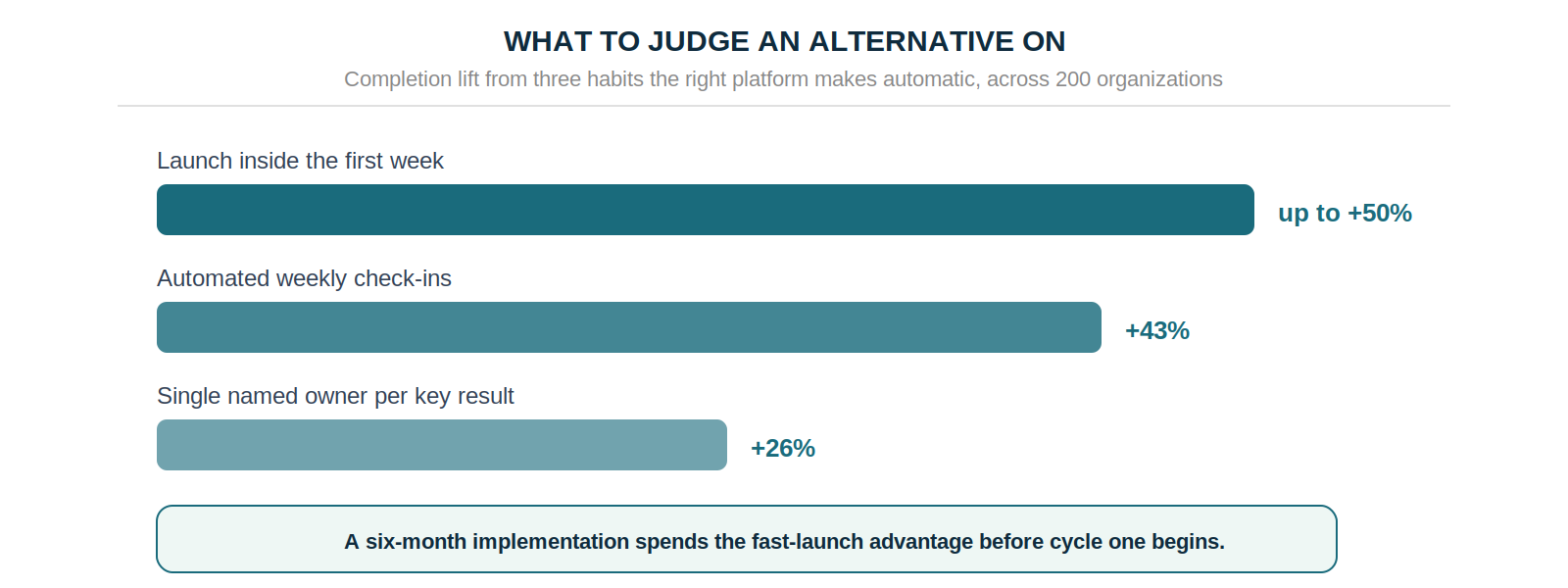
Teams with an automated weekly check-in complete 43% more of their goals than those reviewing monthly or ad hoc. Teams enforcing a single named owner per key result complete 26% more. And teams that launch inside the first week of a cycle see up to 50% higher completion than those with drawn-out rollouts — which is precisely where a six-month enterprise implementation spends its advantage before the first cycle even begins.
Betterworks Alternatives at a Glance
The 10 Best Betterworks Alternatives
1. OKRs Tool
Best for: Growing teams (50–200 people) who need OKRs working this quarter
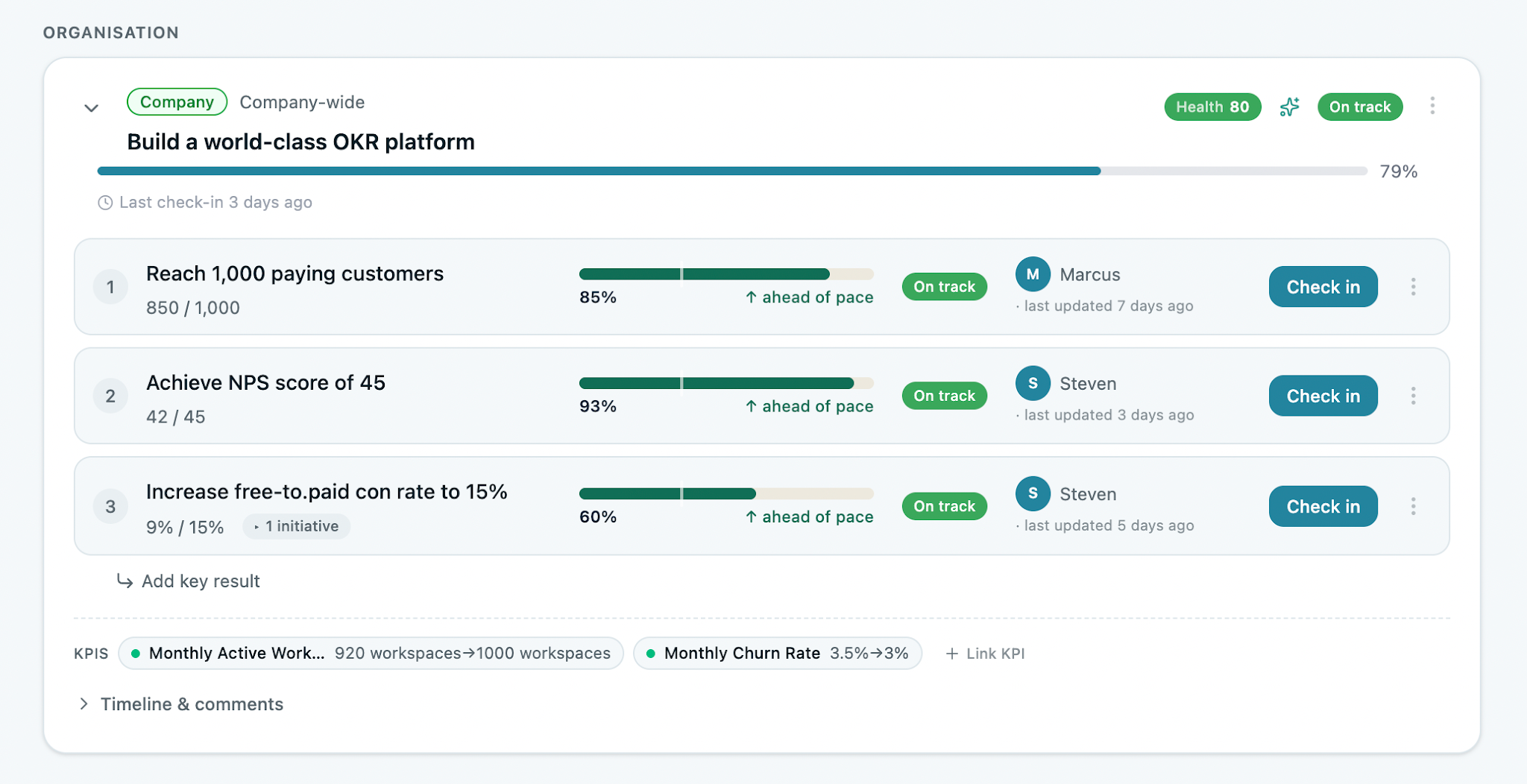
OKRs Tool is the sharpest contrast to Betterworks on this list. Where Betterworks is built for enterprise HR teams running annual calibration cycles, OKRs Tool is built for the VP, Head of Department, or team lead who needs their team running OKRs this quarter — without IT approval, a procurement cycle, or a consultant.
The structural difference that matters most: every Key Result requires a single named owner before it goes live. This isn't a reminder — it's a hard gate. Teams with required single ownership see 26% higher completion rates. Betterworks supports ownership assignment but doesn't enforce it structurally.
The performance review module connects directly to OKR delivery data — KR completion rates appear automatically in reviews alongside 360 feedback and AI-generated themes. No manual compilation, no disconnected systems.
The ROI benchmark: organizations using OKRs Tool generate a 1:88 return — compared to 1:16 for enterprise OKR software. The gap is the overhead. OKRs Tool removes it.
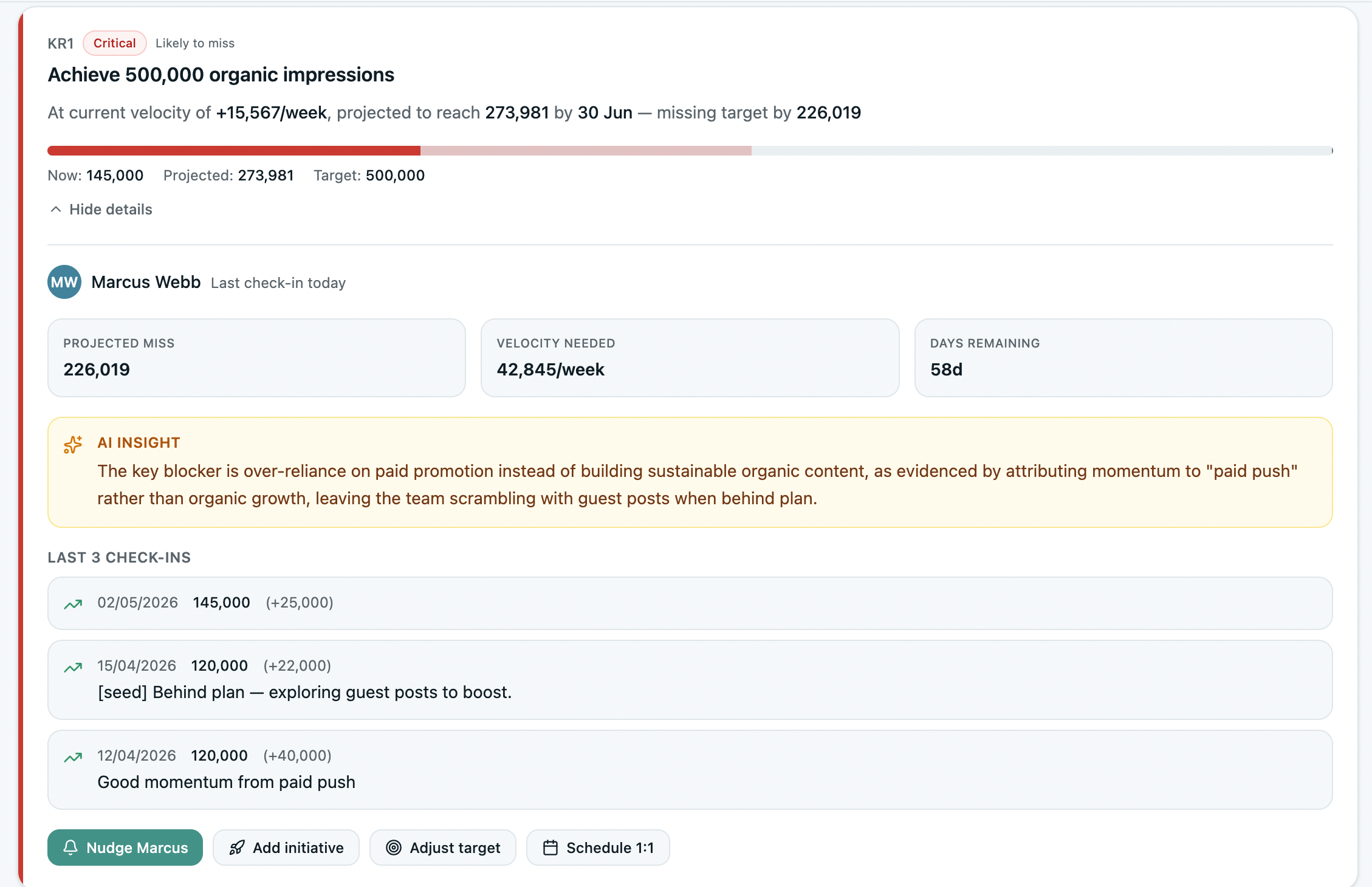
Pricing: Free for 1–5 users. $49/month Scale (6–50). $129/month Expand (51+, SSO + concierge). G2 Rating: 4.6/5 — "Extremely cost effective and easy to use — I can set it up in minutes without training anyone." — Mahir, Trillium (130 people)
2. Lattice
Best for: HR-led organizations that want the closest feature comparison to Betterworks

Lattice is the most direct Betterworks alternative for organizations where OKRs need to connect to performance management, engagement surveys, and compensation data in one system. Goals, continuous feedback, structured reviews, and calibration — all in a single platform with transparent pricing and a self-serve trial.
The key difference from Betterworks: Lattice is accessible to organizations under 500 people without a six-month enterprise engagement. The platform scales from teams of 50 to thousands, and pricing is visible without a sales call.
Note: Lattice required a sales demo to fully evaluate — included here based on G2 reviews and public product documentation.
Pricing: From $11/user/month (Goals module). Full suite from $19/user/month. G2 Rating: 4.7/5
3. Perdoo
Best for: Mid-market organizations connecting strategy to OKRs and KPIs

Perdoo connects strategic vision to quarterly OKRs and KPIs through a visual strategy map — making it the right Betterworks alternative for organizations where the primary need is alignment visibility rather than full HR programme integration.
The Kudos feature maintains engagement mid-cycle when motivation typically dips. The strategy map gives leadership a clear view of how every team's work connects upward — without a dedicated alignment meeting.
Pricing: Free for up to 5 users. From €8/user/month (10-seat minimum). G2 Rating: 4.5/5
4. Tability
Best for: Metrics-driven teams that want the best check-in UX on the market

Tability is the sharpest Betterworks alternative for teams whose primary frustration is that OKR updates stop happening. Automated weekly check-ins, a genuinely beautiful UI, and the best onboarding experience of any tool I tested — Tability makes the weekly habit structurally easy to maintain.
The limitation vs Betterworks: no performance review module. Tability is a pure OKR and goal-tracking platform. If performance management integration is a requirement, look at Lattice or OKRs Tool instead.
Pricing: From $6/user/month. 14-day free trial (credit card required). G2 Rating: 4.7/5
5. 15Five
Best for: Teams that want weekly check-ins and performance reviews tightly integrated
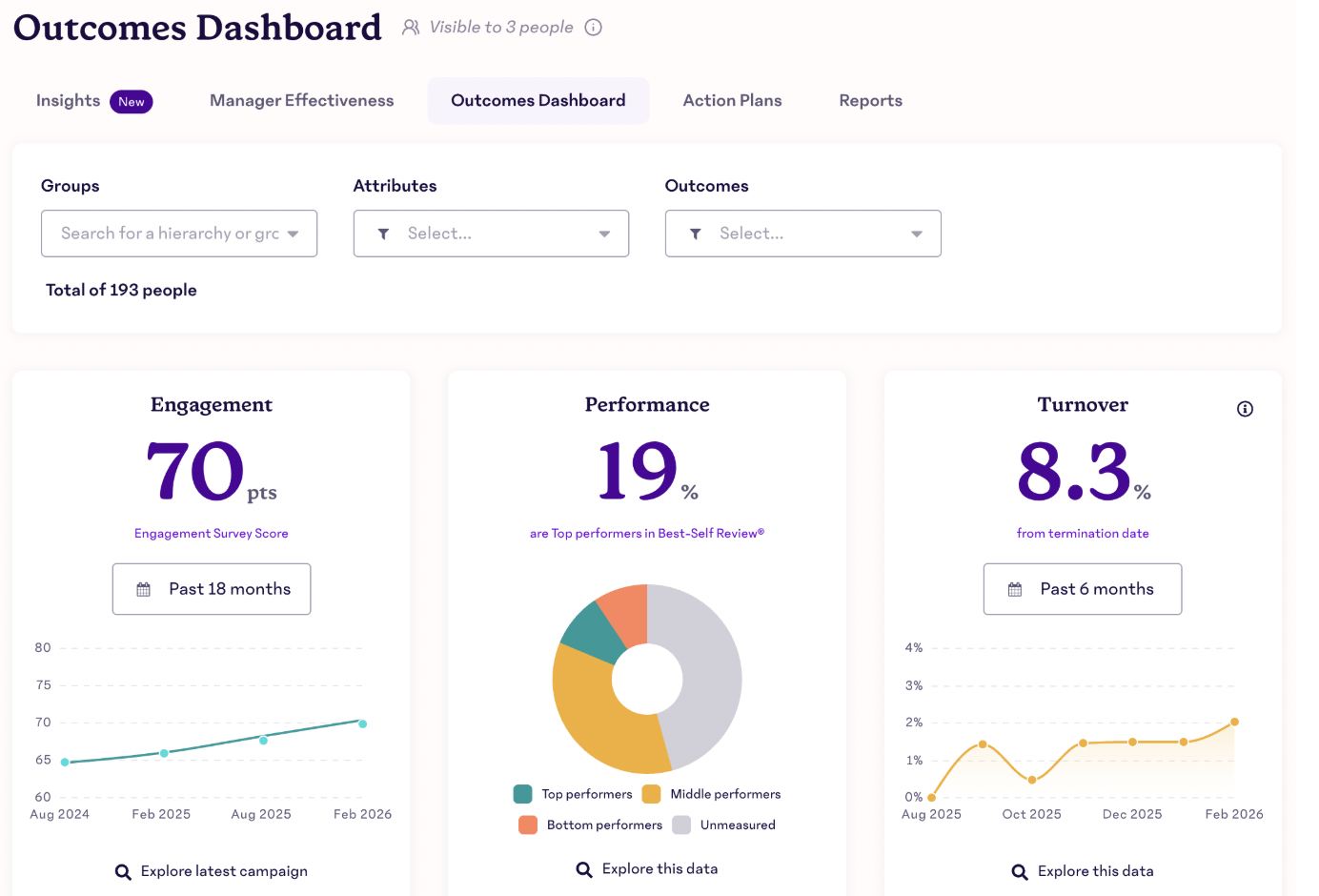
15Five is a performance management platform built around the weekly check-in as a first-class feature. OKRs, weekly pulse surveys, 1:1 templates, and performance reviews all connect through a continuous feedback rhythm — making it a natural Betterworks alternative for organizations where weekly engagement is the primary driver.
The 15Five methodology — setting ambitious targets, checking in weekly, reviewing regularly — mirrors the OKR execution habits that our benchmark data consistently identifies as the highest-return behaviors. The platform makes those habits the default, not an add-on.
Pricing: From $4/user/month (Engage). OKRs from $14/user/month (Perform). G2 Rating: 4.6/5
6. Leapsome
Best for: European organizations that want Betterworks-equivalent depth with better UX
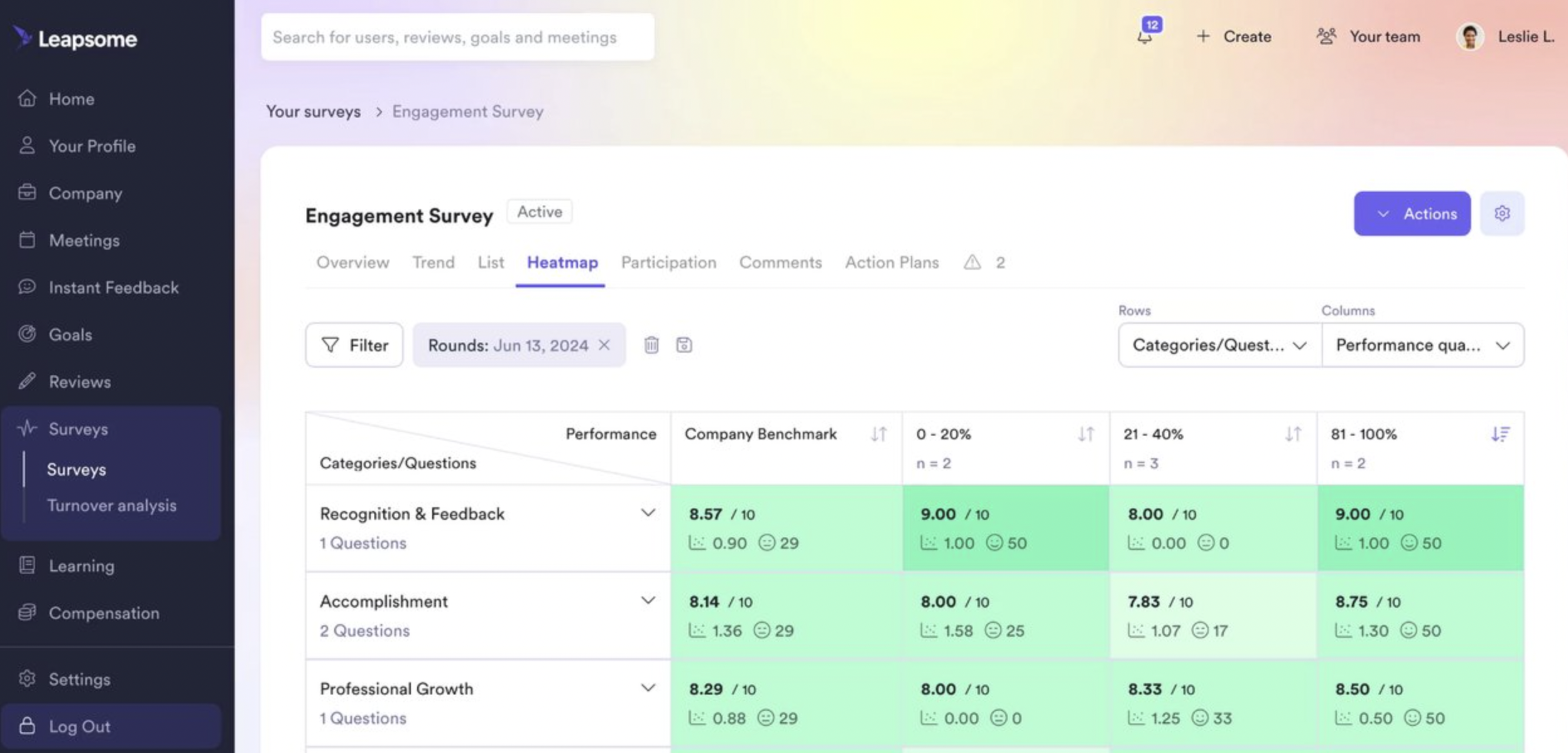
Leapsome is the highest-rated platform on this list — 4.8/5 on G2 — and arguably the most polished Betterworks alternative for organizations that need goals, reviews, learning, and engagement in one system. It consistently tops G2 ratings across multiple HR software categories.
The platform's goal module connects OKRs to individual development plans, performance reviews, and learning pathways — creating a connected people programme rather than disconnected tools. Particularly strong for organizations with a European base or GDPR compliance requirements.
Pricing: From $8/user/month. Custom pricing for full suite. G2 Rating: 4.8/5
7. Mooncamp
Best for: Visual thinkers who want flexible OKR and strategy mapping

Mooncamp is a clean, modern OKR platform with a strong strategy map feature and one of the best Viva Goals migration paths on the market. For organizations displaced by Microsoft's shutdown of Viva Goals and looking for a Betterworks alternative without enterprise complexity, Mooncamp is the most natural destination.
The strategy map provides clear visibility of how all OKRs connect — without the complexity that makes enterprise tools inaccessible for growing teams.
Pricing: From €6/user/month. 14-day free trial. G2 Rating: 4.7/5
8. Synergita
Best for: HR-led organizations that want OKRs linked to performance development

Synergita combines OKR tracking with performance management and development plans — making it a Betterworks alternative for HR teams that want goals to feed directly into review cycles without enterprise pricing. Setting up a goal was faster here than on almost any other platform I tested.
The limitation: updating goals proved trickier than creating them. Progress tracking mid-cycle wasn't intuitive — which is a meaningful gap for a tool whose core job is keeping OKRs alive all quarter.
Pricing: Free forever (limited). Paid plans on request. G2 Rating: 4.5/5
9. Profit.co
Best for: Teams that want Betterworks-level breadth without the sales cycle
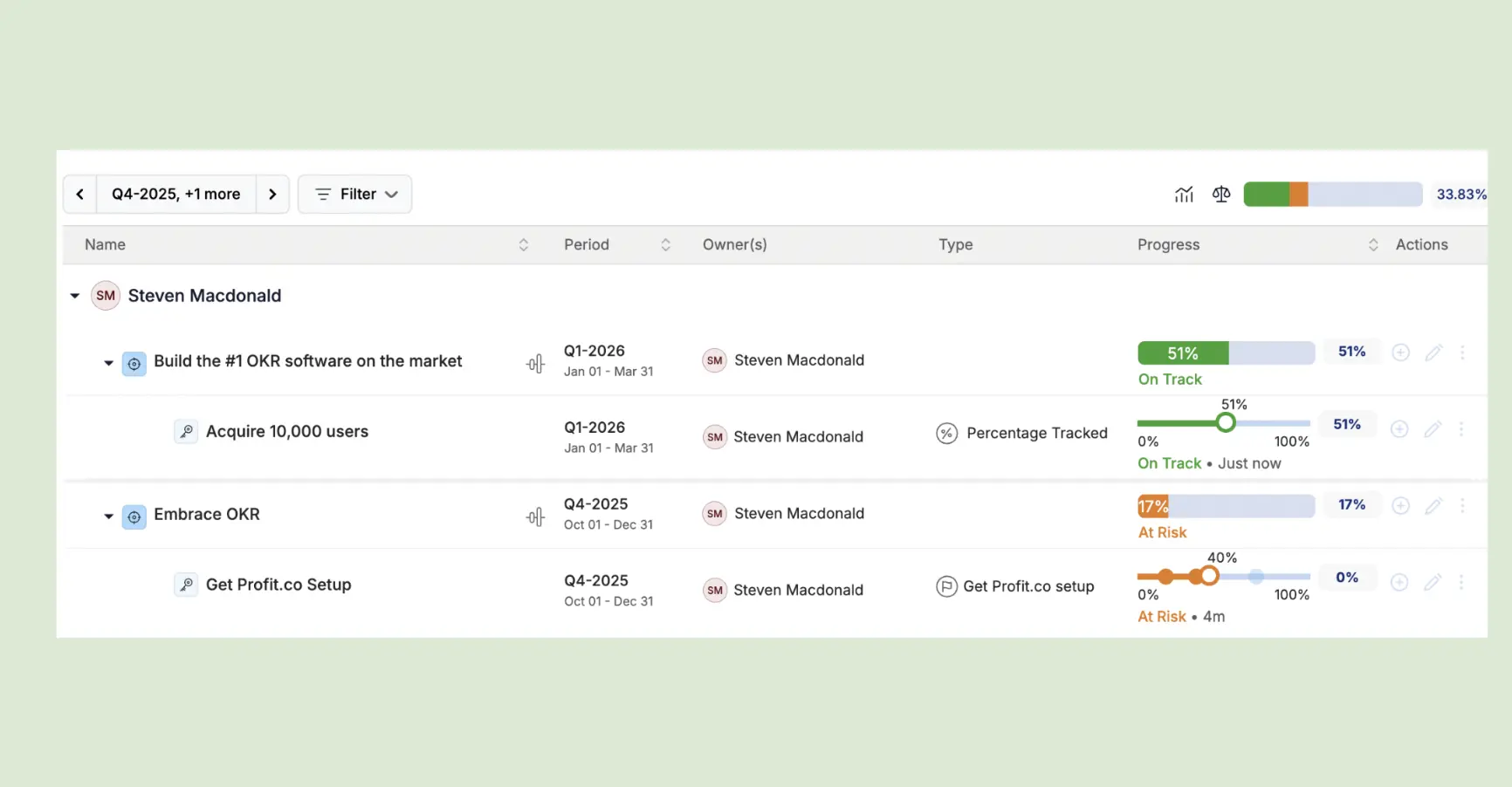
Profit.co is the closest thing on this list to a full Betterworks feature match that you can actually sign up for and evaluate yourself. OKRs, task management, performance reviews, and engagement surveys all sit in one platform — the same breadth Betterworks sells, minus the procurement cycle and the implementation project.
The practical advantage for a growing team is that you can start with just the OKR module and layer the rest in later, rather than committing to a whole-suite rollout on day one. The trade-off is that breadth: onboarding solo takes real time, and the interface carries the weight of everything it does.
Pricing: Free trial available. G2 Rating: 4.7/5
10. Teamflect
Best for: Organizations running on Microsoft 365
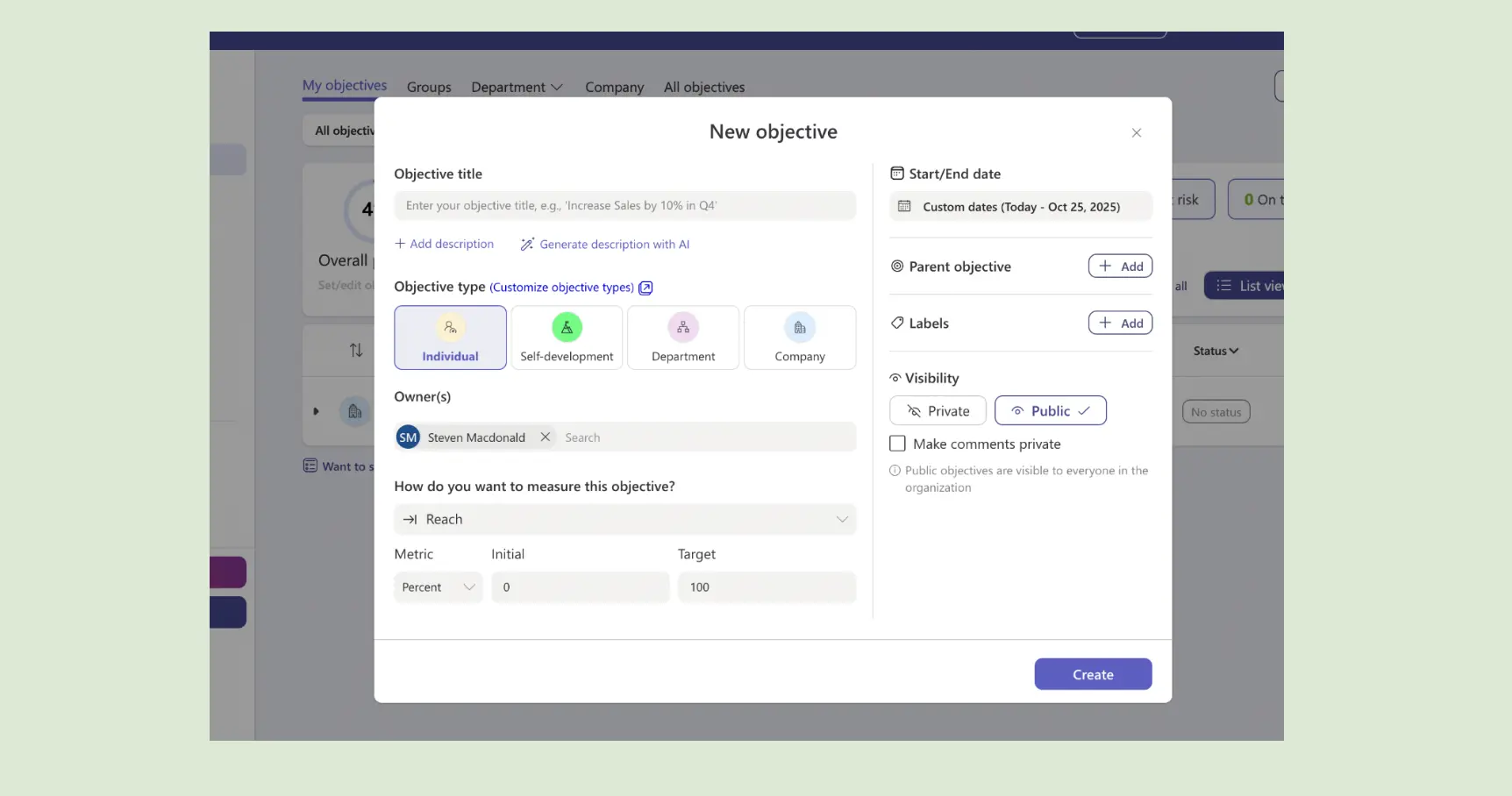
Teamflect is the strongest Betterworks alternative for teams that already live inside Microsoft Teams. Goals, reviews, 1:1s, and feedback run within the Teams interface rather than alongside it — removing the adoption friction of introducing another platform, which is the single biggest predictor of whether a rollout survives past week four.
At 4.8/5 it ties for the highest G2 rating on this list. The trade-off is total ecosystem dependency: outside Microsoft 365 there's no reason to consider it.
Pricing: Free for up to 10 users, then $3–7/user/month. G2 Rating: 4.8/5
Matching the Alternative to the Problem
The right choice follows from what you're actually trying to fix, not from which platform has the longest feature list.
The Shortlist for Growing Teams
Betterworks is the right tool for a specific organization: large, HR-led, with the budget and bandwidth to extract full value from an enterprise suite. If that describes you, the alternatives above are a downgrade.
For a team of 50 to 200 where an operator needs OKRs working this quarter rather than after a six-month implementation, the answer is OKRs Tool — ownership enforced, check-ins automated, reviews connected to delivery, flat-rate, live the same afternoon. If you need full HR-suite parity, Lattice or Leapsome. If you're a Microsoft shop, Teamflect. If check-in discipline is the only gap, Tability.
Whichever you shortlist, run one real cycle before committing. A platform that survives a full quarter of weekly check-ins has proven the only thing that matters; one that looks impressive in a demo has proven nothing.
Data: The ROI of OKRs 2026 Benchmark Report (330 organizations), The 2026 OKR Benchmark Report (200 organizations).