
Playing to Win defines the five strategic choices that determine where a company competes and how it wins. OKRs translate those choices into quarterly execution — the specific outcomes each team is working to move this cycle. The connection isn't accidental. Roger Martin's framework explicitly identifies Management Systems as the fifth and final choice, the layer where strategy either gets operationalized or quietly abandoned. That layer is exactly what OKRs are built to fill.
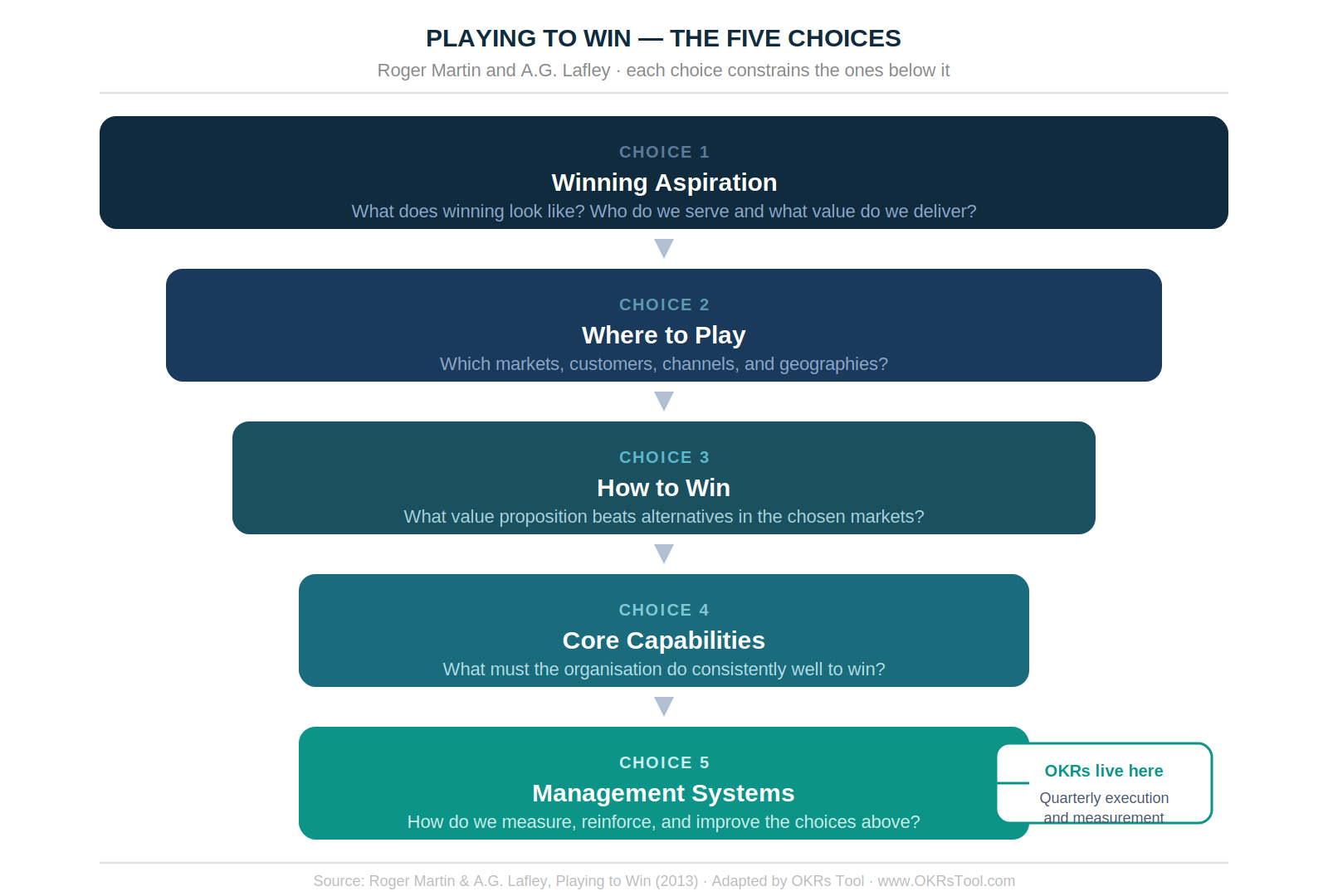
Roger Martin and A.G. Lafley developed Playing to Win at Procter & Gamble in the early 2000s as a framework for making the five strategic choices that determine competitive success: a Winning Aspiration that defines what winning means for the organization, a Where to Play decision about which markets and customers to serve, a How to Win choice about the value proposition that beats alternatives in those markets, the Core Capabilities required to deliver that proposition, and the Management Systems that measure, reinforce, and improve the choices above.
The cascade is deliberate — each choice constrains the ones below it, from the Winning Aspiration that sets direction down through Where to Play, How to Win, and Core Capabilities to the Management Systems that determine whether the first four choices are actually working. Most organizations make the first four choices reasonably well. The fifth is where strategy dies — not because it's conceptually unclear, but because nobody has defined the operational mechanism that keeps those choices visible in the daily work of every team.
The 2026 OKR Benchmark Report makes the cost of that gap concrete: only 5% of teams have more than 75% of their weekly work tied to a strategic goal. 65% of teams admit their goals aren't clearly linked to company strategy at all. That's the Management Systems failure Playing to Win identifies — strategy that exists in the first four choices but never reaches the work.
What Playing to Win Actually Is
Playing to Win is a strategy framework built on five cascading choices. Martin and Lafley's insight was that strategy is not a vision document or a plan — it's an integrated set of choices that reinforce each other. You can't make the How to Win choice without first making the Where to Play choice. You can't identify Core Capabilities without knowing How to Win. And you can't design Management Systems without knowing what you need to measure and reinforce across the first four choices.
Winning Aspiration is the directional choice: what does winning look like for this organization, and for whom? It's qualitative and aspirational — not a revenue target or a market share figure, but a description of what a winning position actually means. Procter & Gamble's original Winning Aspiration under Lafley was to be the best consumer goods company in the world in the eyes of the consumers it serves — a directional statement that constrained everything that followed.
Where to Play defines the competitive arenas: which geographies, customer segments, product categories, channels, and price points the organization will compete in. This is explicitly a choice about where not to play as much as where to play. Every Where to Play decision forecloses other options — and that foreclosure is the point.
How to Win defines the value proposition that beats alternatives in the chosen arenas. For P&G, the choice was product superiority — winning through demonstrably better products rather than lowest cost or distribution dominance. How to Win must be specific to the arenas chosen in Where to Play, not a generic statement of competitive intent.
Core Capabilities are the activities and competencies that must exist to deliver the How to Win proposition in the chosen arenas. These are not aspirational — they're the specific things the organization must be able to do consistently and better than alternatives to win where it has chosen to compete.
Management Systems are the processes, measures, and organizational structures that ensure the first four choices are implemented, monitored, and reinforced. This is the operationalization layer — the mechanisms that translate strategic intent into the daily work of every team.
Where OKRs Fit
OKRs are a Management Systems tool. They're not a strategy framework — they don't help you choose where to play or define your winning proposition. What they do is translate those strategic choices into quarterly execution: the specific outcomes each team is working to move this cycle, the named owner responsible for each outcome, and the weekly check-in that keeps progress visible rather than assumed.
Martin's critique of most Management Systems is that they measure the wrong things — financial metrics and operational KPIs that tell you whether the business is running, not whether the strategic choices are working. A Where to Play choice to expand into mid-market enterprise customers won't show up in a revenue KPI for two or three quarterly cycles. It will show up in a well-written OKR in cycle one — "Generate 40 qualified enterprise opportunities from the mid-market segment by end of Q3" — that makes the strategic choice visible, owned, and tracked while it's still being executed rather than after it has succeeded or failed.
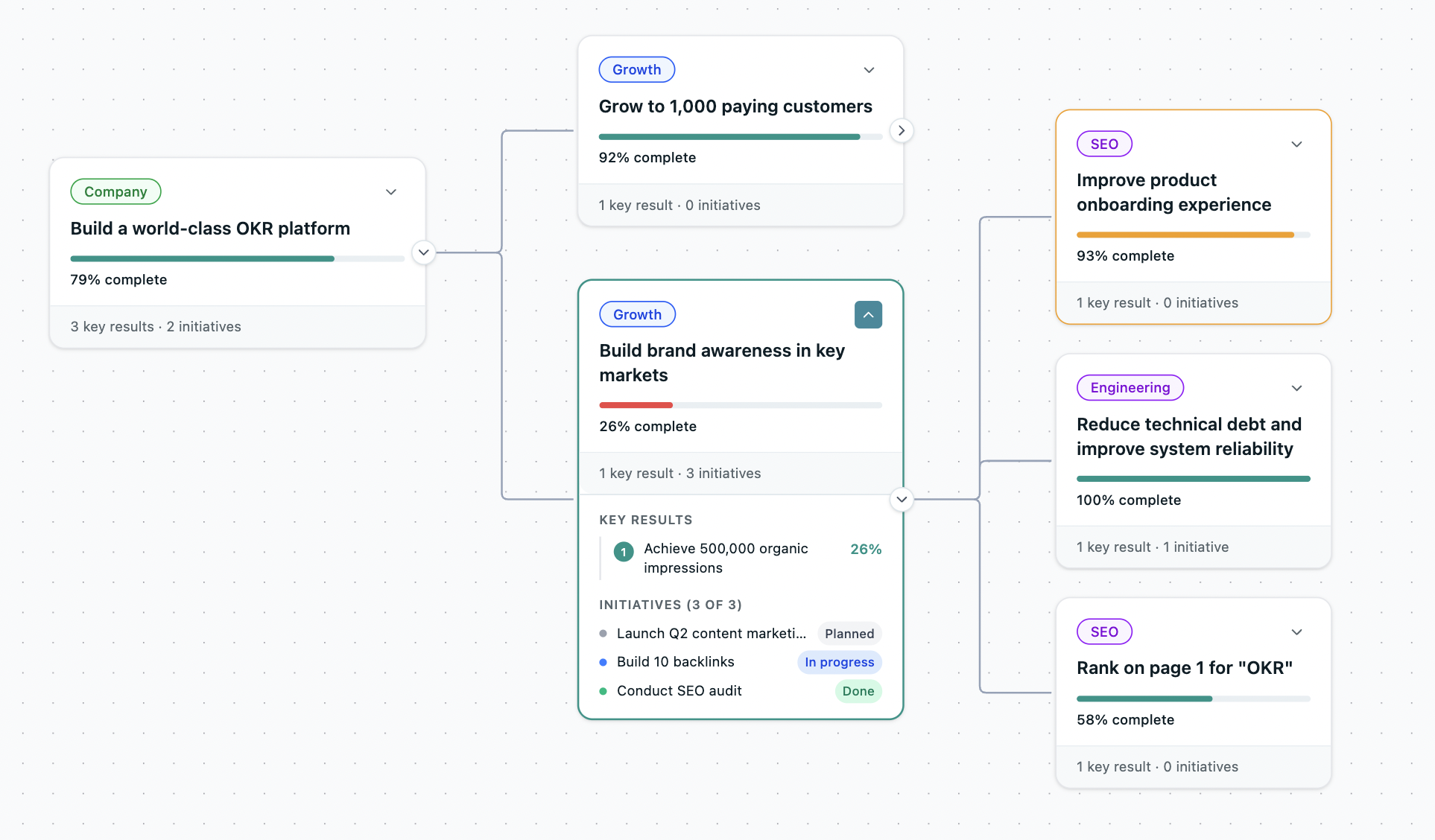
This is the specific contribution OKRs make to Playing to Win: they create the measurement and accountability layer for strategic choices that are too early-stage or too team-specific to show up in financial reporting. The cascade from company Objectives to team Key Results to individual work is the mechanism that makes the Playing to Win choices land in the actual work of every team — not just in the strategy deck reviewed at the annual offsite.
The Management Systems Gap
Martin and Lafley are explicit about why the Management Systems choice is the one most organizations fail to make well. Most organizations inherit their management systems rather than designing them — they use the same planning processes, metrics, and review cadences that were in place before the strategy was set. When a new Where to Play choice requires measuring something that wasn't measured before, or when a new How to Win proposition requires rewarding behavior that wasn't rewarded before, the inherited management systems actively work against the new strategy.
The result is the gap the 2026 OKR Benchmark Report documents: 65% of teams admit their goals aren't clearly linked to company strategy. The strategy exists. The management system — the review cadence, the goal-setting process, the accountability structure — isn't connected to it.
The State of Goal Management found 34% of employees say nothing about how they work would change if their goal tracker were deleted tomorrow. That's the diagnostic measure for whether the Management Systems choice is working: if removing the system doesn't change the work, the system isn't connected to the strategy. Playing to Win gives you the framework for choosing the right strategy. OKRs give you the operational mechanism for making that strategy show up in the work.
How They Work Together in Practice
The practical integration of Playing to Win and OKRs runs in a single direction: the Playing to Win choices are made at the annual planning level, and each choice generates the input for the quarterly OKR planning session.
The Winning Aspiration and Where to Play choices define the annual OKR direction — the company-level Objectives for the year that each quarter's execution will ladder up to. The How to Win choice defines what the team-level Key Results should be measuring — which specific metrics, moved from which baselines to which targets, prove that the winning proposition is working in the chosen arenas. The Core Capabilities choice defines which functional OKRs matter most — which capabilities need to be built or improved this quarter to deliver the How to Win in the chosen arenas.
And the Management Systems choice is where the OKR cycle itself is defined: quarterly cadence, weekly check-in rhythm, named ownership per Key Result, honest scoring at cycle end, and retrospective that carries the learning forward. Teams that run consistent end-of-cycle retrospectives complete 30–45% more goals the following quarter — the compounding effect of a Management System that actually closes cycles and learns from them.
How They Compare
The Right Architecture: Playing to Win + OKRs
Playing to Win is the strongest strategic pairing for OKRs in the frameworks cluster precisely because it names the problem OKRs solve. Most frameworks — Balanced Scorecard, OGSM, Hoshin Kanri — describe a strategic planning process that produces documents. Playing to Win describes a strategic decision-making process that produces choices. And it explicitly identifies the gap between those choices and the daily work as the Management Systems problem.
OKRs close that gap structurally. The Playing to Win session produces the Where to Play and How to Win choices that define the annual strategic direction. The quarterly OKR planning session translates those choices into the Key Results that prove they're working. The weekly check-in keeps the translation visible. And the retrospective at cycle end generates the learning that feeds back into the next quarter's choices.
See how OKRs Tool's Strategy section implements this architecture — Strategy Canvas for the Winning Aspiration and Where to Play choices, Coverage diagnostic to surface gaps before the cycle starts, and the cascade that connects every team's quarterly Key Results to the company's strategic choices — free for up to 5 users.
Data: The 2026 OKR Benchmark Report (200 organizations), The State of Goal Management, OKRs Tool (210 full-time employees at growing companies, 2026).