Hoshin Kanri aligns an entire organization around a 3–5 year strategic direction through annual priorities derived from genuine two-way dialogue. OKRs execute those priorities quarterly with named ownership and weekly accountability. Without the execution layer, Hoshin planning produces beautifully aligned strategy that quietly stalls between annual reviews.
Hoshin Kanri — translated roughly as "direction management" or "policy deployment" — was developed in Japan in the 1960s as part of the Toyota Production System and the broader Total Quality Management movement. Where most Western planning systems cascade strategy top-down, Hoshin Kanri was designed around a fundamentally different premise: that the people closest to the work know things leadership doesn't, and that strategic plans fail when they don't incorporate that knowledge.
The result is a planning system built around dialogue rather than directives — and one of the most sophisticated frameworks for connecting long-term vision to annual execution that exists.
What Hoshin Kanri Actually Is
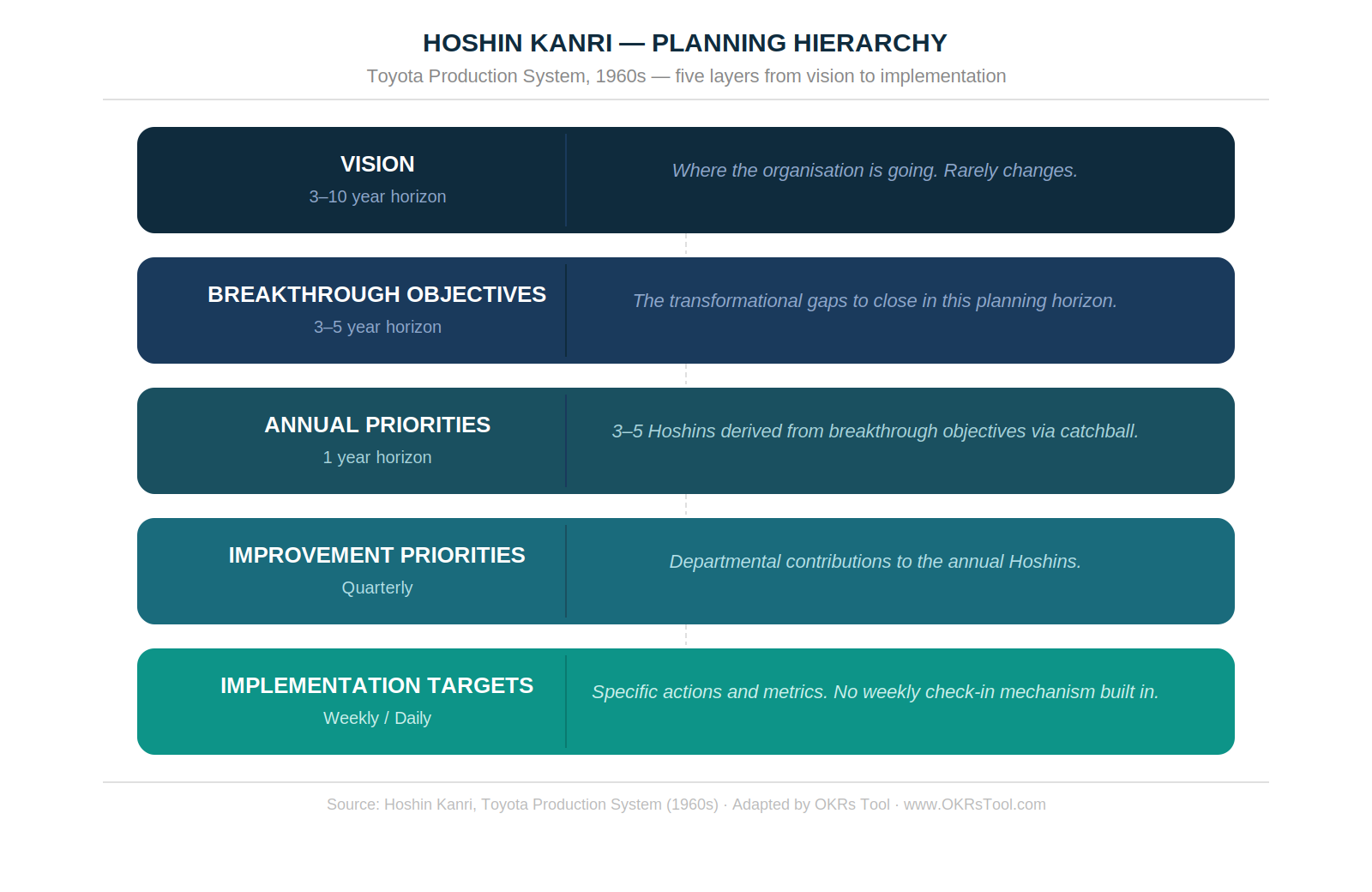
Hoshin Kanri operates across five connected layers, each derived from the one above through a structured planning and dialogue process.
Vision — the organization's long-term destination, typically a 3–10 year horizon. Rarely changes. Sets the direction for every planning cycle beneath it.
Breakthrough Objectives — the 3–5 year transformational goals required to reach the vision. These are the strategic gaps the organization needs to close, not incremental improvements to existing performance.
Annual Priorities (Hoshins) — the 3–5 specific priorities for this year, derived from the breakthrough objectives through the catchball process. The Hoshin is the annual bet: if the organization achieves these priorities this year, it moves meaningfully toward the breakthrough objectives.
Improvement Priorities — departmental contributions to the annual Hoshins. Each function identifies what it will specifically do to support the organization-level Hoshins.
Implementation Targets — the specific actions, projects, and metrics at the team and individual level.
The catchball process — called nemawashi in Japanese — is what distinguishes Hoshin Kanri from top-down strategic cascades. Rather than leadership setting priorities and pushing them down, catchball involves iterative dialogue between levels: leaders propose a Hoshin, teams respond with what they can realistically contribute and what they'd need to deliver it, leaders revise based on that input. This process repeats until the plan reflects both strategic intent and operational reality.
Where Hoshin Kanri Gets It Right
The catchball process is the most sophisticated alignment mechanism in any planning framework. The 2026 OKR Benchmark Report found 65% of teams admit their goals aren't clearly linked to company strategy — the exact problem Hoshin Kanri's dialogue-driven cascade was designed to prevent.
Most OKR cascades are still top-down: leadership sets company Objectives and teams derive their Key Results from them. Hoshin Kanri's catchball discipline — the insistence that the cascade includes genuine bottom-up input before being finalized — produces alignment that's more durable because the teams doing the work have shaped the plan.
The X-matrix, Hoshin Kanri's primary planning tool, also provides something most OKR frameworks lack: explicit cross-functional coordination. The X-matrix maps which teams are responsible for which annual priorities and makes the interdependencies visible at the planning stage rather than discovering them in execution.
The Critical Failure Mode
Hoshin Kanri operates on annual and multi-year time horizons. The planning process is rigorous — and slow. A full Hoshin planning cycle typically takes six to eight weeks. The X-matrix is reviewed quarterly or semi-annually at most. There is no built-in weekly execution mechanism.
The result is a pattern that mirrors the Balanced Scorecard failure: organizations invest significant effort in the Hoshin planning process, produce a beautifully aligned X-matrix connecting vision to implementation targets, and then return to running the business without a weekly system that holds anyone accountable for the implementation targets between reviews.
The implementation layer — the most granular level of Hoshin Kanri — has no named owner per target, no automated weekly check-in, and no mid-cycle intervention mechanism. By Q3, the annual Hoshins are still aligned on the X-matrix. The implementation targets haven't moved since Q1.
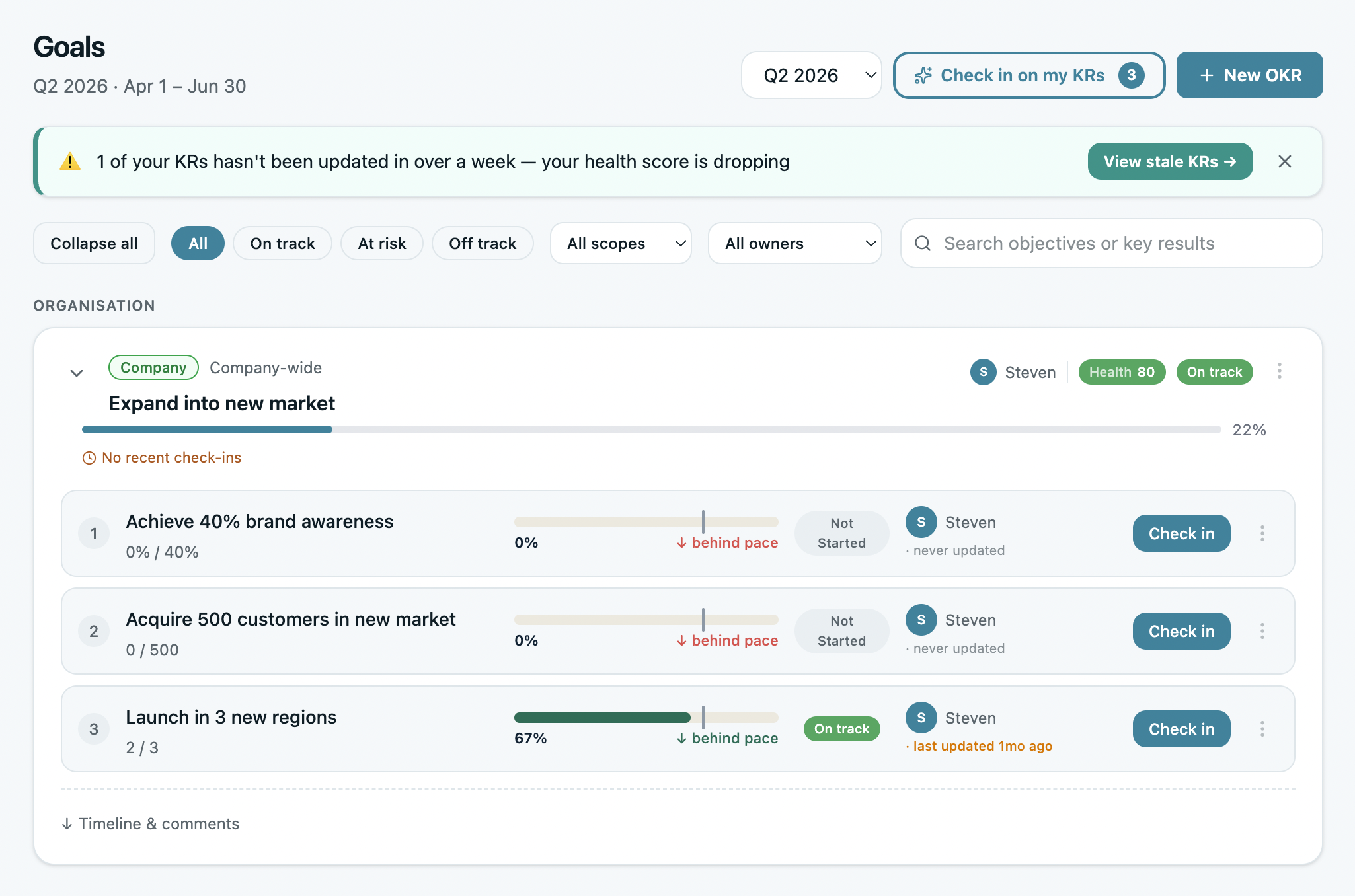
OKRs solve this at exactly the layer Hoshin Kanri leaves open. A quarterly OKR cycle running underneath the annual Hoshins provides the execution infrastructure: named owners per Key Result, automated weekly check-ins, at-risk flagging before problems become misses. Teams with required single ownership see 26% higher completion rates. Teams with weekly check-ins complete 43% more OKRs than those without.
How They Compare
The Right Architecture
Hoshin Kanri and OKRs are not alternatives — they operate at different layers and solve different problems. The organizations that get the most out of both use Hoshin Kanri to set the annual strategic direction and OKRs to execute it quarterly.
The connection is explicit: the annual Hoshins become the inputs to each quarter's OKR planning session. Which Hoshin are we executing this quarter? What specific outcome would prove we moved it? Who owns each Key Result? The quarterly OKR retrospective then feeds back into the Hoshin review — updating the X-matrix with real execution data rather than the self-reported status that most Hoshin reviews rely on.
For organizations already running Hoshin Kanri and considering OKRs: add OKRs as the execution mechanism underneath the implementation targets layer. The catchball process runs annually; the OKR process runs the weekly accountability that keeps implementation targets alive between Hoshin reviews.
See how OKRs Tool implements the full quarterly execution cycle — from cascade planning through weekly check-ins to retrospective — as the execution layer underneath any strategic planning framework.
Data: The 2026 OKR Benchmark Report (200+ organizations).