OGSM connects a qualitative Objective to quantified Goals, the Strategies to achieve them, and the Measures that prove they worked — on a single page, annually. OKRs do the same thing quarterly, with named ownership per measure, a weekly check-in, and a mid-cycle intervention point. The structure is nearly identical. The execution cadence is what separates them.
OGSM — Objectives, Goals, Strategies, Measures — was developed at Procter & Gamble in the 1950s as a tool for translating corporate strategy into a single, structured page that every level of the organisation could act from. The format spread through consumer goods companies over the following decades and is now used at Colgate, Unilever, Nike, and hundreds of large organisations that need strategic clarity communicated simply and consistently across divisions.
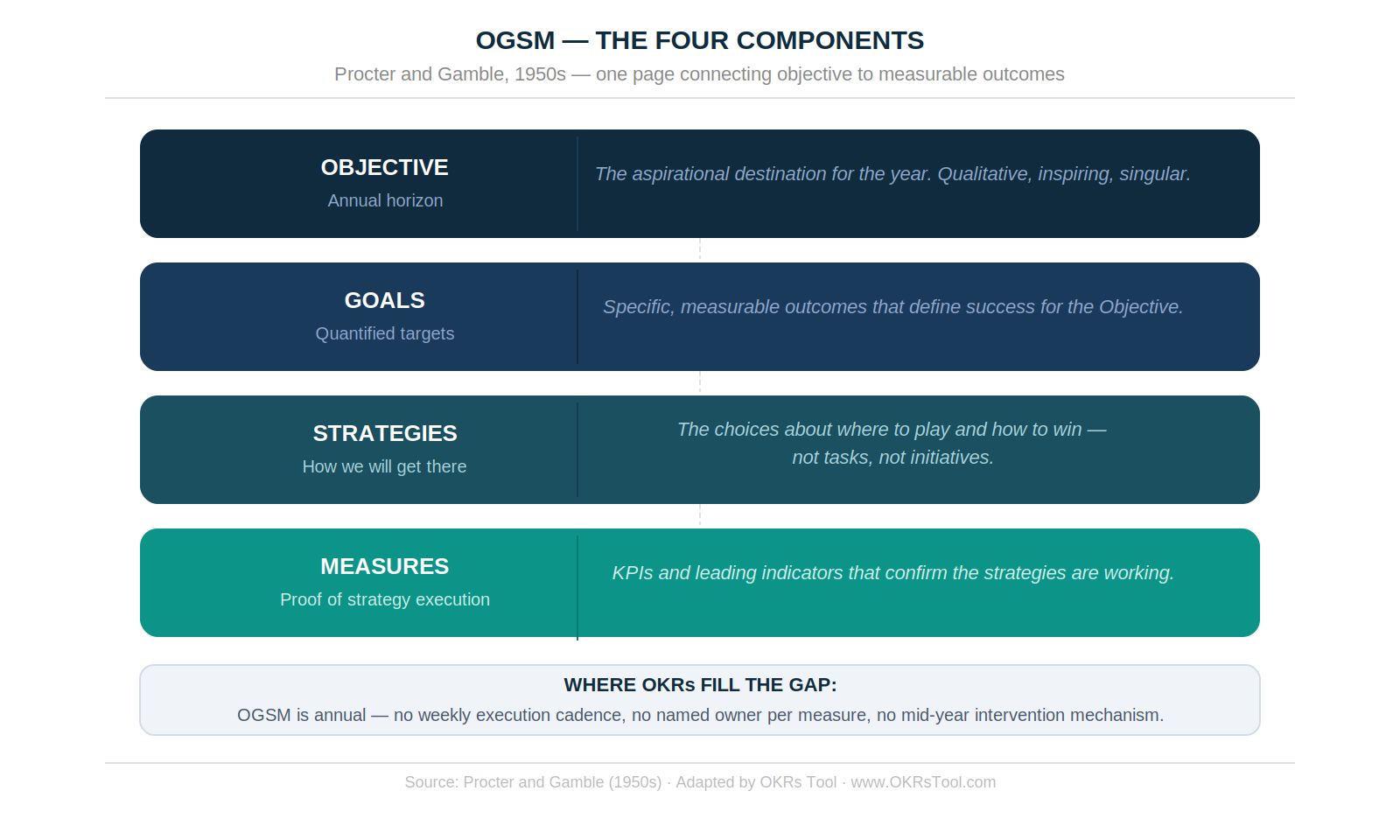
The four-component structure is genuinely elegant. An Objective sets the aspirational direction for the year — qualitative, singular, inspiring. Goals translate that aspiration into specific quantified targets: the numbers that define what success looks like. Strategies define the choices about where to play and how to win — not projects or initiatives, but the directional decisions that determine which Goals are achievable. Measures are the leading indicators and KPIs that confirm the Strategies are working before the year-end Goal review would reveal whether they did.
For any organisation already familiar with OKRs, the parallels are immediately apparent. The Objective maps to the OKR Objective. Goals map to Key Results. Measures map to the KPIs that track progress underneath Key Results. The structural logic is the same: connect an inspiring direction to measurable outcomes that prove it was achieved.
What OGSM Actually Is
The OGSM format sits on a single page — deliberately. The constraint forces strategic clarity: if you can't fit the organisation's priorities onto one structured page, the strategy isn't clear enough to execute from. Each layer derives from the one above it, creating a logical chain from aspiration to action.
The Objective is the year's north star — what the organisation is fundamentally trying to achieve, stated without numbers. The Goals translate that aspiration into the specific outcomes that would prove the Objective was met: market share targets, revenue figures, customer metrics.
The Strategies are the directional choices that make those Goals achievable — not a project list, but a set of bets about where to focus and where not to. The Measures are the leading indicators that confirm the Strategies are generating the right results before the year-end review of the Goals.
The elegance of OGSM is the distinction between Goals (what success looks like) and Measures (how we know we're on the right track to get there). This maps directly to the distinction between lag measures and lead measures that 4DX makes explicit — and it's a distinction most OKR programmes fail to make. Our analysis of 7,857 Key Results found 52% were tasks or KPIs in disguise rather than genuine outcome measures. OGSM's Measures layer, applied to OKR writing, would catch most of that.
Where OGSM Gets It Right
The single-page constraint is a genuine contribution to strategic clarity. Most strategy documents are too long to be used — they get presented at the annual offsite and never referenced again. OGSM forces a level of prioritisation that longer formats don't. If the Strategies don't fit on the page, there are too many of them.
The Goals/Measures distinction is also genuinely useful for OKR writing. OGSM separates the outcome the organisation is trying to achieve (Goal) from the leading indicators that predict whether the chosen Strategies will deliver it (Measures). This is the same discipline that separates a strong Key Result from a KPI — one measures the change you're trying to create, the other monitors whether you're on track to create it. Using OGSM's framework to pressure-test OKR Key Results before the cycle starts produces better outcome measurement.
For organisations operating across multiple divisions, the OGSM format also cascades naturally — each division derives its own OGSM from the corporate one, creating strategic alignment without requiring a centrally managed goal hierarchy. The cascade is implicit in the format.
The Critical Failure Mode
OGSM operates on an annual horizon with no built-in weekly execution mechanism. The single-page document is set at the annual planning session, reviewed at mid-year, and assessed at year-end. Between those review points, there is no structural mechanism to surface whether the Strategies are working, whether the Measures are moving in the right direction, or whether a Goal that was realistic in January is still achievable in August.
The 2026 OKR Benchmark Report found 65% of teams admit their goals aren't clearly linked to company strategy — not because the strategy wasn't documented, but because there's no mechanism keeping the connection alive between planning sessions. OGSM produces clear documentation. It doesn't produce the weekly accountability that keeps teams working from it.
The Measures layer — OGSM's most sophisticated component — has no named owner per measure, no automated check-in prompting weekly updates, and no mid-year intervention point for formally revising a Measure that isn't predicting what it was supposed to predict. The OKR Intelligence Report 2026 found 93% of organisations modify their goals at least occasionally after the cycle starts. An annual OGSM with a mid-year review can accommodate this — but quarterly OKR cycles build the adaptability in structurally rather than relying on the mid-year review to catch drift that may have been accumulating for six months.
How They Compare
The Right Architecture: OGSM + OKRs
The most productive relationship between OGSM and OKRs is the same as with Hoshin Kanri and V2MOM — the annual framework sets the strategic direction, and OKRs provide the quarterly execution mechanism underneath it.
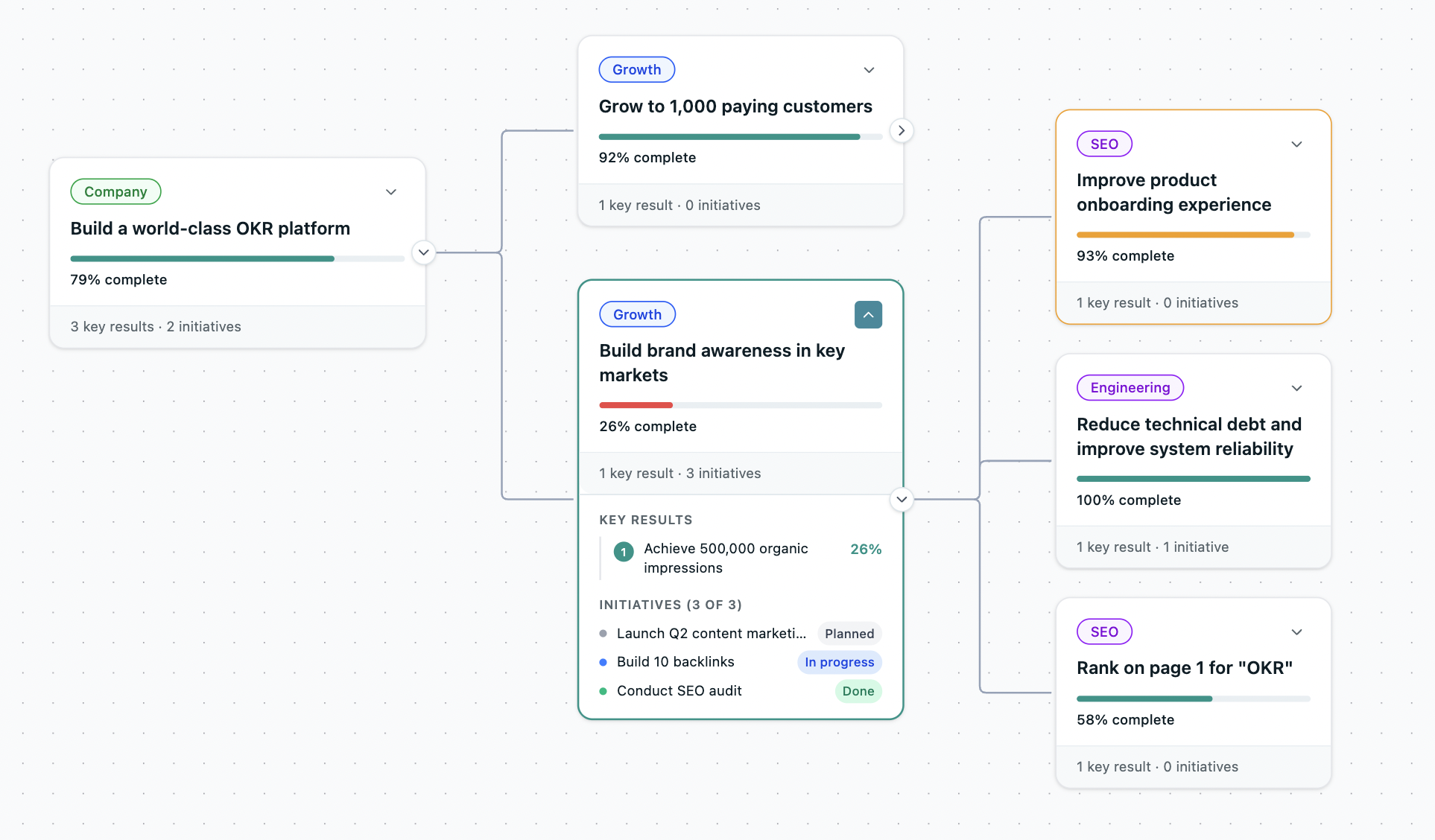
In practice: the annual OGSM is set at the start of the year. Each quarter's OKR planning session begins with the OGSM — which Goals are we executing this quarter, and what specific Key Results would prove we moved them? The OGSM's Measures layer becomes the input to the Key Result writing process — the leading indicators that OGSM identifies as predictive of Goal achievement are the same metrics that make the strongest Key Results.
OGSM also improves OKR Objective writing. Most OKR Objectives are written in isolation from the annual strategic direction. The OGSM Objective above them provides the context that makes the quarterly Objective genuinely purposeful rather than a local priority that happens to exist within the same year.
See how OKRs Tool runs the full quarterly execution cycle — cascade alignment, weekly check-ins, and the retrospective that makes each cycle sharper than the last — as the execution layer underneath any annual strategic framework.
Data: The 2026 OKR Benchmark Report (330 organizations), The OKR Intelligence Report 2026 (222 organizations), OKRs Tool platform data (7,857 Key Results analyzed).