The choice between annual and quarterly OKRs is a false one. Annual OKRs without a quarterly execution mechanism produce a document. Quarterly OKRs without annual strategic context produce busy work. The organizations generating the highest returns run both — at different levels, for different purposes.
The cadence debate in OKR programmes almost always frames annual and quarterly as alternatives. Teams that choose annual OKRs point to the stability — goals that don't change every 90 days, longer horizons for meaningful outcomes to materialize. Teams that choose quarterly point to the agility — short cycles that stay relevant as priorities shift. Both arguments miss the point.
Annual and quarterly OKRs solve different problems in the same execution system. The 2026 OKR Benchmark Report makes the cost of conflating them concrete: only 5% of teams have more than 75% of their weekly work tied to a strategic goal. That gap isn't a planning failure — it's a cadence failure. Annual goals set without a quarterly execution mechanism become irrelevant by Q2. Quarterly goals set without annual strategic context become activity without direction.
The question isn't annual or quarterly. It's what each layer is for.
What Annual OKRs Are For
Annual OKRs at the company level serve one purpose: strategic direction. Two to five objectives that define where the organization is going this year — ambitious enough to be meaningful, stable enough to anchor four quarterly execution cycles without being revisited every 90 days.
Annual company OKRs are not execution targets. They don't get weekly check-ins. They don't get scored at 0.7 in March. They set the direction that each quarter's team Key Results point toward. The right test for an annual company OKR is not "can we achieve this by December?" but "does this describe where we need to be by the end of the year, and would achieving it genuinely transform our position?"
The failure mode: treating annual OKRs as an execution system. When leadership sets annual company OKRs and then waits until the December review to assess progress, they've built a document, not a goal management system. The annual layer needs quarterly execution underneath it to be load-bearing.
What Quarterly OKRs Are For
Quarterly OKRs are the execution mechanism. Team-level objectives derived from the annual company priorities, with Key Results that are specific enough to update weekly, ambitious enough to require genuine effort, and scoped to what's achievable in 90 days.
The 2026 OKR Benchmark Report is specific about why quarterly cadence outperforms annual for execution. Teams that launch their OKR cycle within one week of quarter start see up to 50% higher completion rates than those with extended rollouts — the urgency of a 90-day window creates focus that a 365-day window doesn't. Teams that run end-of-cycle retrospectives complete 30–45% more goals the following quarter — four opportunities per year to learn and adjust rather than one annual post-mortem.
The failure mode at this layer: quarterly OKRs that aren't connected to annual company priorities. When team Key Results are set in isolation from the annual direction, the organization ends up with four well-executed quarters that don't compound toward anything. 65% of teams admit their goals aren't clearly linked to company strategy — the cascade alignment from annual company OKRs to quarterly team Key Results is the structural fix.
The Data on Cadence
The benchmark data makes two things clear about OKR cadence.
First, quarterly is the right execution cadence. Annual cycles are too long to stay relevant — strategic priorities shift, market conditions change, and a goal set in January is often the wrong goal by July. The OKR Intelligence Report 2026 found 93% of organizations modify their OKRs at least occasionally after the cycle starts. A quarterly cycle builds that adaptability in structurally — at the end of each 90-day cycle, teams score honestly, run a retrospective, and set new Key Results based on what they learned. An annual cycle builds it in only once.
Second, the maturity curve is real — and it only works with consistent quarterly cycles. Teams in their first two cycles average 51% OKR completion. By cycle five, that rises to 79%. The 28-percentage-point improvement doesn't come from writing better goals each year — it compounds from four retrospectives per year rather than one, from the weekly check-in habit built across multiple cycles, and from the learning loop that quarterly cadence creates.
Teams checking in weekly complete 43% more OKRs than those reviewing monthly. An annual OKR without a weekly check-in mechanism has no way to generate this lift — the feedback loop is too slow to surface problems while there's still time to act.
The Right Architecture
Annual and quarterly OKRs work together as two connected layers, each doing what the other can't.
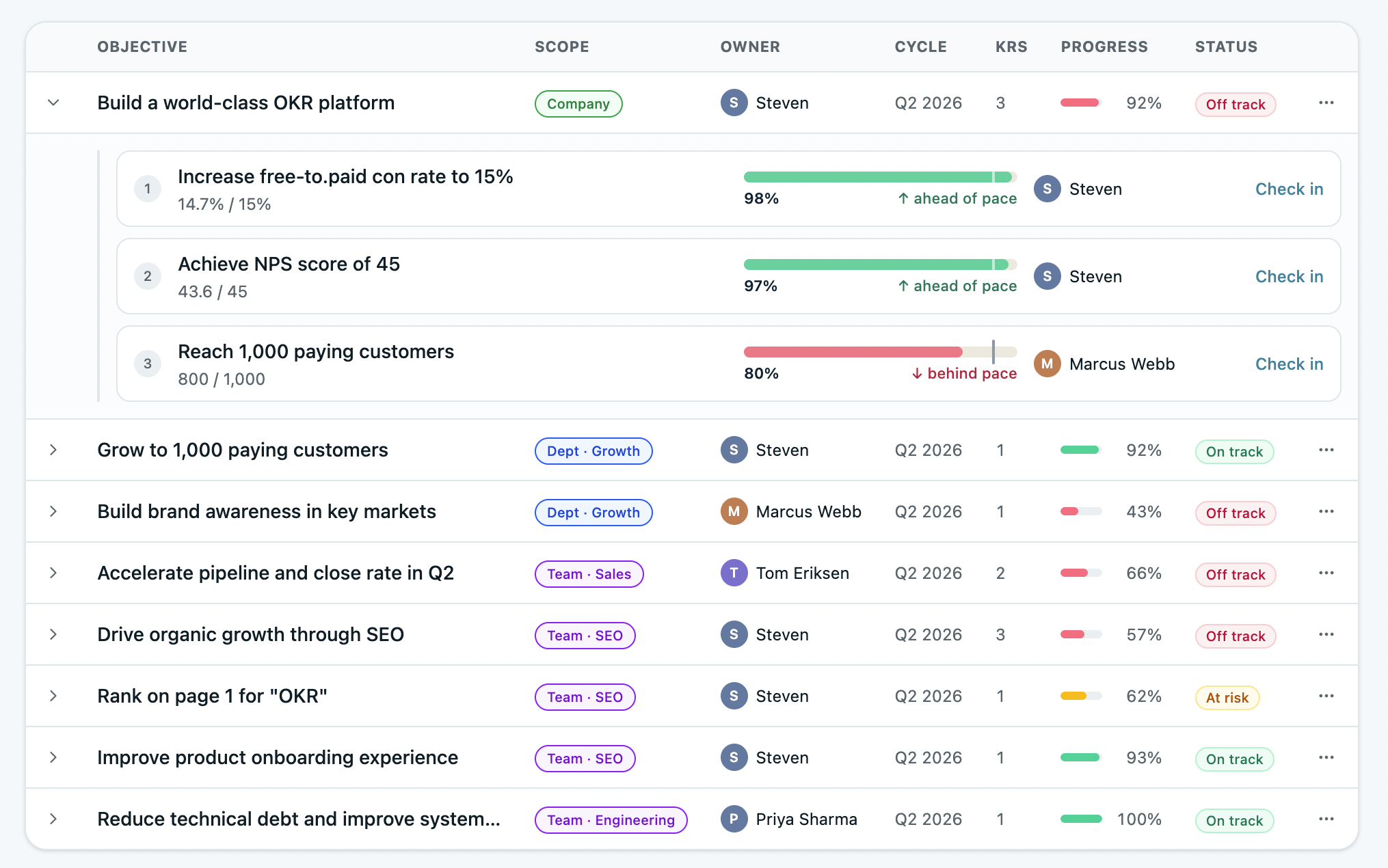
Annual company OKRs — set by leadership in January — establish the year's strategic direction. Two to five objectives that describe where the organization needs to be by December. These are reviewed quarterly to confirm they're still the right direction, revised only if strategy changes fundamentally, and visible to every team throughout the year.
Quarterly team OKRs — set at the start of each 90-day cycle — define how each function will contribute to the annual priorities this quarter. Each team's Key Results must connect to an annual company objective before the cycle starts — the cascade that closes the 65% misalignment gap structurally. Each Key Result has a single named owner. Progress is updated weekly. The cycle ends with an honest score and a retrospective.
The learning from each quarterly cycle feeds back upward. If a quarterly retrospective reveals that the annual company objective is no longer the right priority — or that a team's Key Results weren't pointing at what actually drives the annual goal — that insight shapes the next quarter's planning session. The annual layer provides stability. The quarterly layer provides adaptability. Neither works without the other.
See how OKRs Tool implements both layers — annual strategic direction in the Strategy Canvas, quarterly execution in the OKR cycle, and the cascade alignment that connects them — free for up to 5 users.

Annual vs Quarterly: At a Glance
Neither Layer Works Without the Other
The organizations generating 1:88 return on investment from their OKR programmes aren't choosing between annual and quarterly — they're running both. Annual company OKRs give the quarterly cycles their strategic purpose. Quarterly team OKRs give the annual direction its execution mechanism. Four retrospectives per year give the annual layer the real-world feedback it needs to stay relevant.
The cadence question resolves quickly once it's framed correctly. Annual for direction. Quarterly for execution. The cascade between them for alignment. And a weekly check-in to keep the execution honest.
Data: The 2026 OKR Benchmark Report (200 organizations), The OKR Intelligence Report 2026 (222 organizations).