
A strategy execution framework is the structure that connects a company priority to the daily work meant to deliver it. That connection almost never survives on its own: only 7% of leaders say most daily work ladders up to strategy, and 65% of teams admit their goals aren't linked to company strategy at all. The cascade is the mechanism that closes the gap — and this is how to build one.
A CEO can name the three priorities that define the year. Ask the people executing them and the picture falls apart: in 86% of companies, most employees can't state the strategy at all. The plan exists — the connection between it and what teams do each week is what's missing.
A strategy execution framework builds that connection structurally. It's not a planning template or a goal-setting method — it's the connective tissue that keeps every team's work tied to a company priority, week after week. The core of it is the cascade: a visible line from company strategy down through team objectives, key results, and the initiatives that move them. This guide covers what the framework is, how to cascade strategy step by step, where cascades break, and how to keep one alive past the first cycle.
What a Strategy Execution Framework Is
A strategy execution framework is the system that translates strategic intent into coordinated action and keeps it connected as the quarter runs. It's distinct from strategic planning, which decides where to go. The framework is what makes sure you get there — and its defining feature is the cascade.
The cascade has four levels, each linked to the one above it. At the top sits the company priority — the small number of strategic choices leadership commits to for the year. Below it, each team objective interprets that priority for a specific function: what does "win mid-market" mean for product, or for sales?
Below that, key results make the objective measurable — a movement from a baseline to a target. And at the base, initiatives are the actual work: the projects, campaigns, and builds that move the key results.
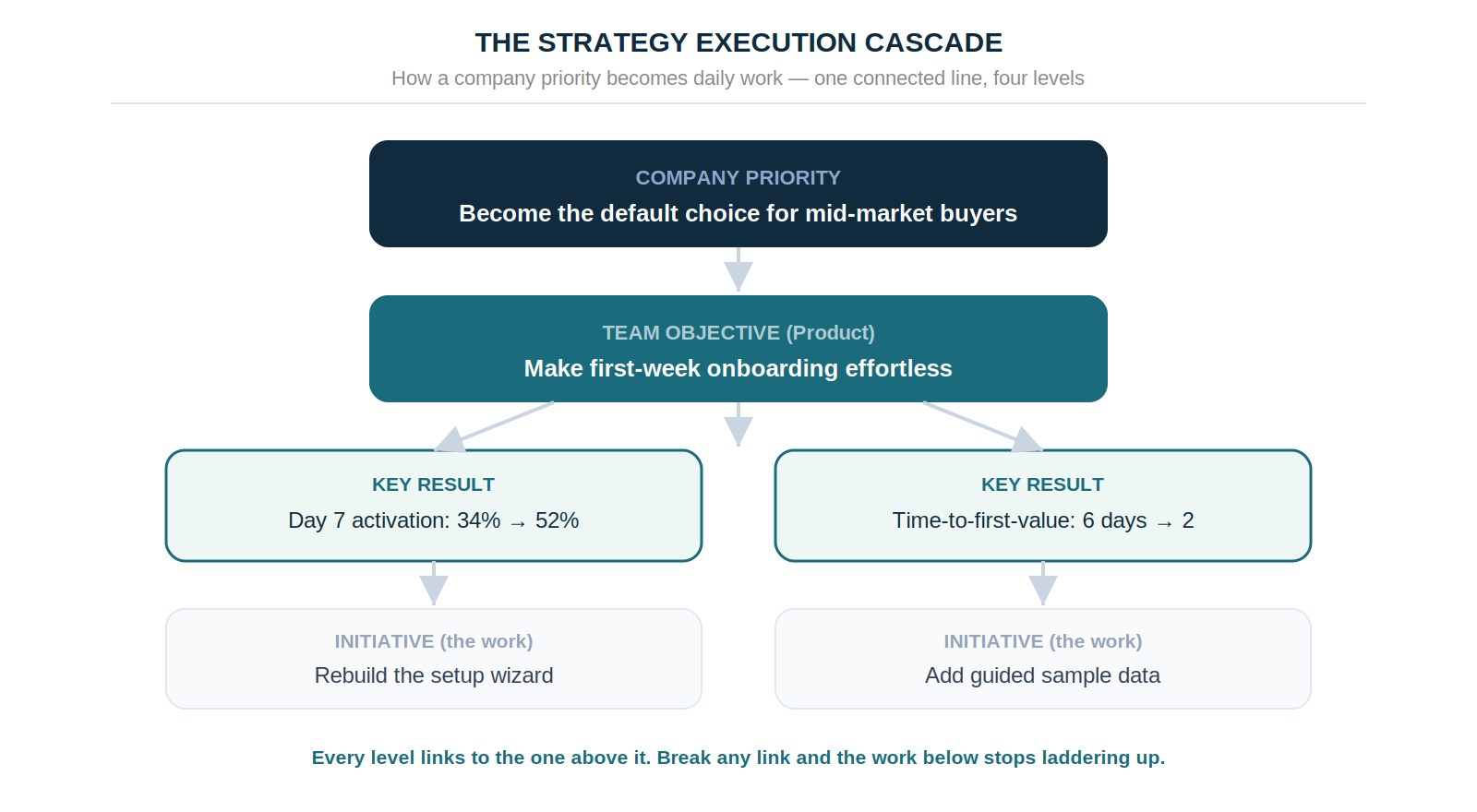
The power of the framework is in the links, not the levels. Any team can write objectives and track key results in isolation. What makes it a cascade is that every level connects explicitly to the one above — so anyone can trace a single initiative back up to the company priority it serves, and leadership can see which priorities have real work behind them and which are orphaned. Break a link, and the work below it stops laddering up.
Why the Cascade Matters: The Laddering Gap
The reason this framework earns its place is that the connection it creates is exactly the one most organizations are missing.
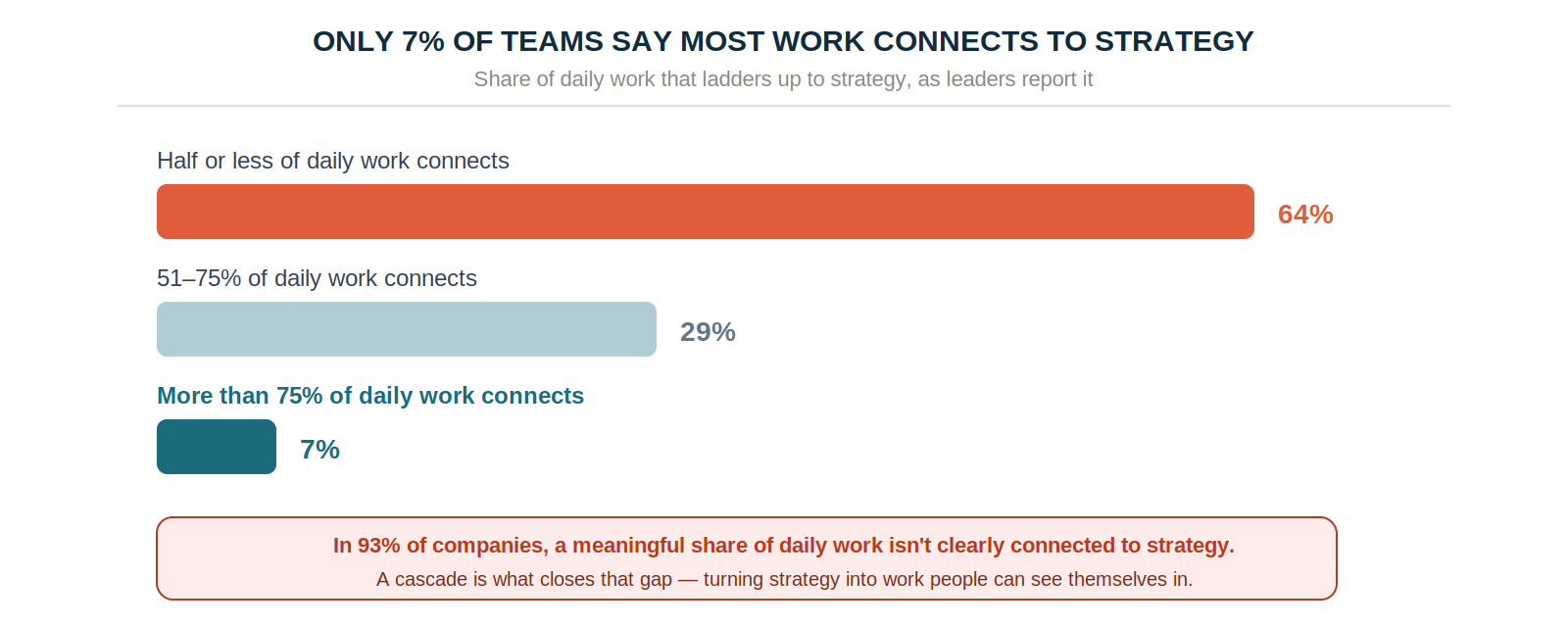
Across 180 strategy leaders, only 7% say most of their teams' daily work ladders up to strategy. Nearly two-thirds put it at half or less. In 93% of companies, a meaningful share of the work happening every day isn't clearly connected to a strategic priority — which means people are busy, but not necessarily busy on the things that matter most.
This is what a cascade fixes. When every team objective visibly links to a company priority, and every person can trace their work back up the chain, the laddering gap closes structurally. The strategy stops being an abstraction people are told about and becomes the frame their own goals hang on. That's the difference between a strategy that's communicated and one that's executed.
How to Cascade Strategy to Teams: Step by Step
The cascade is built top-down, one level at a time. Here's the sequence that works.
Step 1 — Set 3–5 company priorities. Fewer than most leadership teams want, deliberately. A cascade with ten top-level priorities produces teams pulled in ten directions; three to five force the prioritization that makes execution possible. Each priority is a strategic choice, not a metric — "become the default choice for mid-market buyers," not "grow revenue 30%."
Step 2 — Have each team translate a priority into an objective. This is the critical move, and it's bottom-up, not top-down dictation. Leadership sets the priority; the team decides how their function advances it. Product might translate "win mid-market" into "make first-week onboarding effortless." The team owns the interpretation, which is what creates commitment rather than compliance.
Step 3 — Make each objective measurable with 2–3 key results. Each key result is a movement from a baseline to a target — "Day 7 activation from 34% to 52%" — with a single named owner. Two to three per objective, not five; the benchmark on how many to set is clear that focus beats coverage.
Step 4 — Attach initiatives underneath the key results. The initiatives are the work — the projects and experiments meant to move each key result. Keeping them one level below the key result matters: it preserves the distinction between the outcome you're chasing and the activity you think will get you there, so you can change tactics without changing the goal.
Here's the full cascade for a single company priority, top to bottom:
The test of a good cascade is the trace: pick any initiative at the bottom and follow the links up. "Rebuild the setup wizard" moves "Day 7 activation," which delivers "make onboarding effortless," which advances "become the default for mid-market buyers." If you can't draw that line for a piece of work, it doesn't belong in the cascade — and that's a feature, because it surfaces the work that isn't serving the strategy.
Where Cascades Break
Building the cascade once is the easy part. The benchmark data shows where it comes apart.
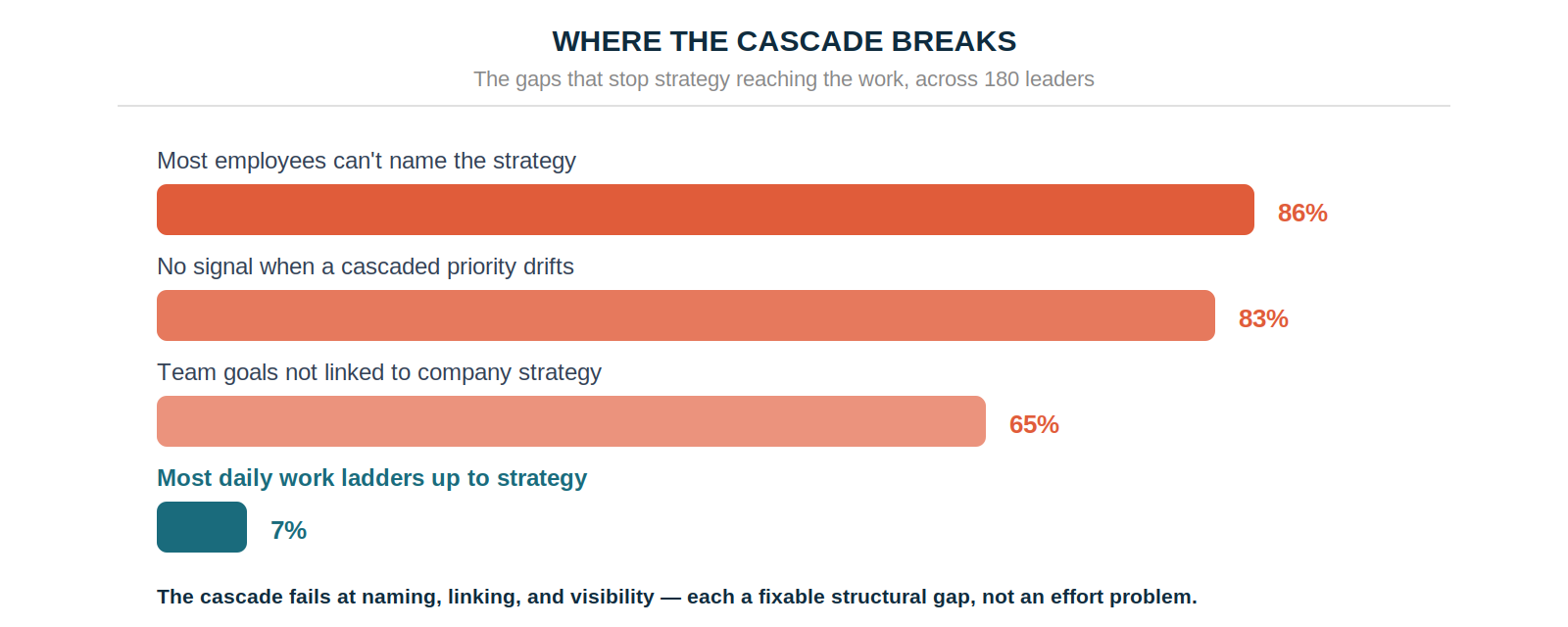
The first break is naming: in 86% of companies, most employees can't state the strategy at all. A cascade that lives in a document nobody opens isn't connecting anything — the link has to be visible in the tools where people actually work.
The second is linking: 65% of teams admit their goals aren't tied to company strategy, which is the laddering gap seen from the team's side.
The third is visibility: 83% of leaders get no automatic signal when a cascaded priority drifts, so a broken link stays broken until someone notices at a review.
None of these is an effort problem — they're structural. And there's a fourth, subtler failure: cascades are treated as one-time events. Priorities shift mid-year, a team pivots, a new initiative appears, and nobody re-draws the links. The alignment map that was accurate in January quietly goes stale by March. A cascade is only useful if it's maintained as a living structure, not built once and filed.
Keeping the Cascade Alive
A cascade is a living structure, and three habits keep it connected through the quarter rather than decaying after the first week.
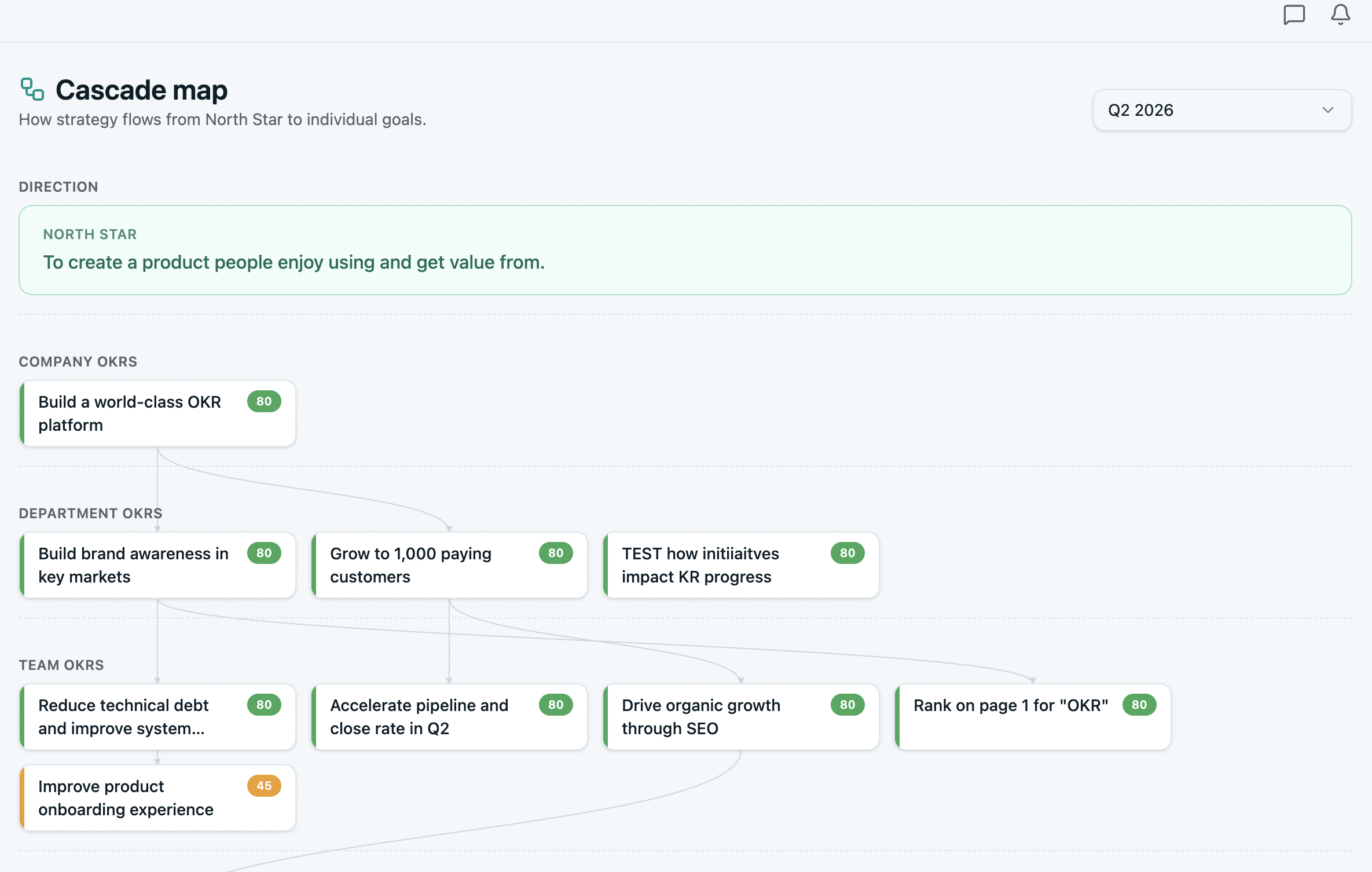
Make it visible where people work. A cascade buried in a slide deck can't do its job — the links have to be somewhere people encounter them in the course of doing their jobs, not somewhere they have to go looking. This is the difference between the 41% of companies that keep strategy in purpose built strategy execution software and the rest relying on a deck seen once a quarter.
Check in weekly against it. A weekly check-in that surfaces which key results moved keeps the cascade in working memory and catches drift early — teams with the habit complete 43% more goals than those reviewing monthly. The check-in is also where a broken or stale link gets spotted, before it costs a quarter.
Re-cascade when priorities shift. When a company priority changes or a team pivots, the links have to be re-drawn deliberately. Treating the cascade as a living map — updated when reality changes rather than left to go stale — is what separates a framework that works from a diagram that was accurate once. The quarterly cycle is the natural rhythm for a full re-cascade, with lighter adjustments as they arise.
From Framework to Execution
A strategy execution framework isn't sophisticated in theory — three to five priorities, translated into team objectives, made measurable with key results, delivered through initiatives, and kept visible weekly. What's hard is the discipline of maintaining the links when priorities shift and the quarter gets busy. That discipline is exactly what the 7% who close the laddering gap have and the other 93% don't.
The cascade is one part of a larger system for keeping strategy named, connected, visible, and decided. For the full operating model, strategy execution covers all four disciplines, and the Strategy Execution Benchmark 2026 breaks down where each one breaks. To build a cascade your whole team can see and trace — from company priority to weekly work — see how OKRs Tool's Cascade Map makes every link visible, free for up to 5 users.
Data: Strategy Execution Benchmark 2026 — 180 strategy and operations leaders at companies of 50–200 employees.