Writing OKRs is a specific craft — not a goal-setting exercise. This guide covers every step: how to write strong Objectives, how to write outcome-based Key Results using the baseline-to-target formula, how to separate initiatives from goals, and how to run the quality check before the cycle starts. Every claim is grounded in benchmark data from 876 organizations and analysis of 20,952 real Key Results.
I've helped dozens of companies write OKRs.
And when it comes to the writing exercise, it plays out the same way every time.
There are two camps. The first tries to write the perfect OKR — agonizing over every word, debating whether the target is ambitious enough, second-guessing the structure. The second just stares at a blank screen with no idea where to start.
Neither camp is wrong. But both are focusing on the wrong thing.
The goal of writing OKRs isn't to write a perfect OKR. It's to pick a general direction, write your Objective and three Key Results, and go. You'll get better every time you go through this exercise.
The important thing is to align on the direction and set something measurable. 52% of Key Results written by real teams are tasks or KPIs in disguise. That finding — from our analysis of 20,952 Key Results on OKRs Tool — is the single most useful data point for anyone learning to write OKRs.
This guide is about closing that gap — the exact craft of writing a Key Result that measures change, not activity.
Why Most OKRs Fail Before the Cycle Starts
The most common OKR failure mode happens at the writing stage — not at execution.
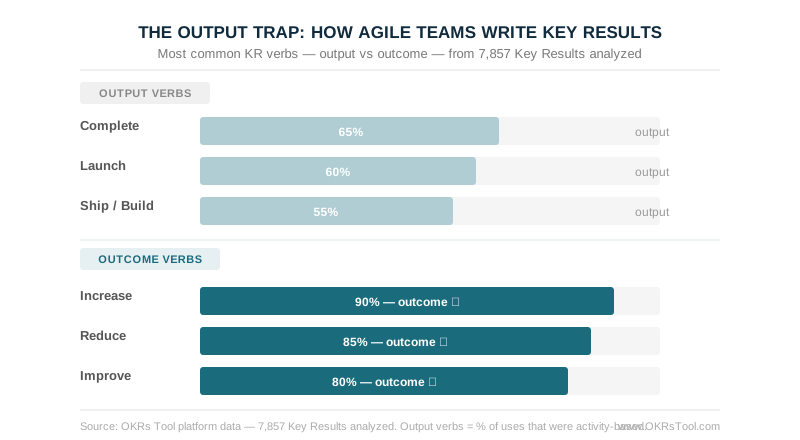
Our analysis of 7,857 Key Results written by real teams found that 52% were tasks or KPIs in disguise. Not ambitious enough. Not outcome-based. Measuring what was done rather than what changed.
The five most common underperforming verbs: Complete, Launch, Conduct, Implement, Test. These describe work. They don't describe what changes as a result of the work.
The fix is a single test applied to every Key Result before the cycle starts.
The forever test: "Can I track this metric every week forever without it being done?"
If yes — it's a KPI, not a Key Result. Move it to your KPI dashboard. A Key Result describes time-bound change from a baseline to a target. A KPI tracks ongoing health. Both matter. They belong in different places.
OKRs Tool enforces this test structurally — Key Results require a baseline and target before going live. See how the writing and setup flow works.
The OKR Structure: What You're Actually Writing
An OKR has two parts with one job each:
The Objective answers: Where are we going?Qualitative. Inspiring. Time-bound. No numbers.
The Key Results answer: How will we know we got there?Quantitative. Specific. Measurable. 2–3 per Objective.
Step 1: Write a Strong Objective
An Objective is not a project. It's not a target. It's the answer to one question: what does success look like at the end of this quarter?
Strong Objectives share four characteristics:
Qualitative. No numbers in the Objective itself. Numbers belong in the Key Results. "Grow revenue by 30%" is a KR, not an Objective.
Inspiring. The best Objectives describe a changed state that feels meaningful — something worth rallying a team around for twelve weeks.
Time-bound. Implicit in the quarterly OKR cycle, but the Objective should feel urgent. "Improve customer satisfaction" is not time-bound. "Make onboarding so clear new users don't need support" is.
Outcome-oriented. Describes what's different, not what's happening. "Run the Q3 product launch" describes activity. "Make the product launch the most successful in company history" describes an outcome.
Objective Examples: Weak vs Strong
Step 2: Write Outcome-Based Key Results
This is where 52% of teams go wrong — confirmed by our analysis of 7,857 Key Results. See the full data in our OKR statistics.
A Key Result is not a task. It's not a project milestone. It's not a KPI your team already tracks. It's a specific, measurable change from a baseline to a target that proves the Objective was achieved.
The Key Result Formula
The classic template looks like this:
Applied, a KR would look like:
Increase Day-7 activation from 34% to 52% for new sign-ups by end of Q3.
It has a baseline, a target, a segment, and a deadline. But our analysis of 24,000 OKRs found the wording was never what decided the outcome. The Key Results that got hit carried one thing the classic template leaves out: a single named owner. So the fuller formula reads:
And it only holds through the quarter if two commitments come with it — the owner checks in on it every week, and a Key Result still stuck at zero at the first check-in gets rescued, not left to sit. That's the difference between a Key Result that's written well and one that gets done.
The Output Trap: What to Avoid
The KPI Test
Some teams write Key Results that are actually KPIs — metrics they track continuously as business health indicators.
"Maintain NPS above 40" is a KPI. It doesn't describe change — it describes a threshold to maintain. The forever test confirms it: you can track NPS above 40 every week forever.
"Increase NPS from 32 to 50 among enterprise accounts by end of Q3" is a Key Result. It describes a specific change from a baseline to a target within a time horizon.
Both matter. KPIs belong on your KPI dashboard. Key Results belong in your OKRs.
Step 3: Apply the Ownership Rule
Every Key Result requires one named owner before the cycle starts. Not a team. Not "the leadership group." One person — accountable for tracking it, escalating when it stalls, and owning the score at cycle end.
The data from our 2026 OKR Benchmark Report: teams with required single ownership see 26% higher completion rates than those with shared or vague accountability. And 50% of all Key Results across growing organizations have no named owner at all.
A Key Result with no single owner is the most common cause of the Invisible OKR — the goal that technically exists on the dashboard while nobody is watching it. The OKR Intelligence Report 2026 found that 7% of off-track Key Results are simply abandoned with no revision, no escalation, and no consequence.
The owner doesn't do all the work. They ensure the work gets done.
Step 4: Calibrate Ambition With Scoring in Mind
OKR scoring uses a 0.0–1.0 scale. The target range is 0.7–0.8 — not 1.0.
Consistently hitting 1.0 means targets are too easy. Goals are being sandbagged. The OKR maturity curve shows what genuine ambition produces over time: cycle 1–2 teams average 51% completion. By cycle 5+, that rises to 79%.

The calibration test: "If we hit this at 70%, would it represent meaningful progress?" If yes — the target is appropriately ambitious. If 70% would feel like a failure — lower the target or reconsider whether it's a Key Result at all.
Step 5: Choose the Right Number of OKRs
Teams running 1–2 Objectives per quarter are twice as likely to achieve them as those running three or more. Each Objective should have 2–3 Key Results.
That means a well-structured team has 2–6 Key Results total for the quarter. More than that and alignment dilutes. Every Objective added past two reduces the probability of completing any of them.
The cascading OKR structure keeps this constraint visible across the organization: company OKRs set 1–2 priorities, department OKRs interpret their contribution, team Key Results name the specific outcomes. When the number is bounded at every level, focus compounds from the top down.
Step 6: Separate Initiatives From Key Results
The most common structural error in OKR writing: treating the work as the goal.
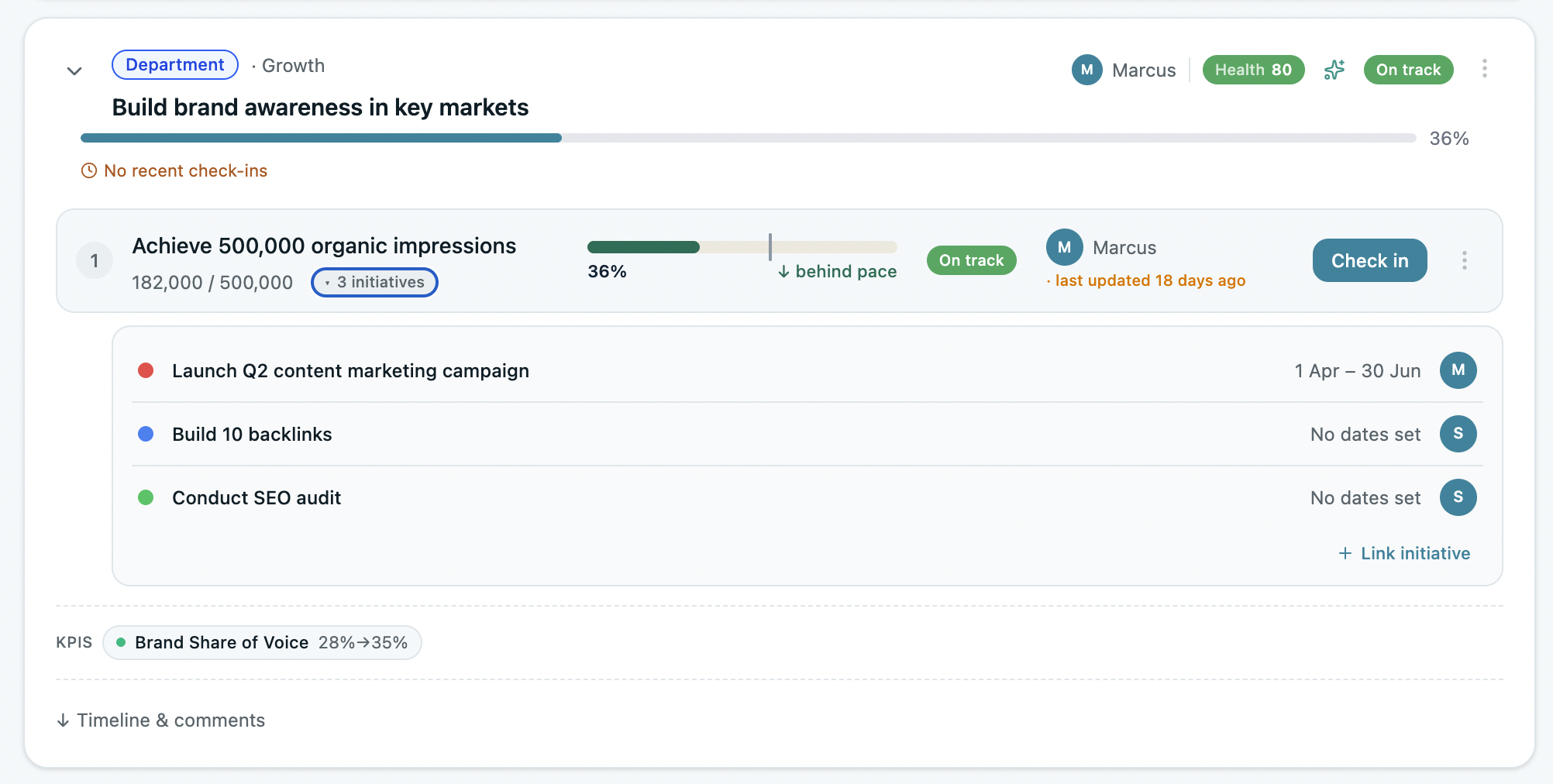
Initiatives are the campaigns, sprints, and experiments that move a Key Result. They belong in OKRs — but underneath the Key Result, not in its place.
High-performing teams attach 2–3 initiatives per Key Result within the first week of the cycle. Teams that delay this step almost never recover momentum. The Key Result is the destination. The initiative is the vehicle.
Step 7: The Pre-Cycle Quality Check
Before any goal goes live, run it through six checks:
A Key Result that passes all six is a genuine business commitment. One that fails more than two needs rewriting before the cycle starts. The OKR best practices guide covers the full quality framework.
OKR Writing Examples by Function
Sales
Objective: Build the enterprise pipeline that funds next year's growth
Key Results:
- Increase enterprise MQL-to-SQL conversion from 18% to 32% — Owner: Sales Manager
- Reduce average sales cycle from 95 days to 65 — Owner: AE Lead
- Increase demo-to-proposal rate from 45% to 70% — Owner: VP Sales
Product
Objective: Make onboarding so clear new users don't need support
Key Results:
- Increase Day 7 activation from 34% to 52% — Owner: Product Lead
- Reduce time-to-first-value from 6 days to 2 — Owner: CX Lead
- Reduce onboarding support tickets by 40% — Owner: PM
Marketing
Objective: Make organic search a predictable acquisition channel
Key Results:
- Grow organic MQLs from 90 to 180 per month — Owner: Content Lead
- Increase top-3 keyword rankings from 14 to 35 — Owner: SEO Lead
- Achieve 40% of total traffic from organic — Owner: Head of Marketing
Engineering
Objective: Build a platform customers can depend on without thinking about it
Key Results:
- Reduce P1 incidents from 8 per month to 2 — Owner: Engineering Lead
- Reduce mean time to recovery from 45 minutes to under 10 — Owner: SRE Lead
- Reduce failed deployments from 18% to under 5% — Owner: VP Eng
For 40+ examples across customer success, people, and more: Key Results Examples → · Sales OKR Examples → · Marketing OKR Examples →
How to Write OKRs With AI
The OKR Intelligence Report 2026 — 222 organizations — found that 83% are using AI in their OKR process. The most valuable writing-stage application: AI that generates outcome-based first drafts, directly addressing the 52% KPI-as-KR problem.
The best practice: use AI as a strong starting point that always needs human refinement. 47% of organizations treat AI output this way — and they consistently produce better-quality goals than the 13% who use AI suggestions as-is.
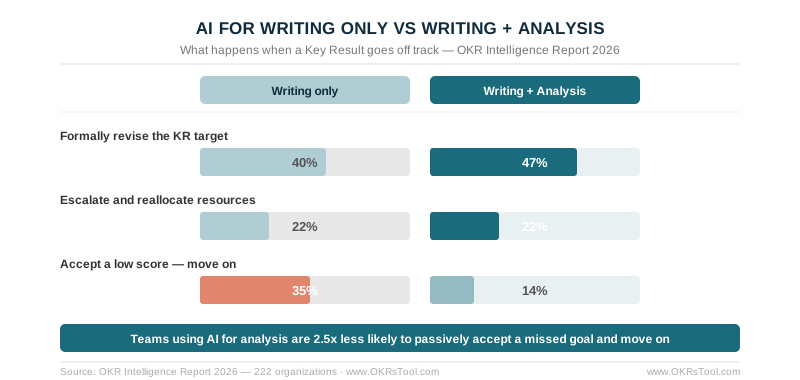
The highest-impact AI use isn't writing though. It's analysis — flagging Key Results that are drifting off-pace before they become misses. Teams using AI for both writing and analysis accept a low OKR score on missed goals only 14% of the time, versus 35% for writing-only teams.
See: AI and OKRs → · AI-Powered OKR Tool →
The Most Common OKR Writing Mistakes
Writing Objectives with numbers. "Grow revenue by 30% this quarter" is a Key Result, not an Objective. The Objective sets the direction: "Build the revenue engine that funds next year's growth."
Confusing initiatives with Key Results. "Launch the new pricing page" is an initiative. "Increase trial-to-paid conversion from 11% to 18%" is the Key Result that launch is supposed to move.
No baseline. "Increase NPS to 50" is incomplete. "Increase NPS from 32 to 50" is a Key Result. Without the baseline, scoring is guesswork.
Shared ownership. "Sales and Marketing jointly own this KR" means nobody owns it. One person. Named. Before the cycle starts.
Too many Objectives. Three or more Objectives per team produces the same completion rate as one — but with three times the overhead. One or two. Maximum. The how many OKRs guide covers the benchmark data in detail.
Copying last quarter's OKRs. OKRs that don't change quarter over quarter are KPIs. If the same goal appears for the third cycle running, either it's not moving (problem) or it's a health metric that belongs on the KPI dashboard (structural fix).
The Difference Is the Writing Stage
Writing OKRs that work is a specific skill. The 52% failure rate in Key Result quality isn't a motivation problem — it's a craft problem. Teams that learn the outcome vs output distinction, apply the baseline-to-target formula, put one named owner on every Key Result, and check in weekly to catch stalls early generate meaningfully better results.
The ROI of OKRs: 2026 Benchmark Report confirms it across 330 organizations: 1:25 return on investment. Teams completing 43% more OKRs when they maintain a weekly check-in habit. 26% higher completion when every Key Result has a named owner.
The OKR framework is the same for every team. The difference is the discipline at the writing stage.
Data: OKRs Tool platform data (20,952 Key Results analyzed), The ROI of OKRs: 2026 Benchmark Report (330 respondents), The 2026 OKR Benchmark Report (200+ organizations), OKR Intelligence Report 2026 (222 organizations).