OKRs return a median 1:25 across 330 organizations — but rolling them out means selling them internally first, and you'll hear the same eight objections every time: micromanagement, we-already-have-KPIs, we-tried-it-and-it-died. Each has a data-backed answer, and most are half-right, which is exactly why they land.
Writing OKRs is the easy part of introducing them. The hard part is the room full of people who've either been burned by them before or assume they're the latest management fad. As the person driving the rollout, you're not defending a framework; you're answering specific, often reasonable pushback from people whose buy-in you need.
This handbook covers the eight objections you'll actually hear, in the skeptic's real words. Each one gets the same treatment: why it feels true, what the data across 330 organizations and 210 employees says, and a one-line answer you can use in the meeting. The point isn't winning the argument. Most objections are pointing at a real failure mode — one that OKRs, done right, are built to fix — and showing that is what actually gets buy-in.
Objection 1: "This is just micromanagement"
The fear underneath this one is real: people picture a tool that tracks their every task and turns weekly check-ins into status interrogations. And they're right to worry, because that's exactly what OKRs become when they're written as task lists instead of outcomes.
The distinction is the whole answer. Across the OKRs Tool platform of 876 organizations and 20,952 key results, 52% of Key Results are tasks or KPIs in disguise — and a goal written as a task ("update the docs," "ship the feature") can only be tracked by watching activity, which is what feels like surveillance. A goal written as an outcome ("cut support tickets 30%") measures the result and leaves the how to the person doing the work, which is the core of writing OKRs that respect autonomy.
The comeback: "OKRs measure outcomes, not activity. If it feels like micromanagement, the goals are written wrong — and that's the thing we're fixing, not adding."
Objection 2: "We already have KPIs — why add this?"
This one's fair on its face: if you're already tracking numbers, why introduce another acronym? The confusion is understandable, because KPIs and Key Results look identical on a dashboard.
The difference is what each is for. KPIs monitor the ongoing health of the business — metrics you watch continuously and want to hold steady. OKRs are about change: the specific outcomes you're trying to move this quarter that aren't moving on their own.
The 52% tasks-in-disguise problem is what happens when teams blur the two and start tracking steady-state metrics as if they were quarterly goals, and it's how a goal set quietly becomes a vanity metric. You need both — KPIs to know the business is healthy, OKRs to know it's improving, and a clear line between the two so neither crowds the other out.
The comeback: "KPIs tell you the business is running. OKRs tell you it's changing. We're not replacing the dashboard — we're adding the thing it doesn't show."
Objection 3: "We tried OKRs and they died"
This is the most common objection in any company over 50 people, and it's the most important to take seriously — because they're not lying. Their OKRs did die. The question is why, and the answer is almost never the framework.
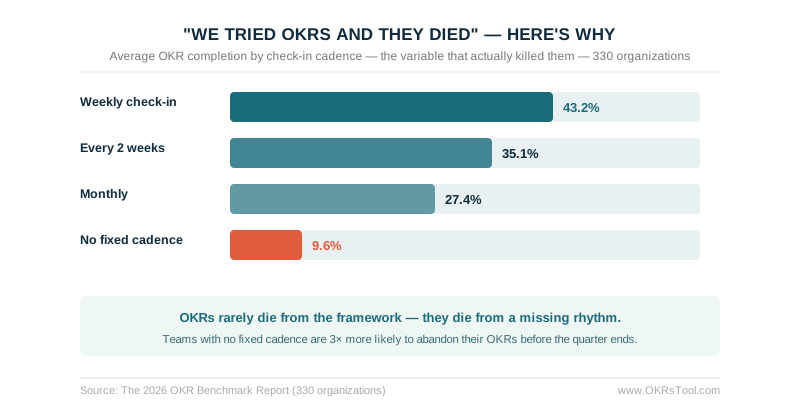
The failure mode is predictable: a big planning kickoff, genuine energy, and then week three arrives with a launch and a fire and the check-ins quietly stop. By week eight nobody remembers what the goals were, and no one spotted the drift while there was still time to act. That's not a reason to avoid OKRs — it's the specific, fixable thing to do differently, and the reasons OKRs fail trace to it again and again.
The comeback: "They died because the weekly rhythm slipped, not because the framework was wrong. The data's clear on this — and the rhythm is the one thing we're going to protect this time."
Objection 4: "Engineering will revolt"
Engineering teams push back on OKRs harder than anyone, and for a good reason: most OKRs handed to them are thinly disguised roadmaps. "Ship feature X" isn't an objective, and engineers know it — so the objection is really "don't make us write our roadmap twice in a worse format."
They're right, and the fix is to let them write outcomes instead of a task list. Engineering is the function most prone to task-based Key Results because shipping is so visible, but the strongest engineering OKRs measure the change the shipping produces — latency, reliability, adoption — not the shipping itself. Show engineering OKR examples that measure outcomes rather than tickets, most of the revolt evaporates, because it turns out engineers like team goals that respect their autonomy over how.
The comeback: "You're right that 'ship X' is a bad OKR. So don't write those — write the outcome the shipping is for, and own the how yourselves."
Objection 5: "We don't have time for another process"
In a busy 50–200 person company this feels self-evidently true — everyone's stretched, and a new process sounds like new overhead. The unspoken fear is that OKRs mean meetings, documents, and administrative weight nobody has capacity for.
The honest answer is that OKRs done right cost about 20 minutes a week, and that time is the highest-return time in the cycle. Organizations using purpose-built goal management software generate a 1:88 return on their OKR investment, and a fast launch plus a weekly check-in — the two habits that drive completion — take less time than the status meetings they replace. The overhead objection usually describes a heavy, document-driven process, not the lightweight OKR meeting rhythm that actually works.
The comeback: "It's 20 minutes a week, and it replaces status meetings rather than adding to them. The version that eats your time is the version we're specifically not doing."
Objection 6: "People will just sandbag the targets"
This objection is the most data-honest of the eight, because it's true: people absolutely will set easy targets. In the State of Goal Management survey of 210 employees, 92% admitted to at least one goal-gaming behavior. The question isn't whether people sandbag — it's what makes them do it.
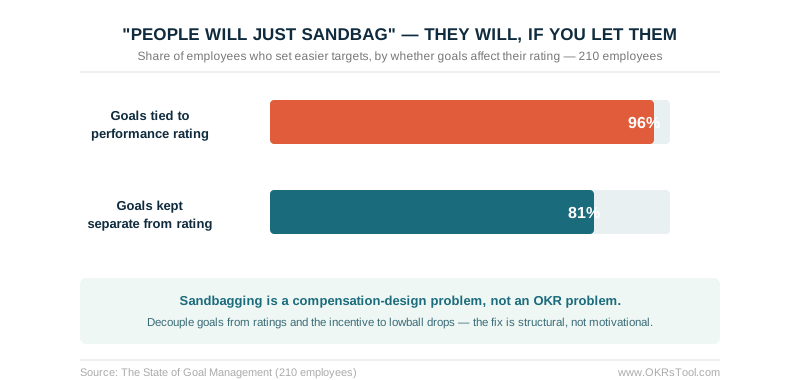
The fix is structural: keep OKRs out of the direct performance-and-compensation calculation, and the reason to sandbag weakens. OKRs are for ambition and learning; ratings are a separate conversation. The link between OKRs and performance can be honest without being a one-to-one scoring formula.
The comeback: "They'll sandbag if we tie targets to their bonus — that's not an OKR problem, it's a comp-design one. Keep the two separate and the incentive to lowball drops."
Objection 7: "Leadership won't stick with it"
Often the person raising this is the most experienced skeptic in the room, and they've watched initiatives get launched with fanfare and abandoned by Q2. It's less an objection to OKRs than a prediction about organizational follow-through — and it's the one that most often comes true.
The data offers both a warning and an argument. Completion climbs with cycle maturity — from around 51% in the first cycles to 79% by the fifth — which means OKRs get better precisely as teams stick with them. Quitting in cycle one, right when it's hardest and the payoff hasn't landed yet, is the single most common way rollouts fail. The counter is to name a champion who owns the process and to commit to a fixed number of cycles before judging results.
The comeback: "You're right that this dies if leadership drifts — so let's name an owner and commit to three cycles up front. The data says it compounds; we just have to not quit in cycle one."

Objection 8: "This is just corporate theater"
The final objection is the cynical one, and it's usually aimed at the whole category: OKRs are a fad, a ritual, something that generates activity without results. Behind it is a legitimate demand — show me this actually does something.
The return is measurable. Across 330 organizations in the ROI of OKRs benchmark, OKRs generate a median 1:25 return, rising to 1:88 for teams running them on purpose-built software. Theater doesn't produce a measurable return; a working operating rhythm does. The cynicism is earned by bad implementations — the theatrical version where goals are set, filed, and never looked at again — which is exactly the version the weekly rhythm prevents.
The comeback: "Corporate theater doesn't return 25 to 1 across 330 companies. The theater version is goals nobody revisits — which is the version the weekly check-in is designed to kill."
What Every Objection Has in Common
Read the eight together and a pattern emerges: almost none of them are objections to OKRs as a concept. They're objections to bad OKRs — task lists, comp-linked targets, kickoffs with no follow-through, roadmaps in disguise. Each skeptic is describing a real failure mode they've seen or feared.
That's the most useful thing to walk into the room with. You're not there to defend a framework against people who don't get it; you're there to agree with their concern and show that the version you're rolling out is built to avoid exactly what they're worried about. The objection is the specification — every one of them tells you what to get right.
The Rollout That Answers Them Structurally
Most of these objections resolve the same way: with outcomes instead of tasks, a rhythm that holds, ownership that's clear, and goals kept separate from comp. Those aren't motivational fixes — they're structural, which means the right setup answers half the room before anyone raises a hand.
The tool you run OKRs on decides whether that structure holds or slips. Enforced ownership on every Key Result kills the "no accountability" worry, an automated weekly check-in protects the rhythm that stops the "we tried it and it died" repeat, and outcome-based Key Results defuse the micromanagement and engineering objections at the source. The OKRs Tool platform is built around exactly those four things, free for up to five users, so the rollout starts on the structure the objections demand.
Data: The 2026 OKR Benchmark Report (330 organizations), the ROI of OKRs: 2026 Benchmark Report (330 organizations), The State of Goal Management (210 full-time employees), and OKRs Tool platform data (876 organizations, 20,952 key results).