Joining a new company with OKR experience is an advantage - but only if you use it carefully. The fastest way to kill a new OKR programme is to implement it like the last one. This article is for the CFO, CTO, or VP who has been here before and needs to do it right in a new context.
_______________________________________________________________________________________________________
You've seen OKRs work.
You know what good looks like - the crisp objectives, the measurable key results, the weekly check-in that actually changes how people prioritize.
You've also seen OKRs fail. The programme that ran for two cycles and quietly died. The planning session that produced a slide deck nobody opened again. The key results that looked right on paper and meant nothing to the people accountable for them.
That experience is what you're carrying into this new company. The question is how to use it.
The Credibility Problem
The instinct for a new leader with OKR experience is to move fast. You know the framework. You know it works. But the company doesn't have it yet, which means every week without it is a week of misalignment you can already see and measure.
But moving fast in a new organization with a framework people haven't experienced is how OKR programmes get labelled as top-down initiatives before they've had a chance to prove themselves.
The credibility problem isn't about the framework - it's about the timing.
An OKR programme introduced in week two by a new executive feels like imposition. The same programme introduced in week eight, after relationships are built and context is established, feels like leadership.
The first thing to get right isn't the objective-setting process. It's the sequencing.
What To Do Before You Introduce The Framework
Spend the first four to six weeks learning how the company currently tracks progress and makes decisions. Not to judge the existing process - to understand it well enough to position OKRs as an improvement rather than a replacement.
Most companies at the 51 to 200-person stage have some version of goal-setting already. It might be a shared spreadsheet, a quarterly all-hands with targets on a slide, or a Confluence page that gets updated twice a year.
Whatever it is, acknowledge it. Find out what's working about it and what isn't - from the people using it, not from your own assessment of it.
That listening period does two things. It builds the relationships that will make the OKR rollout go faster when you do launch it.
And it gives you the specific language to explain why OKRs solve the problems the team is already feeling, rather than arriving as a solution to a problem nobody asked you to fix.
The Rollout That Actually Lands
When you're ready to introduce OKRs, start with one team - not the whole company.
Pick the team where the need is most visible and the lead is most open. Run one cycle with them properly: a planning session, a mid-quarter check-in, a retrospective.
Let that cycle produce a result - not a perfect OKR programme, but a tangible experience of what it feels like when goals are tracked and managed rather than set and forgotten.
That first team becomes the proof of concept. Their experience - the specific things that got better - is more persuasive to the rest of the organization than any framework presentation you could give.
When the head of engineering sees that the product team hit three of four key results and can articulate exactly why the fourth one missed, the conversation about rolling out OKRs company-wide changes character entirely.
This is how most of our customers approach it. Not a company-wide mandate in week one - a structured rollout that started with leadership, demonstrated results, and expanded from there.
The weekly review of 2026 OKRs became a habit because the process was embedded properly, not because it was imposed from above.
When To Start Using a Dedicated OKR Tool
One of the most common mistakes new leaders make when rolling out OKRs is underinvesting in tooling and over-investing in process.
A framework without a home gets lost. Objectives discussed in a planning session but never entered into a shared system disappear within two weeks. The check-in cadence that relies on someone manually updating a spreadsheet fails the moment that person has a busy week.
OKR software doesn't need to be sophisticated. It needs to be simple enough that a senior operator can set it up in an afternoon, visible enough that the team sees their objectives without being reminded to look, and structured enough to support the check-in rhythm that makes OKRs work beyond the first cycle.
OKRs Tool is built for exactly this situation - a new leader who needs to get a team running OKRs properly this quarter without it becoming another initiative that quietly dies. The setup takes less than 30 minutes.
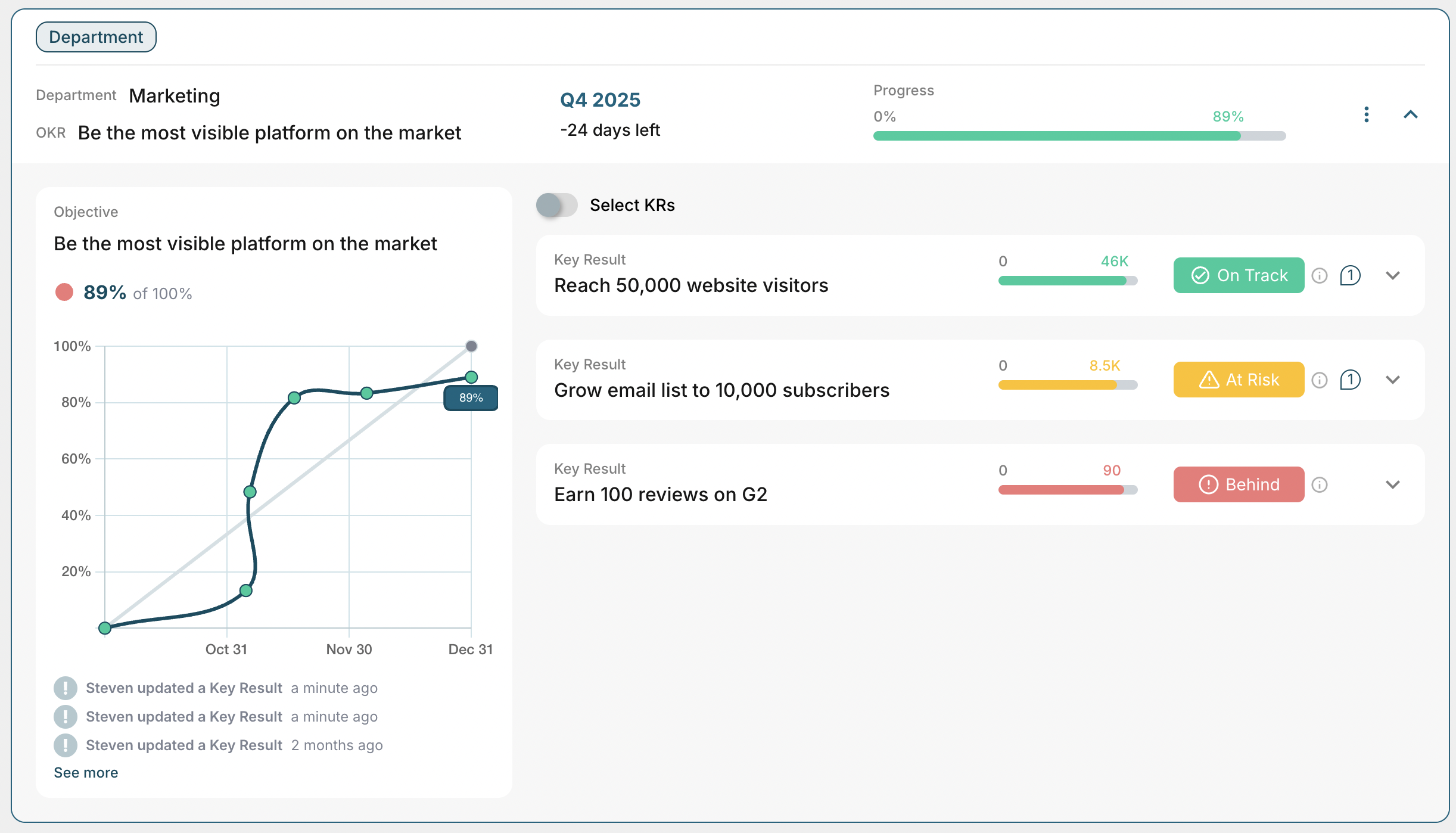
With our concierge onboarding, I will personally import users, migrate any existing goals, and run the first session with your team. The weekly nudges keep the team engaged without the leader having to chase.
And at $49 per month, it doesn't require a procurement conversation to get started.
What The Second Cycle Looks Like
If the first cycle goes well - and it doesn't need to go perfectly, it just needs to go - the second cycle expands. More teams, cleaner objectives, a check-in cadence that runs without prompting.
By the third cycle, OKRs stop being the new leader's initiative and start being how the company runs. The quarterly planning session is on the calendar before anyone asks for it. The mid-quarter review is where decisions get made, not where updates get reported.
The end-of-cycle retrospective feeds directly into the next quarter's goals.
That's the programme worth building - not the one that impresses in month one but exhausts everyone by month three.
The leaders who get OKRs to stick in a new company are the ones who played the long game: sequenced the rollout, started small, demonstrated results, and let the evidence do the persuading.
The framework is the easy part. You already know it works. The job now is to make this company believe it too - on their terms, at their pace, with a process that fits where they actually are.