52% of all key results are tasks or projects in disguise — which is what happens when teams try to use OKRs as a project management system. The two do different jobs: OKRs set the outcome, projects deliver it. The trick is connecting them, and that's exactly what Initiatives do.
Here's the confusion. You set an OKR. Then someone asks, "so what are we actually doing about it?" — and the OKR quietly turns into a task list. Ship the feature. Run the campaign. Migrate the database. Now it's a project plan with the word "objective" stapled to the top.
That's the mistake. A project is work you complete. An OKR is a change you're trying to create. "Launch the new onboarding flow" is a project — it's done when it ships. "Increase Day 7 activation from 34% to 52%" is an outcome — it's done when the number moves, which the launch may or may not achieve.
You need both. The outcome tells you where you're going. The projects are how you get there. The problem is that most tools force you to pick one or the other — a project tool that tracks tasks with no line to the goal, or a goals tool that tracks numbers with no line to the work. So the two drift apart, and nobody can answer the only question that matters: is the work we're doing actually moving the goal? Named ownership on each piece is what keeps the answer clear.
OKRs vs Project Management: The Difference in One Line
An OKR defines the outcome. Project management delivers the work. Confuse the two and you get a to-do list that looks like a strategy.
Here's the split, side by side:
Neither is better. They answer different questions. A team with great project management and no OKRs ships a lot of work with no way to know if it mattered. A team with OKRs and no project management sets good goals — often written well — and has no plan to hit them.
Where Teams Get It Wrong
The most common failure is writing the project as the Key Result. It feels productive — the goal is concrete, everyone knows what to do. But it quietly kills the point of OKRs, and it's one of the main reasons OKRs fail.
It's also more common than most teams realize. Across the OKRs Tool platform of 876 organizations and 20,952 key results, 52% of all Key Results are tasks or projects in disguise — work that gets marked done whether or not the outcome moved.
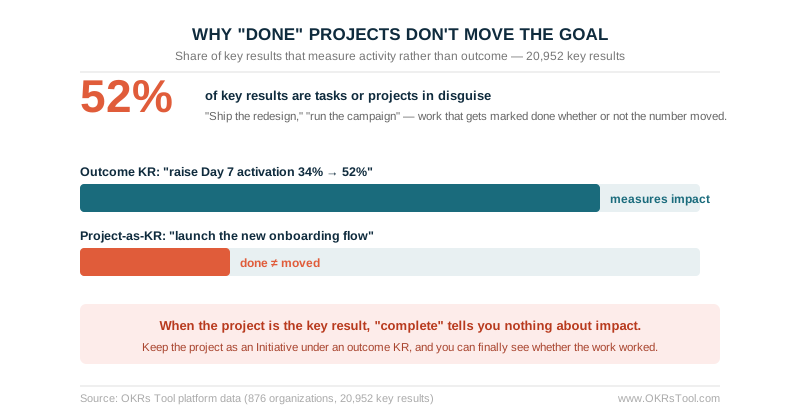
When "ship the redesign" is your Key Result, you'll mark it done the day it ships. Activation might be flat. Support tickets might have gone up. Doesn't matter — the box is checked, the OKR is green, and you've learned nothing about whether the work was worth doing. That green-but-meaningless status has a name: the watermelon OKR, green on the outside and red in the middle.
Write the outcome as the Key Result instead, and the redesign becomes what it always was: one project you're betting on to move the number. If it ships and activation stays flat, the OKR stays red, and that's the system working. You wanted to know. Now you know. Strong OKR examples always separate the two — the outcome in the Key Result, the work beneath it.
Initiatives: Where OKRs and Projects Connect
This is the piece most tools miss, and it's the whole point. In OKRs Tool, every Key Result can have Initiatives attached — the specific projects and work you're betting on to move that number.
The Objective is the outcome you want. The Key Result is how you'll measure it. The Initiative is the work you're doing to get there. Three layers, one line of sight: goal, measure, work.
Take a concrete example. The Objective is "make onboarding the reason new users stick." The Key Result is "increase Day 7 activation from 34% to 52%" — the number that proves it. Underneath sit the Initiatives: rebuild the onboarding flow, add an activation email sequence, ship in-app tooltips. Each is a real project with its own tasks and deadline, but none of them is the goal. They're the bets you're placing on that one number.
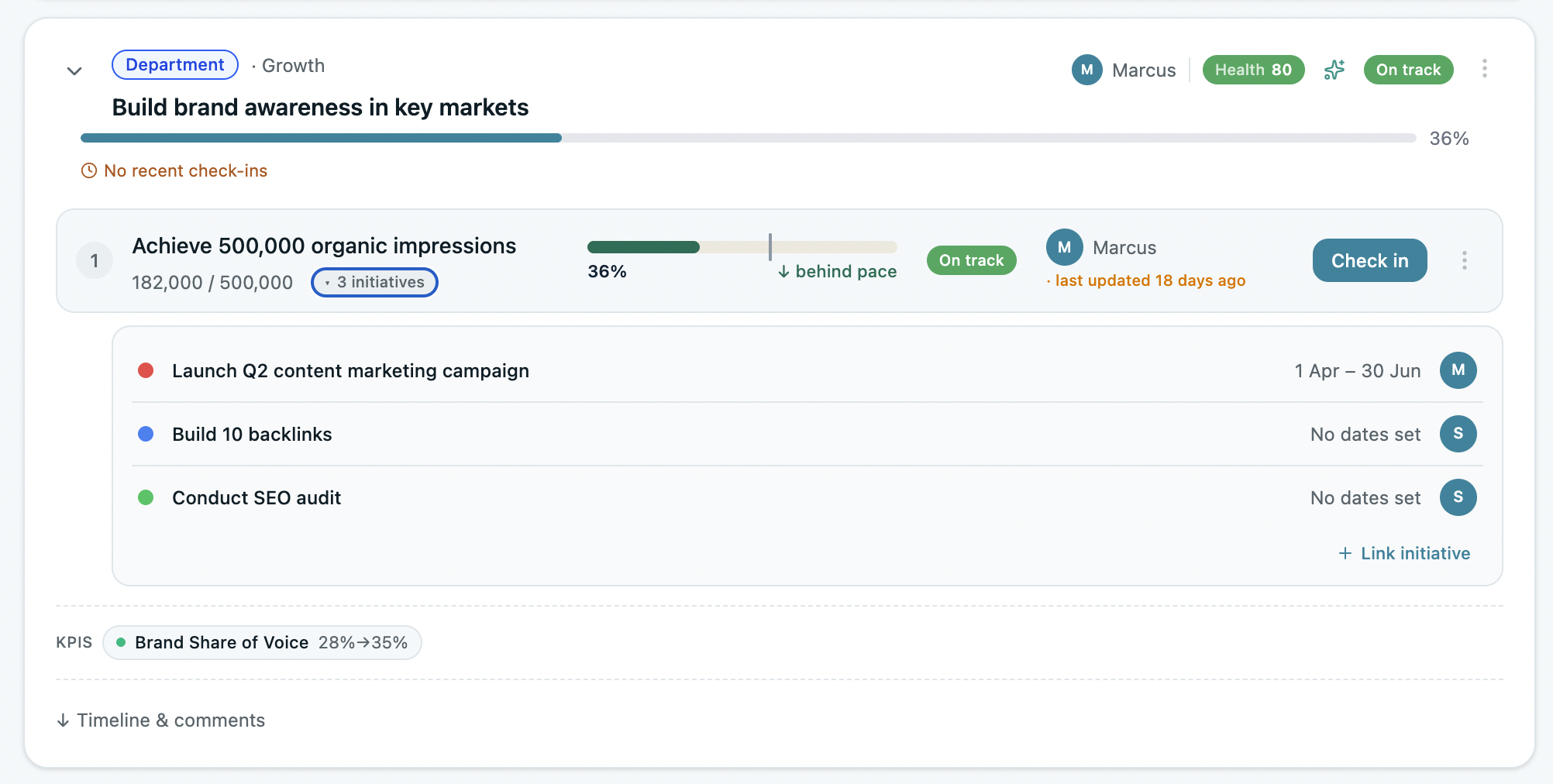
This structure does something a project tool alone can't: it keeps the work honest about its purpose. In a standalone project tracker, "rebuild the onboarding flow" is a goal in itself — you finish it, you close it, you feel productive. Sat under a Key Result, the same project is explicitly a means to an end. If activation doesn't move, finishing the rebuild isn't a win; it's a bet that didn't pay off, and you can see that plainly.
Now the check-in question changes. Instead of "is this project on track?" you ask "is this project moving the number?" — and if a Key Result is stalled while all its Initiatives are marked done, you've found something important. The work finished. The outcome didn't budge. That's a signal to change the bet, not to do more of the same.
That's the difference between running projects and driving outcomes. Projects tell you what got done. Initiatives tied to Key Results tell you what worked.
Do You Still Need Jira or Asana?
Yes — and this is the question most teams actually have. Adopting OKRs doesn't mean ripping out the project management tool your team already lives in. The two operate at different altitudes, and they're better kept that way.
Your project tool is where the work happens: tickets, sprints, subtasks, dependencies, the daily mechanics of shipping. That's not what OKRs are for, and forcing quarterly outcomes into a sprint board is as wrong as forcing sprint tickets into an OKR. The Initiative in your OKR tool is the project — "rebuild onboarding" — while the fifty tickets that make up that rebuild stay in Jira where they belong.
The connection between them is a link, not a merge. The Initiative names the project and ties it to the Key Result it's meant to move; the project tool holds the execution detail underneath.
Your engineers keep working where they already work, and leadership gets a clean line from company outcome down to the projects driving it, without wading through a sprint backlog to find it. That separation — outcomes and their bets in one place, task-level execution in another — is what stops OKRs from collapsing into a second, worse project tracker.
How to Use Both Together in a Cycle
You don't need to choose between an OKR system and project management. You need them connected. Here's the flow that works across a cycle.
Start with the outcome. Set the Objective and Key Results first — the change you want and how you'll measure it — before anyone lists a single task. This is the heart of good OKR planning: if you start with the work, you'll reverse-engineer goals to match what you already planned to do.
Then attach the Initiatives. Under each Key Result, list the projects you believe will move it. These are your bets. Keep them few — a Key Result with fifteen initiatives isn't focused, it's a backlog.
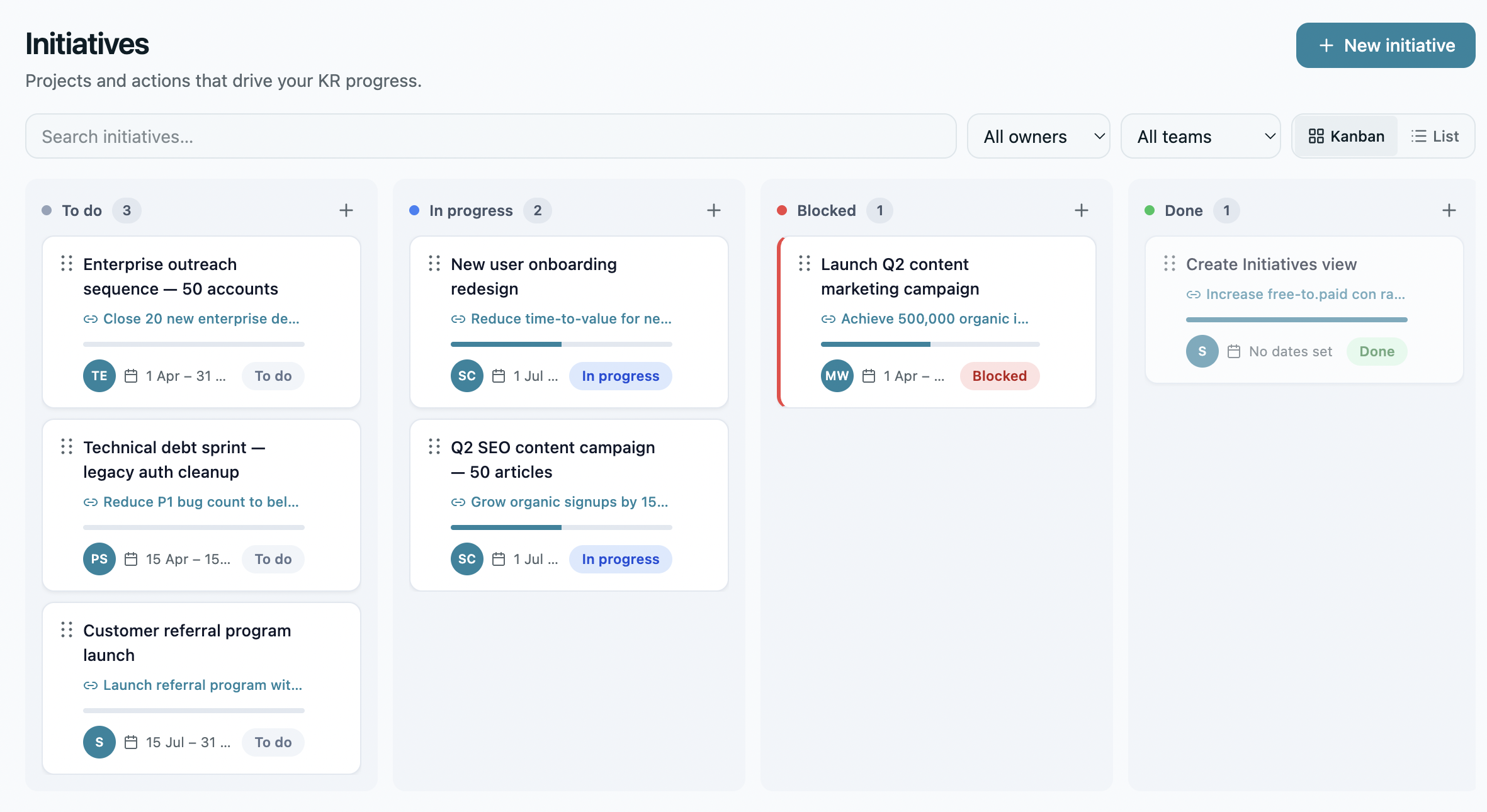
Run the weekly check-in on both layers. Update the Key Result (did the number move?) and the Initiatives (is the work progressing?). Seeing them together is what surfaces the disconnect early — the project that's on track but not moving anything, or the number that's climbing without the initiative you thought would drive it.
Close the loop at cycle end. Which Initiatives actually moved their Key Results? That's your best input for the next cycle — you're no longer guessing which work matters, you have a quarter of evidence. A short retrospective and honest scoring turn that evidence into better bets next time.
The Question Only the Connection Can Answer
Run projects alone and you'll always ship work. Run OKRs alone and you'll always set goals. Connect them, and you can finally answer whether the work you shipped moved the goals you set.
That's the entire case for tying project management to OKRs rather than running them in separate tools. The Initiative that finished but changed nothing is the most valuable thing a cycle can teach you — and you only see it when the work and the outcome live on the same line. It's why the OKRs Tool platform keeps Initiatives under the Key Results they serve, instead of in a separate project tool that never connects back to the goal.
Data: OKRs Tool platform data (876 organizations, 20,952 key results).