
A first OKR cycle averages 51% completion, so a pilot judged on its score looks like a failure when it's actually on track. The metric that predicts rollout success isn't the completion rate — it's whether the team built the weekly check-in habit, and that single signal is worth 43% more completions over time.
An OKR pilot is a time-boxed trial of the framework with one or two teams before a full rollout. It runs one cycle, against criteria set in advance, and ends in a go/no-go decision about whether to expand. The point is to learn how OKRs behave in your organization while the cost of being wrong is one quarter, not one year.
A pilot exists because the framework rarely breaks; the rollout does. Companies push OKRs out everywhere at once, hit the normal friction of a first cycle, and take it as proof the method doesn't work. A pilot contains that friction to one team and produces evidence instead of a verdict.
Why a Pilot Beats a Full Rollout
A company-wide rollout bets the framework's reputation on the first cycle going well. First cycles are messy everywhere, and when the mess is company-wide, people conclude the framework failed rather than that the cycle was new. That conclusion is hard to reverse, which is why so many organizations are on their second or third abandoned attempt.
A pilot inverts the bet. It commits one or two teams for one cycle and contains the inevitable friction to a small group. A good result gives the rollout a proof point and an internal advocate; a bad one costs a single team's quarter instead of the whole company's.
A pilot is also different from running your first OKR cycle. A first cycle assumes the organization has already committed; a pilot is a deliberate test with an exit built in. That framing is what separates a pilot from a premature rollout — and it's why a pilot sits earlier than full OKR adoption.
How to Scope the Pilot
A pilot is bounded on three axes. Get any one wrong and the pilot either proves nothing or never ends.
- Teams: one or two, never a whole department. One gives the cleanest read; two lets you compare an easy-to-measure function against a harder one. More than two is a rollout wearing a pilot's name.
- Length: exactly one full cycle. A quarterly cycle suits most teams — long enough for outcomes to compound, short enough to read a result. A pilot shorter than one OKR cycle never reaches the retrospective, where most of the learning lives.
- Scope: one to two Objectives, two to three Key Results each. A pilot tests whether the habits form, not whether a team can carry a heavy goal load.
Those three bounds keep the pilot readable. The fourth decision — the success criteria — is the one teams skip and the one that matters most.
Write the criteria before the pilot starts, because criteria invented afterward just rationalize whatever happened. The rest of this guide is largely about choosing them well, and the short version is to measure habits, not the score.
Choosing the Pilot Team
The instinct is to pick the highest-performing team so the pilot looks good. That's backwards — a pilot exists to learn, and the easiest team teaches you least about what the rollout will hit. Pick a representative team with a committed manager instead.
The manager choice carries the most weight. The pilot tests whether your managers can run the weekly check-in as much as it tests the framework. A manager who becomes an internal OKR champion is often the most valuable thing a pilot produces, because that person carries the rollout to the next teams.
Why the Completion Score Misleads
The criteria that decide whether to expand have to measure the right thing. The trap is judging the pilot on completion rate, which is the wrong signal in a first cycle.
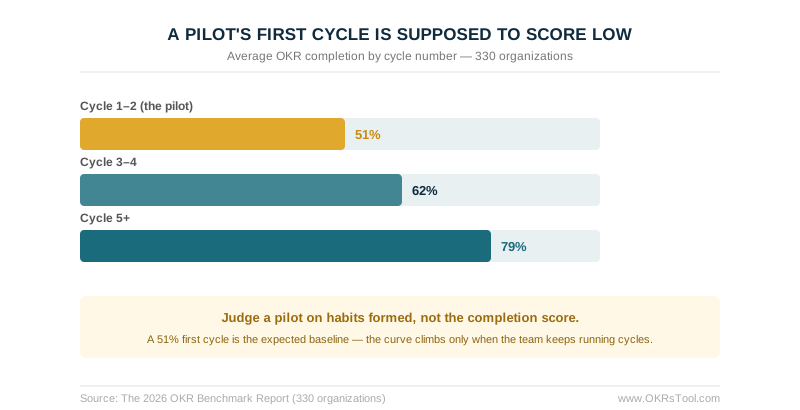
A pilot scoring 51% looks like failure if you expected 100%, and looks correct once you know the maturity curve. Completion climbs across cycles as the team learns, so the first cycle is meant to be the low one. Judging the pilot on its raw score kills programs that were working exactly as expected.
Set Go/No-Go Criteria on the Habits
The honest criteria measure the habits that predict later success, not the score the team happened to hit. Each one has a benchmark behind it, and a pilot passes only if the team built all three.
- Weekly check-in held for 10+ of 12 weeks. This is the cadence worth 43% more completions than monthly or ad hoc review — and the single habit most predictive of whether the team sustains OKRs at all. Set the recurring check-in cadence before the cycle starts and count how many weeks actually happen.
- One named owner on every Key Result. Single ownership lifts completion 26% over shared or vague accountability. At the retro, check that every Key Result had one person accountable for it all cycle — not a team, not "leadership."
- Launched in under a week, with outcomes not activities. A fast launch is worth up to 50% higher completion than one that drags past a month. Confirm the goals measured real change rather than tasks in disguise, since a pilot full of activity metrics tests nothing.
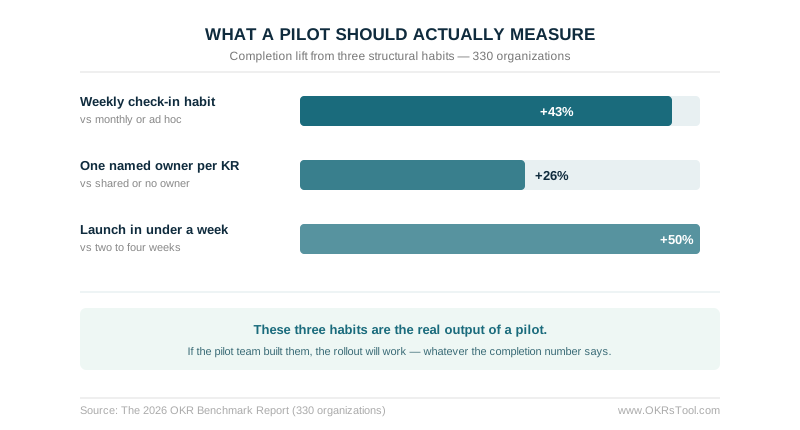
A pilot that built those habits is a go even at a modest score, because the score will climb. A pilot that hit a high number without them is a false positive — the team sandbagged, and the rollout will expose it.
Running the Pilot Cycle
The pilot runs like any well-structured cycle, except you watch the process as closely as the outcomes. Planning comes first, and it's where a pilot is won or lost.
Set one or two Objectives with two to three Key Results each, every Key Result owned by one person and written as a measurable outcome. A team that leaves OKR planning with vague goals spends the cycle confused about what it's testing. A few company OKR examples on the table during drafting prevents most of that.
Then the weekly rhythm holds, and you note where the team struggles. Each check-in is short — progress, blockers, what's at risk — and the value is the cadence, not the meeting. A mid-cycle review at the halfway point catches drift while there's time to act, and tests whether your managers run that review when it counts.
The friction points are the pilot's most valuable output. Whether the team struggles to write good Key Results, hold the cadence, or get teammates engaged tells you exactly what to fix before the rollout. Write each one down as it happens.
Reading the Result and Deciding
The pilot ends with a retrospective, and that's where the go/no-go call gets made. Score each Key Result honestly on the 0.0–1.0 scale, then set the score aside and ask three questions that actually predict the rollout.
That last question is the most honest signal a pilot gives. A team that wants to keep going found real value whatever its score; a team relieved it's over has told you the rollout needs a different approach. A go means expanding with the pilot's friction points already designed out.
A no-go rarely means OKRs don't work. It usually means the implementation needs adjusting, and the pilot just told you how — for the price of one quarter instead of a company-wide failure.
What the Pilot Needs Underneath It
A pilot tests the framework, but it also tests the infrastructure underneath it. A pilot run in a spreadsheet tests the spreadsheet's limits as much as the OKRs — the check-in has to be effortless, ownership enforced at goal creation, and the cascade visible, or the result is contaminated.
Purpose-built OKR software removes those variables so the pilot tests OKRs, not the tooling. The OKRs Tool platform runs a pilot team's full cycle — planning, automated weekly check-ins, named ownership, and an honest retrospective — and sets up in an afternoon with no consultant. Because it's free for up to five users and flat-rate above that, the pricing doesn't punish you for expanding when the pilot works.
A Pilot Is a Decision, Not a Trial Run
A pilot answers the one question the planning debate can't settle on its own: will OKRs work here, with these managers and these teams. It replaces the argument with evidence, for the price of a single team's quarter.
Judge it on the three habits — the weekly check-in, named ownership, a fast outcome-based launch. Those habits are what completion grows out of, so a team that built them is ready to expand whatever its first-cycle score. A go isn't a hope that the rollout works; it's a scaled copy of something you've already run once and watched hold.
A no-go is worth as much as a go. The pilot shows you exactly what needs adjusting before a wider rollout — the check-in that didn't hold, the ownership that stayed vague, the goals that measured activity. You fix those first, for the cost of one team's quarter rather than a company-wide stall.
Data: The 2026 OKR Benchmark Report (200 organizations).