Across 200 organizations, teams spending more than 30 minutes a week reviewing OKRs completed fewer of them than teams spending less. The weekly check-in still drives 43% more completed OKRs — but only when it is a two-minute written update rather than a recurring call. Visibility is a property of the system, not an output of a meeting.
When goals aren't visible by default, teams compensate with manual coordination — standups, spreadsheet updates, Slack threads, and the recurring sync that starts at fifteen minutes and grows to forty-five. Each one exists to answer a question the OKR system should already have answered: what moved, and what's stuck.
The cost is real and measurable. If the only moment a leader knows how a team is doing is during a status call, that isn't visibility — it's dependency. And the benchmark data shows the meetings don't even work: teams spending 45+ minutes a week on OKR review complete fewer goals than teams keeping it under 30.
A Check-In Is Not a Meeting
The distinction the data supports isn't between checking in and not checking in. It's between a written update and a recurring status meeting.
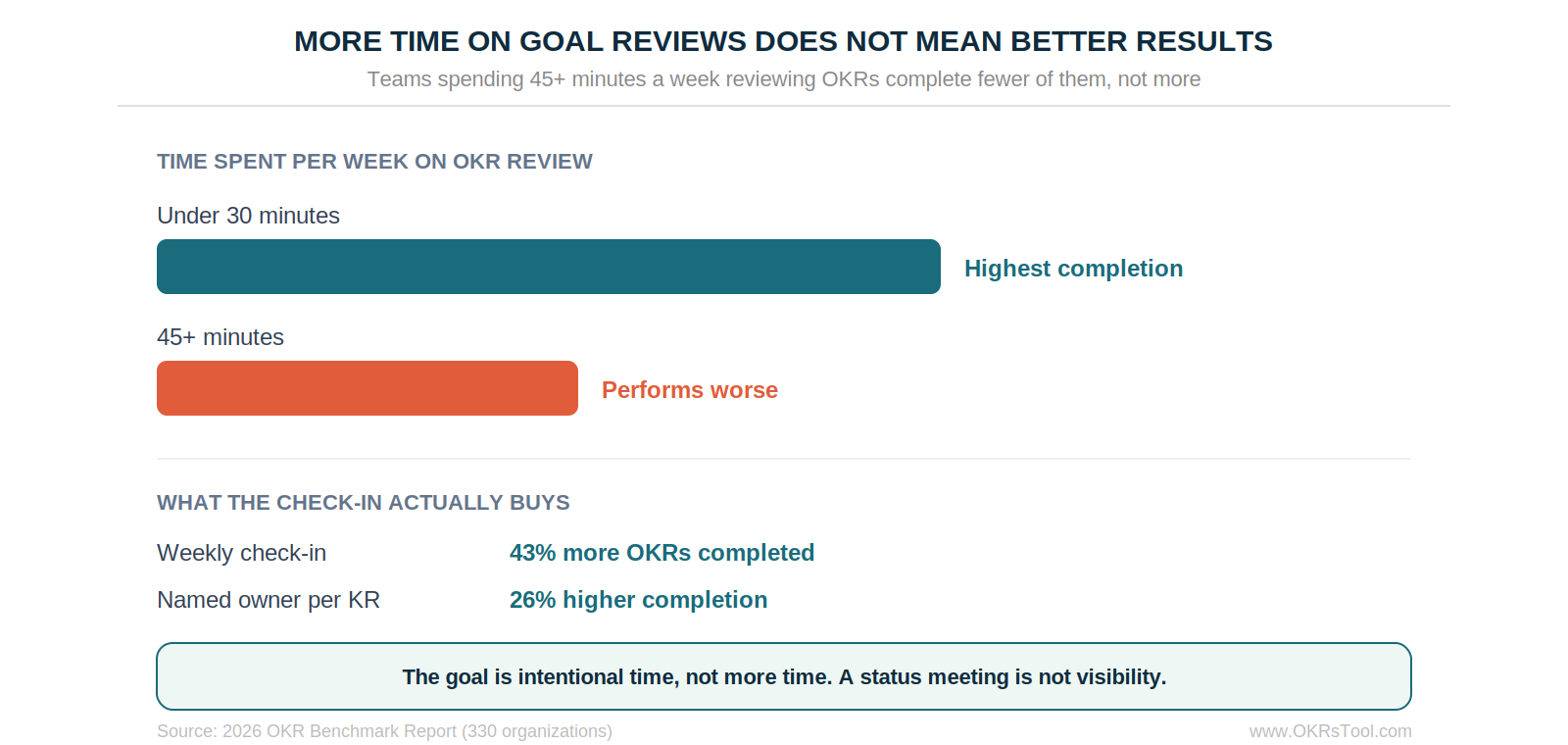
Teams that check in weekly complete 43% more OKRs than those reviewing monthly or ad hoc. That figure holds whether the check-in happens in a room or in a text field. What changes is the cost: a three-minute written update from each owner produces the same visibility as a thirty-minute call, and produces it asynchronously, in writing, where it can be read later.
The counterintuitive finding is that spending longer makes outcomes worse. Beyond 30 minutes a week, a team is no longer reviewing goals — it is holding a meeting about goals. The check-in exists to surface what moved and what's blocked. Everything past that is process bloat.
Visibility Doesn't Start With the Leader
The instinct behind status meetings is that someone senior needs to see progress. The platform data suggests the opposite: what makes updates happen isn't leadership oversight, it's whether anyone else can see the number at all.
Solo workspaces update 17% of their Key Results. Only 30% of them ever update a single one. Add two people and that active rate more than doubles to 61%; with a full team it reaches 91%. The mechanism isn't supervision — it's that a goal in shared space gets updated, and a goal in a private document doesn't.
This reframes what a leader is actually solving for. The question isn't "how do I see what my team is doing without asking?" It's "how does the team see its own progress without anyone assembling a report?" Answer the second and the first becomes automatic.
Assign One Named Owner Per Key Result
Roughly 50% of Key Results in the platform data have no named owner. A goal owned by everyone is updated by nobody, and the recurring status meeting exists precisely to compensate for that gap — it is the manual process that replaces the missing accountability.
Required single ownership drives 26% higher completion. The owner isn't responsible for doing all the work; they're responsible for the number being current and honest every week. That responsibility is what makes the written update happen without anyone chasing it.
This is also the cheapest change available. It requires no tooling, no process design, and no cultural shift — only the discipline of not letting a Key Result go live without a name attached.
Make the Update Take Two Minutes
An update that takes ten minutes won't happen consistently. The friction is what kills the habit, not the intent. Three prompts, answered in writing, are enough.
What's the status? On track, at risk, or off track. One word.
What's the number? The current value of the Key Result you wrote, not a narrative about the work. "Onboarding completion is at 58%, up from 45%" tells you something. "Made good progress on onboarding" doesn't.
What's blocked, and who can unblock it? Only if something is. Most weeks this is empty, and that's fine.
Written, these three answers take under three minutes per owner. Delivered into Slack or MS Teams where the team already works, they require nobody to open a dashboard. And because they're written, they're searchable — the leader reads them at 7am rather than convening a call at 10.
Surface Drift Automatically
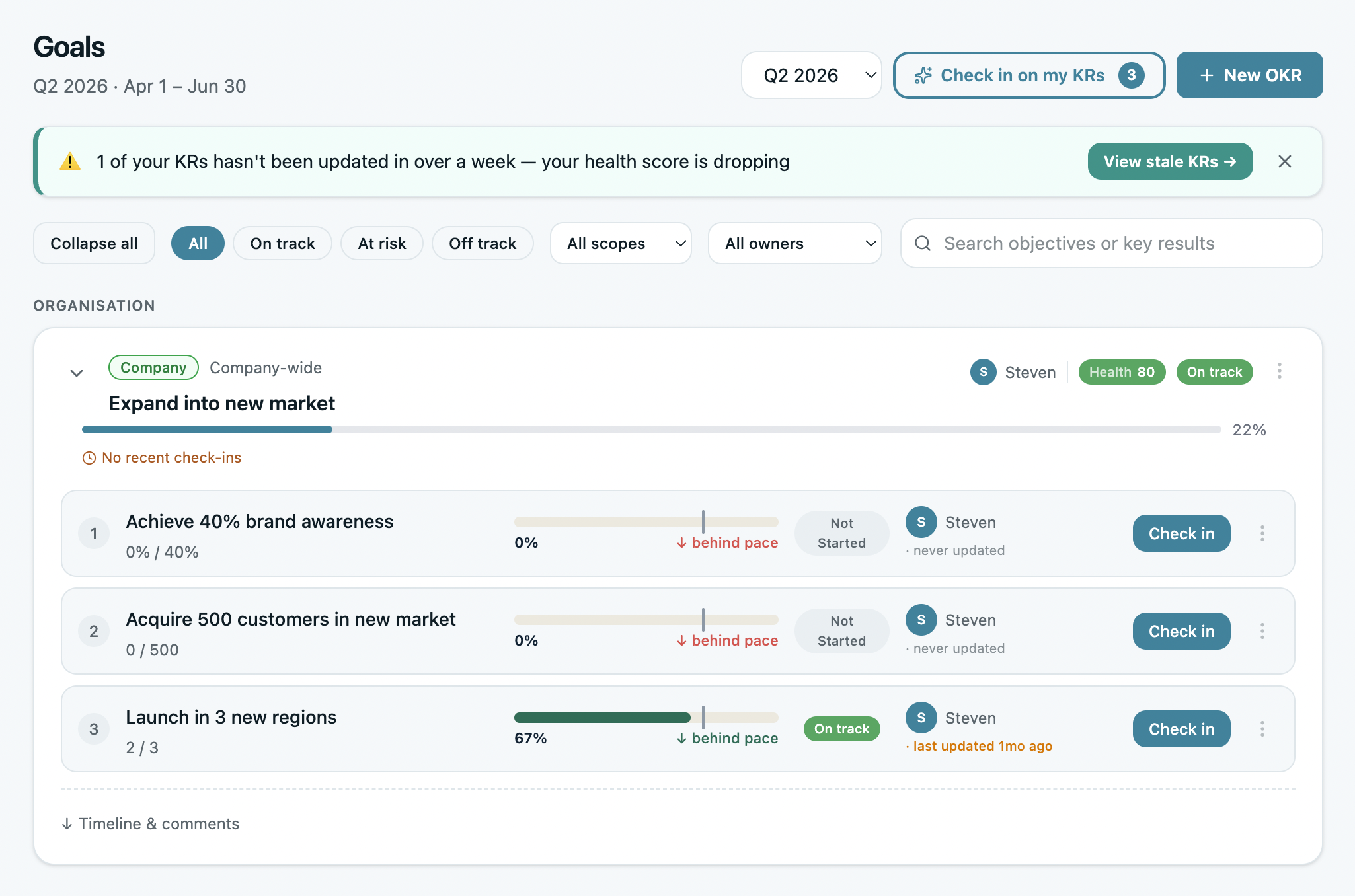
The reason status meetings feel necessary is that problems are invisible until someone reports them. An at-risk flag that fires when a Key Result drifts below trajectory removes that dependency entirely.
The value is in the timing. A Key Result slipping in week three is recoverable — the team can change the approach, reallocate effort, or adjust the target for a defensible reason. The same drift discovered in week eleven leaves one option: lower the number and hope nobody notices. Struggling teams left 31% of their objectives frozen at zero progress across the entire cycle. High performers left 4%.
Automated flagging also removes the psychological cost of raising a hand. When the system surfaces the risk, the owner isn't confessing — they're responding to a signal everyone can already see.
Close the Cycle in Writing
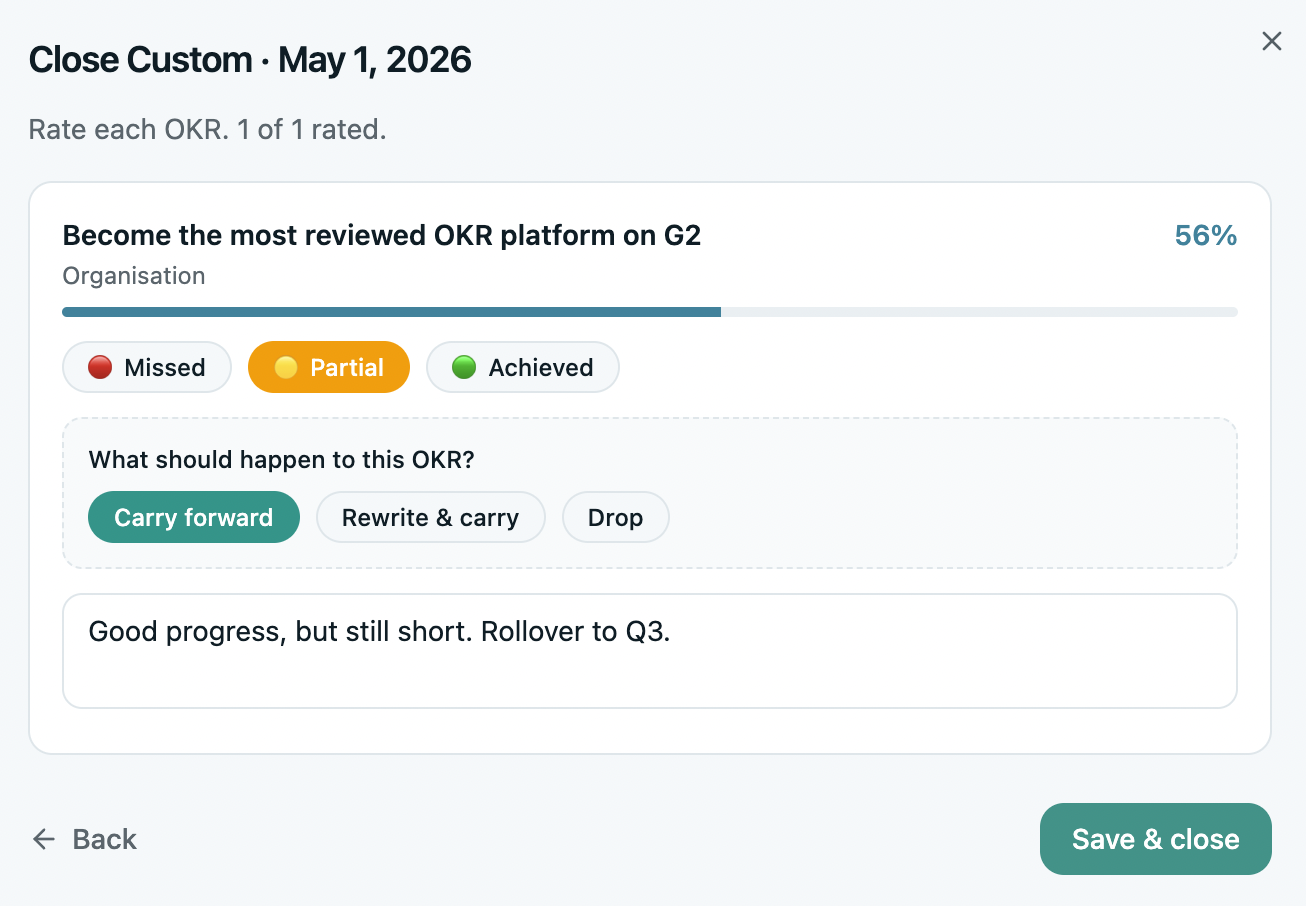
The end-of-cycle retrospective is the one moment where a conversation genuinely beats a document, and it still doesn't need to be long. Thirty minutes, four questions: what moved, what stalled, why, and what changes next cycle.
Teams that run consistent retrospectives complete 30–45% more goals the following quarter. The compounding is what the maturity curve measures — 51% completion in cycles one and two rising to 79% by cycle five. Skipping the retro doesn't save time. It costs the next quarter.
Clarity Without Control
Tracking team goals without status meetings requires four things, none of them a tool: a single named owner on every Key Result, a written weekly update that takes three minutes, automatic surfacing of drift, and a real ending to every quarterly cycle.
What that produces isn't less accountability. It's accountability that doesn't depend on a leader asking. The team sees its own progress, the numbers stay honest because they stay visible, and the meetings that remain are the ones where something actually gets decided. See how OKRs Tool runs the full weekly cycle without adding a single recurring call — free for up to 5 users.
Data: The 2026 OKR Benchmark Report (200 organizations), OKRs Tool platform data (876 organizations, 7,419 objectives, 20,952 key results).