The single most expensive mistake in OKR software is not picking the wrong tool — it's buying a tool nobody sustains. Reddit threads, G2 reviews, and our own benchmark data all describe the same pattern: tools get mandated top-down, then quietly ignored by week three.
In 2025, two widely-used OKR platforms disappeared on their customers within 13 months of each other. Microsoft retired Viva Goals on December 31, 2025 — with no replacement. Workboard acquired Quantive on May 28, 2025, forcing migrations mid-strategy. Hundreds of teams were left re-implementing their goal programmes from scratch.
Vendor stability is now a buying criterion. So is adoption design. So is the growth tax hidden inside per-user pricing. This guide covers what most OKR software comparison posts don't.
The Real Failure Mode: Adoption, Not Features
Before comparing pricing tiers and integration libraries, the most important question is simpler: will people actually use this every week?
The 2026 OKR Benchmark Report across 330 organizations found that teams without a consistent weekly check-in are 3x more likely to abandon their OKRs entirely. The tool doesn't cause that abandonment — but the right tool prevents it by making the check-in habit structural rather than dependent on memory and motivation.
Most G2 and Reddit reviews don't describe the wrong tool being chosen. They describe the right tool being ignored. Organizations are "forced to use it" but "nobody seems to use it in reality." OKRs become "project milestones that don't really quantify much." The framework survives the planning session and dies before week three.
The 2026 OKR Benchmark Report is precise about what actually prevents abandonment: automated Slack or MS Teams check-in nudges, required named ownership per Key Result, and live dashboards that leadership actually opens. Teams with weekly check-ins complete 43% more OKRs than those without. These are adoption mechanics, not features. They should be the first filter on any shortlist.
The Hidden Costs of OKR Software
Sticker price is the cheap part. The expensive surprises come from three places.
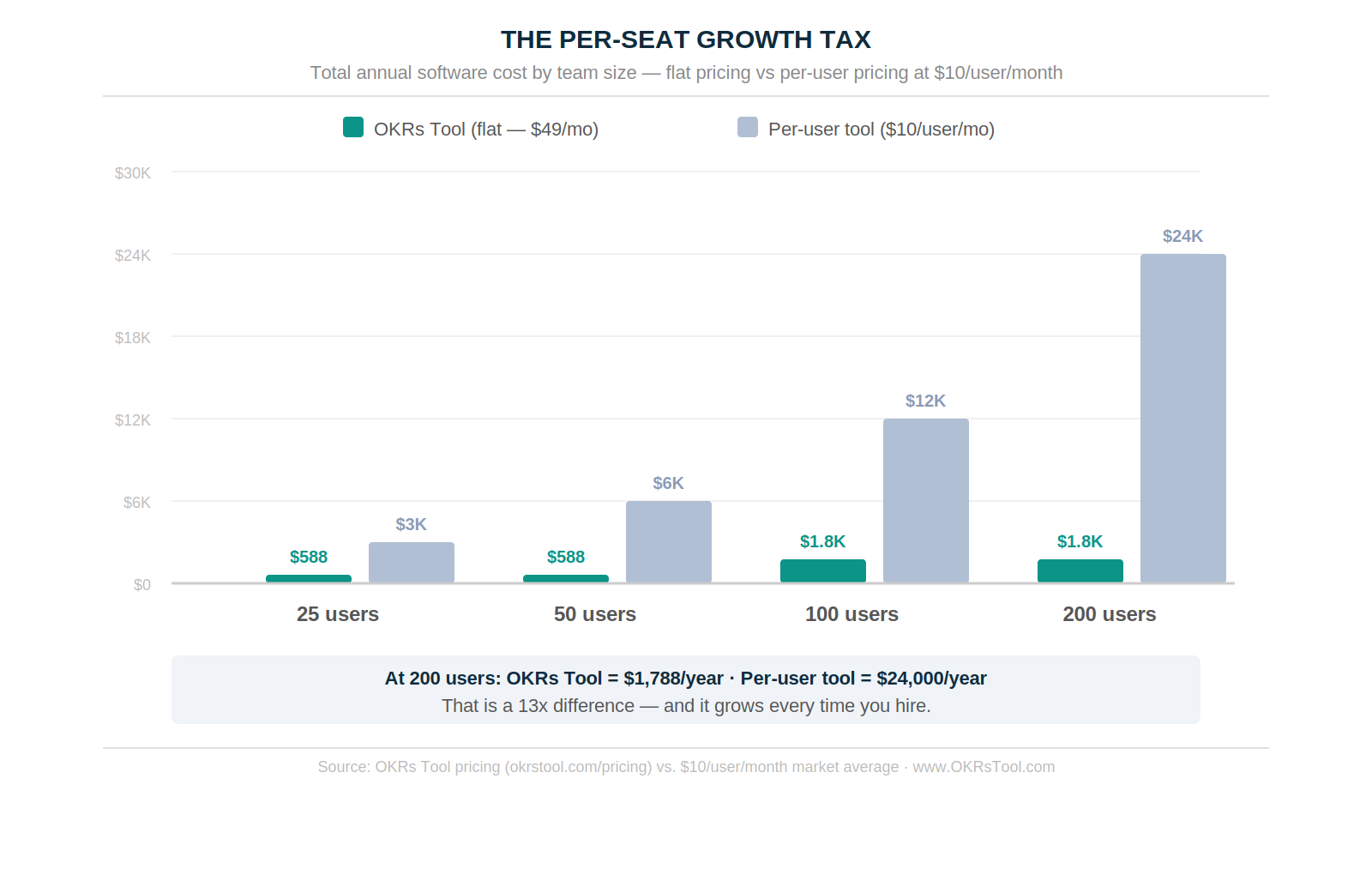
Per-seat pricing punishes the visibility OKRs require. If only editors get full licenses but the whole organization needs to see goal progress, per-seat tools create a choice between paying for everyone or undermining transparency. At a 200-person organization, a $10/user/month tool costs $24,000 per year. OKRs Tool's flat pricing costs $1,788. The delta compounds every year the team grows.
Minimum seats and contract floors are buried. Perdoo requires a minimum of 5 paid seats and a $3,000 annual contract. Mooncamp's Enterprise tier requires 100 users and a $10,000 minimum for priority support. Betterworks and Workboard are demo-gated with no public pricing — Vendr transaction data shows average Betterworks contracts running approximately $77,000/year, with implementation fees adding another $20,000–$50,000.
Coaching is almost always extra. The research consistently shows that OKR software adoption fails not from missing features but from missing change management. Most vendors sell coaching as a separate package. A realistic first-year budget for an enterprise deployment: software license + implementation + OKR coaching + internal champion time. The subscription is the smallest line item.
Vendor Stability: The Criterion That Appeared in 2025
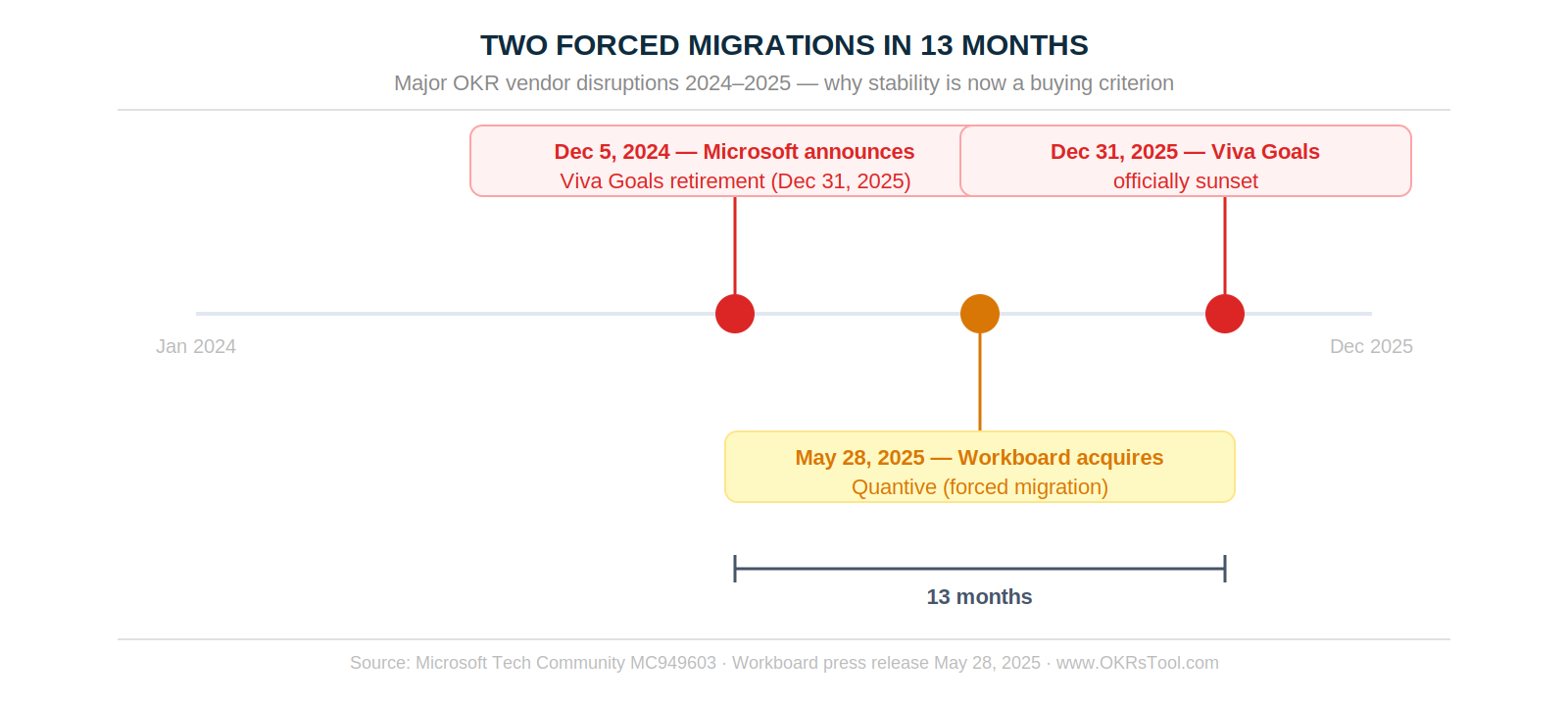
On December 5, 2024, Microsoft announced it was retiring Viva Goals with a 13-month wind-down ending December 31, 2025. No replacement was offered. Teams that had built their entire strategy into the platform were told to migrate. One Microsoft Tech Community user wrote: "It was a huge blow for us as well. They announced it a couple months after we put our entire strategy into Viva Goals."
On May 28, 2025 — 13 months later — Workboard acquired Quantive (formerly Gtmhub), announcing that "Quantive customers will transition to the WorkBoard platform over the coming months." Another forced migration for teams mid-cycle.
Two major disruptions in 13 months. Both happened with advance notice that gave teams weeks rather than quarters to adapt. The checklist question that now belongs on every shortlist evaluation: "Can we export all our OKR and KPI data at any time, and what happens to our data if you're acquired or sunset?" Ask explicitly. Viva Goals and Quantive customers wished they had.
Signals of stability to look for: independent and venture-backed (not a product inside a larger suite), active feature development, self-serve access without sales gates, and explicit data-export rights in the contract.
Implementation Time Reality
The promise of "set up in 30 minutes" is true for lightweight tools. It is not true for mid-market or enterprise platforms — and the gap matters because the 2026 OKR Benchmark Report found teams that complete setup and launch in under one week see up to 50% higher OKR completion rates than those taking three to four weeks.
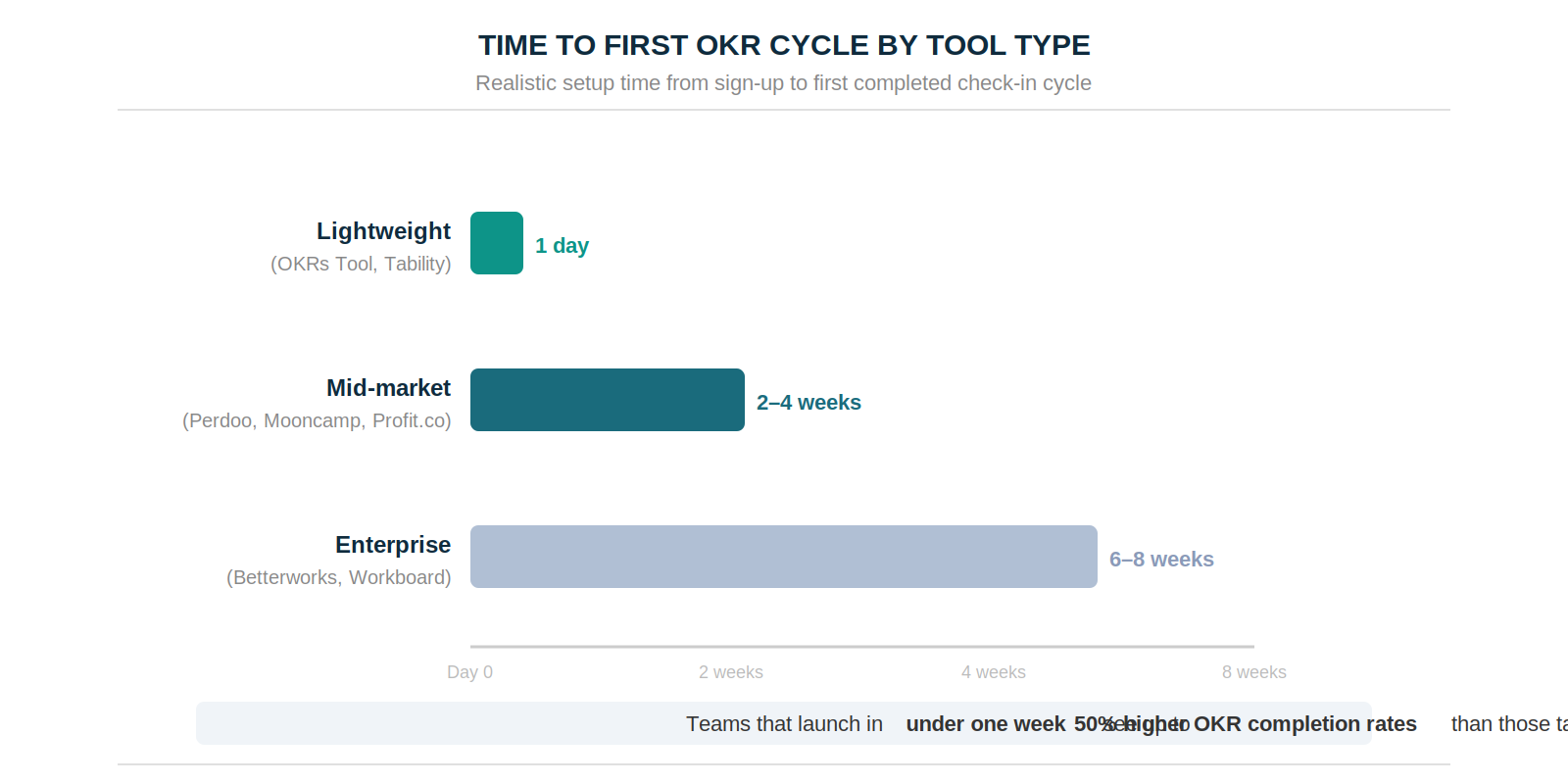
A realistic guide: lightweight self-serve tools (OKRs Tool, Tability) can have a team live in a single afternoon. Mid-market tools (Perdoo, Mooncamp, Profit.co) typically take two to four weeks accounting for configuration, cascade setup, and first check-in training. Enterprise tools (Betterworks, Workboard) assume a dedicated implementation project, typically six to eight weeks with IT involvement for SSO, SCIM, and HRIS integration.
4 Tools Reviewed in Depth
Perdoo
Best for: Leadership teams connecting strategy to quarterly OKRs (200–500 employees)
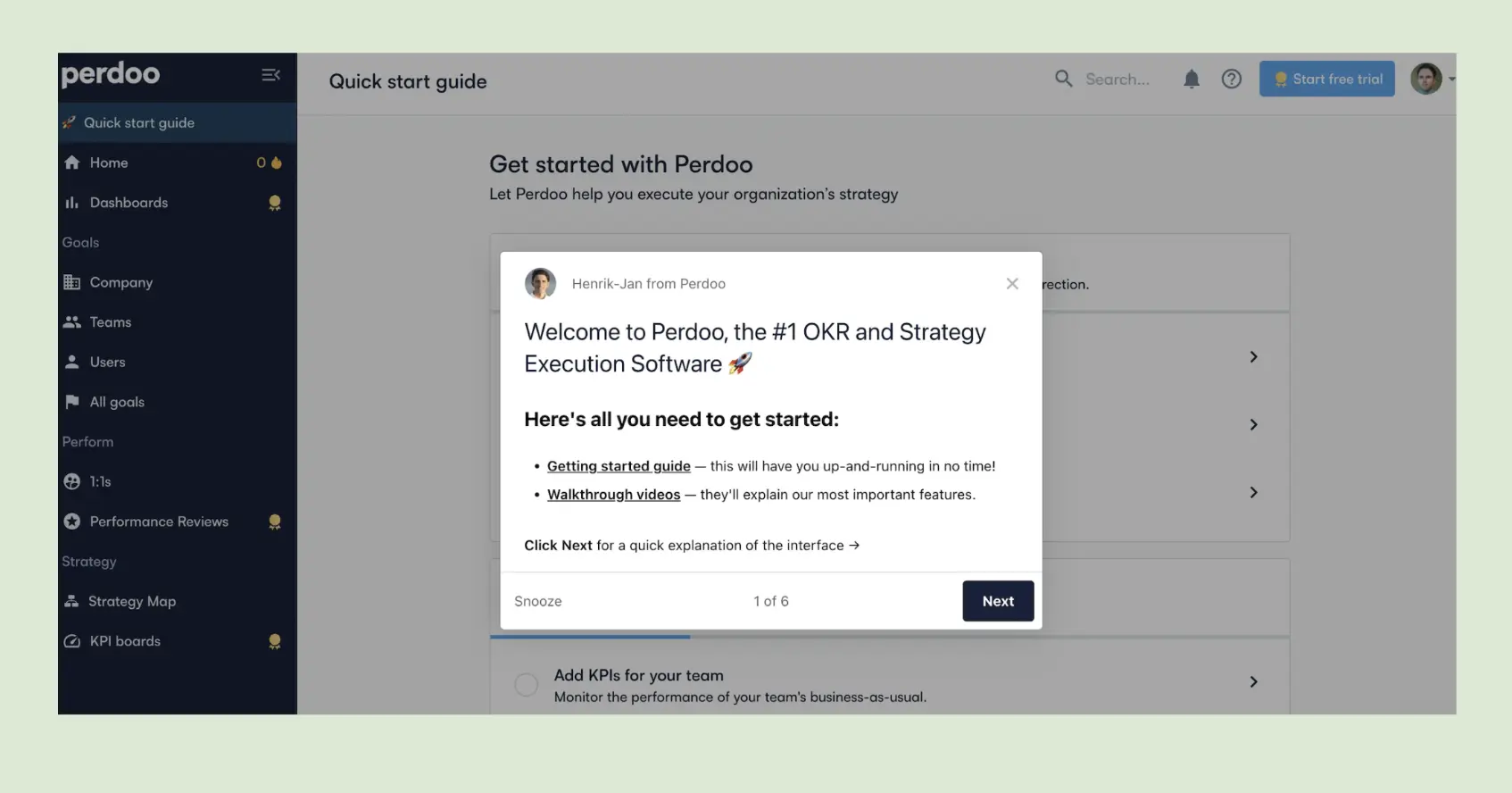
Perdoo's differentiator is its Strategy Map — a visual chain from long-term vision through annual strategy to quarterly OKRs and KPIs. For organizations where the gap between strategic direction and execution is the primary problem, that layer adds genuine value.
The consistent complaint across G2 reviews: the mobile app is weak to the point of being unreliable. For distributed teams where mobile access is standard, this is a real limitation. The UI is also considered dated compared to newer competitors.
The pricing floor matters: 5 paid seats minimum, $3,000 annual contract floor. Teams under 10 people should note that the free tier (up to 5 users) doesn't include cascade features or strategy maps. View-only licenses from approximately $1.75/user/month make org-wide transparency accessible without full per-seat costs.
G2 rating: 4.5/5. Pricing: Free ≤5 users. €8–11/user/month paid (5-seat minimum, $3,000 floor).
Mooncamp
Best for: Microsoft Teams-heavy organizations under 150 employees that prioritize design
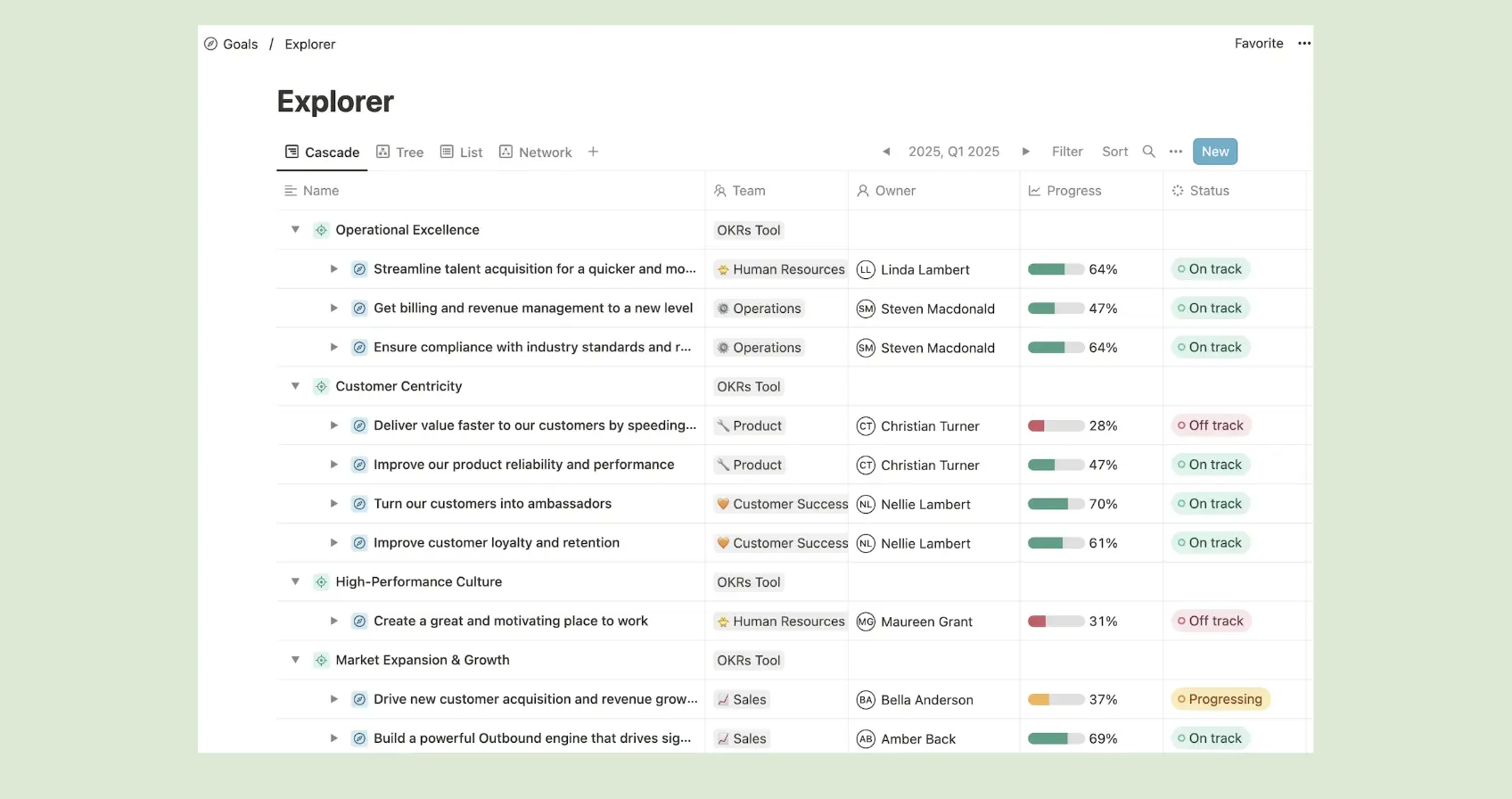
Mooncamp consistently earns the highest UX ratings in the category — clean interface, flexible workflows, and strong Microsoft Teams integration. Customization is the primary differentiator: teams can adapt the OKR structure to their culture rather than conforming to a rigid framework.
The two consistent gaps: no native mobile app (responsive web only, described in reviews as "clunky" on mobile), and no shipped AI as of mid-2026. The connector library is also smaller than Microsoft or Atlassian ecosystem tools.
The Enterprise tier requires 100 users minimum and a $10,000 priority support floor — creating a pricing cliff for teams between 50–100 people that makes the mid-tier less competitive than it looks.
G2 rating: 4.8/5. Pricing: 14-day trial, no permanent free tier. €6–10/user/month. Enterprise requires 100 users.
Profit.co
Best for: Organizations that need OKRs, KPIs, performance management, and project tracking unified
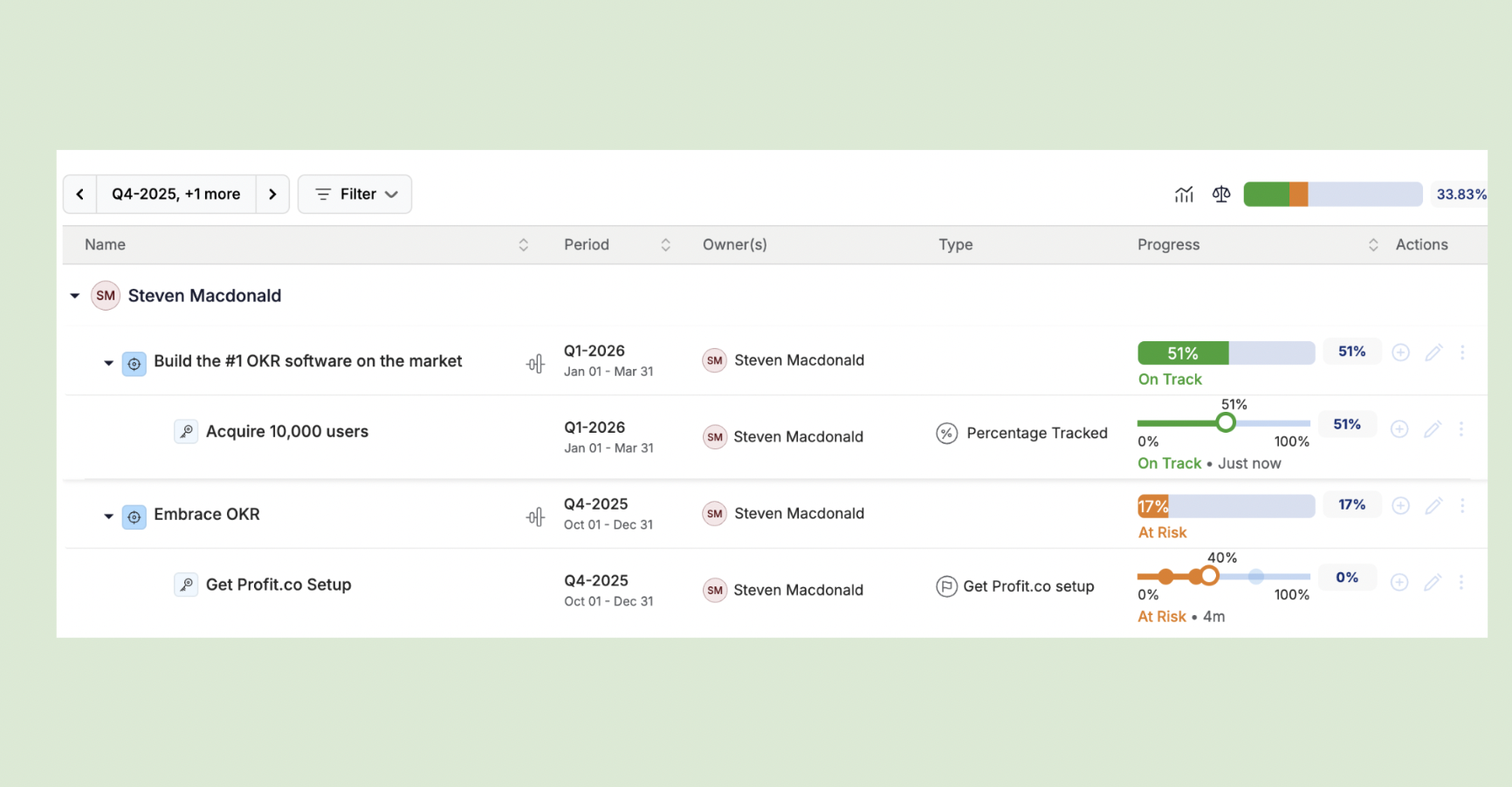
Profit.co's breadth is unmatched in the mid-market category. OKRs, balanced scorecard, 300+ KPI library, performance reviews, and project tracking in one platform — for organizations where the challenge is consolidating fragmented goal and performance tooling, this comprehensiveness is the point.
The consistent complaint: the learning curve is steep, and the first year typically requires dedicated internal ownership to configure and maintain. Reviews describe needing "a lot of assistance and ownership in the first year" and finding the initial steps "very hard to start." The feature density that makes it powerful at scale is the same density that slows adoption at the 50–100 person stage.
Pricing is opaque — module-based and effectively contact-sales for anything beyond the sandbox Launch plan. Budget accordingly.
G2 rating: 4.8/5. Pricing: Free Launch plan. Paid custom (estimated $7–9/user/month on published sources; Vendr average ~$14,000/year).
Betterworks
Best for: Enterprise organizations (500+ employees) with committed OKR-driven performance management
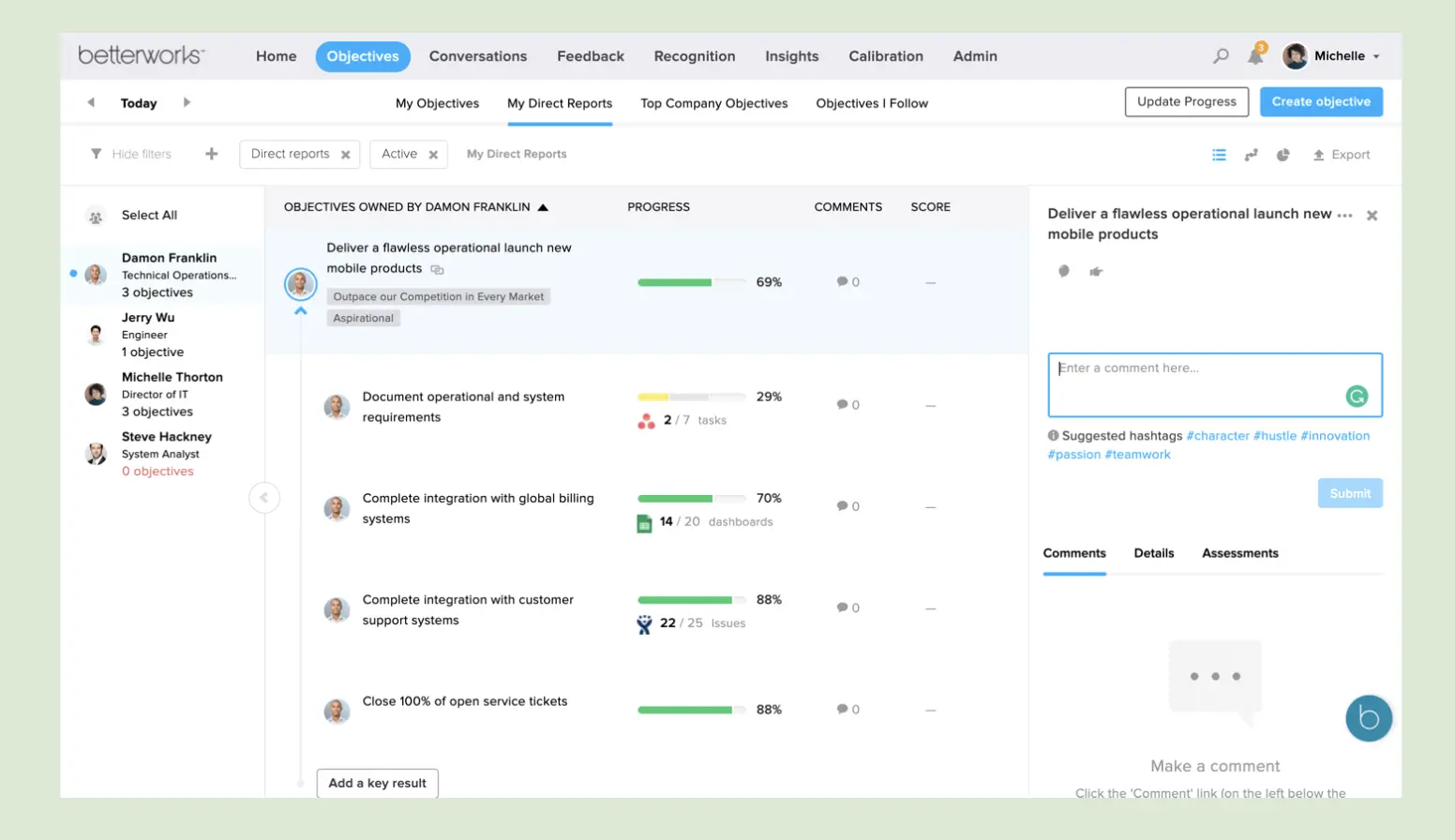
Betterworks is the enterprise incumbent — cascading alignment at scale, calibration, continuous feedback, and deep HRIS integration (Workday, SuccessFactors). It's the right fit for organizations where OKRs are already embedded in how performance management works and the challenge is scaling the infrastructure, not building the habit.
The single most consistent complaint in G2 reviews is reporting: "reporting module is inefficient and complicated," "the analytics are nonsense," "I have no control over reporting." For organizations where board-level OKR analytics are critical, validate the reporting module explicitly in the pilot before signing.
The sales process is gated — no public pricing, no free trial, demo required. Vendr transaction data shows a minimum of approximately $2,100 and a maximum of $169,200, with an average of around $77,000 per year. Implementation fees add $20,000–$50,000 for typical enterprise deployments.
G2 rating: 4.3/5. Pricing: Enterprise, demo-gated. Vendr average ~$77,000/year + implementation.
OKRs Tool: Built for 50–200 People
OKRs Tool occupies a specific position in this market: the 50–200 person organization that needs OKR execution and alignment without a six-week implementation or a per-seat growth tax.
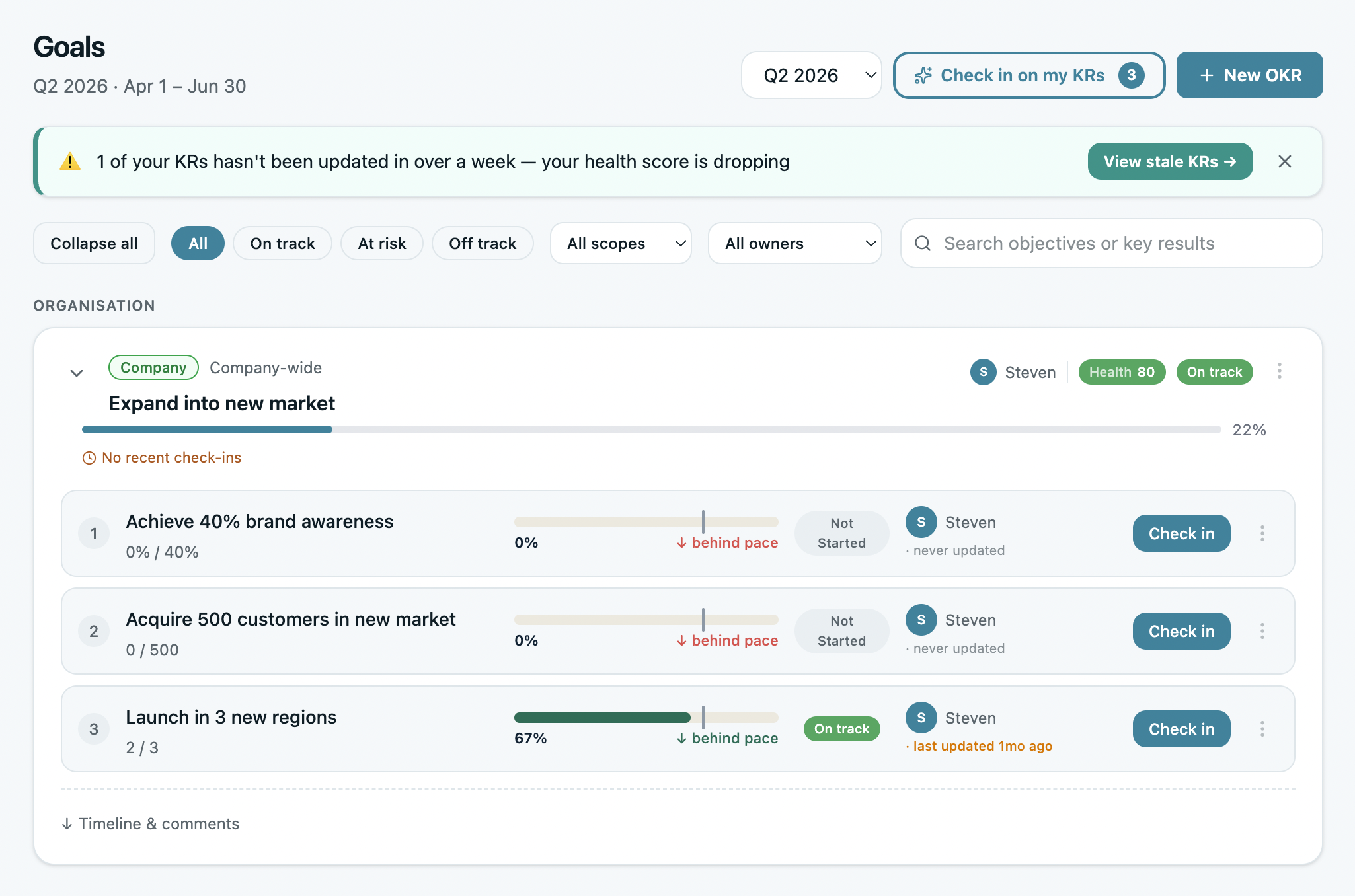
Setup takes an afternoon. The automated weekly check-in via Slack or MS Teams removes the discipline dependency — the nudge goes out whether or not anyone remembers to send it. Required named ownership before any Key Result goes live closes the accountability gap that the benchmark data shows affects 50% of all Key Results across growing organizations.
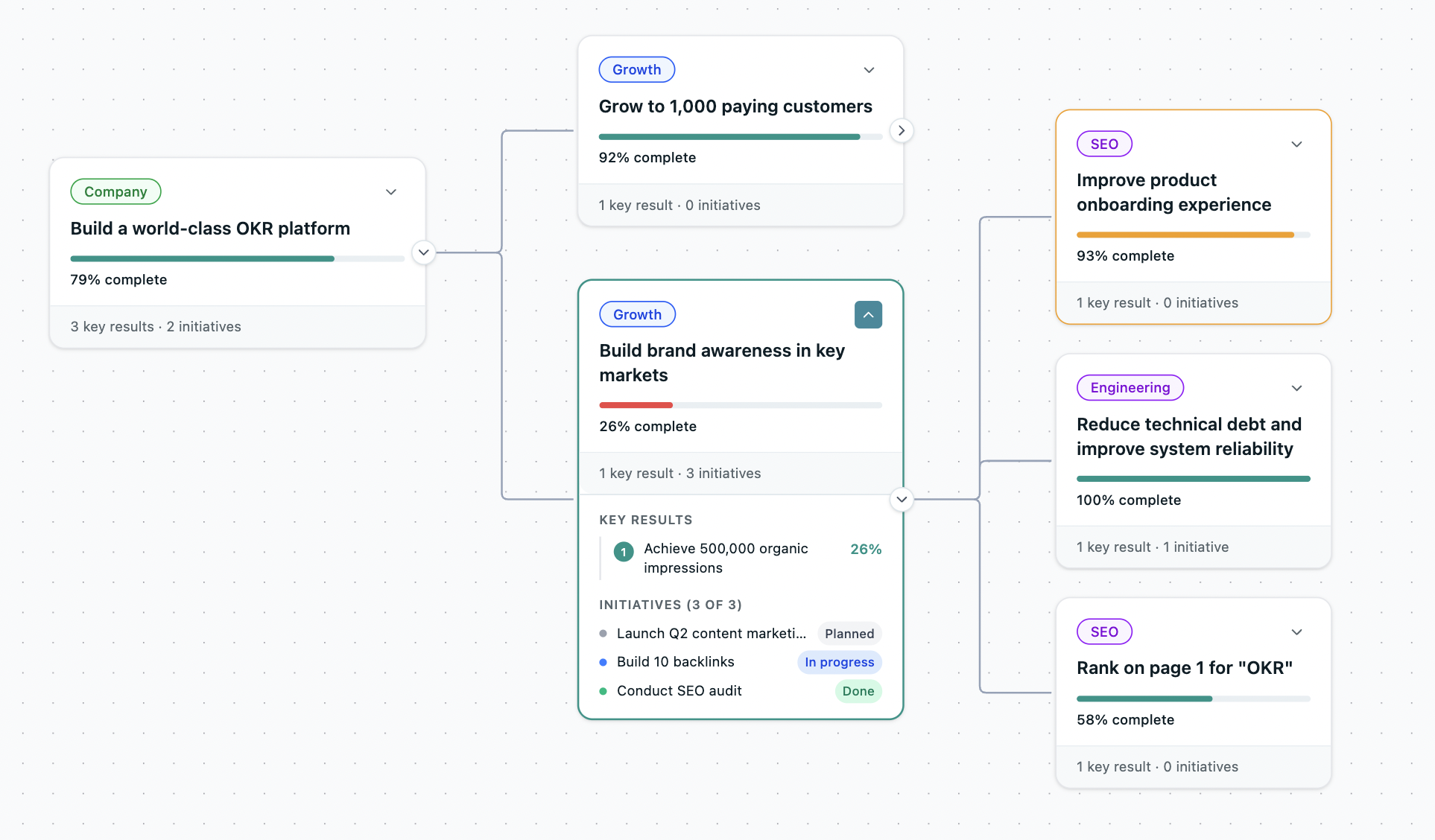
Flat pricing at $49/month for up to 50 users means no per-seat growth tax as the team scales. The ROI data across 330 organizations: purpose-built OKR software generates a 1:88 return on investment versus 1:25 on spreadsheets and 1:16 on enterprise platforms. The tool doesn't generate that return — the weekly check-in habit it makes structural does.
The limitation: integrations currently cover Jira, Asana, Linear, ClickUp, Slack, and MS Teams. Salesforce, GitHub, and HRIS integrations are on the roadmap; for organizations that need them today, supplement or evaluate Profit.co or Workboard.
Pricing: Free for 1–5 users. $49/month flat for 6–50. $129/month for 51+. 60-day adoption guarantee — full refund if adoption targets aren't hit.
The 14-Question Evaluation Checklist
Run every shortlisted tool through these questions before committing. The PDF version includes a scoring table for comparing up to three vendors side by side.
Fit and Adoption
Can a non-technical teammate set up an Objective and complete a check-in in under 30 minutes without help? What is the weekly active usage rate among comparable customers at day 60 — ask for data, not logos? How long did comparable customers take to run their first complete check-in cycle? Does it send check-in nudges natively in Slack or MS Teams, or just send a link back to the app?
Pricing and Contract
Is pricing per-user or flat-rate? Are there free or cheap view-only licenses? What is the minimum seat count and minimum annual contract value? What is the total year-one cost including implementation, onboarding, and coaching? Which features are gated — SSO, SCIM, API access, HRIS integrations, advanced dashboards? Is there a free trial or free tier, is billing monthly or annual-only, and what is the renewal-increase policy?
Delivery and Vendor Risk
SaaS or self-hosted? Where is data stored? What is the SOC 2 and GDPR status? Which integrations are native versus Zapier — confirm your must-haves. Can you export all OKR and KPI data at any time, and what happens to your data if the vendor is acquired or sunsets? Is OKR coaching included or a separate line item? Is a dedicated Customer Success Manager included or additional cost?
Recommendation by Stage
Before buying anything: run one OKR cycle on a free tier. Prove the framework works for your team. Appoint an executive sponsor and an OKR champion. The threshold to move to paid: you've completed one cycle, scored Key Results honestly, and spreadsheet overhead is now the bottleneck.
15–150 employees: OKRs Tool for flat pricing, same-afternoon setup, and adoption-first design. Perdoo if strategy-to-execution visualization is the primary need. Mooncamp if the organization is deeply embedded in Microsoft Teams and prioritizes UX.
Scaling 150–500: Profit.co if consolidating OKRs, performance management, and KPI tracking is the objective. Budget for the learning curve and a dedicated internal programme owner.
Enterprise 500+: Betterworks if OKRs are already embedded in performance management and the challenge is enterprise-scale alignment. Run a 100–300 user pilot over one OKR cycle first, validate the reporting module, and confirm Jira and HRIS integrations are included in your tier.
Cross-cutting rule for all stages: don't tie OKRs directly to individual compensation or bonuses. The research is consistent — it suppresses stretch goals and invites gaming. The 2026 OKR Benchmark Report found the highest-performing teams separate OKR completion from performance review outcomes, using delivery data as context rather than a direct evaluation input.
Data: The ROI of OKRs: 2026 Benchmark Report (330 respondents), The 2026 OKR Benchmark Report (200+ organizations), OKR Intelligence Report 2026 (222 organizations). Vendor pricing data from publicly available sources — verify directly with vendors before committing.