
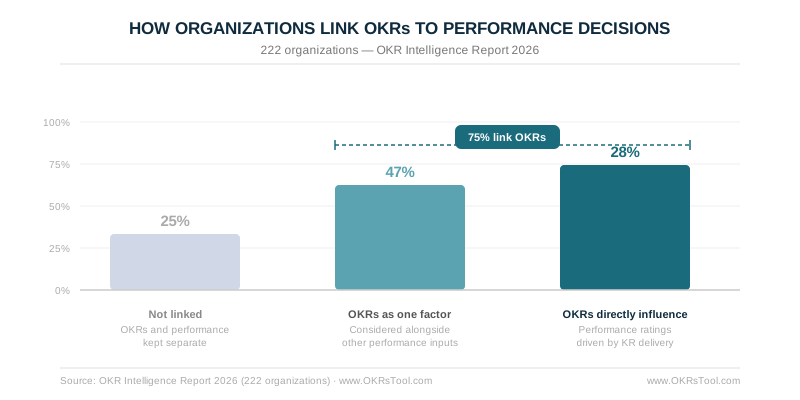
75% of organizations have formally linked OKR outcomes to performance decisions. That doesn't mean every team needs performance reviews built into their OKR tool. It means the connection matters — and the question is whether to make it structural in one platform or intentional across two.
Two teams. Same company size. Same OKR framework.
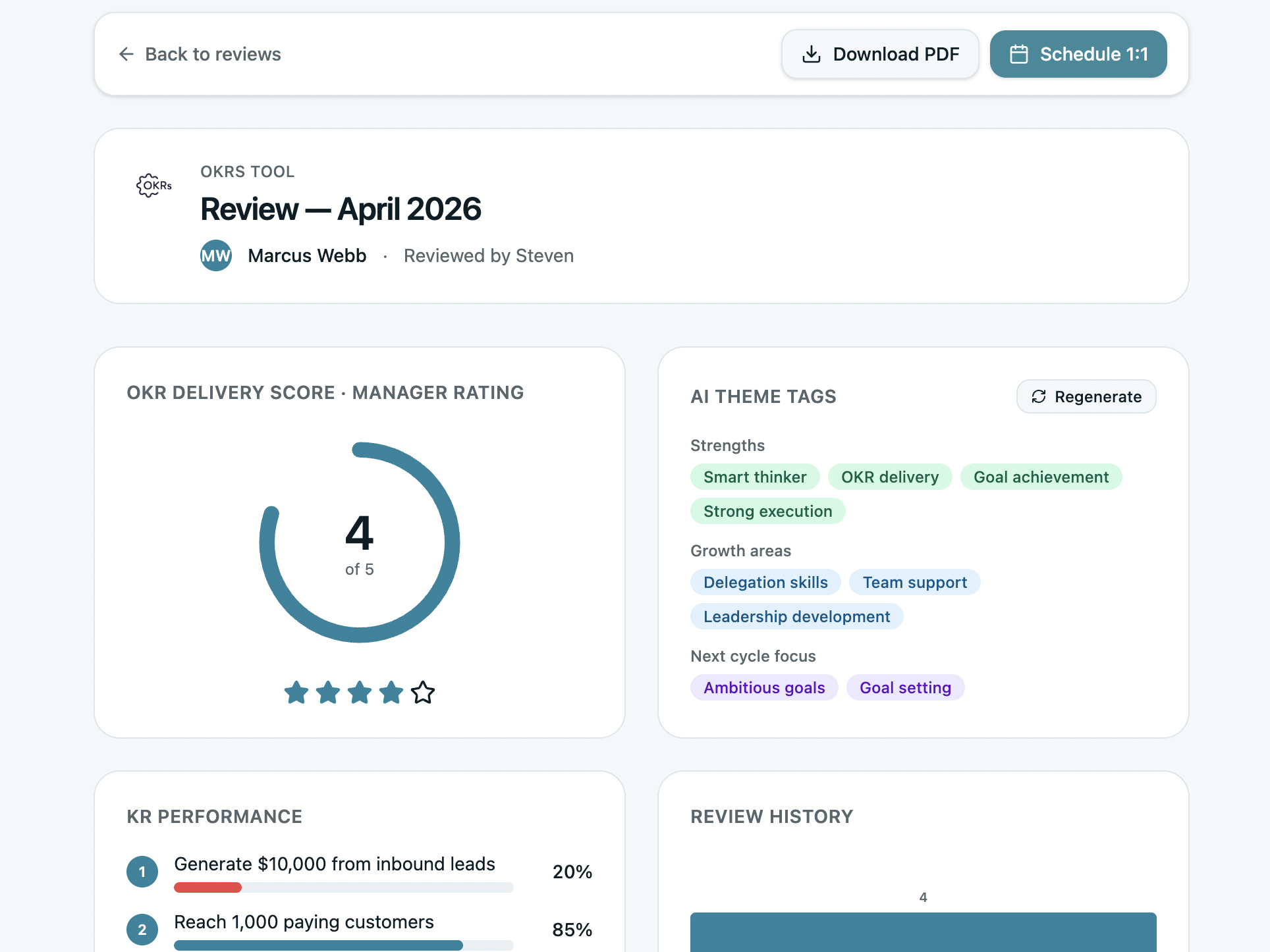
The first team uses OKRs Tool — runs OKRs, KPIs, 360 reviews, and performance reviews all in one platform. Key Result completion rates feed directly into review cycles. No manual compilation. No disconnected systems.
The second team uses Tability for OKR tracking and runs performance reviews in a separate tool — or informally in 1:1s. The OKR data exists. The performance conversation happens. But the connection between delivery and evaluation is manual, inconsistent, and easy to skip.
Both approaches can work. The right one depends on your stage, your People Ops maturity, and whether the connection between goal delivery and performance decisions is a priority this cycle — or something for later.
Why This Decision Matters
The OKR Intelligence Report 2026 found that 75% of organizations have formally linked OKR outcomes to performance decisions — 47% as one factor among several, 28% with OKRs directly influencing ratings.
That number makes the question urgent. If your organization is already using OKR delivery data in performance conversations — or planning to — the tool you choose determines how much friction that connection creates. A platform that surfaces KR completion rates automatically in review cycles removes a step that many teams skip when it's manual. A platform that requires exporting data and reformatting it for another system creates enough friction that the connection often doesn't happen.
The question isn't just do we want performance reviews? It's how important is the structural connection between goal delivery and performance evaluation right now?
When Strict Goal Tracking Is Enough
Choose a goal-tracking-only OKR tool when:
You're in the first two cycles. The highest priority in a first OKR cycle is getting the habit established — weekly check-ins running, ownership assigned, cascade complete. Adding performance review infrastructure before that habit exists creates complexity before there's a foundation to build on.
You already have a mature HR platform. Organizations running Workday, BambooHR, or a comparable HRIS may not want OKR data in the same platform as compensation and compliance workflows. Keeping OKRs in a purpose-built tool and feeding data into HR systems via export or integration is a reasonable architecture at this scale.
Your team is under 20 people. At this stage, performance conversations are typically happening informally and frequently — the structural connection between OKR delivery and performance evaluation doesn't require software to maintain. A lightweight OKR tracker handles the goal side; the performance side happens in 1:1s.
The goal-tracking problem is the primary one. If the current pain is that goals go stale by week four, that check-ins don't happen automatically, or that leadership can't see alignment without a status meeting — those are execution problems. Solve the execution problem first. Performance review integration is a second-order problem.
Best tools for this scenario: Tability, Weekdone, Perdoo, Mooncamp
When Built-In Performance Reviews Are Worth It
Choose an OKR tool with built-in performance reviews when:
You're past 20–30 people and running formal review cycles. Once the organization is large enough that informal performance conversations aren't sufficient — when reviews need documentation, structure, and consistency — the connection between OKR delivery data and review scores becomes worth building structurally rather than manually.
You want OKR data to inform performance ratings automatically. Manually pulling Key Result scores from one system to reference in another is exactly the kind of process that gets skipped when a quarter is busy. A platform that surfaces completion rates, check-in consistency, and 360 feedback alongside OKR scores — without any manual compilation — produces more consistent and more data-informed performance conversations.
You don't want a separate HR platform yet. For organizations at 30–150 people without a full HRIS, combining OKR tracking with performance reviews in one tool is a pragmatic decision. It avoids the cost and complexity of a separate People Ops platform while still providing the structured review infrastructure that this stage requires.
Performance conversations are currently disconnected from goal delivery. If managers are running performance reviews based primarily on recollection, tenure, or subjective impression — rather than on documented goal delivery data — building the connection structurally closes a gap that has real consequences for retention and accountability.
Best tools for this scenario: OKRs Tool, Lattice, Profit.co, Betterworks, Leapsome
The Spectrum: What Each Approach Looks Like
The OKRs Tool Position on This Spectrum
OKRs Tool sits deliberately in the middle — the 30–200 person organization that needs OKR execution infrastructure and performance review connection without enterprise overhead.
The platform includes performance reviews connected directly to OKR delivery scores, 360 reviews with competency ratings alongside KR completion rates, and 1:1 management built around OKR progress — all in one platform at $49/month flat, without a sales call, without a six-week implementation.
For teams that want strict goal tracking only, the free tier covers that without touching the performance layer. For teams that want the connection, it's there when the organization is ready for it.
The OKR software for performance reviews guide covers the full category in detail — 10 platforms ranked specifically for how well they connect OKR delivery to performance decisions.
The Decision Framework
Three questions that resolve this for most teams:
Are you running formal performance reviews yet? If the answer is no — or if reviews happen informally in 1:1s — you don't need built-in performance reviews. Focus on the OKR execution layer: check-in infrastructure, required ownership, and alignment visibility. Add performance review integration when formal cycles begin.
Do you have an existing HRIS or performance platform? If yes, keep OKRs in a purpose-built tool and connect the data via export or integration rather than consolidating everything into one platform. If no, combining OKRs and performance reviews in one tool saves a software decision and a per-tool cost.
How important is the structural connection right now? If performance conversations are currently based on recollection rather than delivery data, making the connection structural — in the platform — produces immediate improvement. If the connection is already happening manually and consistently, it can wait until the OKR execution habit is established.
Final Thoughts
The 75% of organizations that have linked OKR outcomes to performance decisions didn't all do it on day one. Most built the OKR habit first, then connected it to performance evaluation once the data was reliable.
The right sequence: establish the OKR cycle — weekly check-ins, required ownership, complete cascade — before adding performance review infrastructure. A platform with both is valuable when you need both. It's unnecessary complexity when you're still building the execution habit.
If you're evaluating tools across both dimensions, the best OKR software guide covers 28 platforms with explicit notes on which include performance management and which are execution-only.
Data: OKR Intelligence Report 2026 (222 organizations), The 2026 OKR Benchmark Report (200+ organizations).