
4DX and OKRs solve the same problem from different angles. Both are weekly execution systems. Both require named ownership and a visible scoreboard. The difference is that 4DX caps at 1–2 goals and has no cascade mechanism. OKRs scale the same discipline across every team and function.
The 4 Disciplines of Execution — developed by Chris McChesney, Sean Covey, and Jim Huling and published in 2012 — came out of a decade of Franklin Covey implementation work with organizations that had strategy but couldn't execute it. The conclusion was the same one that Andy Grove had reached at Intel in the 1970s: the problem isn't knowing what to do. The problem is doing it while the whirlwind of day-to-day operations pulls attention in every other direction.
4DX calls this tension explicitly. The "whirlwind" — the urgent, ongoing demands of running the business — is the enemy of important. Left unmanaged, the whirlwind wins every time.
What 4DX Actually Is
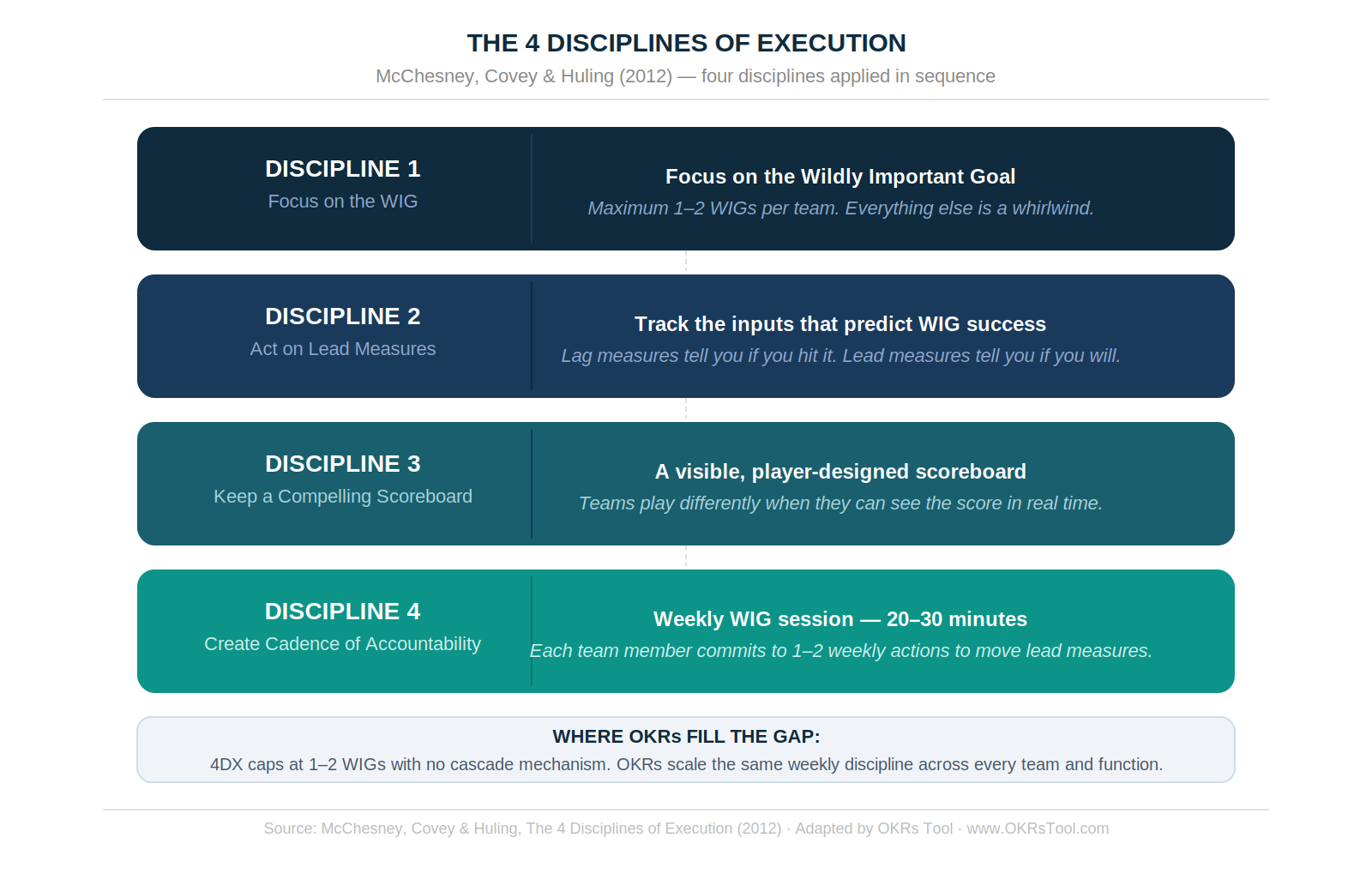
The four disciplines are applied in sequence. Each one builds on the previous.
Discipline 1: Focus on the Wildly Important Goal. A WIG is not a priority among many — it's the one result that, if achieved, would make everything else less important. 4DX is uncompromising here: one to two WIGs per team maximum. Everything else is whirlwind. The discipline of selection is the discipline.
Discipline 2: Act on Lead Measures. Lag measures tell you whether you hit the WIG — revenue, retention, NPS. Lead measures predict whether you will — calls made, conversations converted, features shipped. 4DX argues, correctly, that most teams track the wrong thing: they watch the lag measure while hoping it moves, rather than managing the lead measure that determines whether it will.
Discipline 3: Keep a Compelling Scoreboard. The scoreboard is player-designed, not manager-designed, and it answers one question at a glance: are we winning or losing? 4DX is specific about this — a scoreboard that players design and maintain produces more engagement than one management reports from.
Discipline 4: Create a Cadence of Accountability. The weekly WIG session — 20 to 30 minutes, no longer — is the mechanism that keeps the other three disciplines alive. Each team member commits to one or two actions that will move the lead measure before the next session. Accountability is peer-to-peer, not hierarchical.
Where 4DX Gets It Right
The lead vs lag measure distinction in Discipline 2 is the most underrated concept in execution frameworks. Most OKR programmes fail at exactly this point — teams write Key Results that are lag measures (revenue up 20%, NPS above 50) without identifying the lead measures that will move them. OKR platform data shows 52% of Key Results are tasks or KPIs in disguise — the same error 4DX was designed to fix.
The weekly WIG session is also structurally sound. Twenty to thirty minutes, peer accountability, specific weekly commitments. The 2026 OKR Benchmark Report found teams with automated weekly check-ins complete 43% more OKRs than those without. 4DX arrived at the same conclusion a decade earlier, from implementation experience rather than platform data.
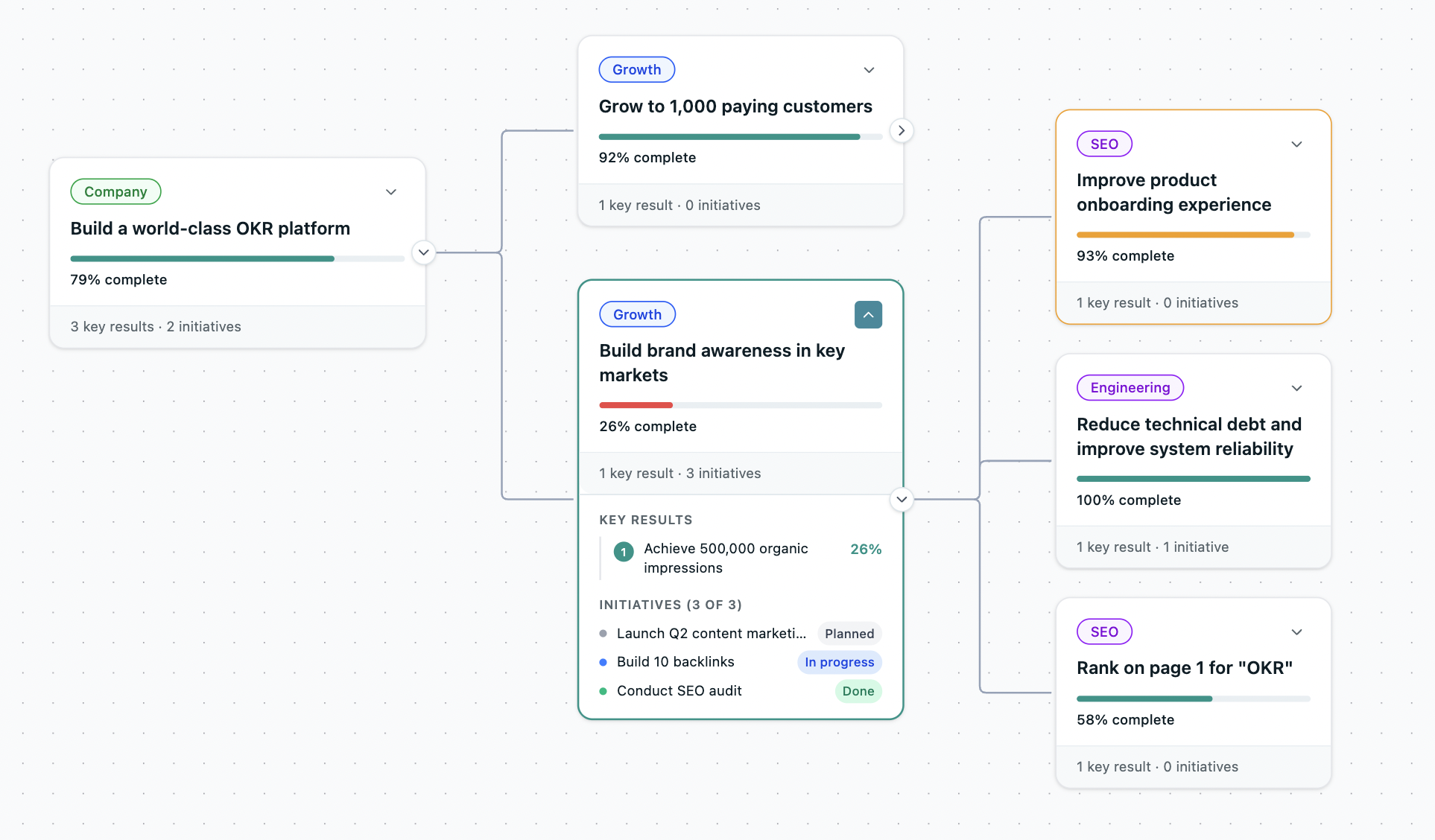
The scoreboard concept — visible, real-time, player-designed — maps directly to what OKRs Tool's alignment map provides: a live view of every Objective and Key Result across every team, updated weekly rather than assembled at review time.
The Critical Failure Mode
4DX is deliberately narrow. One to two WIGs per team is not a guideline — it's a hard constraint. McChesney and Covey argue that focus is the framework's core insight: the reason most organizations fail to execute isn't bad planning, it's too many priorities treated as equally important.
That narrowness is also 4DX's structural limitation for growing organizations. A 100-person company has a Sales team, a Product team, an Engineering team, a Customer Success team. Each needs to run its own execution discipline. 4DX has no native mechanism for aligning those WIGs across functions — no cascade from company WIG to team WIG, no visibility into whether each team's weekly commitments are pointing in the same direction.
The second limitation: 4DX assumes the WIG is set correctly and doesn't question it within a cycle. There's no mid-cycle review mechanism for formally reassessing whether the WIG is still the right goal — or whether the lead measures selected in Discipline 2 are actually predicting what they were supposed to predict. OKRs build the week-six mid-cycle review into the quarterly cycle structure precisely because this assumption often doesn't hold.
How They Compare
The Right Architecture: 4DX + OKRs
The most productive relationship between 4DX and OKRs is not a choice between them — it's using 4DX's lead measure discipline to write better Key Results. Before setting a Key Result, ask the 4DX question: is this a lag measure (the outcome I want) or a lead measure (the input that predicts it)? A well-written OKR typically has one lag Key Result ("increase trial-to-paid conversion to 15%") and one or two lead Key Results ("achieve 80% demo completion rate within 48 hours of trial start").
The WIG session cadence from Discipline 4 also improves OKR check-ins. The specific format — each person reports on last week's commitment, scores it, and commits to next week's one or two actions — is tighter than most OKR weekly review formats and worth adopting directly.
For organizations already running 4DX and considering OKRs: OKRs provide the cascade mechanism and alignment visibility that WIGs don't. Run the WIG sessions as before — and use the OKR cascade to connect each team's WIG to a company-level Objective that everyone can see.
See how OKRs Tool implements the weekly check-in, cascade, and named ownership that scales 4DX's discipline across every team.
Data: The 2026 OKR Benchmark Report (200+ organizations), OKRs Tool platform data (7,857 Key Results analyzed).