OKRs Tool vs Workboard
I build OKRs Tool, and I tested Workboard hands-on in a demo account a direct contact gave me — the same objective, Key Results, owners and check-in setup — then scored both on one rubric: what makes goals get hit. Here's where each one wins.

Requires a named owner on every Key Result, like Workboard does, but gets a team live in an afternoon at one flat, published price — no program office, admin or quote required.
An enterprise strategy-execution platform with full cascade, an AI-agent suite and the depth Boeing-scale orgs need. It demands a guided rollout, real admin and a five-figure quote.
These two agree on the thing that matters most — both require an owner on every Key Result — and split on everything around it. Workboard is built for 500+ enterprise rollouts with the depth and price to match; OKRs Tool brings the same enforced ownership to a 50–200 team, live in an afternoon at a flat rate.
OKRs Tool is my own product, so I know it from the inside; Workboard I tested in a demo account a direct contact gave me — the same objective, two Key Results, owners and check-in flow — so this is the only logged-in Workboard review you'll find on a list like this. I scored both on the same rubric, built on platform data across 3,527 organizations that shows which habits move the odds of hitting a goal. I publish where OKRs Tool falls short, lower down.
The Short Answer
Pick Workboard if you're rolling OKRs out to hundreds or thousands of people with a dedicated program office, deep org hierarchy, enterprise support and the budget and admin capacity its depth demands. Pick OKRs Tool if you're a 50–200 person company that wants the same enforced ownership without the enterprise weight — at a flat, published price, live this afternoon.
Both enforce ownership. Only one needs an enterprise budget.
Workboard and OKRs Tool are the two tools I tested that require an owner on every Key Result. Workboard's comes with a guided rollout, ongoing admin and a five-figure quote; OKRs Tool's comes at a flat $129 a month, with a team live in an afternoon.
Feature by Feature
Everything below I checked in a live account, not from a pricing page.
| Capability | OKRs Tool | Workboard |
|---|---|---|
| Named owner required on every Key Result | Required | Required |
| Score required on every Key Result | Enforced | Optional |
| Automatic check-in reminders | Yes | Yes |
| Time to first cycle | Live in an afternoon | Guided rollout, steep curve |
| Enterprise cascade depth | Alignment map (50–200) | Full enterprise cascade |
| AI features | AI KR analysis | AI agent suite |
| Pricing | From $129/mo, flat | Quote-based (5-figure) |
| Pricing transparency | Public | Quote-only, demo required |
| EU data residency | Yes (Ireland) | US-based |
| Free trial | 14 days, no card | None (demo only) |
Checked in a live account. Feature availability and pricing shift — confirm current terms with each vendor before you buy.
Where Workboard Is the Better Pick
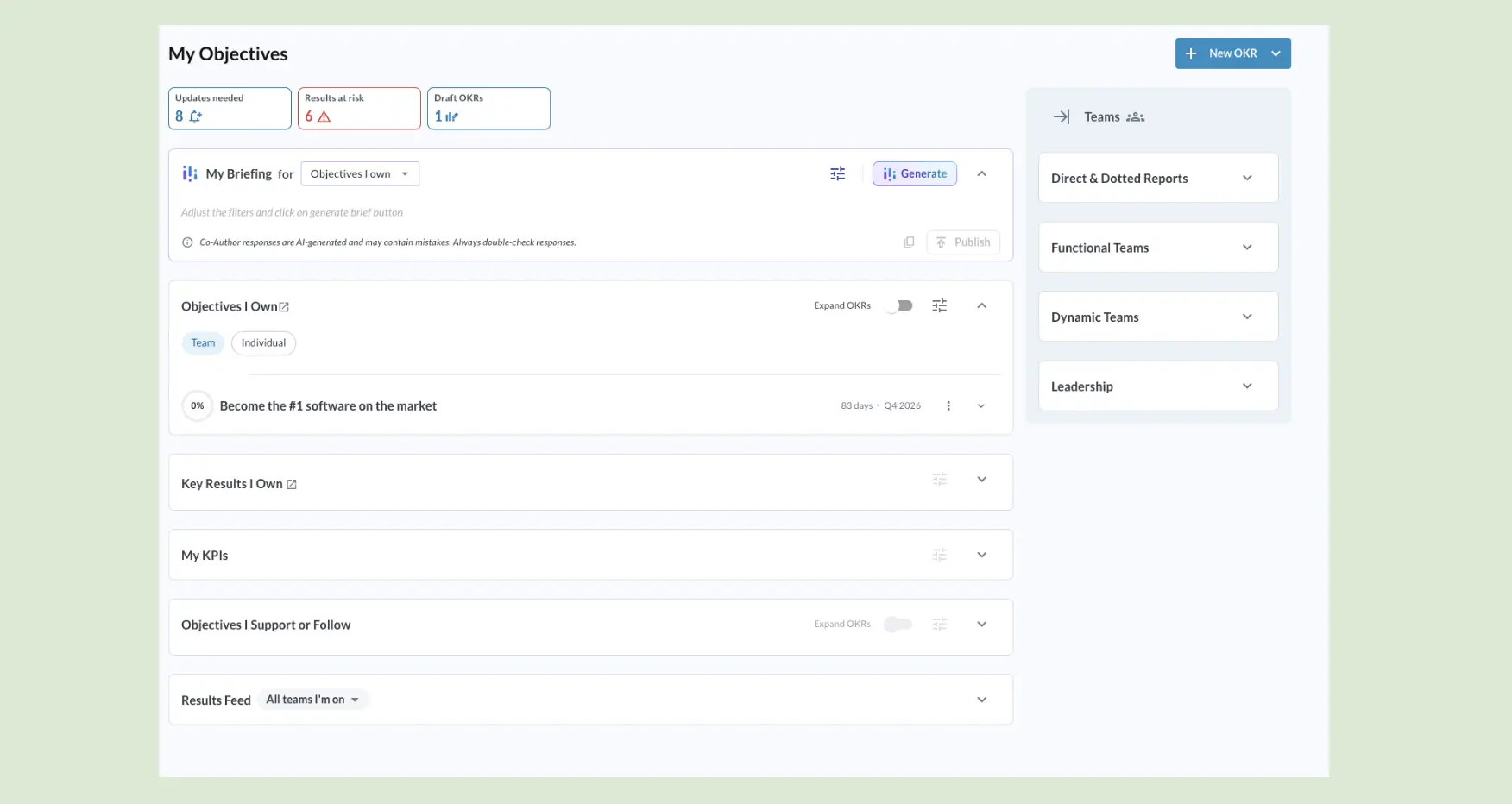
Workboard is a different weight class. It's built for large organizations that need OKRs, strategic portfolio management, performance management and an AI-agent suite in one system, and it's used by the likes of Boeing, AstraZeneca and Avery Dennison. The full cascade handles deep org hierarchies that would break simpler tools, and the AI agents — Portfolio Analyst, Chief of Staff and Leadership Coach — automate QBR and MBR prep, surface at-risk OKRs and coach managers on goal conversations. Creating a goal is more frictionless than most enterprise tools allow: you paste in plain text and it converts to a structured Objective and Key Result. If you're running a formal strategy-execution programme at 500+, Workboard has the depth for it.
Workboard wins on
- Full enterprise cascade for 500+
- AI agent suite (QBR/MBR prep, coaching)
- Strategic portfolio management
- Depth for Boeing-scale organisations
Where it costs you
- Steep learning curve and ongoing admin
- Guided rollout before you see value
- Quote-only, five-figure pricing
- No free trial; US-based hosting
Where OKRs Tool Pulls Ahead
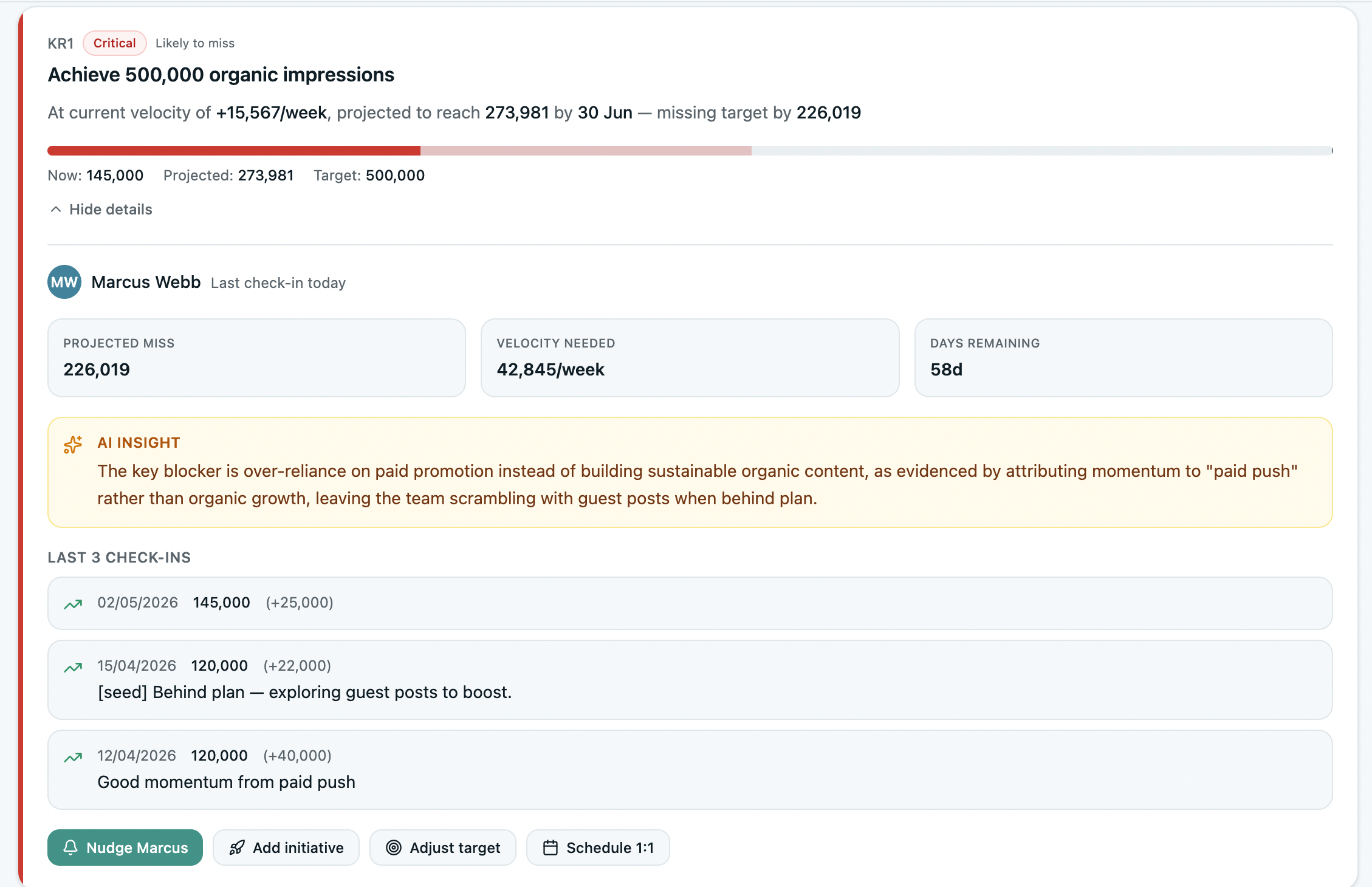
OKRs Tool enforces the same named-owner habit Workboard does, and requires a score on every Key Result too, but a team goes from signup to a live cycle in about an afternoon rather than a guided enterprise rollout. There's no program office to staff, no weeks of configuration, and the price is flat and published — from $129 a month for the whole organisation, not a five-figure quote. Data stays in the EU by default. For a 50–200 person company, it delivers the habit that moves the odds most without the enterprise weight, admin and cost.
OKRs Tool wins on
- Same enforced ownership, plus required scoring
- Live in an afternoon, no guided rollout
- Flat, published pricing — no quote
- EU data residency by default
Where it isn't the fit
- Built for 50–200 people, not 500+ rollouts
- Cascade is cleaner than it is elaborate
- No strategic-portfolio or program-office layer
Questions Buyers Ask Me
We're 500+ — isn't Workboard the obvious pick?
If you have a dedicated OKR program office, a deep org hierarchy and the admin capacity to run an enterprise platform, yes — Workboard is built for exactly that. Below about 500, starting on Workboard usually means paying and configuring for structure you won't use for a year or more. OKRs Tool enforces the same named-owner habit, right-sized for 50–200, without the rollout.
How far apart are they on price?
A long way. Workboard is quote-only — no public price, demo required, and deals typically start in the five figures a year. OKRs Tool is flat and published, from $129 a month for the whole organisation. If budget and time-to-value matter, that gap usually makes the call.
Both enforce ownership — so what's the real difference?
Scale, setup and price. Workboard earns its weight on deep hierarchies, strategic portfolio management and a program office at 500+; it demands real training and admin to use well. OKRs Tool delivers the same owner-required habit for a 50–200 team, live in an afternoon, at a flat rate.
Did you actually test Workboard, or read the feature pages?
I tested it. Workboard is demo-only, so I got hands-on access through a direct contact and set up the same OKR I ran everywhere else — an objective, two Key Results, owners and the check-in flow. The table reflects my time in the product, not their marketing pages, and it's the only independent logged-in Workboard review you'll find on a list like this.
Want enforced ownership without the enterprise weight?
Open a free trial, create an objective, and watch the check-ins run themselves.
Benchmark figures from The OKR Benchmark Report. Feature scoring from a live account test of both tools.