OKRs Tool vs Tability
I build OKRs Tool, and I tested Tability hands-on in a real account — same objective, Key Results, owners and check-in setup — then scored both on one rubric: what makes goals get hit. Here's where each one wins.

Enforces a named owner and a score on every Key Result, and runs check-ins on its own. Built for 50–200 person teams that want the habits to hold without a champion chasing them.
Fast to set up with a clean strategy map and friendly check-in prompts. Ownership and scoring stay optional, so the discipline leans on the team rather than the tool.
Both tools track OKRs and run weekly check-ins. The difference shows up in week six — when a launch slips and the goals stop getting updated — and it comes down to which habits each tool makes unavoidable versus optional.
OKRs Tool is my own product, so I know it from the inside; Tability I set up in a real account — the same objective, two Key Results, owners and check-in flow. I scored both on the same rubric, built on platform data across 3,527 organizations that shows which habits move the odds of hitting a goal. I publish where OKRs Tool falls short, lower down.
The Short Answer
Pick OKRs Tool if you want the tool to hold the process when attention drifts — every Key Result has an owner and a score because the product requires it, and check-ins run automatically. Pick Tability if you want the lightest possible start and you're comfortable that ownership and scoring are things your team has to remember to do.
The gap is one column: owner required.
OKRs Tool makes you assign a name to every Key Result. Tability leaves it optional. In the benchmark data, a named owner is the single habit most tied to teams that hit their goals — 65% hit with it, 17% without.
Feature by Feature
Everything below I checked in a live account, not from a pricing page.
| Capability | OKRs Tool | Tability |
|---|---|---|
| Named owner required on every Key Result | Required | Optional |
| Automatic check-in reminders | Yes | Yes |
| Score on every Key Result | Enforced | Optional |
| Alignment / cascade view | Alignment map | Strategy map |
| Weekly progress tracked live | Yes | Yes |
| Free trial | 14 days, no card | 14 days, no card |
| Entry price | From $129/mo, flat per org | From $6/user/mo (annual) |
| Two-way Jira sync | Yes | One-way |
| AI draft and check-in summaries | Yes | Yes |
| Data residency in the EU | Ireland | US; EU on request |
| Built for 500+ seat rollouts | 50–200 focus | Mid-market |
Checked in a live account in November 2026. Feature availability shifts — confirm current limits on each vendor's plan before you buy.
Where Tability Is the Better Pick
Tability is good at the start of the journey. The editor is quick, the strategy map is one of the clearest in the category, and the check-in prompts are friendly enough that people answer them. For a small team adopting OKRs for the first time, that low friction matters more than enforcement. Tability has also repositioned around AI, now pitching an "AI-native" platform for human and agent teams with a new, higher Agentic plan at $20/user/month, though in the core OKR product ownership and scoring stay optional.
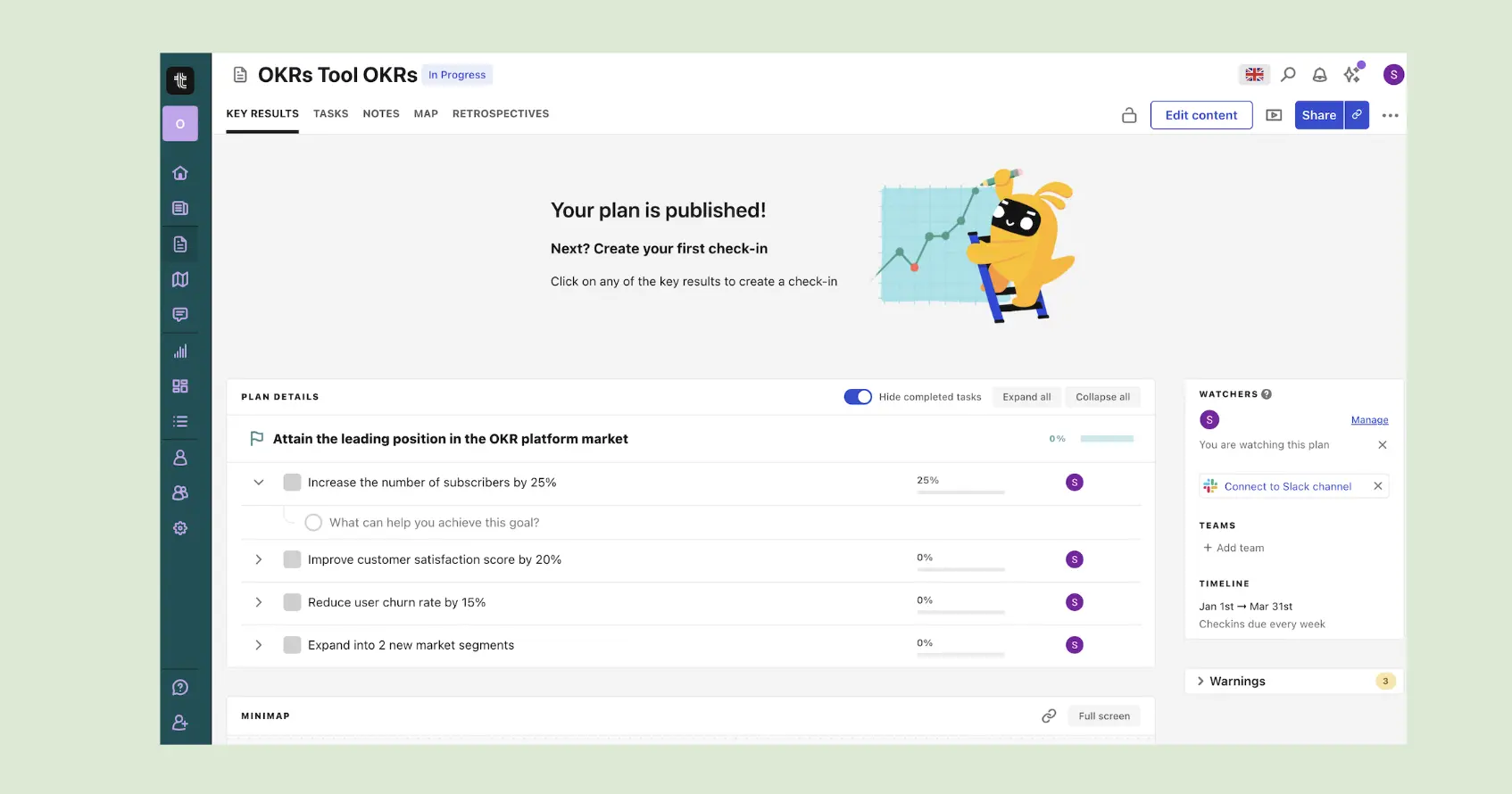
Tability wins on
- Fastest setup of the two
- Clean, readable strategy map
- Friendly check-in prompts people answer
- Low entry price at $6/user/month
Where it costs you later
- Ownership stays optional, so goals go unowned
- Scoring is a habit, not a requirement
- One-way Jira sync
- US data residency by default (EU on request)
Where OKRs Tool Pulls Ahead
OKRs Tool is built around the four habits my data shows separate teams that hit their goals from teams that miss: a named owner on every Key Result, goals that ladder up to a company priority, a score on every result, and progress tracked live. The product requires the first and third rather than leaving them to discipline, which is what holds the cadence together through the week-six slump.
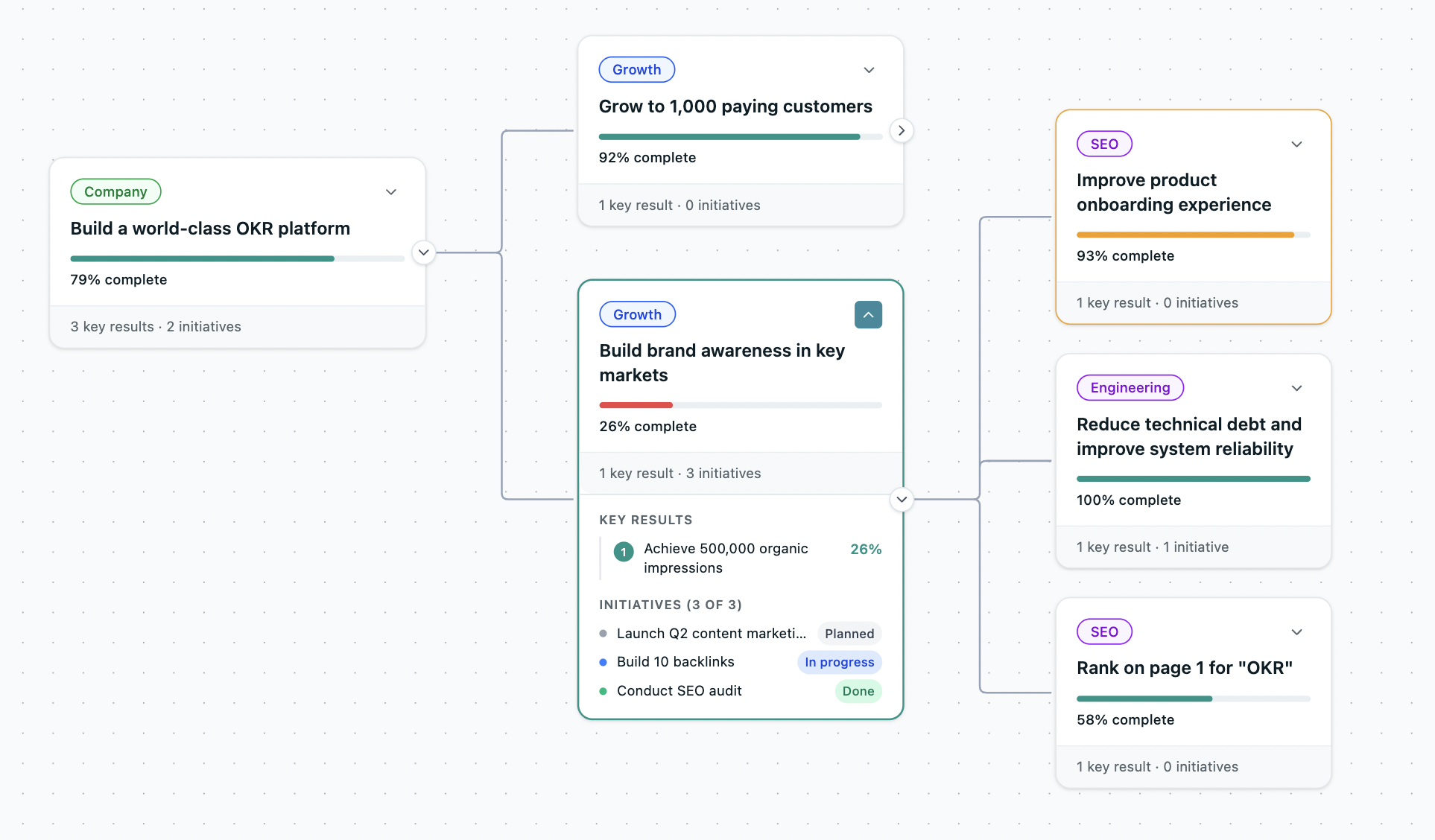
OKRs Tool wins on
- Owner required on every Key Result
- A score enforced on every result
- Automatic check-ins that run without a champion
- Two-way Jira sync and EU data residency
Where it isn't the fit
- Built for 50–200 people, not 500+ rollouts
- Less of a blank-canvas strategy-map tool
- Fewer integrations than the largest platforms
Questions Buyers Ask Me
Did you test both hands-on or read the feature pages?
I build OKRs Tool, so I know it from the inside, and I set up the same OKR in Tability in a real account — signup, an objective, two Key Results, owners and the check-in flow. The table reflects what each live product does, not what a pricing page claims.
You make one of these — can I trust the verdict?
OKRs Tool is scored on the same rubric as Tability, and the comparison shows where it falls short: it's built for 50–200 people, not 500+ rollouts, and it carries fewer integrations than the biggest platforms.
Is Tability a bad tool?
No. It's a clean, fast tool that's a good first step into OKRs, and it's leaning hard into AI and agent workflows. The reason OKRs Tool scores higher is that it requires the habits that decide whether goals get hit, where Tability leaves them optional.
Which should a 40-person company pick?
OKRs Tool, in most cases. At 40 people the real risk is goals going stale by week six with nobody owning them, and the enforcement is what prevents that — setup friction matters less.
See the habits enforced by default
Open a free trial, create an objective, and watch the check-ins run themselves.
Benchmark figures from The OKR Benchmark Report. Feature scoring from a live account test of both tools.