OKRs Tool vs Perdoo
I build OKRs Tool, and I tested Perdoo hands-on in a real account — same objective, Key Results, owners and check-in setup — then scored both on one rubric: what makes goals get hit. Here's where each one wins.

Requires a named owner and a score on every Key Result, runs check-ins on its own, and gets a team live in an afternoon at one flat price — a single screen to create an OKR, not four.
Ties OKRs, KPIs and a strategy roadmap into one framework with a strong alignment view, now with AI drafting and coaching. The UX takes more clicks, and ownership stays optional.
Both connect goals to strategy, but they pull in different directions. Perdoo adds depth — OKRs, KPIs and a roadmap in one framework — at the cost of extra clicks. OKRs Tool strips to the habits that get goals hit and gets you live fast. The choice is depth versus discipline and speed.
OKRs Tool is my own product, so I know it from the inside; Perdoo I set up in a real account — the same objective, two Key Results, owners and check-in flow. I scored both on the same rubric, built on platform data across 3,527 organizations that shows which habits move the odds of hitting a goal. I publish where OKRs Tool falls short, lower down.
The Short Answer
Pick Perdoo if you want OKRs and KPIs tied together in one strategic framework, with a clear alignment view from company vision through OKRs to KPIs, and you'll accept a heavier, click-ier interface to get it. Pick OKRs Tool if you want a named owner and a score required on every Key Result, a flat price, and a team live in an afternoon without fighting the UX.
The strategy depth is real. So is the click count.
Perdoo's alignment view, tying vision to OKRs to KPIs, is one of the best on the market. But creating a single OKR with three Key Results took four separate actions in my test. OKRs Tool does it on one screen, with an owner required before the goal goes live.
Feature by Feature
Everything below I checked in a live account, not from a pricing page.
| Capability | OKRs Tool | Perdoo |
|---|---|---|
| Named owner required on every Key Result | Required | Optional |
| Score required on every Key Result | Enforced | Optional |
| Automatic check-in reminders | Yes | Yes |
| Cascade / alignment view | Alignment map | Vision → OKR → KPI |
| Built-in KPI tracking layer | OKR-focused | Yes, built in |
| Clicks to create one OKR | One screen | Four separate actions |
| AI + MCP server | AI KR analysis + MCP | Spark, Vince + MCP |
| Pricing model | Flat per org | Per seat (min 5) |
| Free plan | 14-day trial, no card | Free up to 5 users |
| EU data residency | Yes (Ireland) | Yes (Germany) |
Checked in a live account. Feature availability and pricing shift — confirm current terms with each vendor before you buy.
Where Perdoo Is the Better Pick
Perdoo is built for organizations that want the link between quarterly execution and multi-year strategy to be explicit. It connects company OKRs, team Key Results and KPIs in one framework, with an initiative and roadmap layer alongside, and the alignment view — a clear visual hierarchy from company vision through OKRs to KPIs — is one of the best on the market. It has leaned into AI too, with an AI Agent (Spark), an AI Coach (Vince) and an MCP server, and because Perdoo is a German company it hosts in the EU. If a built-in KPI layer and strategy depth are what you're buying, Perdoo gives you more of it.
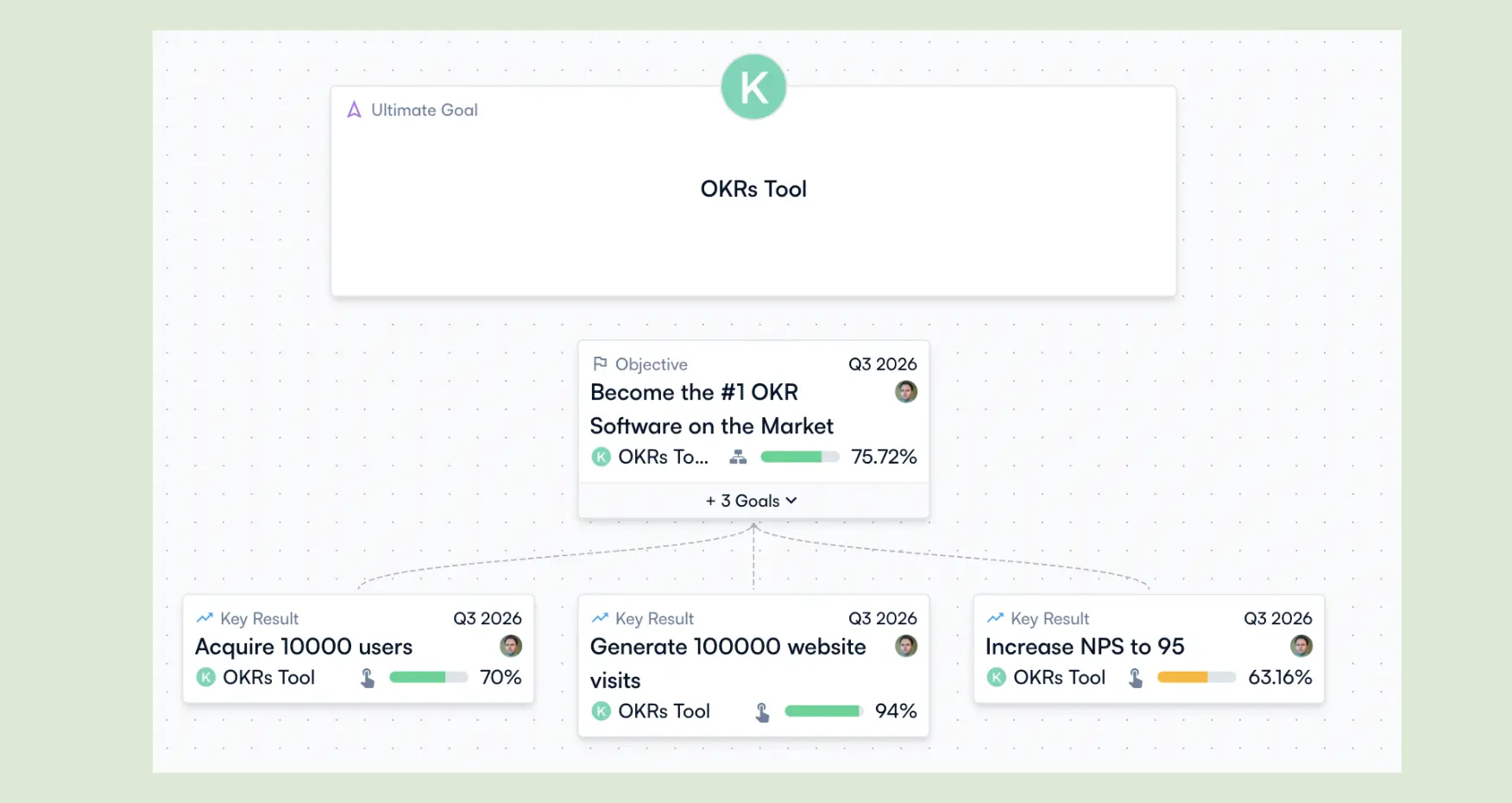
Perdoo wins on
- OKRs and KPIs in one strategy framework
- Strong vision-to-KPI alignment view
- AI drafting and coaching (Spark, Vince)
- Free up to 5 users; EU hosting
Where it costs you
- Ownership and scoring stay optional
- Four actions to create one OKR
- Overwhelming, a lot on every screen
- Per-seat pricing past the free tier
Where OKRs Tool Pulls Ahead
OKRs Tool requires the two habits my data shows matter most — a named owner and a score on every Key Result — rather than leaving them optional. Creating an OKR is one screen, not four, check-ins fire automatically in Slack, Teams and email, and the price stays flat for the whole company instead of climbing per seat. It carries the same AI-and-MCP access Perdoo does, so an assistant can read and update your OKRs either way. It's the stronger pick when you want the habits enforced and a team live this week, not after a week of configuration.
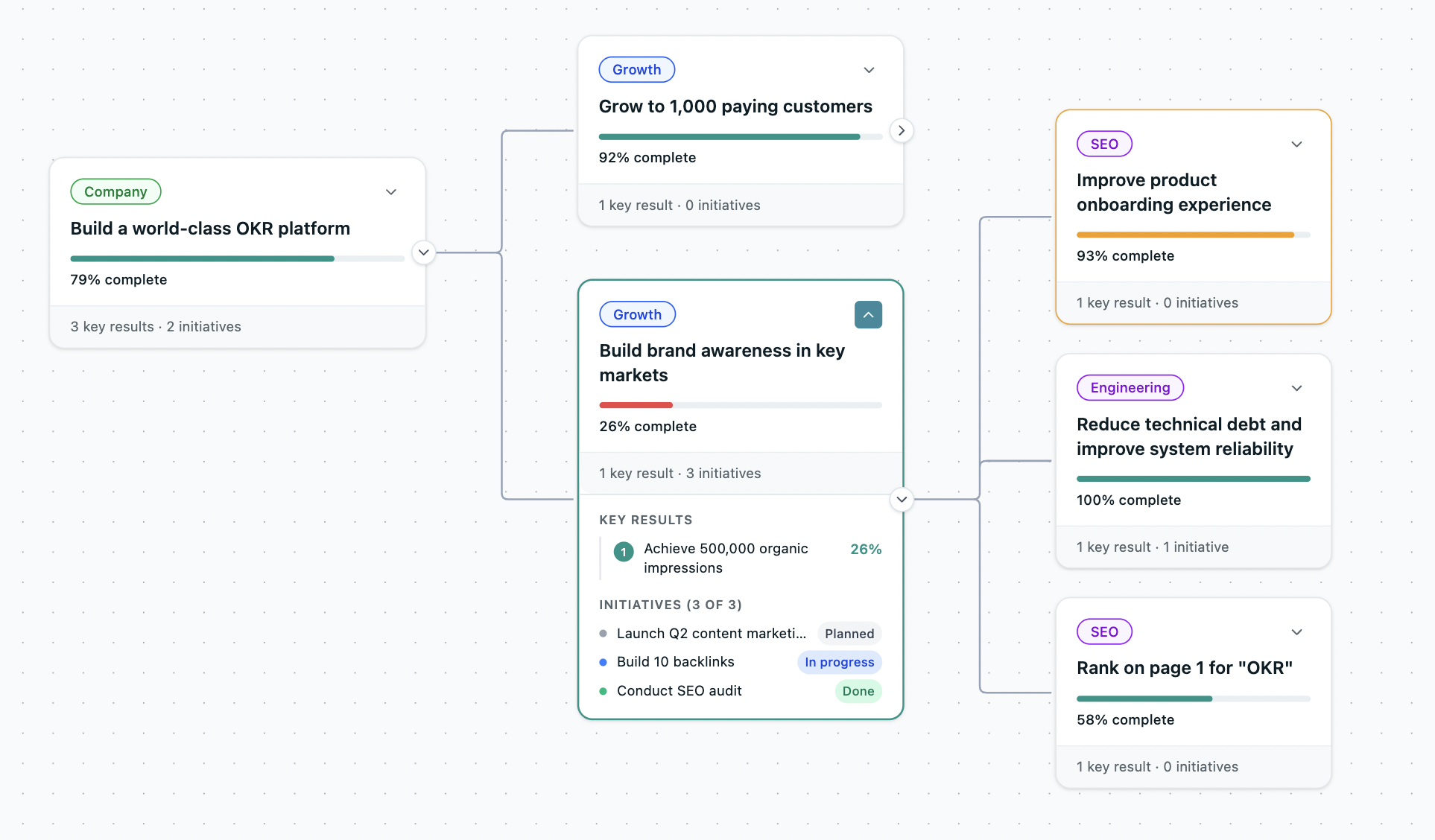
OKRs Tool wins on
- Owner and score required on every Key Result
- One-screen OKR creation
- Flat pricing — no per-seat tax as you hire
- Live in an afternoon, AI and MCP included
Where it isn't the fit
- OKR-focused, not a deep KPI platform
- No free tier — a 14-day trial instead
- Fewer integrations than the largest platforms
Questions Buyers Ask Me
We want OKRs and KPIs together — doesn't Perdoo win?
On the KPI layer, yes. Perdoo's built-in KPI tracking and the vision-to-KPI alignment view go deeper than OKRs Tool, which stays OKR-focused. If connecting operational KPIs to strategy is central to what you're buying, Perdoo is the stronger fit. If the goal is getting teams to actually hit their OKRs, the enforced ownership and faster workflow in OKRs Tool matter more.
How far apart are they on price?
Perdoo is free up to 5 users, then per seat from around €6.40 a user with a 5-licence minimum, so cost climbs as you roll out. OKRs Tool is flat, from $129 a month for the whole organisation. Small teams start cheaper on Perdoo; at scale, flat pricing wins.
Both have AI and an MCP server — what's the real difference?
Less than the marketing suggests. Perdoo drafts and coaches OKRs with Spark and Vince; OKRs Tool flags Key Results that are really tasks or stale mid-cycle, and both expose an MCP server so an assistant can read and update your OKRs. The bigger difference isn't AI — it's that OKRs Tool requires an owner and a score where Perdoo leaves them optional.
Did you test both hands-on or read the feature pages?
I build OKRs Tool, so I know it from the inside, and I set up the same OKR in Perdoo in a real account — signup, an objective, two Key Results, owners and the check-in flow. The table reflects what each live product does, not what a pricing page claims.
Want the habits enforced, live this week?
Open a free trial, create an objective, and watch the check-ins run themselves.
Benchmark figures from The OKR Benchmark Report. Feature scoring from a live account test of both tools.