OKRs Tool vs Mooncamp
I build OKRs Tool, and I tested Mooncamp hands-on in a real account — same objective, Key Results, owners and check-in setup — then scored both on one rubric: what makes goals get hit. Here's where each one wins.

Requires a named owner and a score on every Key Result, runs check-ins on its own, and stays one flat price as you grow. Built for 50–200 person teams that want the habits enforced, not optional.
The clearest visual cascade in the category and the cleanest migration path off Viva Goals, in a modern interface. Per-seat pricing, and ownership and scoring stay optional.
Both run OKRs with automated check-ins and a strong cascade view. The split is in two places: how the goals get run — whether ownership and scoring are enforced or left to the team — and how the bill behaves as you add people.
OKRs Tool is my own product, so I know it from the inside; Mooncamp I set up in a real account — the same objective, two Key Results, owners and check-in flow. I scored both on the same rubric, built on platform data across 3,527 organizations that shows which habits move the odds of hitting a goal. I publish where OKRs Tool falls short, lower down.
The Short Answer
Pick Mooncamp if the strategy map is the thing you care about most — a clean, visual cascade from company goals to team level — or if you're migrating off Viva Goals and want the smoothest path. Pick OKRs Tool if you want the tool to hold the process when attention drifts, with a named owner and a score required on every Key Result, and a flat price that doesn't climb as you hire.
Same cascade clarity. A very different bill at scale.
Mooncamp's strategy map is excellent, but it's priced per seat — a 50-person team pays around €350 a month, and it keeps rising with every hire. OKRs Tool is one flat rate for the whole organisation, from $129 a month whether you're 10 people or 100.
Feature by Feature
Everything below I checked in a live account, not from a pricing page.
| Capability | OKRs Tool | Mooncamp |
|---|---|---|
| Named owner required on every Key Result | Required | Optional |
| Score required on every Key Result | Enforced | Optional |
| Automatic check-in reminders | Yes (Slack + Teams + email) | Yes (Slack + Teams) |
| Cascade / alignment view | Alignment map | Strategy map (standout) |
| AI features | AI KR analysis | None yet |
| Pricing model | Flat per org | Per seat (min 5) |
| Cost at 50 people | From $129/mo, flat | ~€350/mo |
| EU data residency | Yes (Ireland) | Yes (Germany) |
| Free trial | 14 days, no card | 14 days, no card |
| Built for 500+ seat rollouts | 50–200 focus | Mid-market to enterprise |
Checked in a live account in November 2026. Feature availability and pricing shift — confirm current terms with each vendor before you buy.
Where Mooncamp Is the Better Pick
Mooncamp has the clearest strategy map in the category. It gives you a clean visual view of how every team's OKRs connect to company priorities without feeling overwhelming, and the interface is modern and fast — the kind of tool people are happy to open on a Monday. For teams leaving Viva Goals, it's the most direct migration path, and because Mooncamp is a German company, it hosts in the EU, so a procurement review that asks about data residency clears easily. If the visual cascade is the thing your rollout hinges on, Mooncamp is the stronger tool.
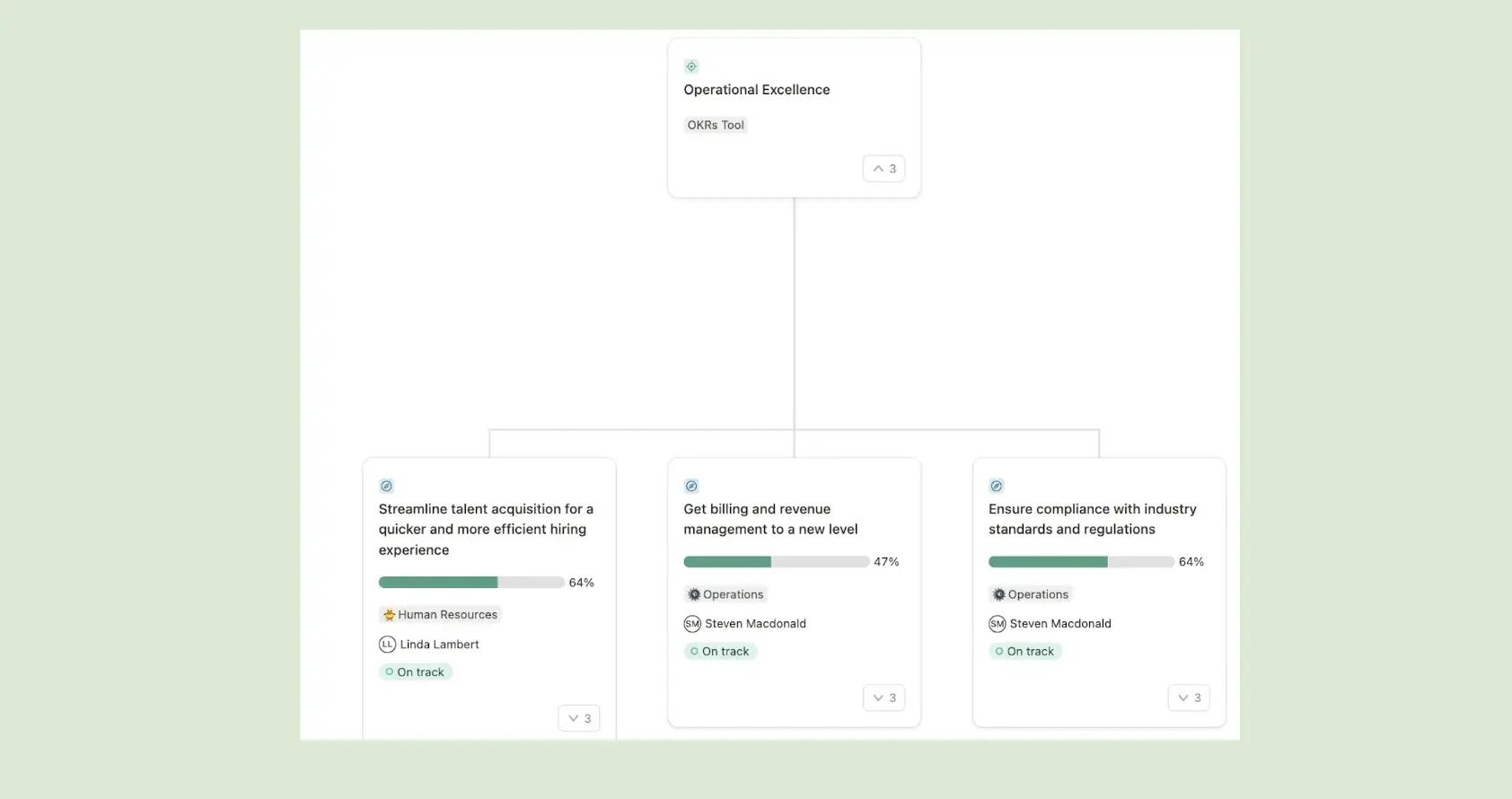
Mooncamp wins on
- The clearest strategy map in the category
- Modern, fast interface
- Cleanest Viva Goals migration path
- EU hosting (German company)
Where it costs you
- Per-seat pricing climbs — ~€350/mo at 50 people
- Ownership and scoring stay optional
- No AI yet
- Cluttered sign-up dashboard, pre-filled sample data
Where OKRs Tool Pulls Ahead
OKRs Tool is built around the habits my data shows separate teams that hit their goals from teams that miss, and it requires the two that matter most — a named owner and a score on every Key Result — rather than leaving them to discipline. Check-ins run automatically in Slack, Teams and email, AI flags Key Results that are really tasks or stale mid-cycle, and the price is one flat rate for the whole company, so adoption never becomes a per-seat budget line. It's the stronger pick when you want the system to hold the process, not just display it.
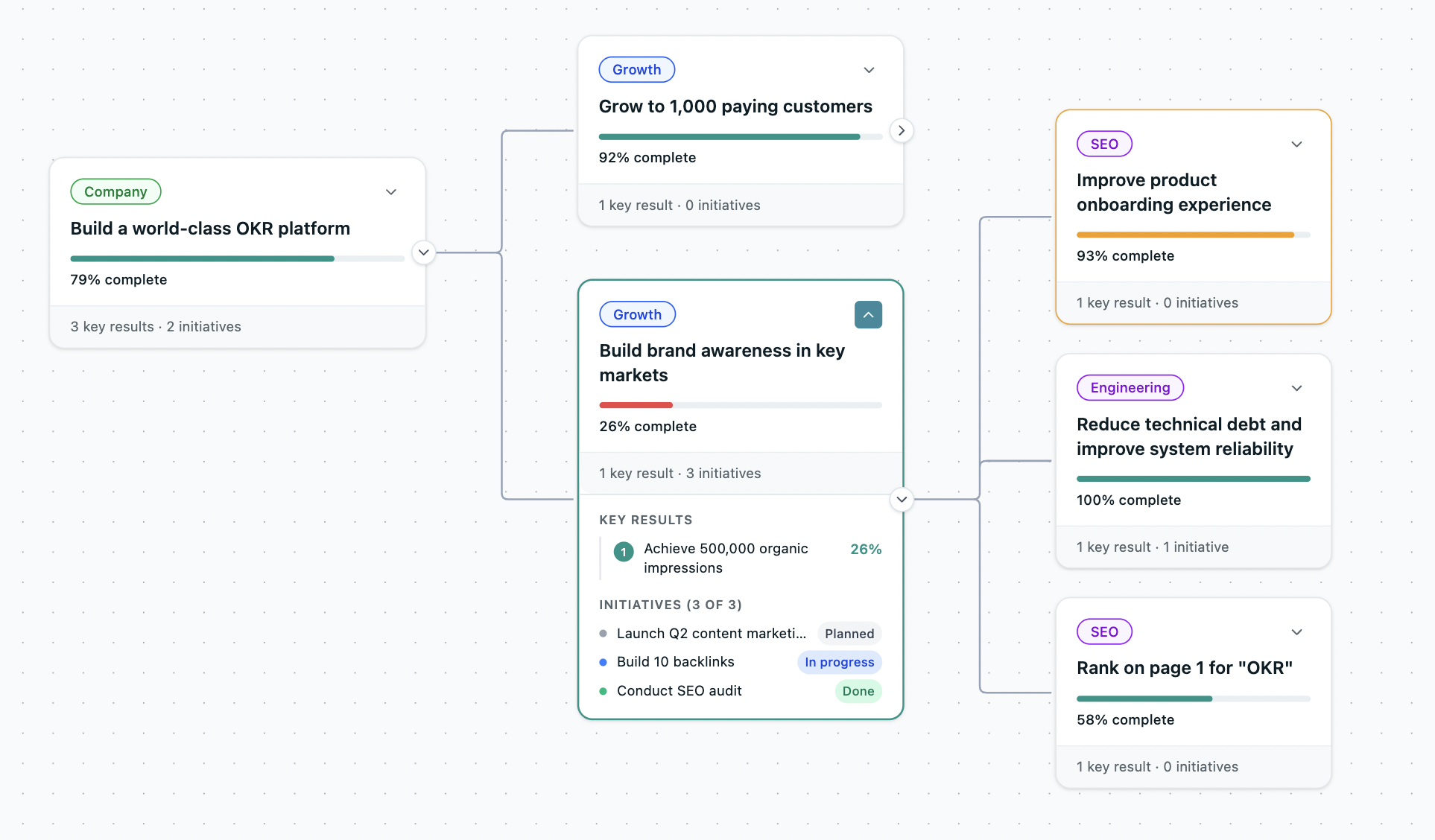
OKRs Tool wins on
- Owner and score required on every Key Result
- Flat pricing — no per-seat tax as you hire
- AI Key Result analysis built in
- Live in an afternoon, no guided rollout
Where it isn't the fit
- Built for 50–200 people, not 500+ rollouts
- Alignment map is cleaner than it is elaborate
- Fewer integrations than the largest platforms
Questions Buyers Ask Me
We're migrating off Viva Goals — which is better?
Both are good targets. Mooncamp built its migration path specifically for Viva Goals teams and keeps the strategy-map feel those users expect. OKRs Tool imports a spreadsheet of OKRs in one click and gets a team live in about 15 minutes, with ownership enforced from the start. If you want the closest like-for-like to Viva Goals' visual model, Mooncamp; if you want the habits enforced and a flat bill, OKRs Tool.
How far apart are they on price at scale?
A long way. Mooncamp is per seat — around €350 a month at 50 people, and it keeps climbing. OKRs Tool is flat, from $129 a month for the whole organisation whether you're 10 people or 100. The more you roll it out, the wider the gap.
Does Mooncamp have AI?
Not yet. Mooncamp has said it will ship AI only when it improves the workflow, which I respect, but as of November 2026 there's no AI in the product. OKRs Tool includes AI Key Result analysis that flags weak or at-risk goals.
Where does each one host our data?
Both keep data in the EU, so neither forces a compromise on residency. OKRs Tool hosts in Ireland (eu-west-1), GDPR-compliant by default; Mooncamp is a German company and hosts in the EU. If EU residency is a procurement gate, both clear it.
Did you test both hands-on or read the feature pages?
I build OKRs Tool, so I know it from the inside, and I set up the same OKR in Mooncamp in a real account — signup, an objective, two Key Results, owners and the check-in flow. The table reflects what each live product does, not what a pricing page claims.
Want the habits enforced, at a flat price?
Open a free trial, create an objective, and watch the check-ins run themselves.
Benchmark figures from The OKR Benchmark Report. Feature scoring from a live account test of both tools.