OKRs Tool vs Cascade
I build OKRs Tool, and I tested Cascade hands-on in a real account — same objective, Key Results, owners and check-in setup — then scored both on one rubric: what makes goals get hit. Here's where each one wins.

Requires a named owner and a score on every Key Result, runs check-ins on its own, and gets a team live in an afternoon at one flat, published price — no strategy-map project first.
Enterprise strategy execution with the strongest multi-level reporting in the category — strategy maps, pillars and cross-business-unit dashboards. Heavy to configure, quote-only pricing.
Cascade is built for the layer above most teams — corporate strategy across business units, with reporting to match. OKRs Tool is built for the 50–200 person team that wants ownership enforced and a cycle running fast. The split is enterprise strategy reporting versus speed and enforced discipline.
OKRs Tool is my own product, so I know it from the inside; Cascade I set up in a real account — the same objective, two Key Results, owners and check-in flow. I scored both on the same rubric, built on platform data across 3,527 organizations that shows which habits move the odds of hitting a goal. I publish where OKRs Tool falls short, lower down.
The Short Answer
Pick Cascade if you're a corporate strategy team at 500+ that needs to translate strategy into goals across business units, regions and functions, with executive reporting layered on top, and you have time to configure strategy maps before the first goal goes live. Pick OKRs Tool if you're 50–200 and want a named owner and a score required on every Key Result, a flat published price, and a cycle running this afternoon.
Enterprise reporting is the draw. The setup is the catch.
Cascade's multi-level reporting across business units is the strongest in the enterprise segment. But strategy maps, pillar structures and multi-level hierarchies need real configuration before the first goal is live, and there's no public price. OKRs Tool enforces ownership and is live in an afternoon at a flat, published rate.
Feature by Feature
Everything below I checked in a live account, not from a pricing page.
| Capability | OKRs Tool | Cascade |
|---|---|---|
| Named owner required on every Key Result | Required | Optional |
| Score required on every Key Result | Enforced | Optional |
| Automatic check-in reminders | Yes | Yes |
| Time to first cycle | Live in an afternoon | Heavy config before goal one |
| Multi-level reporting across business units | Alignment map (50–200) | Strongest in enterprise |
| AI features | AI KR analysis | AI-powered (Enterprise) |
| Pricing | From $129/mo, flat | Quote-based |
| Pricing transparency | Public | Quote-only |
| Built for | 50–200 teams | 500+ corporate strategy |
| Free plan / trial | 14-day trial, no card | Free up to 2 users |
Checked in a live account. Feature availability and pricing shift — confirm current terms with each vendor before you buy.
Where Cascade Is the Better Pick
Cascade is an enterprise strategy-execution platform, built for large organizations that need to translate corporate strategy into departmental and team goals. It handles the complexity of multiple business units, cross-functional dependencies and executive reporting layers that would break simpler tools, and the multi-level reporting infrastructure is the strongest I've seen in the enterprise segment. The strategy map — company mission through strategic pillars to OKRs — is well-designed for that scale, and it now markets itself as AI-powered on its enterprise plan. For a corporate strategy team at 500+, Cascade has the depth for it.
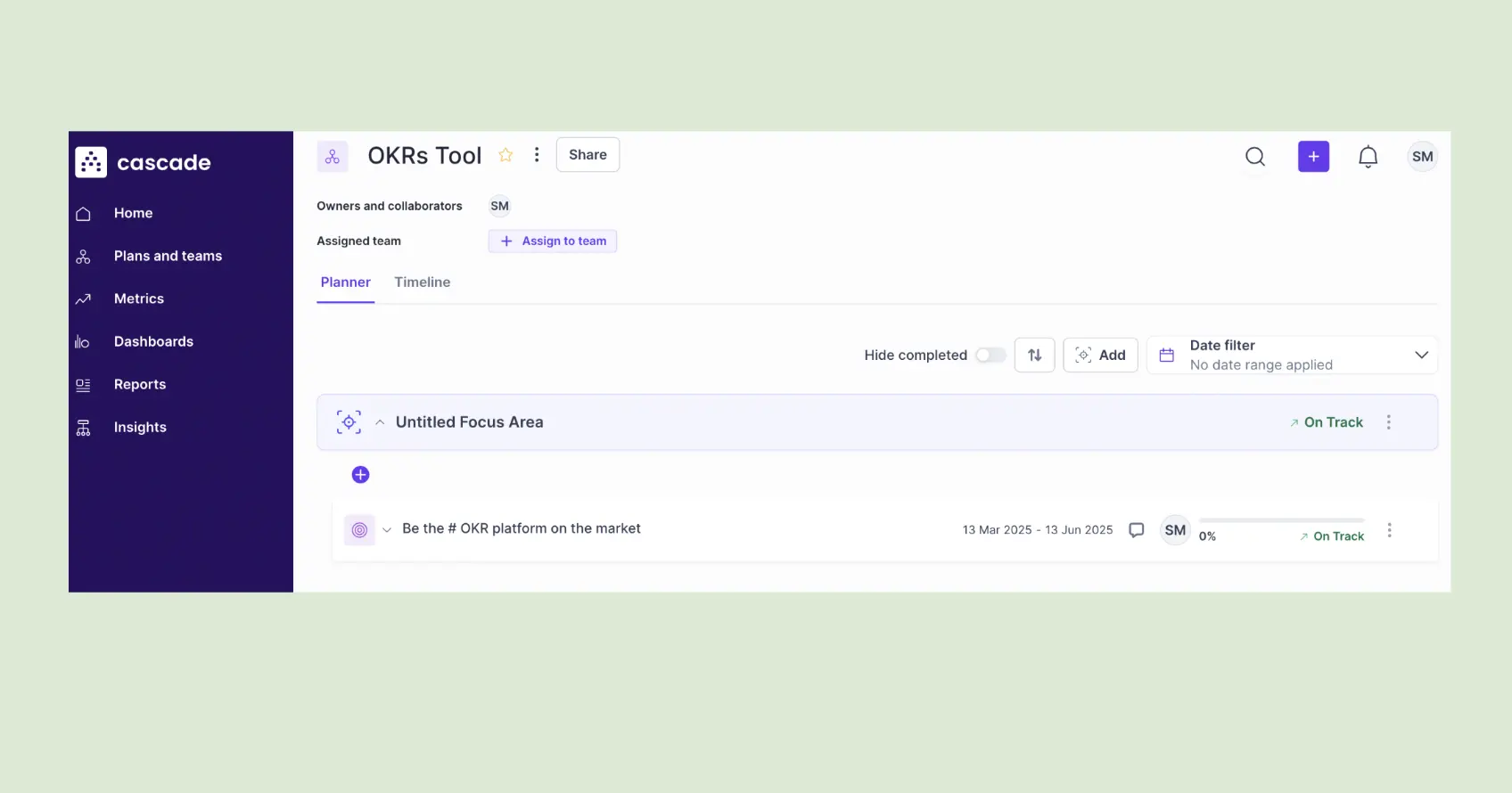
Cascade wins on
- Multi-level reporting across business units
- Enterprise strategy maps and pillars
- Initiative tracking at scale
- Depth for 500+ corporate strategy
Where it costs you
- Heavy configuration before the first goal
- Too complex for most growing teams
- Ownership and scoring stay optional
- Quote-only — no public rates
Where OKRs Tool Pulls Ahead
OKRs Tool requires the two habits my data shows matter most — a named owner and a score on every Key Result — rather than leaving them optional. A team goes from signup to a live cycle in about an afternoon, with no strategy-map project to build first, check-ins fire automatically in Slack, Teams and email, and the price is flat and published, from $129 a month for the whole organisation. For a 50–200 person team, it delivers the habit that moves the odds most without the enterprise configuration and cost.
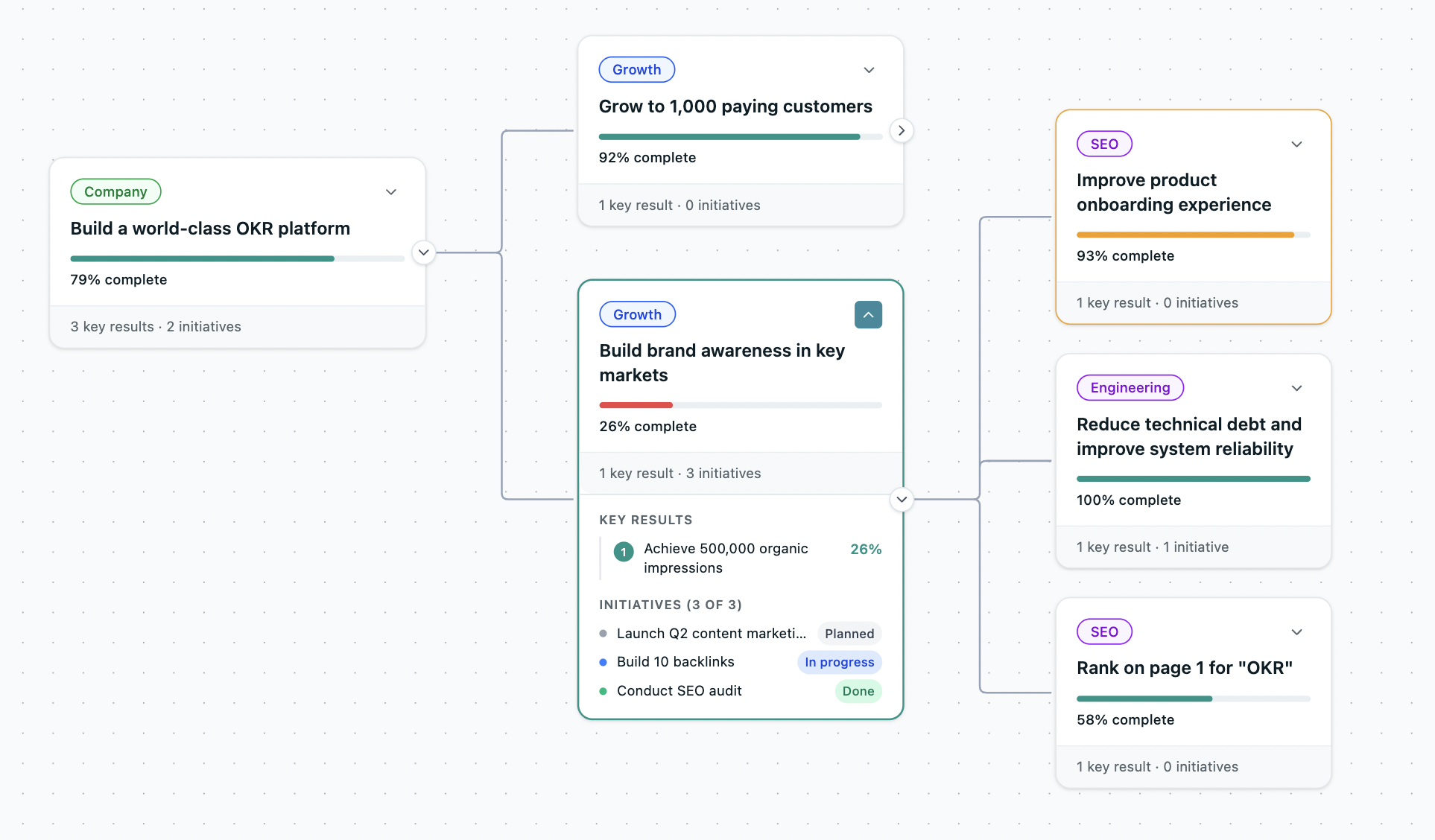
OKRs Tool wins on
- Owner and score required on every Key Result
- Live in an afternoon, no config project
- Flat, published pricing — no quote
- Right-sized for 50–200 teams
Where it isn't the fit
- Built for 50–200, not 500+ strategy teams
- No cross-business-unit reporting layer
- Cleaner cascade, not an elaborate one
Questions Buyers Ask Me
We report strategy across business units — doesn't Cascade win?
For cross-business-unit reporting at 500+, yes. Cascade's multi-level reporting and strategy maps go well beyond OKRs Tool, which is built for a single 50–200 team rather than a corporate strategy office. If that enterprise reporting layer is what you're buying, Cascade is the stronger fit. If the goal is getting a team to hit their OKRs fast, OKRs Tool's enforced ownership matters more.
How far apart are they on price?
Cascade is free up to 2 users, then quote-only — no public rates for Essentials or Enterprise. OKRs Tool is flat and published, from $129 a month for the whole organisation. If you want a number without a sales call, that's a clear difference.
How long until we're running a cycle?
On Cascade, plan for real configuration first — strategy maps, pillar structures and multi-level hierarchies before the first goal is live. On OKRs Tool, a team goes from signup to a live cycle in about an afternoon, with ownership enforced from the start.
Did you test both hands-on or read the feature pages?
I build OKRs Tool, so I know it from the inside, and I set up the same OKR in Cascade in a real account — signup, an objective, two Key Results, owners and the check-in flow. The table reflects what each live product does, not what a pricing page claims.
Want the habits enforced, without the config project?
Open a free trial, create an objective, and watch the check-ins run themselves.
Benchmark figures from The OKR Benchmark Report. Feature scoring from a live account test of both tools.