Most strategy framework rollouts fail at the same point: the planning session ends, the deck looks compelling, and then the quarter starts and the framework quietly disappears under the weight of daily work. This guide covers how to prevent that — with the data on what separates frameworks that take hold from ones that fade.
Every leadership team has experienced this. A strategy offsite produces clear priorities. A framework gets chosen — OKRs, BSC, MBO, or a custom approach. Slides get built. The executive team is aligned. And then two months later, the framework is technically running but practically invisible. Teams are busy, but nobody can point to how their work connects to the strategy that was set in January.
The 2026 OKR Benchmark Report across 330 organizations identified the root cause: only 5% of teams have more than 75% of their weekly work tied to a strategic goal. 65% of teams admit their goals aren't linked to company strategy at all. The problem isn't strategy quality. It's rollout structure.
Why Most Strategy Framework Rollouts Fail
The failure pattern is consistent across organizations of every size. It's not a lack of commitment from leadership. It's a set of predictable structural gaps that appear in the same order every time.
The cascade never completes. The OKR Intelligence Report 2026 found only 16% of organizations complete the full cascade — company strategy translated to department goals to team Key Results — within the same week. For the other 84%, teams spend the first two to four weeks of the quarter without clear direction. By the time the cascade is complete, momentum is already lost.
The framework becomes overhead. When updating the strategy system takes more effort than telling your manager in a message, people choose the message. Strategy frameworks that require weekly manual effort to maintain — updating spreadsheets, attending progress meetings, filling in reports — erode adoption faster than any other single factor. The framework needs to make visibility effortless, not create more work.
No accountability structure. A strategy goal without a named owner is a statement of intent. The benchmark data is precise: 50% of all strategic goals across growing organizations have no single named person accountable. Teams with required single ownership see 26% higher completion rates. Without it, goals drift from owned to assumed to invisible.
No weekly rhythm. The single highest-return habit in any strategy execution programme is a consistent weekly check-in. Teams that review strategic goal progress weekly complete 43% more goals than those reviewing monthly or ad hoc. Most rollouts design the planning session well and neglect the rhythm that keeps the plan alive.

The 6 Steps to a Strategy Framework Rollout That Sticks
Step 1: Choose the framework before the offsite
The worst time to debate OKRs vs balanced scorecard vs MBO is in the planning session itself. That conversation needs to happen beforehand — with a clear decision made and communicated before anyone sits down to set goals.
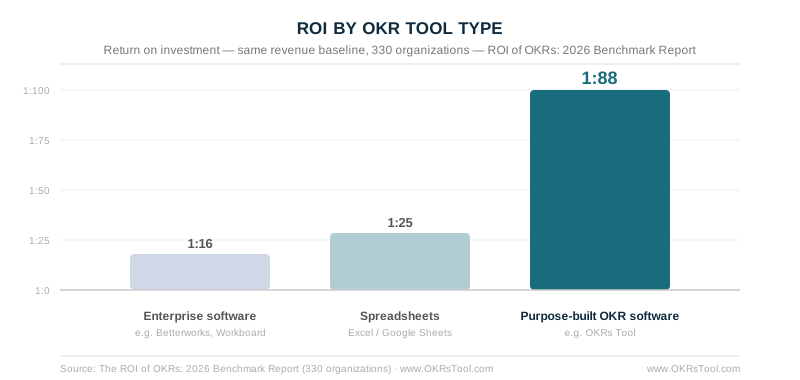
OKRs are the most widely adopted framework for growing organizations at the 50–200 person stage — the benchmark data shows they generate a 1:88 return on investment against the same revenue baseline when implemented correctly. Balanced scorecards work well for organizations with mature measurement infrastructure. MBO suits organizations where individual accountability is the primary need.
The choice matters less than the commitment to one framework, applied consistently, for at least four cycles before evaluating alternatives.
Step 2: Set company-level goals first
Before any department or team sets a single goal, company-level priorities need to be finalized by leadership. This is the anchor the entire cascade hangs from — and it needs to be specific enough that every team can answer: "What is our specific contribution to this priority?"
Vague company goals produce vague team goals. "Be more customer-centric" cannot cascade. "Make the first 90 days so strong that churn becomes an exception" can — it tells every team what direction to face and what kind of outcomes to target.
Keep the number small: 1–2 company objectives per quarter. Teams running more than two top-level priorities are twice as likely to hit none of them.
Step 3: Complete the cascade in days, not weeks
Run company and department goal-setting in a single half-day session. Department heads leave with the company priorities finalized and a 2–3 day window to set their team's cascading goals within that context.
The cascade should be complete — every team's goals set, owned, and visible — before day seven of the new cycle. Teams that hit this target see up to 50% higher completion rates than those that take three to four weeks.
The cascade check before going live: every team goal should connect to a company priority in one sentence. If it takes a paragraph, the connection is assumed rather than structural.
Step 4: Assign one owner per goal before anything goes live
Every goal — at company, department, and team level — needs one named person accountable before it enters the active cycle. Not a team. Not "jointly owned." One person who updates it weekly, escalates when it stalls, and owns the score at cycle end.
This is the single highest-leverage structural decision in any rollout. It's also the one most organizations skip in the interest of being "collaborative." The result is 50% of goals with no real owner — and 26% lower completion rates than teams that enforce it.
Step 5: Build the weekly rhythm before the cycle starts
The weekly check-in is not a meeting. It's a structured update — 20 minutes, four questions: what moved, what's at risk, priority this week, where help is needed. It should run automatically at the same time every week, via Slack or MS Teams, without anyone scheduling it.
If the check-in requires a decision to run it, it will eventually stop being run. The teams generating the highest returns from strategy frameworks don't have more disciplined employees — they have automated infrastructure that makes the weekly habit structurally unavoidable.
The alignment map is the visibility layer that makes the weekly check-in meaningful: every team's goals connected to company priorities in a live view, updated automatically as progress is tracked.
Step 6: End every cycle with a retrospective
Teams that run structured end-of-cycle retrospectives complete 30–45% more goals the following cycle. The retrospective is where the rollout compounds — 60 minutes, four questions, three specific changes committed for the next cycle.
Without the retrospective, the same structural problems repeat. The same goals underperform for the third cycle in a row because nobody stopped to ask why. The rollout that produces lasting results is the one where each cycle makes the next one better.
Choosing the Right Tool for the Rollout
The tool choice is a structural decision, not a preference. Strategy management software that makes the cascade visible, enforces ownership, and automates the weekly check-in generates 1:88 ROI. Spreadsheets generate 1:25. Enterprise platforms that require four weeks of configuration before the first cycle runs generate 1:16.
The right tool for a 50–200 person organization is one that gets the first cycle live in under a week. Strategy execution software that requires an implementation project before the first goal is set is already working against the rollout.
For a full comparison of platforms by rollout speed, ownership enforcement, and pricing: Best OKR Software → · How to Choose OKR Software →
What a Good Rollout Looks Like at 90 Days
At 90 days — the end of the first cycle — a successful rollout looks like this:
The cascade was complete before day seven. Every goal had a named owner before the cycle started. The weekly check-in ran for at least 10 of the 12 weeks. The mid-cycle review happened at week six and produced at least one goal revision. The end-of-cycle retrospective ran and produced three specific changes for cycle two.
First-cycle completion averages 51% across organizations regardless of framework. That's not failure — it's the baseline. The organizations that reach 79% completion by cycle five aren't the ones that had a better strategy. They're the ones that built the structure correctly in cycle one and let the discipline compound.
The goal of a strategy framework rollout isn't perfection. It's a functioning system: goals that are specific and measurable, a cascade that connects every team to company priorities, named owners who check in weekly, and a retrospective that makes cycle two better than cycle one.
Data: The ROI of OKRs: 2026 Benchmark Report (330 respondents), The 2026 OKR Benchmark Report (200+ organizations), OKR Intelligence Report 2026 (222 organizations).