Alignment is easy at 10 people. Everyone hears the same updates. Priorities are shared instinctively. By 50 people, that breaks down — not because of lack of effort, but because teams are making assumptions in the absence of clarity. OKR alignment is the structural fix. This guide covers what it is, why it breaks, and how to rebuild it before the next cycle starts.
The most common pattern in growing organizations isn't teams that don't care about strategy. It's teams that genuinely believe they're working on the right things — and discover at the end-of-cycle review that their work had little visible connection to what the company was actually trying to achieve.
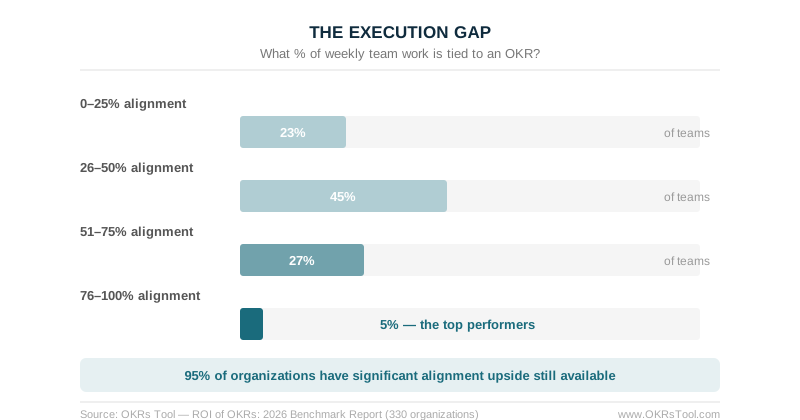
The 2026 OKR Benchmark Report across 330 organizations captures this precisely: 65% of teams admit their goals aren't linked to company strategy. Only 5% of teams have more than 75% of their weekly work tied to a strategic goal. This isn't a motivation problem. It's a structure problem.
OKR alignment is the practice of connecting every team's Key Results to company priorities — explicitly, structurally, and visibly — so that the connection doesn't have to be assumed, remembered, or explained in a meeting.
What Is OKR Alignment?
OKR alignment is the practice of ensuring every team, department, and individual goal connects to a shared set of company priorities — explicitly, not by assumption.
It connects three layers:
- Company-level Objectives — where the organization is going this quarter
- Department-level OKRs — each function's specific contribution to company priorities
- Team Key Results — the measurable outcomes each team will deliver
When alignment is strong, every team member can draw a direct line from their weekly work to the company's most important outcomes. When it's weak, teams are executing in silos — contributing to their own priorities, not necessarily the company's.
The OKR Intelligence Report 2026 found only 16% of organizations complete the full cascade — company OKRs to team Key Results — within the same week. For the other 84%, the alignment gap opens before the cycle even begins.
What OKR Misalignment Looks Like
Misalignment rarely announces itself. It accumulates quietly through the first half of the quarter and surfaces at the mid-cycle review when it's already expensive to fix.
The signs are specific: teams have OKRs but can't articulate how they connect to company priorities. Different departments define success differently. Goals are set in isolation without visibility into other teams' work. The weekly review becomes a status update rather than a strategic check-in. And by week eight, the OKRs that were set in week one are invisible — technically active, practically abandoned.
The OKR Intelligence Report 2026 found 7% of off-track Key Results are simply abandoned mid-cycle — informally dropped with no revision or escalation. This is the Invisible OKR pattern, and it's almost always a symptom of weak alignment: goals that were never structurally connected to anything the team was working on.
How to Build OKR Alignment
1. Start with company-level Objectives before anything else
Alignment begins with a clear signal from the top. Before teams can connect their work to company priorities, those priorities need to exist — finalized, communicated, and specific enough to cascade from.
Limit company-level OKRs to 1–2 Objectives per quarter. Each should be qualitative, inspiring, and specific enough that every team can answer: "What is our specific contribution to this?" Vague objectives don't cascade. "Be more customer-centric" cannot cascade. "Make the first 90 days so strong that churn becomes an exception" can.
Communicate the company Objectives before any department or team begins writing their own goals. The cascade can only happen in sequence — company first, teams second.
2. Run the cascade fast — in days, not weeks
The cascade — company OKRs to department OKRs to team Key Results — should complete before the first week of the cycle is over. Teams that complete the cascade in under a week see up to 50% higher completion rates than those that take 3–4 weeks.
The practical method: run company and department goal-setting in a single half-day session. Department heads leave with company priorities finalized and a 2–3 day window to set their team Key Results. The cascade compresses from weeks to days, and the cycle starts with everyone already connected.
The cascade check: every team Key Result should connect to a company priority in one sentence. If it takes a paragraph, the connection is implied rather than structural. Fix it before the cycle starts.
3. Make alignment visible — not assumed
OKRs can't drive alignment if nobody can see them. The most common alignment failure isn't bad goals — it's invisible ones. Goals set in planning documents that nobody opens by week four, spreadsheets that three people bookmarked and nobody updates, slide decks from the offsite that exist on a shared drive nobody navigates to.
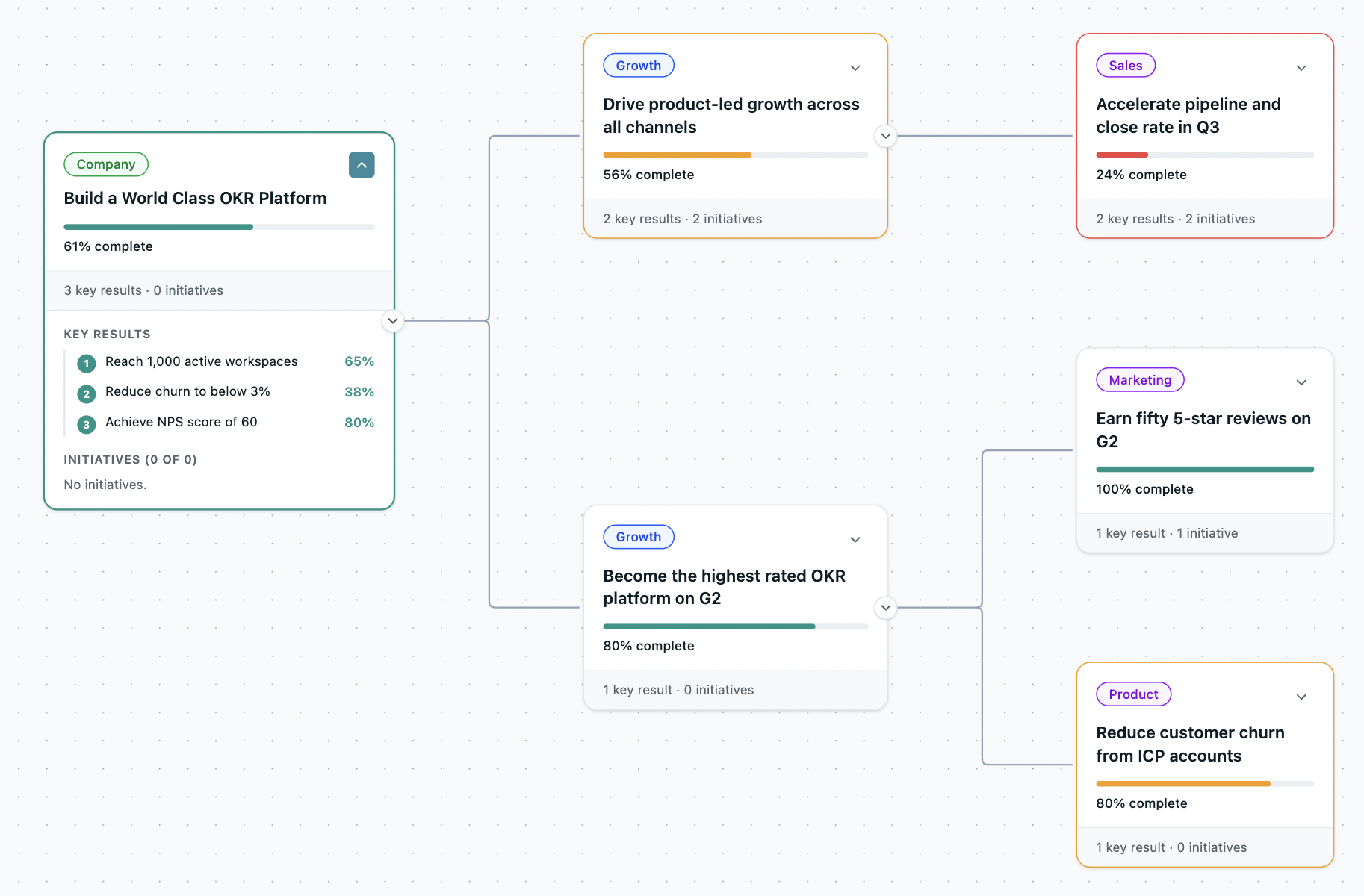
The alignment map is the structural fix: every team's Key Results connected to company priorities in a live view, updated automatically as progress is tracked. Leadership sees what's on track and what's drifting without calling a meeting. Team members see how their work connects to company strategy without asking.
4. Enforce ownership before the cycle starts
An aligned goal without a named owner is still a goal at risk. 50% of all Key Results across growing organizations have no named owner. Teams with required single ownership per Key Result see 26% higher completion rates than those with shared or vague accountability.
The ownership requirement isn't just about accountability — it's about alignment maintenance. The named owner is the person who updates the Key Result weekly, escalates when it stalls, and surfaces connection problems before they compound. Without a named owner, alignment drifts silently through the cycle.
The structural fix: every Key Result requires a named owner before it goes live. Not a team. Not "jointly." One person.
5. Sync on strategy weekly — not just status
Most cross-functional meetings are status updates: what teams did, what they're doing, what's next. Useful for coordination. Not sufficient for alignment.
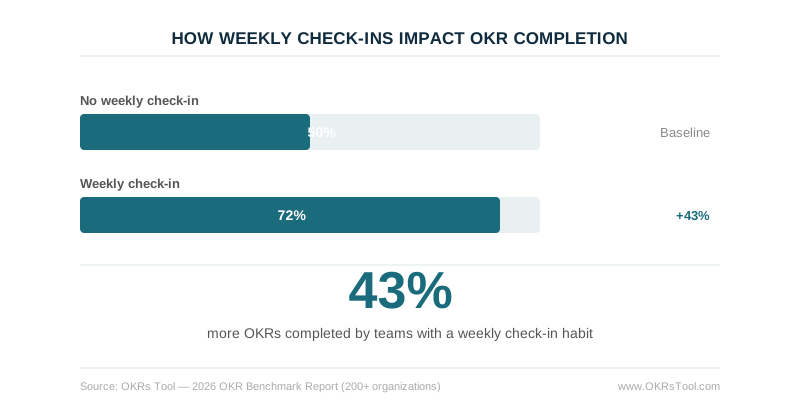
The weekly check-in that drives 43% more OKR completions isn't a status update — it's a structured review of whether work is connected to strategic outcomes. Four questions: what moved, what's at risk, priority this week, where is help needed. Twenty minutes, automated nudge, same time every week.
The distinction matters because status updates show what's happening. The strategic check-in shows whether what's happening is connected to what the organization is trying to achieve. Teams that maintain this distinction through the full 12-week cycle don't lose alignment mid-quarter.
6. Reflect on alignment at cycle end
Alignment isn't something you build once — it's something you maintain and improve cycle over cycle. The end-of-cycle review is where that improvement happens.
Teams that run structured retrospectives complete 30–45% more OKRs the following cycle. The alignment-specific questions to add to the retrospective: did team OKRs clearly support company priorities? Where did alignment break down or drift mid-cycle? Were cross-functional Key Results genuinely connected or just referencing the same language?
The answers feed directly into the next cycle's cascade — producing tighter connections, faster cascade completion, and less invisible OKR drift with each iteration.
OKR Alignment vs OKR Adoption
Alignment and adoption are related but distinct problems. Adoption is about whether teams run OKRs at all — whether the habit of weekly check-ins and honest scoring takes hold. Alignment is about whether the OKRs being run are connected to what the organization is actually trying to achieve.
You can have high adoption with low alignment — teams that run OKRs diligently but in silos, producing results that don't aggregate to company-level outcomes. You can also have high alignment with low adoption — teams that write well-cascaded goals but stop tracking them by week six.
The organizations generating the highest returns from OKRs — a 1:88 return on investment per the 2026 benchmark — have both. The OKR software that enforces the cascade structurally, requires named ownership, and automates the weekly check-in is the tool that makes both achievable simultaneously.
Alignment Is Built Into the Structure, Not the Culture
The teams that hold alignment through a full cycle don't run on more disciplined employees or better communication habits. They run on structure they built once: a cascade finished before day seven, a named owner on every Key Result, and a live alignment map that surfaces drift before it compounds into a mid-cycle scramble. Culture gets the credit afterward, but the structure is what did the work.
The benchmark numbers show what that structure returns — 43% more goals completed with a weekly check-in rhythm, 26% higher completion when every Key Result has a named owner, and a completion rate that climbs from 51% in cycle one to 79% by cycle five. That last figure is the point worth ending on: alignment compounds.
Each cycle the structure holds, the next cascade is tighter, the drift is smaller, and the return is higher — and the structure only has to be built once.
Data: The ROI of OKRs: 2026 Benchmark Report (330 respondents), The 2026 OKR Benchmark Report (200 organizations), OKR Intelligence Report 2026 (222 organizations).