EOS gives organizations the operating rhythm, meeting cadence, and accountability structure that keeps a leadership team aligned week to week. OKRs give them the measurable outcome targets and cascade visibility that keeps every team pointed at the same strategic priorities. Organizations running both — the Rocks from EOS inside an OKR structure — get an execution system with no meaningful gaps.
Gino Wickman introduced the Entrepreneurial Operating System in Traction (2007) after spending years helping entrepreneurs build and scale businesses. The diagnosis was consistent across every company he worked with: most leadership teams had good strategies and good people, but no operating system to translate strategy into consistent weekly execution.
EOS became the answer — six interdependent components that, when strengthened simultaneously, produce a healthy, well-run business. Today it's used by more than 200,000 companies worldwide, primarily at the 10–250 employee stage where the chaos of growth first overwhelms the founder's ability to manage everything directly.
What EOS Actually Is
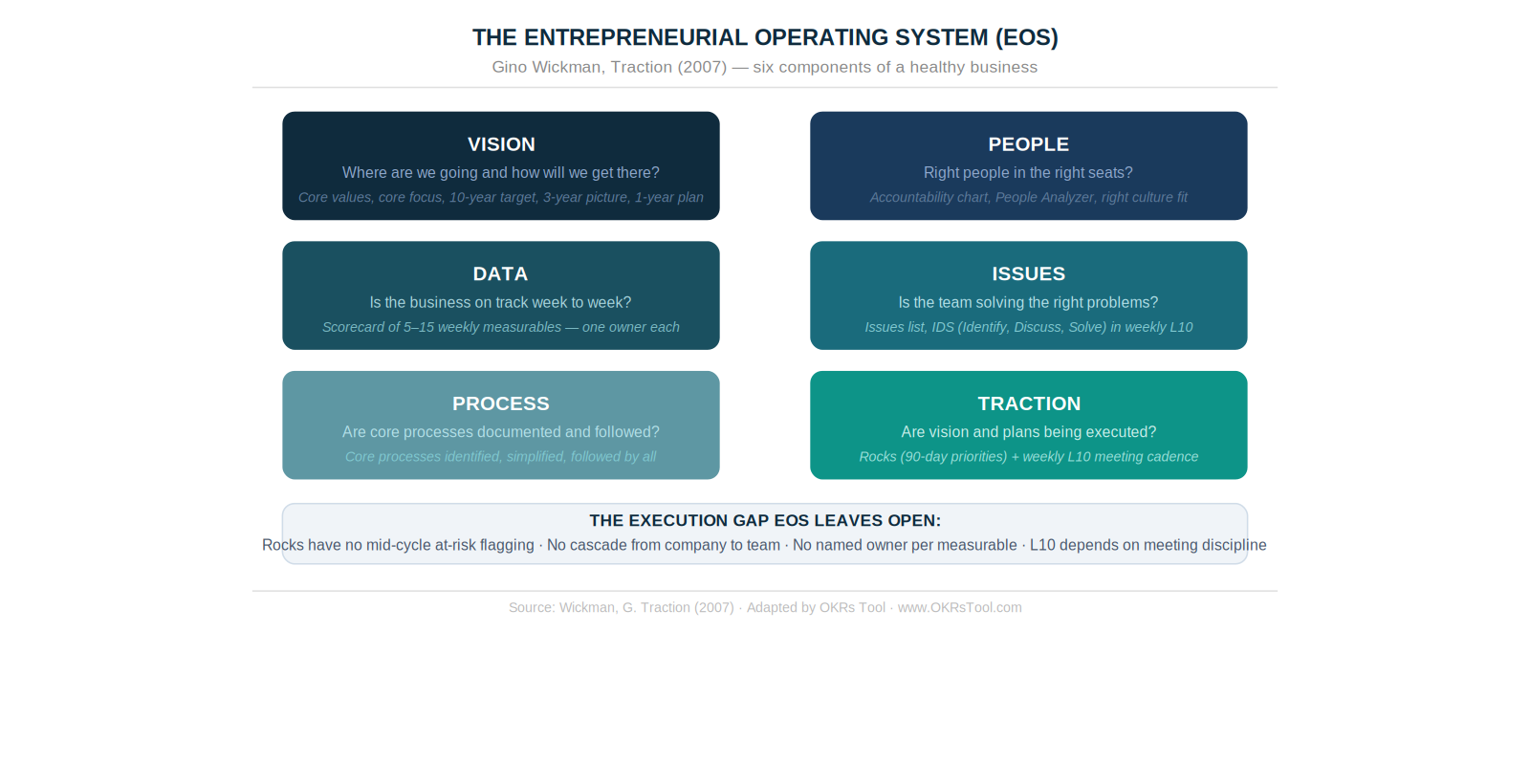
EOS is an operating system — a complete set of tools, meetings, and disciplines that runs every aspect of how a business operates. The six components work together as an integrated system, not as a menu of options.
Vision answers where the organization is going and how it will get there. Core values, core focus, a 10-year target, a 3-year picture, and an annual plan — all defined, documented, and shared with the whole organization.
People ensures the right people are in the right seats. The Accountability Chart defines roles and responsibilities. The People Analyzer evaluates whether each person shares the company's core values and has the skills to do their job.
Data keeps the business on track through a Scorecard — a set of five to fifteen weekly measurables, each owned by one person, reviewed every week at the Level 10 meeting. If a number falls below its target for two consecutive weeks, it becomes an Issue.
Issues is the system for surfacing and solving problems. The Issues List is open to everyone. Issues are solved through IDS — Identify, Discuss, Solve — during the weekly L10 meeting, ensuring that problems don't accumulate or fester.
Process ensures the organization's core ways of working are documented, simplified, and followed consistently. This is the component most organizations skip — and the one that produces the most leverage when done properly.
Traction is execution. Rocks are 90-day priorities — three to seven per person or team — set at the quarterly planning session and reviewed weekly in the L10. The weekly Level 10 meeting is EOS's core accountability ritual: a structured 90-minute agenda that keeps the leadership team focused, aligned, and solving the right problems.
Where EOS Gets It Right
The Level 10 meeting is one of the most effective weekly rituals in business. The structure is tight: segue, scorecard review, Rock review, customer and employee headlines, to-do list review, IDS on the Issues List. Ninety minutes, every week, never missed. The discipline required to maintain that cadence — and the accountability it creates — is something most OKR programmes aspire to but rarely achieve.
The Scorecard concept is also strong. Five to fifteen weekly measurables, each owned by one person, reviewed against a target every week. This is precisely the lead measure discipline that 4DX calls Discipline 2 — and it surfaces problems in week two rather than week thirteen.
The 2026 OKR Benchmark Report found teams that check in weekly complete 43% more OKRs than those reviewing monthly. EOS's weekly L10 meeting enforces this rhythm structurally — which is exactly why companies running EOS tend to have stronger execution habits than those without any operating system.
The Critical Failure Mode
EOS's Traction component runs on Rocks — 90-day priorities, three to seven per person. Rocks are directional and completion-based: either the Rock is done by the end of the quarter or it isn't. What Rocks typically don't have is a measurable outcome attached. "Launch the new onboarding flow" is a Rock. "Increase onboarding completion from 45% to 70%" is a Key Result.
That distinction matters. A Rock can be completed — the onboarding flow can launch — while the business outcome it was supposed to drive doesn't move. EOS has no structural mechanism for catching that gap mid-quarter. The L10 meeting asks "Is the Rock on track?" not "Is the outcome the Rock was supposed to drive on track?"
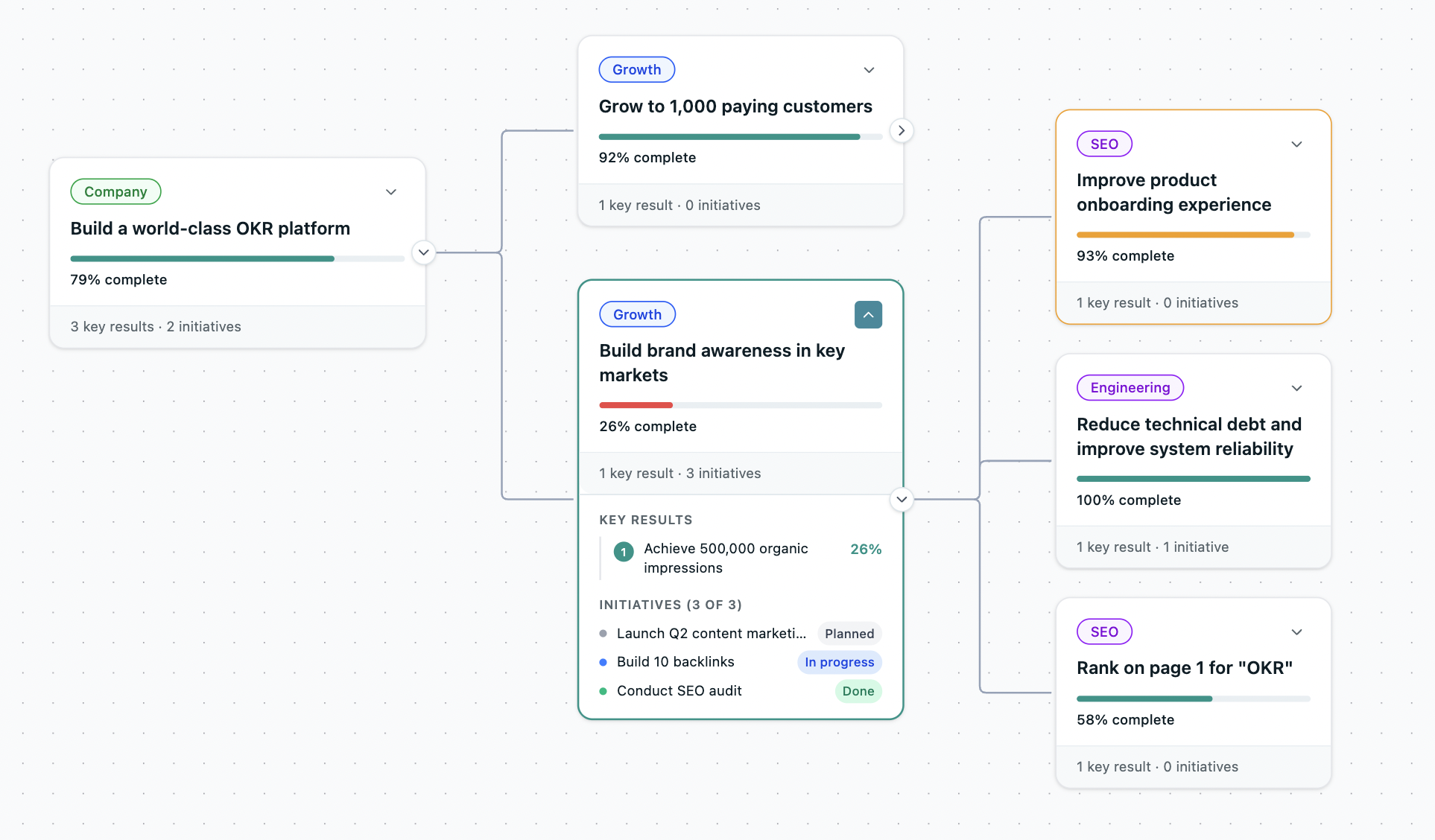
The second gap: EOS has no native cascade mechanism. The leadership team sets Rocks at the quarterly planning session. Departmental teams set their own Rocks. The connection between those two layers is a conversation — not a structural link.
The 2026 OKR Benchmark Report found 65% of teams admit their goals aren't clearly linked to company strategy. EOS addresses this through the Vision/Traction Organizer and shared clarity on the company's top Rocks — but without a structural cascade that requires every team Rock to link to a company Rock before the quarter starts.
How They Compare
The Right Architecture: EOS + OKRs
EOS and OKRs are not alternatives. They complement each other at different layers.
EOS provides the operating rhythm — the meeting cadence, people accountability, issue resolution, and process discipline that keeps an organization healthy and functional. This is the infrastructure that makes any goal-setting framework sustainable. Teams without this infrastructure struggle to maintain the weekly OKR check-in habit because the broader meeting and accountability architecture isn't in place.
OKRs provide the outcome measurement layer that EOS's Rocks don't include. Every Rock becomes a better Rock when it has an OKR Key Result attached — a specific measurable outcome that proves the Rock moved the business, not just that it was completed. The OKR cascade makes the connection between company priorities and team execution structural rather than conversational.
The practical integration: set company OKRs at the quarterly planning session alongside the Rocks. Each Rock gets a Key Result that measures its outcome. The L10 Scorecard measurables become the KPIs that run continuously underneath the quarterly OKR cycle. The weekly L10 becomes the check-in where OKR progress is reviewed alongside the Issues List.
For EOS companies considering OKRs: the L10 meeting already gives you the weekly rhythm. What OKRs add is the measurable outcome layer on top of Rocks, the structural cascade from company to team, and the retrospective infrastructure that makes each cycle sharper than the last. See how OKRs Tool implements the full execution cycle as the outcome measurement layer underneath EOS.
Data: The 2026 OKR Benchmark Report (200+ organizations).