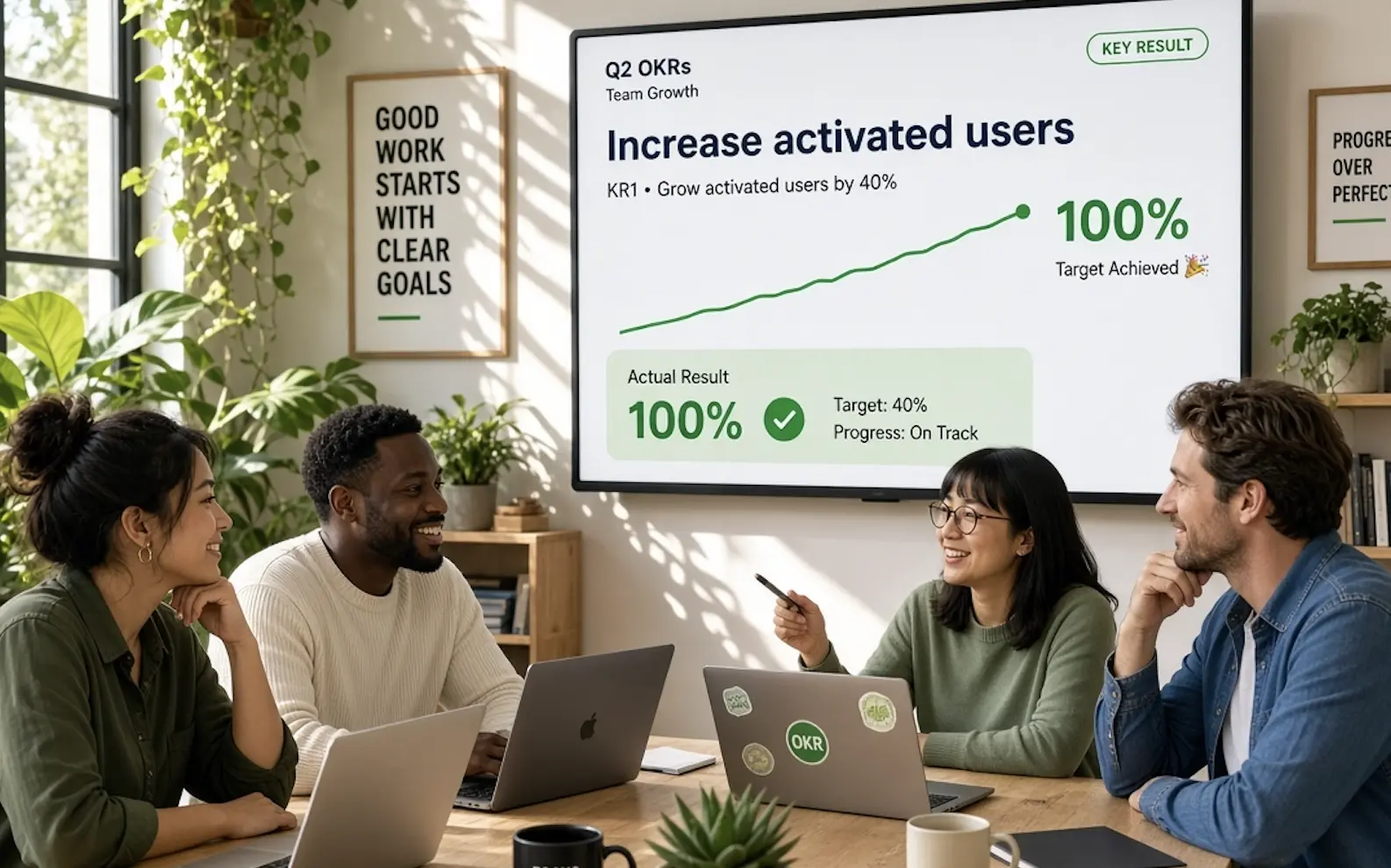
Most companies that set a BHAG are still running it as a poster on the wall three years later. The problem isn't the goal — it's the absence of a quarterly execution system underneath it. That's what OKRs are for.
Jim Collins and Jerry Porras introduced the concept of the Big Hairy Audacious Goal in Built to Last (1994), based on their research into visionary companies that outperformed peers across decades. The insight was that the most enduring organizations didn't just set annual goals — they committed to a single transformational destination so ambitious and so clear that it aligned every decision for ten to twenty-five years.
NASA's BHAG was to put a man on the moon and return him safely by the end of the decade. Henry Ford's was to democratize the automobile. Google's was to organize the world's information and make it universally accessible and useful.
These aren't quarterly Objectives. They're not even annual plans. A BHAG operates on a horizon that makes most goal-setting frameworks irrelevant — and that's exactly why it's so commonly misused.
What a BHAG Actually Is
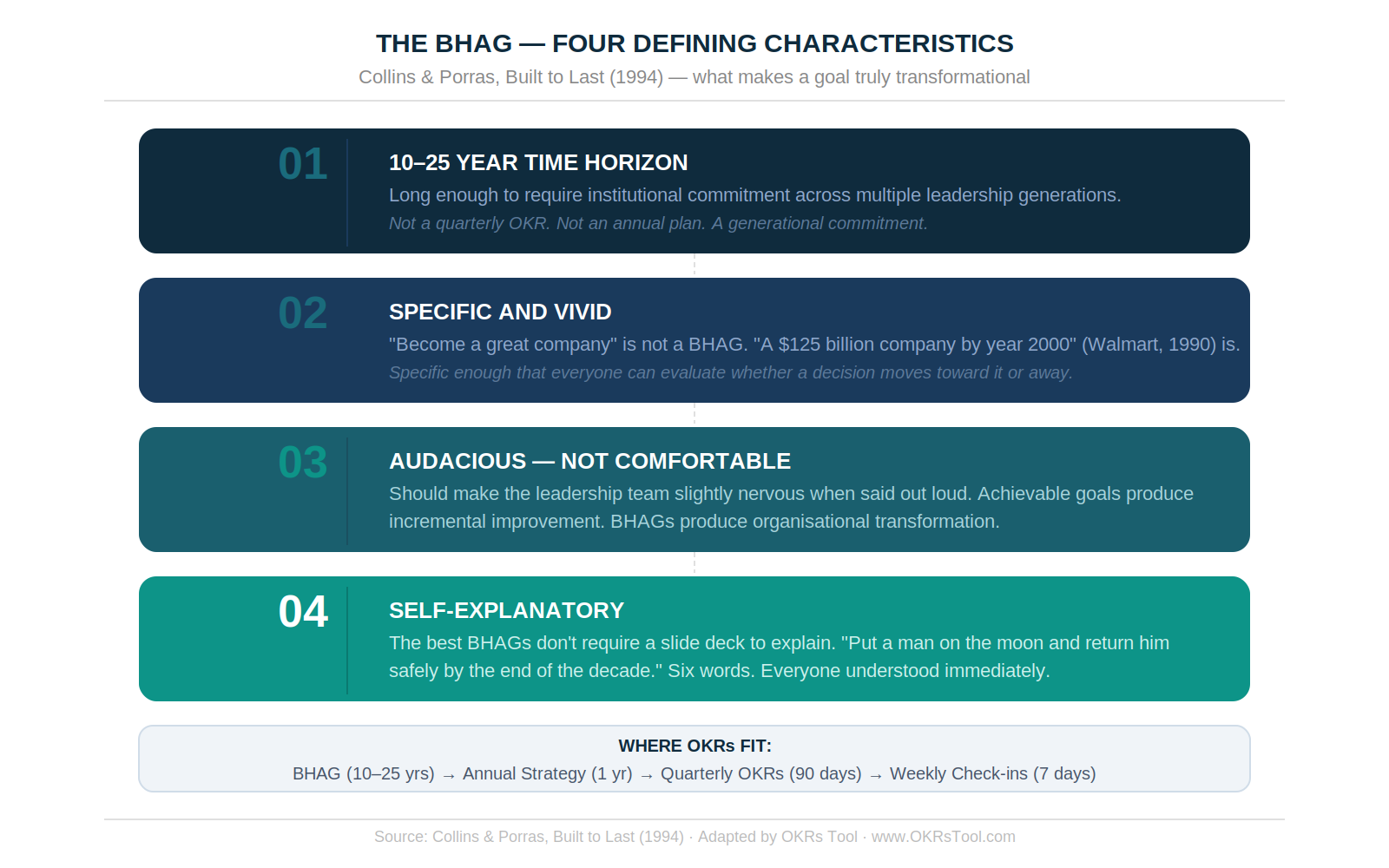
A BHAG has four characteristics that distinguish it from every other goal type.
It is 10–25 years long. Not this year. Not this decade, necessarily. Long enough that no single team, leadership generation, or planning cycle can complete it — it requires institutional commitment across leadership transitions.
It is specific and vivid. "Become a great company" is not a BHAG. "Become a $125 billion company by the year 2000" — Walmart's BHAG in 1990 — is. The specificity is what creates alignment: everyone in the organization can evaluate whether a decision moves toward or away from the destination.
It is uncomfortable. Collins and Porras were explicit: a real BHAG should feel audacious — something that makes the leadership team slightly nervous when they say it out loud. Achievable goals produce incremental improvement. BHAGs produce organizational transformation.
It is self-explanatory. The best BHAGs don't require a slide deck to explain. You either understand immediately why it matters or the goal isn't clear enough.
What OKRs Actually Are
OKRs are a quarterly execution framework. An Objective sets the direction for the next 90 days. Two to four Key Results define the specific outcomes that prove the Objective was achieved. A single named owner per Key Result creates individual accountability. An automated weekly check-in makes progress visible before it becomes a problem.
The OKR cycle runs quarterly — planning, execution, mid-cycle review, retrospective. Then it restarts. The 2026 OKR Benchmark Report found first-cycle teams average 51% completion; teams in cycle five average 79%. The discipline compounds across quarterly cycles in a way that a BHAG operating on a 20-year horizon never can.
OKRs and BHAGs are not alternatives. They don't compete. They operate at entirely different time horizons — and organizations that understand the relationship between them get significantly more out of both.
The Critical Failure Mode
The most common BHAG failure is this: a leadership team commits to a transformational 10-year goal in a strategy offsite, publishes it, and then returns to running annual OKR planning sessions that have no explicit connection to it.
By year three, the BHAG is a framed print in the reception area. The quarterly OKRs are connected to this year's revenue targets and operational priorities. Nobody in the weekly check-in meeting references the BHAG. The cascade from company Objectives down to team Key Results is tight — but it connects to this quarter's business priorities, not the 10-year destination.
The BHAG hasn't been abandoned. It's been orphaned.
The 2026 OKR Benchmark Report found 65% of teams admit their goals aren't clearly linked to company strategy. For companies running a BHAG, that number likely understates the problem: most teams can't articulate how their weekly Key Result updates connect to a goal that won't resolve for fifteen years.
The fix is structural. The OKR framework needs to be explicitly anchored to the BHAG at the annual planning layer — and the company OKRs each quarter need to be evaluated not just against this year's business targets but against whether they move the organization meaningfully toward the BHAG.
The Right Architecture
BHAG, annual strategy, and OKRs are three separate layers of a single connected system. Each operates at a different time horizon and serves a different function.
BHAG (10–25 years) — the transformational destination. Rarely changes. Sets the direction for every strategy cycle that follows.
Annual strategy (1 year) — the specific bets for this year. Which markets, which products, which capabilities. Evaluated at year end against the BHAG: are we getting closer?
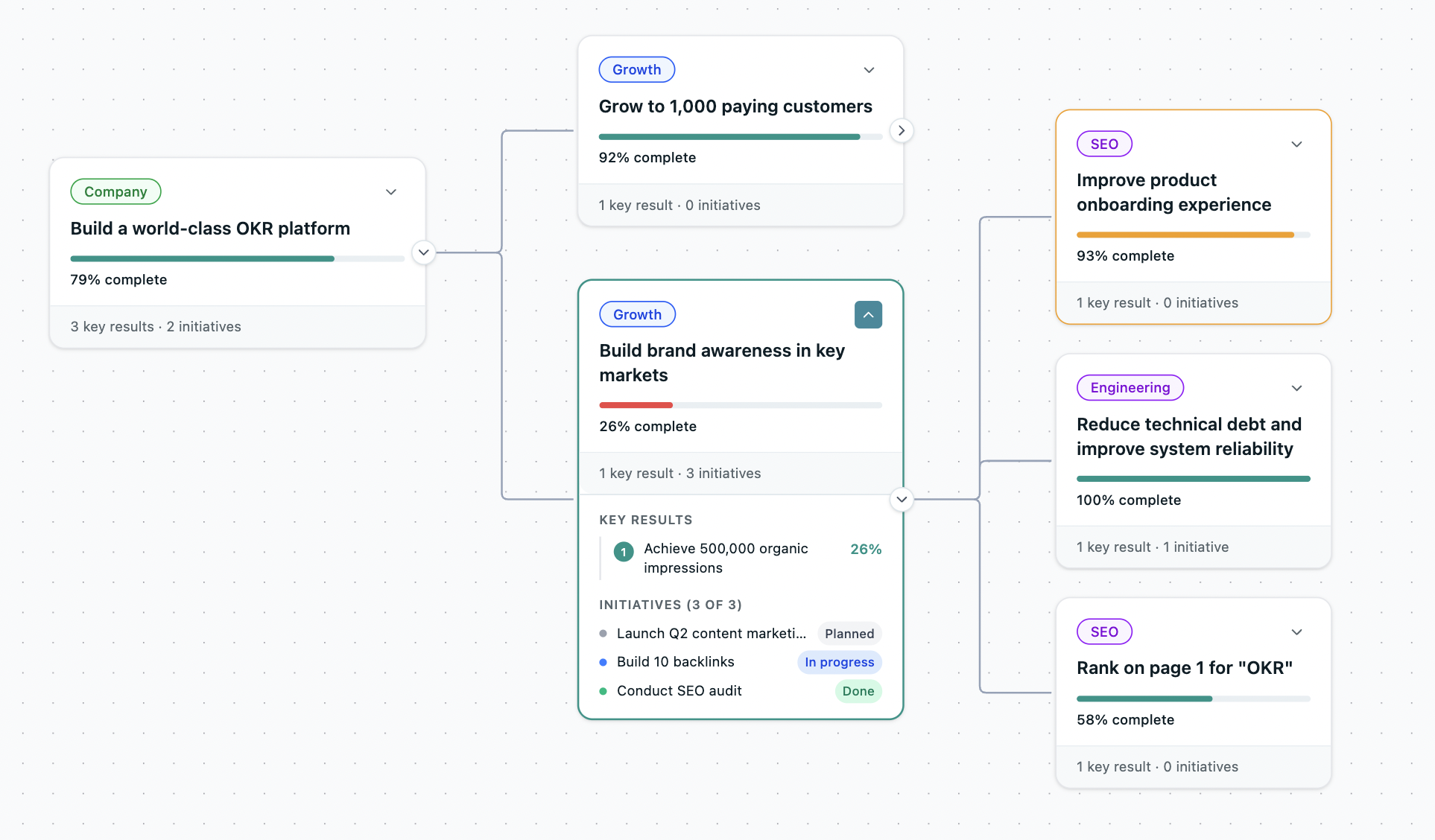
Quarterly OKRs (90 days) — the specific outcomes this leadership team will drive this quarter. Each quarter's Objectives should connect to the annual strategy, which connects to the BHAG. The OKR cascade makes that connection structural rather than assumed.
Weekly check-ins (7 days) — the execution rhythm that keeps Key Results alive between planning sessions. Teams with automated weekly check-ins complete 43% more OKRs than those reviewing monthly. Teams with required ownership per Key Result see 26% higher completion rates.
How They Compare
The Verdict
BHAG and OKRs are not competing frameworks. Treating them as alternatives is a category error — like comparing a compass to a sprint plan. The compass tells you which direction is north. The sprint plan tells you what to build this week. You need both.
The organizations that get the most from a BHAG are the ones running tight quarterly OKRs with strong cascade alignment and disciplined weekly check-ins — because the BHAG only becomes real when the execution layer underneath it is honest and consistent. The ROI data is clear: organizations using purpose-built OKR software generate a 1:88 return on investment — the execution infrastructure is what turns a transformational goal from inspiration into progress.
See how OKRs Tool works as the quarterly execution layer beneath your BHAG — free for up to 5 users, no credit card required.
Data: The ROI of OKRs: 2026 Benchmark Report (330 respondents), The 2026 OKR Benchmark Report (200+ organizations).